Ample Biometrics presents a 13-slide deck (7 slides available for review) centered on a vein-scanning identification device. The company positions itself as a hardware and software integrator, handling in-house manufacturing for a product that claims up to 99% accuracy. The deck is notable for its extreme minimalism, using short phrases and simple icons to describe use cases ranging from hotel access to online security. However, the presentation is functionally incomplete for a professional fundraise. It omits a defined problem statement, market size analysis, competitive landscape, and unit…
Key takeaways
- The core product is a vein-scanning identification device intended to simplify security (Slide 2).
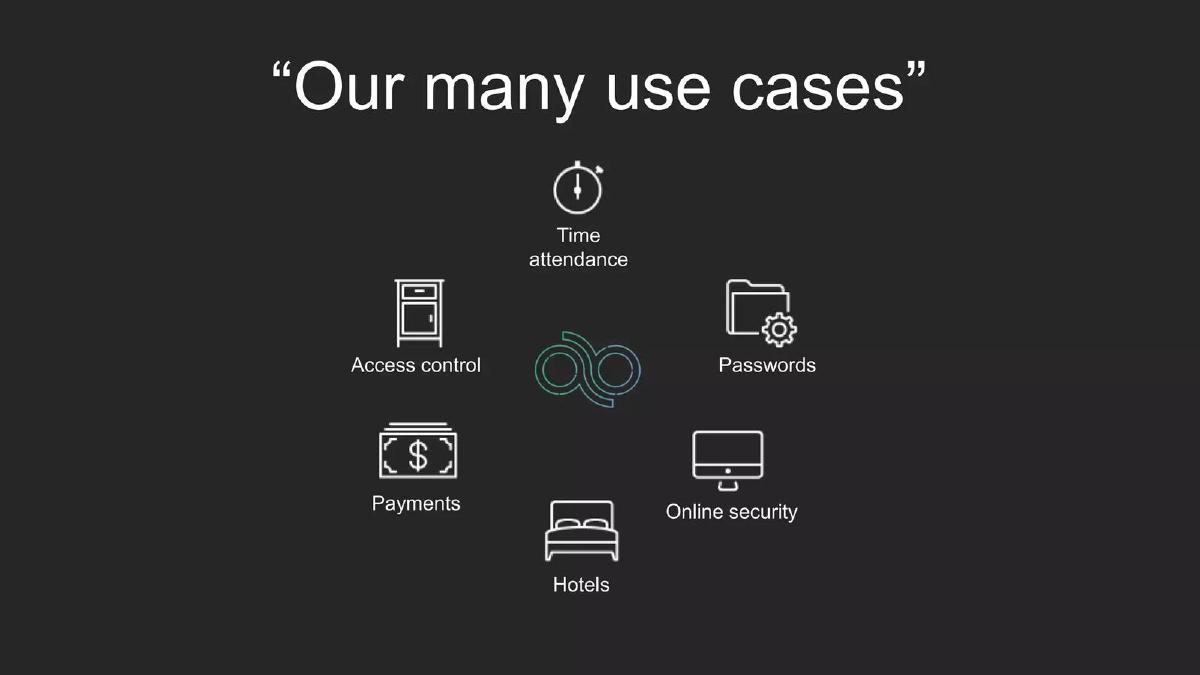
- Ample identifies six primary use cases: time attendance, access control, payments, hotels, online security, and passwords (Slide 3).
- The company claims to handle manufacturing in-house, which suggests a capital-intensive hardware model (Slide 5).
- Product accuracy is cited as 'up to 99%,' though no testing methodology or third-party validation is provided (Slide 5).
- The initial go-to-market strategy targets small businesses and hotels (Slide 5).
- The team consists of five members—Aditya, Donny a, Dylan, Eric, and Janani—described generally as electrical engineers and programmers (Slide 6).
- The deck lacks a specific financial 'Ask,' including the amount of capital sought or the intended use of funds (Slide 7).
- There is no mention of existing traction, revenue, or intellectual property status throughout the reviewed slides.
The Ample Pitch Deck: A Study in Minimalist Hardware Presentation
Ample Biometrics presents a pitch deck that leans heavily on the 'less is more' philosophy. While this approach can work for high-level introductory meetings, the deck reviewed here lacks the technical and financial density required for a formal seed or Series A round. The company focuses on the simplicity of vein-scanning as a universal identification solution, yet leaves significant questions unanswered regarding the viability of the business itself.
Slide 1: Title Slide
The deck opens with a clean, teal-to-blue gradient background featuring the Ample Biometrics logo—a stylized 'ab' that resembles an infinity symbol or a fingerprint pattern. The tagline 'identification made simple' establishes the company's value proposition immediately. It is a professional, if generic, start that signals a focus on design and user experience.
Slide 2: The Solution
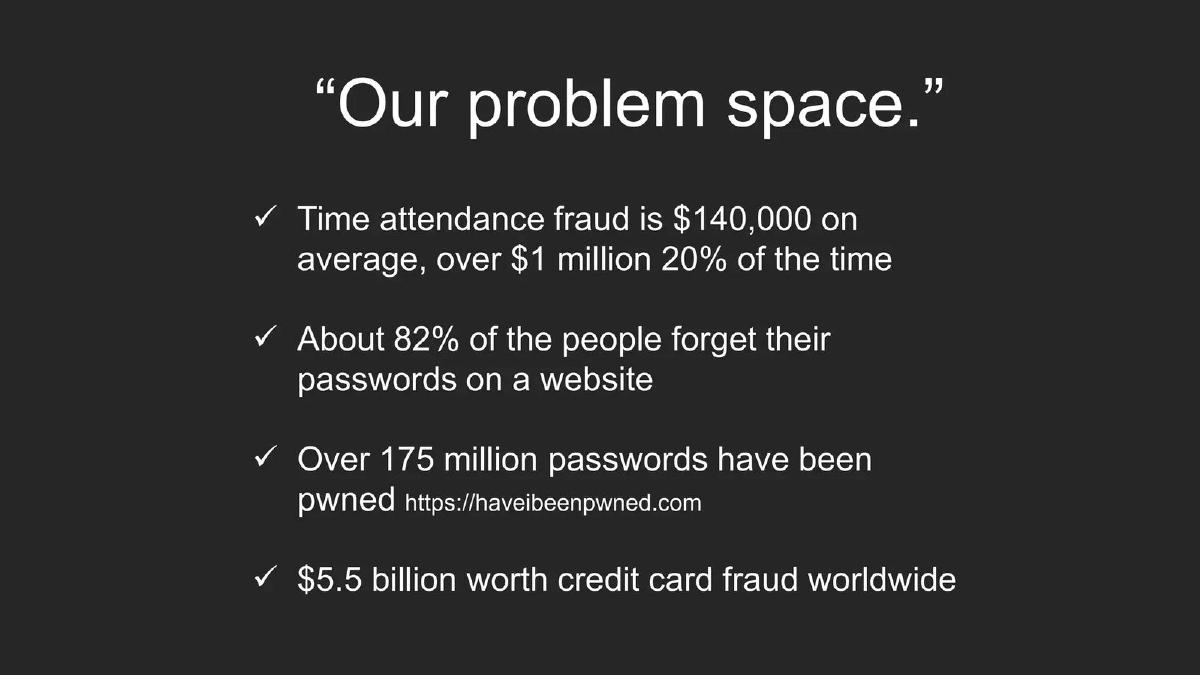
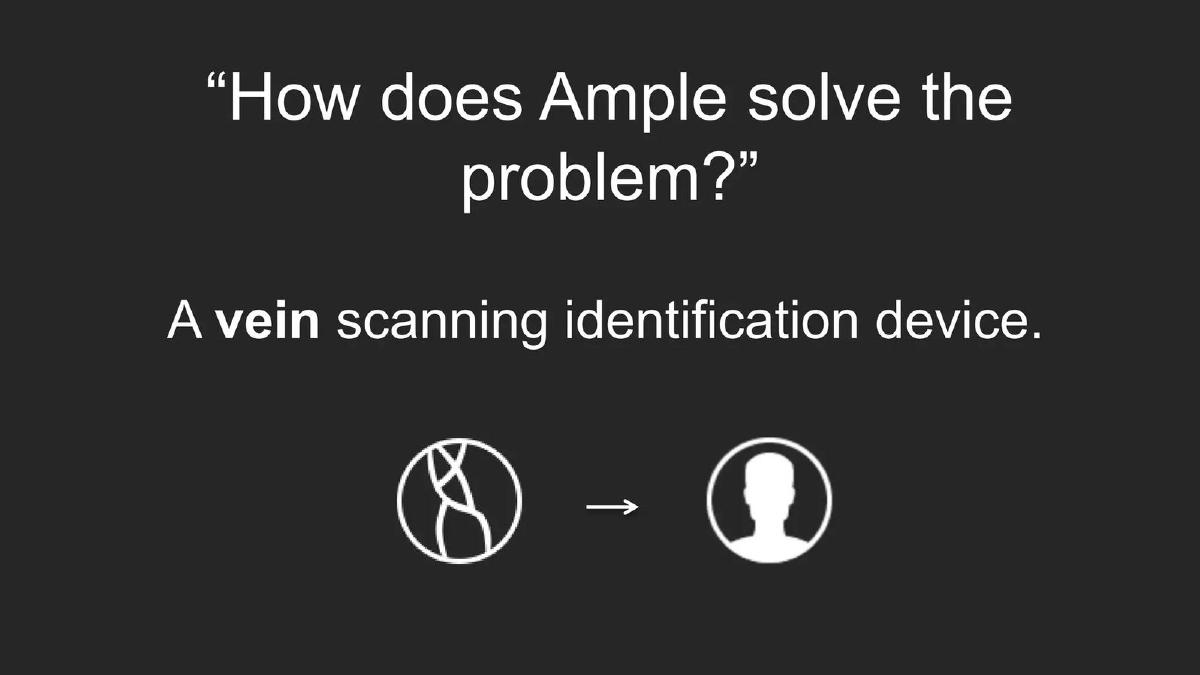
Slide 2 poses the question, 'How does Ample solve the problem?' and answers it with: 'A vein scanning identification device.' The slide uses two icons—a simplified diagram of veins and a standard user profile silhouette—connected by an arrow. This slide is effective at explaining what the product is, but it fails to define the problem it is solving. Without a preceding slide explaining the failures of current biometrics (e.g., fingerprint spoofing or facial recognition errors), the solution lacks context.
Slide 3: Use Cases
This slide lists six icons surrounding the Ample logo. The use cases include: Time attendance , Access control , Passwords , Online security , Hotels , and Payments . While this demonstrates the versatility of the technology, it also suggests a lack of focus. For an early-stage startup, attempting to disrupt both physical access (hotels) and digital security (passwords) simultaneously can be a red flag for investors who prefer a 'wedge' strategy into a single, high-value market.
Slide 4: Seamless Integration
Slide 4 shows a laptop and a smartphone displaying what appears to be the Ample web interface. The text 'Seamless integration' is the only copy. The laptop screen shows a 3D render of a device and a 'Request a demo' button. This slide attempts to prove that the hardware works in tandem with existing digital ecosystems, though it provides no technical detail on APIs, SDKs, or how the hardware actually connects to these devices (e.g., Bluetooth, USB-C, or Cloud).
Slide 5: Business Model
The 'Business Model' slide is arguably the most problematic in the deck. It contains three bullet points: 'In house vein scanner manufacturing,' 'Up to 99% accurate,' and 'Currently targeting small businesses and hotels.' These are operational facts, not a business model. A business model should explain how the company makes money (e.g., unit price, subscription fees, installation costs). Furthermore, claiming 'up to 99% accurate' is a potential weakness in the security industry, where 'five nines' (99.999%) is often the standard for biometric reliability.
Slide 6: The Team
Slide 6 introduces five team members: Aditya, Donny a, Dylan, Eric, and Janani. The caption reads, 'We’re electrical engineers and programmers.' While the photos are professional, the lack of last names, titles, and professional history is a significant omission. Investors bet on teams, and this slide provides no evidence of the team's ability to scale a hardware company or navigate the complex regulatory environment of biometric data.
Slide 7: Contact Information
The final slide returns to the teal gradient and provides a general info email address and the company website. Notably, there is no 'Ask' slide. A standard pitch deck should conclude with the amount of money being raised, the valuation (optional), and the specific milestones the team intends to hit with the new capital. By omitting this, the deck feels more like a sales brochure than a fundraising tool.
What Ample Does Well
The visual consistency of the deck is high. The use of whitespace and simple iconography makes the deck very easy to digest in under 60 seconds. In an initial 'teaser' email, this level of brevity can be an asset, as it doesn't overwhelm the reader with technical jargon. The focus on 'vein scanning' as a specific niche within biometrics is also a clear differentiator from the crowded fingerprint and facial recognition markets.
Critical Omissions
The most glaring omission is the lack of a Market Size slide. Biometrics is a multi-billion dollar industry, but Ample does not define which slice of that market they are pursuing. There is also no Competition slide. Companies like Fujitsu have had palm-vein technology for years; Ample needs to explain why their device is smaller, cheaper, or more accurate than established enterprise solutions.
Furthermore, there is no mention of Intellectual Property (IP) . In hardware, patents are a primary driver of valuation. Without mentioning whether their scanning method or algorithms are proprietary or patented, the company appears vulnerable to larger manufacturers. Finally, the Financials are non-existent. There are no projections, no COGS (Cost of Goods Sold), and no information on the current burn rate.
Advice for Founders Copying This Style
If you choose to adopt Ample's minimalist style, you must ensure that the few words you do use are high-impact. Don't skip the 'Why Now.' Minimalist decks often fail because they explain the 'What' but not the urgency. If you are building hardware, you must include a slide on your supply chain or manufacturing partnerships to mitigate the perceived risk of 'hardware is hard.' Most importantly, never leave out the 'Ask.' An investor should never finish a deck wondering how much money you want and what you plan to do with it.
Summary of Deck Facts
Company: Ample Biometrics · Sector: Biometrics / Hardware / Security · Stage: Not stated (appears to be Pre-Seed or Seed) · Slides Reviewed: 7 of 13 · Key Technology: Vein-scanning identification · Target Markets: Small businesses and hotels
Frequently asked questions
- What is the primary technology behind Ample?
- Ample utilizes vein-scanning technology for identification purposes. According to Slide 2, the device scans internal vein patterns to verify a user's identity. This is presented as a simpler alternative to traditional identification methods, though the deck does not explicitly detail the hardware specifications or the specific light spectrum used for the scans.
- Which industries is Ample targeting first?
- Based on Slide 5, Ample is currently focusing its sales and marketing efforts on small businesses and the hotel industry. Slide 3 also suggests broader applications in financial payments and digital security, but the business model slide clarifies that the immediate commercial focus is on physical access and hospitality sectors.
- How does Ample plan to generate revenue?
- The deck does not explicitly state its revenue model. Slide 5 mentions 'in house vein scanner manufacturing,' implying a hardware sales model. However, it is unclear if there is a recurring software-as-a-service (SaaS) component for the 'Online security' and 'Passwords' use cases mentioned on Slide 3. Pricing tiers and margins are entirely absent.
- Who are the founders and what is their background?
- Slide 6 lists five team members: Aditya, Donny a, Dylan, Eric, and Janani. The slide states they are 'electrical engineers and programmers.' The deck does not provide last names (except for a partial name for Donny), previous company experience, educational background, or specific roles like CEO or CTO, making it difficult to assess founder-market fit.
- What critical information is missing from the Ample deck?
- The deck is missing several standard venture capital requirements: a quantified market size (TAM/SAM/SOM), a competitive analysis against existing biometric players (like Apple FaceID or Fujitsu PalmSecure), a clear financial ask, a roadmap of past or future milestones, and any data regarding customer traction or pilot programs.