RingCaptcha’s 2012 seed deck is a study in brevity, relying on high-impact metrics and recognizable logos rather than dense text. With only 8 slides, the company highlights $500k ARR and 20% month-over-month growth (Slide 3), immediately establishing credibility. They use a clever 'problem' slide featuring a real-world tweet from Telegram (Slide 4) to demonstrate market demand for reliable SMS gateways. While the deck lacks a formal 'Ask' slide or detailed competitive analysis, it compensates with strong team pedigree from companies like Travelocity and PwC (Slide 7). This teardown explores h…
Key takeaways
- The deck leads with a high-density logo slide featuring Klarna, GameFly, and Rocket Internet to establish immediate enterprise credibility (Slide 2).
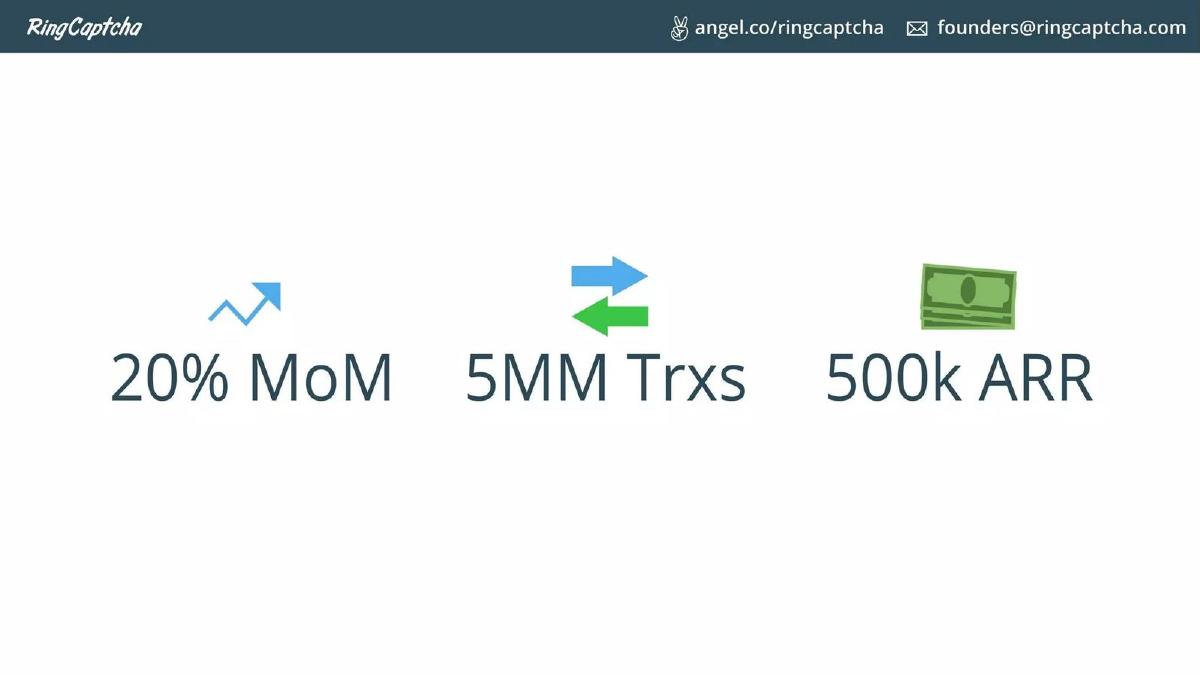
- Traction is quantified with three key metrics: 20% MoM growth, 5 million transactions, and $500k ARR (Slide 3).
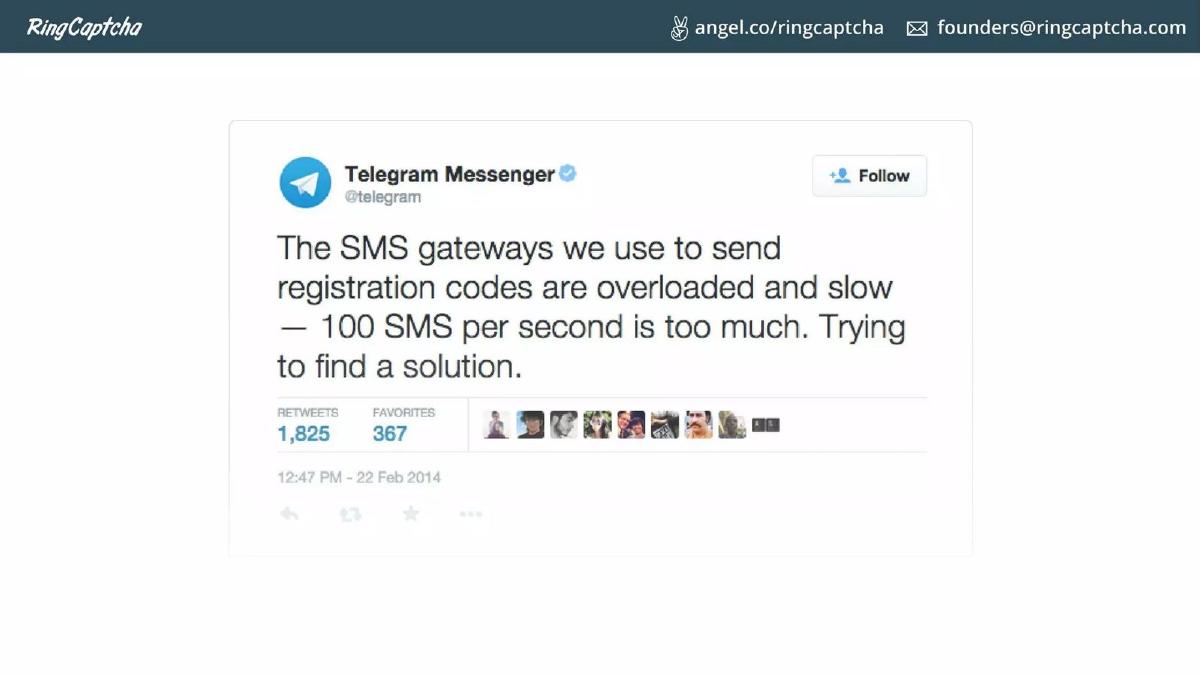
- The problem is framed through a third-party pain point: a Telegram tweet complaining about overloaded SMS gateways (Slide 4).
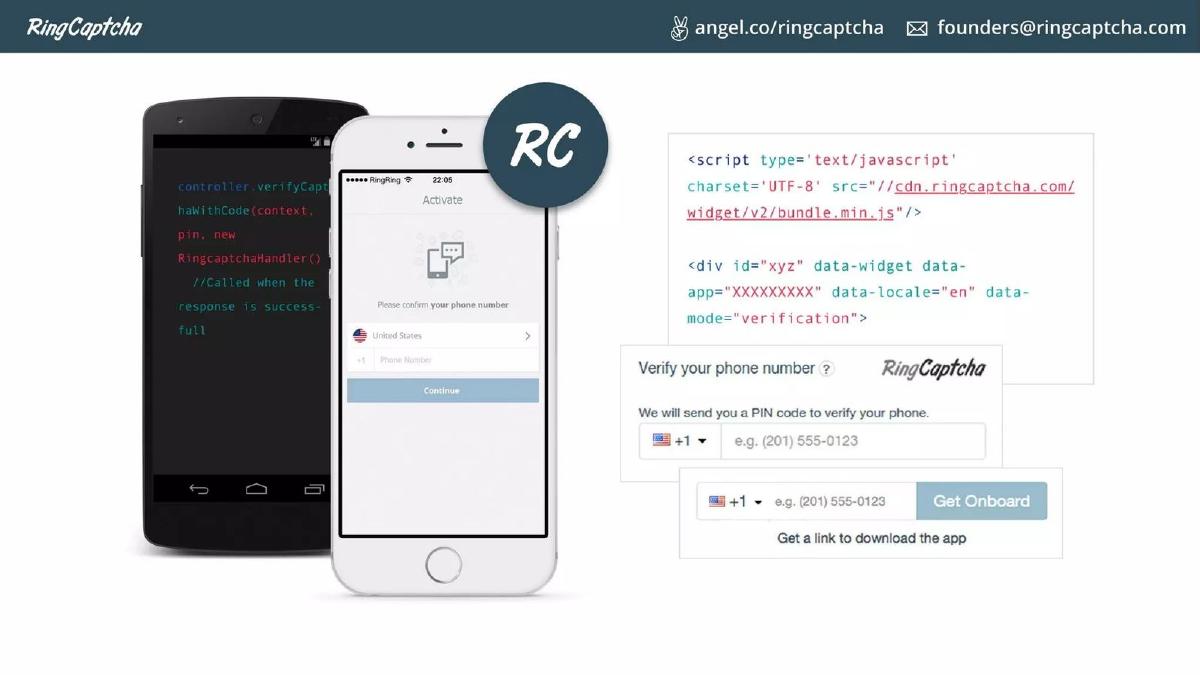
- Product utility is demonstrated via a code snippet and mobile UI mockups, emphasizing ease of integration for developers (Slide 5).
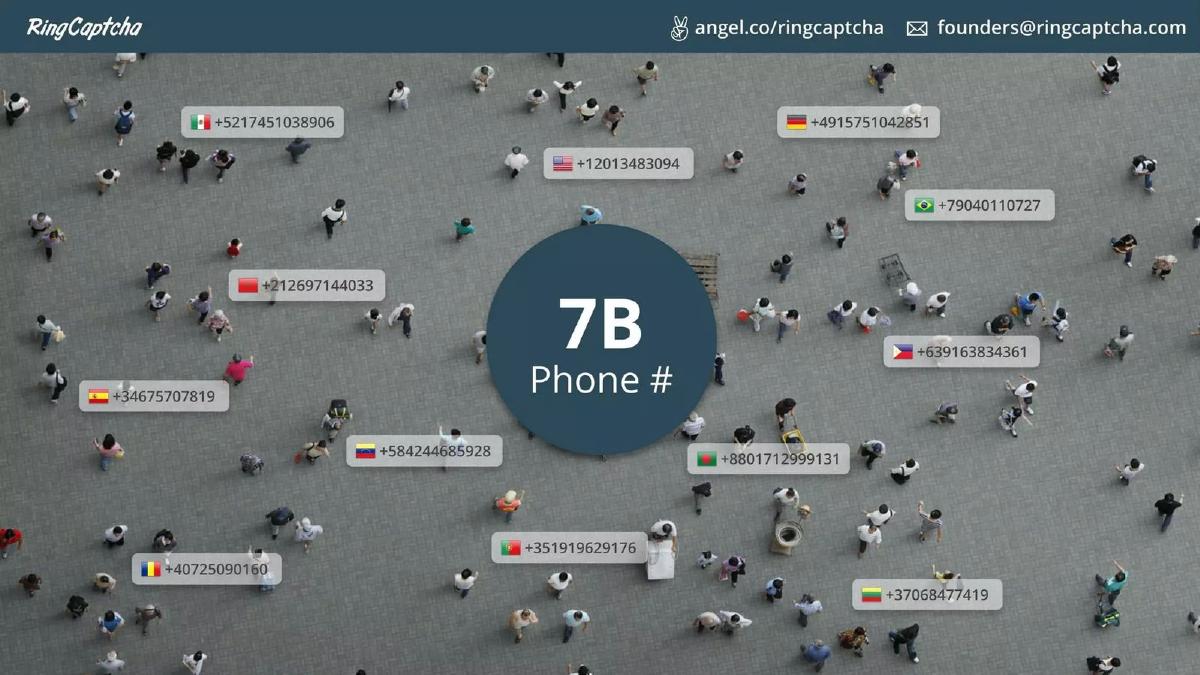
- Market scale is represented by a single figure: 7 billion phone numbers, suggesting a massive global TAM (Slide 6).
- The team slide highlights specific academic degrees and past experience at Fon, Travelocity, and PwC (Slide 7).
- There is no slide detailing the specific funding amount requested or the planned use of funds.
- The deck omits a traditional competitor matrix, choosing to focus entirely on its own growth and customer base.
The Power of Brevity: RingCaptcha’s 8-Slide Seed Deck
In the world of startup fundraising, there is a common misconception that more slides equal more value. RingCaptcha’s seed deck from 2012 stands as a direct rebuttal to that idea. With only eight slides, the founders managed to communicate a clear problem, a functional solution, and—most importantly—massive early traction. At the time of this deck, the company was already claiming $500k in ARR, a figure that many startups don't hit until their Series A. This teardown examines how they used social proof and developer-centric messaging to secure their early funding.
Slide 1: The Hook
The cover slide is minimalist, featuring the company logo and a Lego-style character. The tagline, "Two-Step Verification Made Simple," (Slide 1) immediately tells the investor what the product does. It doesn't use buzzwords like 'synergy' or 'disruption'; it describes a utility. The branding is friendly and approachable, which contrasts with the often-dry nature of security and verification software.
Slide 2: Social Proof as a Foundation
Most decks save their customer logos for the end. RingCaptcha puts them on Slide 2. By showing logos for GameFly, Easy Taxi, BTC China, Xapo, Klarna, and Rocket Internet , they eliminate the 'credibility gap' instantly. For a seed investor, seeing Rocket Internet and Klarna—two massive players in the global tech ecosystem—suggests that the product has already passed the technical due diligence of sophisticated buyers.
Slide 3: The Traction Trifecta
Slide 3 is the strongest slide in the deck. It contains only three data points: "20% MoM" growth, "5MM Trxs" (transactions), and "500k ARR" . By presenting these figures without the clutter of charts or long-winded explanations, the founders force the investor to focus on the raw success of the business. $500,000 in annual recurring revenue at the seed stage is an outlier, and it makes the rest of the deck a formality rather than a persuasion piece.
Slide 4: The Problem (via Telegram)
Instead of a generic slide about how 'security is hard,' Slide 4 uses a screenshot of a tweet from Telegram Messenger dated February 22, 2014. The tweet reads: "The SMS gateways we use to send registration codes are overloaded and slow — 100 SMS per second is too much. Trying to find a solution." This is a brilliant way to frame a problem. It proves that even top-tier tech companies face this specific pain point, creating an immediate 'market pull' narrative.
Slide 5: The Product and Integration
Slide 5 shows the product in action. It features mobile mockups of the verification screen and, crucially, a JavaScript code snippet . This signals that RingCaptcha is a developer-first tool. The inclusion of the code snippet reinforces the 'Made Simple' promise from the cover slide, showing that integration is a matter of a few lines of code rather than a months-long enterprise implementation.
Slide 6: Market Size
The market slide (Slide 6) is highly abstract. It shows a top-down view of a crowd with various international phone numbers floating above people's heads, centered around a circle that says "7B Phone #" . While this doesn't provide a traditional Bottom-Up TAM (Total Addressable Market) analysis, it effectively communicates the global scale of the opportunity. Every phone number is a potential transaction point for RingCaptcha.
Slide 7: The Team
The team slide (Slide 7) uses a corkboard aesthetic with 'Polaroid' photos of the founders: Mariano (CEO), Martin (CTO), and Nick (COO) . The slide lists their credentials clearly: Business Administration (Mariano), MSC Software Engineering (Martin), and MSC Economics (Nick). The professional pedigree is established via logos for Fon, Ideeli, Travelocity, and PwC . This tells investors that the team has a mix of technical depth and corporate experience.
Slide 8: The Close
The final slide (Slide 8) repeats the Lego character and provides contact information: founders@ringcaptcha.com and an AngelList link . Notably, there is no 'Ask' slide in this deck. There is no mention of how much money they are raising or what they will spend it on. This suggests the deck may have been used as a teaser or that the founders preferred to discuss terms in person once the traction metrics had hooked the investor.
What Works in This Deck
Metric-First Storytelling: By putting the $500k ARR and 5 million transactions on Slide 3, the founders ensure that the investor is looking at every subsequent slide through the lens of a successful, growing business. It changes the conversation from "Will this work?" to "How big can this get?"
External Validation: The use of the Telegram tweet is a masterstroke. It provides an unbiased, third-party confirmation of the problem RingCaptcha solves. It is much more convincing than a founder-written slide about 'market pain.'
Developer Focus: The inclusion of the code snippet on Slide 5 is essential for an API-based business. It shows that the founders understand their primary user (the developer) and have built a product that respects their time.
What Is Missing
The Ask: The most glaring omission is the lack of a funding request. Investors need to know how much capital is being sought and what the milestones for that capital will be. Without this, the deck feels more like a sales presentation than a fundraising tool.
Competitive Landscape: The deck does not mention competitors like Twilio or Nexmo (now Vonage). In a crowded space like SMS gateways and 2FA, investors usually want to see how a startup differentiates itself from the incumbents.
Unit Economics: While $500k ARR is impressive, the deck says nothing about margins. SMS is notoriously a low-margin business due to carrier costs. Showing the gross margin or the contribution margin per transaction would have strengthened the financial case.
What a Founder Should Copy
The 'Logo Slide' Placement: If you have recognizable customers, don't hide them at the end. Move them to the front to build immediate trust. RingCaptcha’s use of Klarna and Rocket Internet logos early on makes the rest of their claims much more believable.
Visual Simplicity: This deck is remarkably uncluttered. There are no walls of text. Each slide has one job and one primary visual element. Founders should aim for this level of clarity, ensuring that an investor can 'read' the entire deck in under two minutes.
Real-World Evidence: Use social media, news clippings, or customer support tickets to illustrate the problem. A real person or company complaining about a problem is always more compelling than a bulleted list of theoretical issues.
Final Thoughts
RingCaptcha’s deck is a high-signal, low-noise document. It relies heavily on the fact that the business was already performing exceptionally well. While the lack of a formal 'Ask' and competitive analysis are risks, the sheer weight of the traction metrics ($500k ARR at Seed) likely made those omissions irrelevant to the investors they were targeting. It is a perfect example of how a strong business can succeed with a simple deck, provided the core metrics are undeniable.
Frequently asked questions
- How much did RingCaptcha raise with this deck?
- According to catalogue data from pitchdeckhunt.com, RingCaptcha raised $35,000 in 2012 during its Seed stage. While the deck itself does not state a specific 'Ask' amount, the traction metrics shown suggest the company was already generating significant revenue ($500k ARR) relative to the small amount of capital raised.
- What is the primary value proposition of RingCaptcha?
- The deck defines the company as 'Two-Step Verification Made Simple' (Slide 1). It positions itself as a solution for companies like Telegram that struggle with SMS gateway reliability. By offering a RESTful API that can be integrated in minutes, it provides high-growth companies with a scalable way to handle international SMS and voice traffic for user verification.
- Who were RingCaptcha's early customers?
- Slide 2 displays logos for six major entities: GameFly, Easy Taxi, BTC China, Xapo, Klarna, and Rocket Internet. These logos serve as a powerful validation tool, showing that the platform was already being used by high-volume, international businesses in the gaming, fintech, and e-commerce sectors before the seed round was finalized.
- Is there a team slide in the RingCaptcha deck?
- Yes, Slide 7 introduces the three founders: Mariano (CEO), Martin (CTO), and Nick (COO). The slide includes their educational backgrounds—Business Administration, MSC Software Engineering, and MSC Economics—and lists previous professional experience at notable companies such as Fon, Ideeli, Travelocity, and PwC.
- What metrics did the founders use to prove traction?
- Slide 3 is dedicated entirely to traction, using three simple icons and figures: 20% month-over-month (MoM) growth, 5 million total transactions (Trxs), and $500,000 in Annual Recurring Revenue (ARR). This combination of growth, volume, and revenue is exceptionally strong for a seed-stage company.