Sternum’s 10-slide deck is a masterclass in establishing 'Problem/Solution' fit for a highly technical audience. By citing a 300% increase in IoT attacks (Slide 4) and listing hundreds of vulnerable vendors (Slide 3), the company creates immediate urgency. The deck leans heavily on the founders' pedigree—specifically their background in Israel’s Unit 8200 (Slide 6)—to validate their 'Integrity-based attack prevention' technology. However, as a Series B deck, it is unusually light on business fundamentals. There are no slides covering revenue, churn, customer acquisition costs, or the specific…
Key takeaways
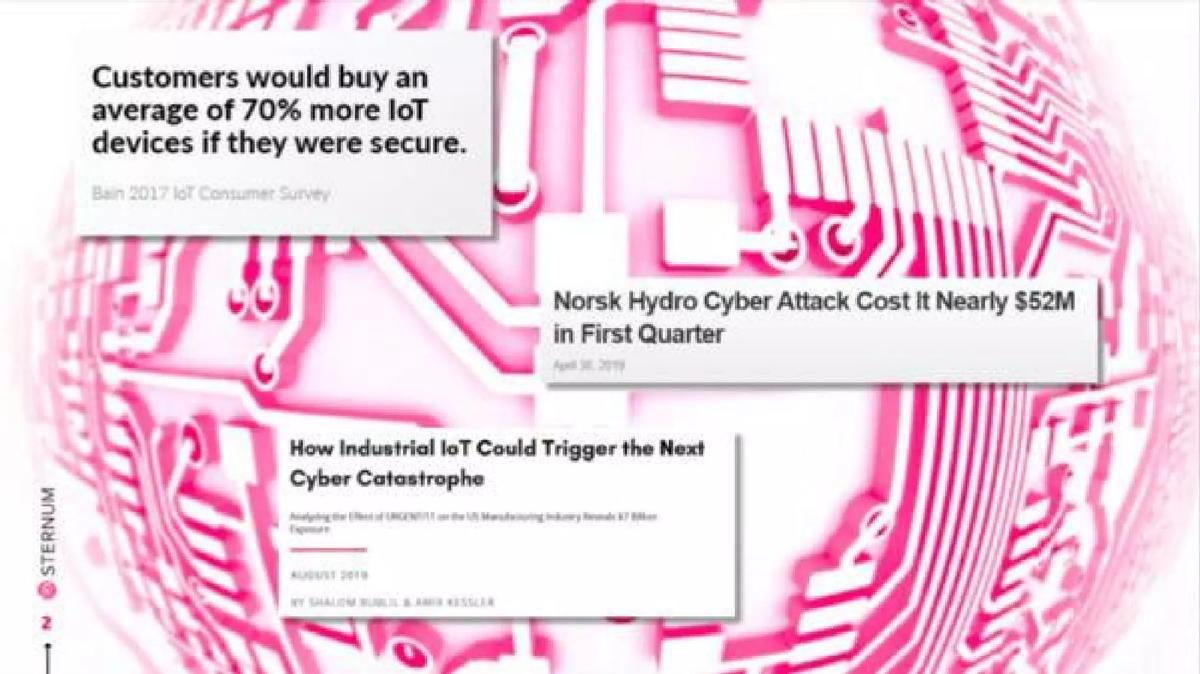
- The deck uses fear, uncertainty, and doubt (FUD) effectively by citing a $52M loss from a single cyber attack on Slide 2.
- Market demand is quantified by a Bain survey stating customers would buy 70% more IoT devices if they were secure (Slide 2).
- Technical validation is provided through the mention of three pending patents for their EIV (Embedded Integrity Verification) software on Slide 8.
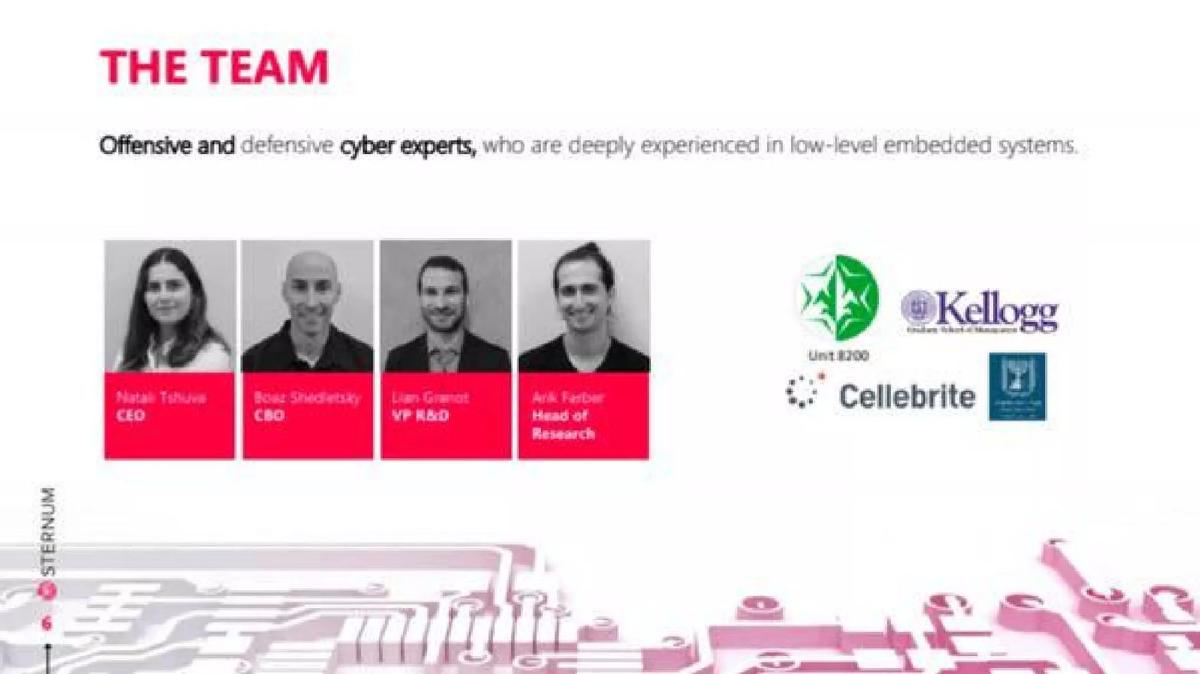
- The team slide (Slide 6) emphasizes 'offensive and defensive cyber experts' with backgrounds in Unit 8200 and Cellebrite.
- Sternum positions itself as a 'patchless' solution, claiming to protect exploitable points without needing constant updates (Slide 8).
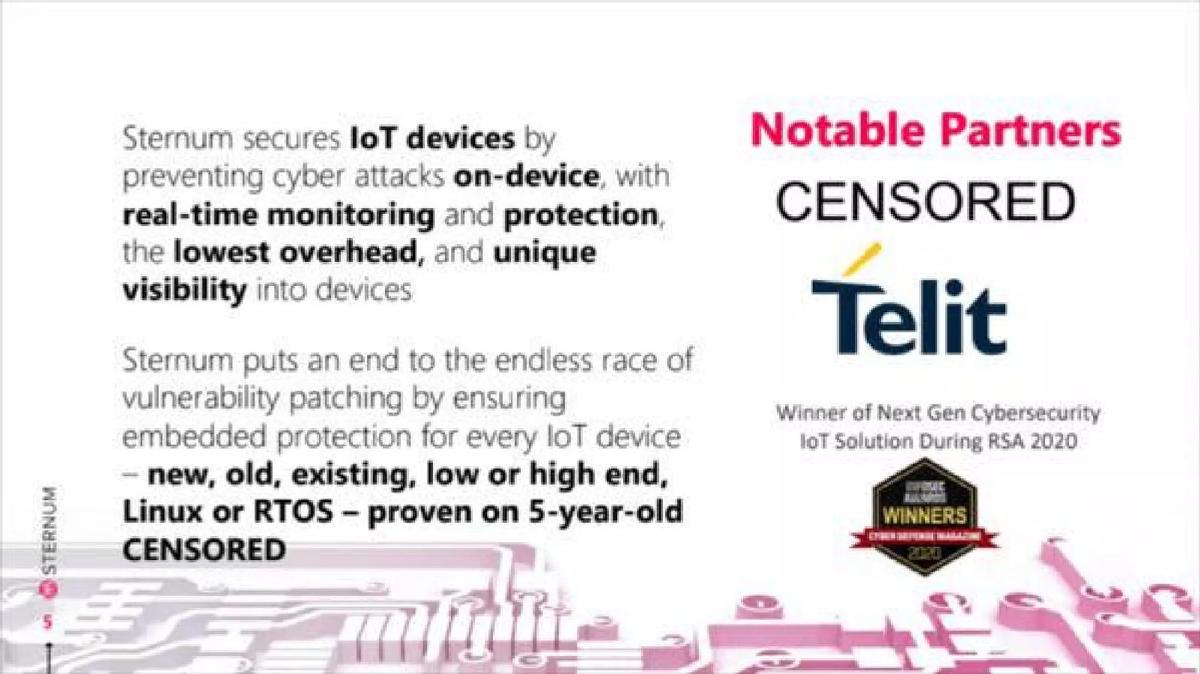
- The deck highlights a partnership with Telit and a 2020 RSA cybersecurity award to demonstrate industry recognition (Slide 5).
- The solution is platform-agnostic, claiming compatibility with both Linux and RTOS (Real-Time Operating Systems) on Slide 8.
- There is a complete absence of financial data, including ARR, growth rates, or unit economics, which is rare for a Series B deck.
Introduction: The High-Stakes World of IoT Security
Sternum’s pitch deck is a focused, 10-slide presentation designed to address a specific, growing pain point in the technology sector: the inherent insecurity of the Internet of Things (IoT). Founded in 2018, the company raised a total of $36,000,000, culminating in a Series B round. This deck represents the narrative used to secure that capital, focusing heavily on the technical 'how' and the macro 'why' while remaining surprisingly quiet on the 'how much.'
Slides 1-4: Establishing the Crisis
Slide 1: Title Slide. The deck opens with the logo and the tagline 'Securing IoT Devices, From Within.' It lists CEO Natali Tshuva and CBO Boaz Shedletsky. The visual theme—a pink-hued circuit board—is maintained throughout the deck.
Slide 2: The Economic Impact. This slide uses three high-profile callouts to establish the stakes. It quotes a 2017 Bain survey stating that 'Customers would buy an average of 70% more IoT devices if they were secure.' It also references a specific event: the Norsk Hydro cyber attack, which 'cost it nearly $52M in First Quarter.' By leading with lost revenue and missed sales opportunities, Sternum frames security not as a cost center, but as a business enabler.
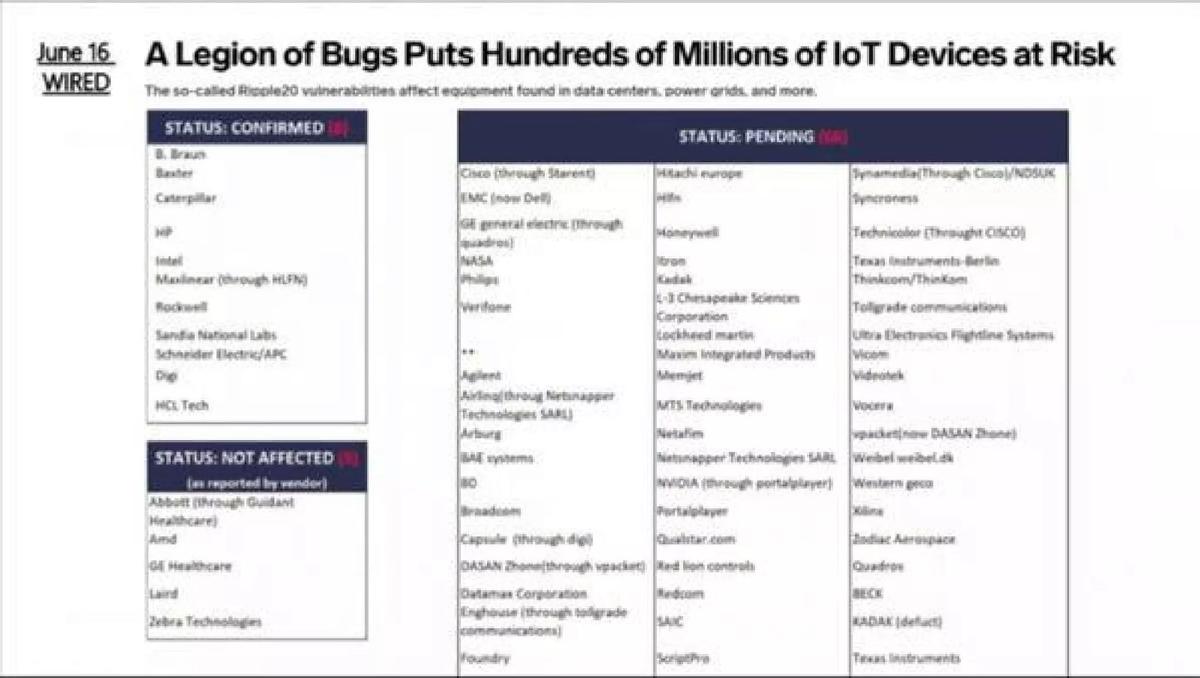
Slide 3: The Scale of Vulnerability. Sternum utilizes a Wired article from June 16 regarding the 'Ripple20' vulnerabilities. The slide lists dozens of affected vendors, including HP, Intel, Schneider Electric, and Rockwell. This 'wall of names' serves as social proof of the problem's ubiquity; if these giants are at risk, the entire industry is at risk.
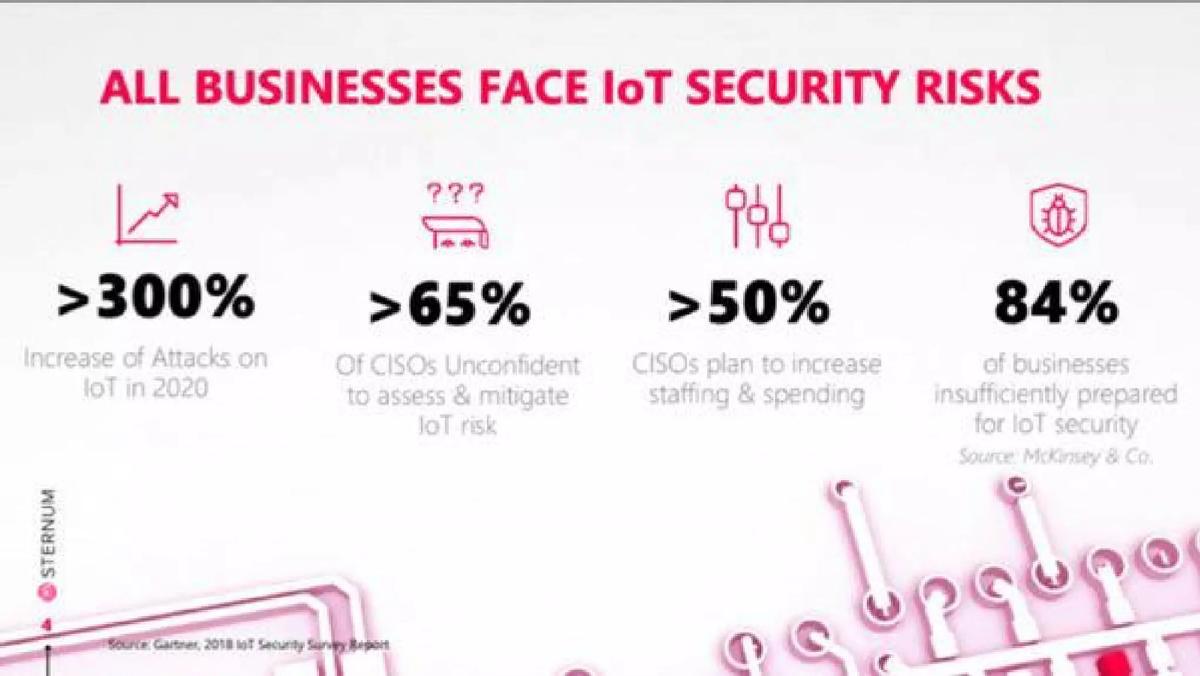
Slide 4: Market Sentiment. This slide provides four key metrics to justify the timing of the investment. It claims a '>300% Increase of Attacks on IoT in 2020' and notes that '84% of businesses' are insufficiently prepared according to McKinsey. This slide transitions the narrative from 'there is a problem' to 'the problem is accelerating and the market is desperate for a solution.'
Slides 5-6: Validation and The Team
Slide 5: Notable Partners and Awards. Sternum highlights its partnership with Telit and mentions a 'Winner of Next Gen Cybersecurity IoT Solution During RSA 2020' award. One partner name is 'CENSORED,' a common tactic in cybersecurity decks to imply high-stakes government or enterprise contracts that cannot be disclosed due to NDAs. The slide also claims the solution is 'proven on 5-year-old CENSORED' devices, emphasizing backwards compatibility.
Slide 6: The Team. The team slide is a critical component of Sternum's credibility. It features four leaders and highlights their experience in 'low-level embedded systems.' The inclusion of the Unit 8200 logo (the Israeli Intelligence Corps' elite signals intelligence unit) is a powerful signal to VCs in the cybersecurity space, suggesting a level of technical rigor that is difficult to replicate.
Slides 7-9: The Technical Solution
Slide 7: The 'Why.' This slide explains the technical hurdles of IoT security: high diversity, no standardization, and resource constraints (compute, memory, battery). It concludes with the punchline: 'IoT worldwide is growing exponentially, but security solutions are 20 years behind.'
Slide 8: EIV (Embedded Integrity Verification). This is the core product slide. It introduces Sternum's 'Proprietary On-Device Real Time Protection.' Key features include '3 Patents Pending,' minimal overhead, and the ability to work for both source code and 3rd party code automatically. The visual shows the 'EIV Software' sitting directly on a chip, reinforcing the 'from within' messaging.
Slide 9: ADS (Analytics & Detection System). While Slide 8 covers prevention, Slide 9 covers visibility. It showcases a dashboard that provides 'Immediate alerts' and 'Advanced IoT analytics.' The screenshot shows metrics like 'Active Devices' and 'Critical CVEs,' demonstrating that the product is a functional platform, not just a background utility.
Slide 10: Conclusion
Slide 10: Thank You. The deck ends with a repeat of the contact information for the CEO and CBO. There is no summary of the investment terms or a closing 'ask' regarding the $36 million raised.
What Works in the Sternum Deck
The deck is exceptionally strong at Problem Definition . By using specific dollar amounts ($52M loss) and specific vulnerability names (Ripple20), it avoids the vague 'cybersecurity is important' platitudes that plague many decks. It creates a sense of inevitable disaster that only Sternum can prevent.
The Team Credibility is another high point. In deep-tech and cybersecurity, the pedigree of the founders often carries more weight than early revenue. By leaning into their offensive and defensive backgrounds and their ties to elite intelligence units, they provide the 'why us' answer very effectively.
Finally, the Product Positioning is clear. They aren't just another firewall; they are 'on-device' and 'patchless.' In an industry where patching thousands of remote devices is a logistical nightmare, the promise of a solution that 'puts an end to the endless race of vulnerability patching' (Slide 5) is a compelling value proposition.
What is Missing from the Sternum Deck
The most glaring omission is Financial Traction . For a Series B deck, the total absence of revenue figures, growth charts, or customer logos (beyond Telit) is highly unusual. Investors at this stage typically require detailed unit economics, including Customer Acquisition Cost (CAC), Lifetime Value (LTV), and monthly burn rates. This deck reads more like a Series A or even a Seed deck focused on vision and tech.
There is also no Competitive Landscape slide. The IoT security market is crowded with players like Armis, Microsoft (via CyberX), and various legacy providers. Failing to address how Sternum differentiates itself from these competitors—other than the 'on-device' claim—leaves a significant gap in the investment thesis.
Lastly, the Funding Ask is missing. A standard pitch deck should conclude with how much money is being raised, the milestones that capital will help achieve, and the intended allocation (e.g., 40% R&D, 40% Sales/Marketing, 20% Ops). Without this, the deck feels like a general capabilities briefing rather than a solicitation for investment.
What a Founder Should Copy
Founders should emulate Sternum's use of Third-Party Validation . Instead of claiming the market is big, they cite Bain, McKinsey, and Gartner (Slide 4). Instead of claiming their tech is good, they cite an RSA award and patent filings. This shifts the burden of proof from the founder to recognized authorities.
The Visual Consistency is also worth noting. The circuit board motif and the limited color palette (pink, black, white) make the deck feel professional and cohesive. It looks like a product from a company that understands design and detail.
Finally, the 'Wall of Pain' approach on Slide 3 is a great way to handle a fragmented market. If you are solving a problem for an entire industry, showing a list of the biggest names in that industry who are currently failing to solve it themselves is a powerful way to demonstrate the necessity of your solution.
Frequently asked questions
- What is Sternum's core value proposition?
- Sternum provides on-device, real-time protection for IoT devices. Unlike traditional security that relies on perimeter defense or frequent patching, Sternum's 'Embedded Integrity Verification' (EIV) works from within the device's code to prevent attacks at the exploitation stage. This reduces the cost of patch management and provides visibility into device health and security anomalies.
- How does the deck validate the market need?
- The deck uses a multi-pronged approach to market validation. It cites a 300% increase in IoT attacks in 2020 (Slide 4), references a Wired article about the 'Ripple20' vulnerabilities affecting hundreds of millions of devices (Slide 3), and notes that 84% of businesses feel insufficiently prepared for IoT security according to McKinsey (Slide 4).
- What technical details are provided about the product?
- Slide 8 and 9 detail the two-part solution: EIV (Embedded Integrity Verification) and ADS (Analytics & Detection System). EIV is described as a patent-pending, low-overhead software that integrates with source and 3rd-party code. ADS provides a dashboard for real-time alerts, attack investigation, and an 'intuitive story-based timeline' for breaches.
- Who is the team behind Sternum?
- The leadership team consists of CEO Natali Tshuva, CBO Boaz Shedletsky, VP R&D Lian Granot, and Head of Research Arik Farber. The deck emphasizes their experience in low-level embedded systems and offensive/defensive cyber security, highlighting affiliations with Israel's elite Unit 8200, Cellebrite, and Kellogg (Slide 6).
- What is missing from this deck that an investor would expect?
- For a Series B round, the deck is missing critical financial and operational data. There are no mentions of Annual Recurring Revenue (ARR), customer count, churn rates, or sales pipeline. Additionally, the deck does not include a competition slide, a go-to-market strategy, or a specific funding ask detailing how the capital will be deployed.