SteadyBudget’s 2015 pitch deck is a masterclass in identifying a 'Goldilocks' market opportunity. The company targeted Pay-Per-Click (PPC) analysts who were stuck between the manual drudgery of Excel and the prohibitive costs of enterprise platforms like Marin Software and Kenshoo. With 35+ agencies already using their free tool and managing $4.4 million in monthly ad spend, the deck focuses heavily on product-market fit and a clear path to monetization via a tiered SaaS model launching in May 2015. While the deck lacks a specific 'Ask' slide regarding the amount of capital being raised, it c…
Key takeaways
- The deck identifies a massive market gap between free manual workflows and enterprise software costing $10,000+ per month (Slide 7).
- Traction is demonstrated by $4,400,000+ in monthly ad spend under management across 15,000+ campaigns (Slide 13).
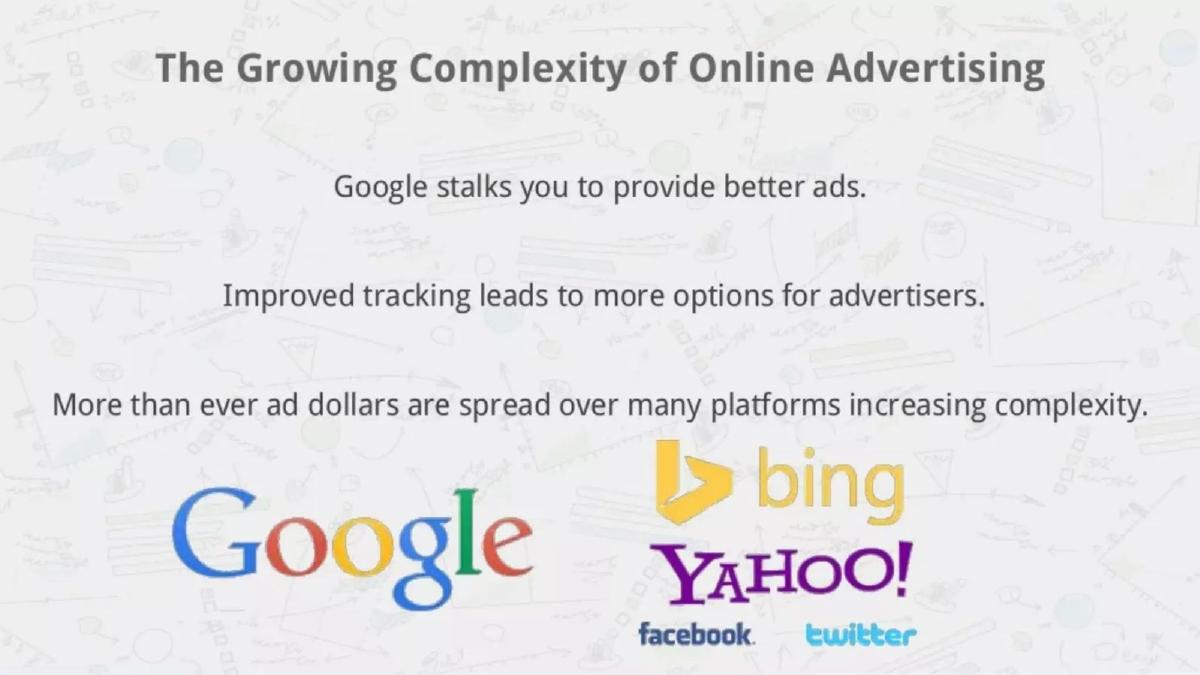
- The product solves the 'complexity' problem of ad dollars being spread across Google, Bing, Yahoo, Facebook, and Twitter (Slide 4).
- A clear monetization plan is presented, with a 'Premium' version launching in May 2015 targeting $1,500+ in initial MRR (Slide 15).
- Pricing is transparently tiered based on monthly managed ad spend, ranging from $50 to $1,500 per month (Slide 16).
- The team slide highlights a CEO with 7 years of PPC analyst experience, providing deep domain expertise (Slide 9).
- Social proof is utilized effectively through Twitter screenshots and a blog post from a PPC analyst (Slide 17).
- The deck projects a path to $100 million in annual revenue by targeting 5,000+ customers at a $20k ACV by Q3 2020 (Slide 21).
Executive Summary: The Budget Management Wedge
SteadyBudget (which later rebranded to Shape) presents a classic 'wedge' strategy in this 2015 pitch deck. By focusing on a single, painful task—managing budgets across multiple ad platforms—they built a tool that PPC analysts actually wanted to use. The deck is structured to educate a generalist investor on the nuances of the digital advertising industry before diving into the specific pain points of agency life. It successfully argues that while the 'Big Tech' platforms provide the inventory, they do not provide the cross-platform visibility required by modern agencies.
Slides 1-4: The Context of Complexity
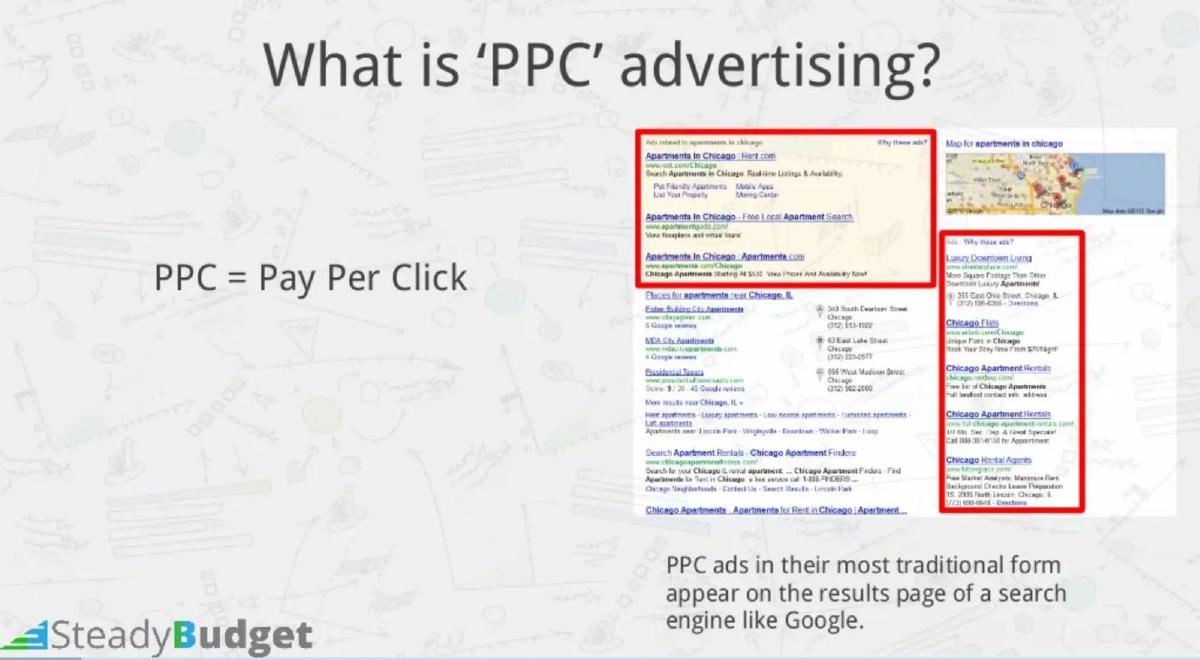
The deck opens with a clear mission statement on Slide 1: 'Changing the way pay-per-click analysts optimize monthly budgets.' This immediately identifies the target persona. Slide 2 provides a basic primer on what PPC advertising is, using a Google search results page as a visual aid. This is a common tactic for startups in technical niches to ensure the investor understands the 'where' and 'what' of the product.
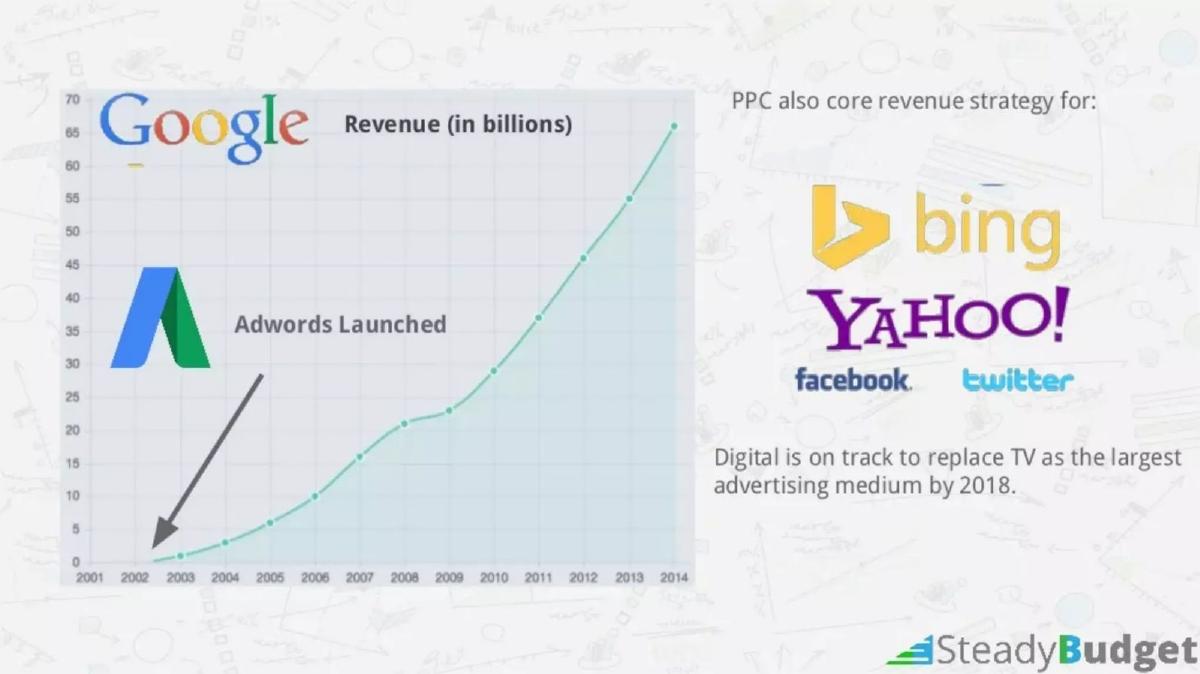
Slide 3 uses a revenue growth chart for Google (reaching over $60 billion by 2014) to establish market size and momentum. It notes that 'Digital is on track to replace TV as the largest advertising medium by 2018.' Slide 4 then introduces the core conflict: 'The Growing Complexity of Online Advertising.' By listing Google, Bing, Yahoo, Facebook, and Twitter, the founders highlight that ad dollars are no longer centralized, which creates a data fragmentation problem for the people managing those budgets.
Slides 5-8: The Customer and the Gap
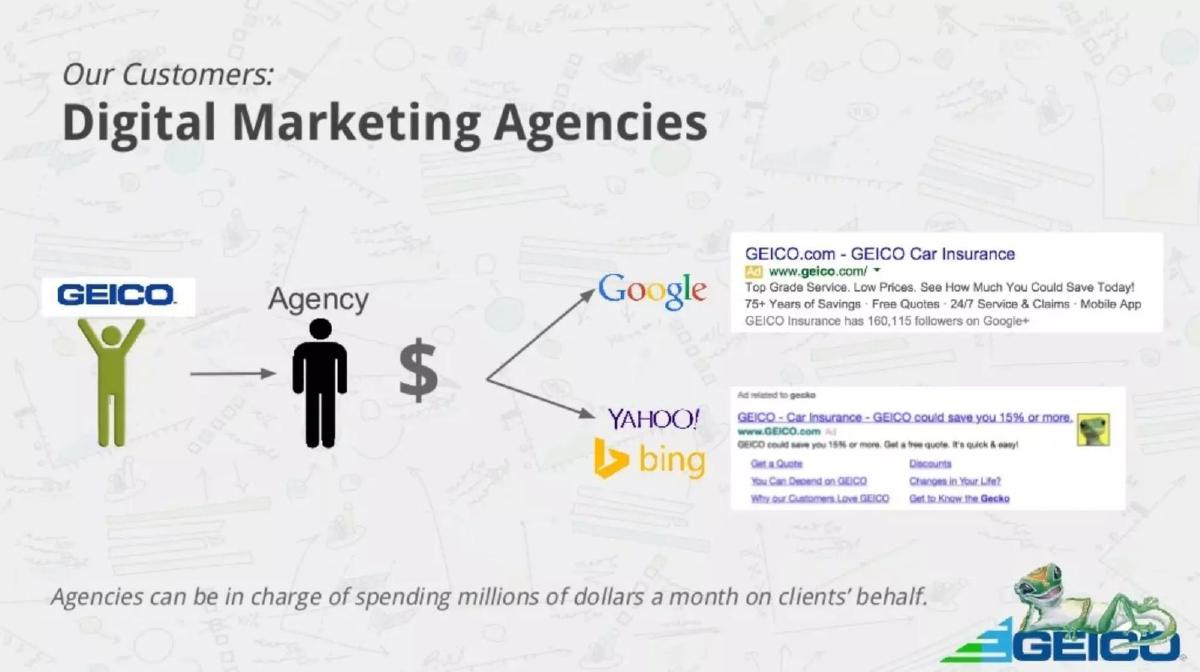
Slide 5 asks 'Who creates the ads?' and Slide 6 answers: 'Digital Marketing Agencies.' Using GEICO as a hypothetical client, the slide illustrates how an agency sits between the brand's money and the various ad platforms. It explicitly states that agencies can be in charge of spending 'millions of dollars a month on clients' behalf.'
Slide 7 is the most critical slide in the deck for establishing the market opportunity. It presents a binary choice for analysts: 'Tedious Manual Workflows in Excel' (Free) or 'Expensive Software' like Marin Software and Kenshoo ($10,000+/mo). This visualizes the 'unserved middle'—agencies that have outgrown spreadsheets but cannot afford enterprise-grade platforms. Slide 8 reinforces this by citing a 2014 State of Search Report showing that 56% of PPC digital marketers intended to focus more on automation software in 2015.
Slides 9-12: The Team and the Product
The team slide (Slide 9) emphasizes domain expertise. CEO Jon Davis is described as a 'PPC analyst for 7 years,' which gives him the 'founder-market fit' necessary to build a tool for his peers. The rest of the team includes a full-stack developer, a senior developer, a designer, and a financial manager. Notably, the developer, Chris Vlessis, is credited with experience building platforms using Google and Bing data, which is a key technical requirement for this product.
Slides 10, 11, and 12 showcase the product interface. Slide 10 shows a dashboard where analysts can 'easily scan hundreds of budgets' using color-coded progress bars (red, yellow, green). Slide 11 highlights 'email alerts and projections,' showing a spend graph with an 'Ideal' line versus 'Projected Spend.' Slide 12 demonstrates the 'write' capability of the software, showing that analysts can 'push edits to platforms' directly from the SteadyBudget interface to pause or activate campaigns. This moves the tool from a passive reporting dashboard to an active management utility.
Slides 13-16: Traction and Monetization
Slide 13 delivers the 'hard' metrics: 35+ agencies, $4.4M+ in monthly spend, and 15,000+ campaigns. Slide 14 visualizes this growth with a 'Milestones' chart, showing a steep upward trajectory in 'Monthly Ad Spend Under Mgmt' since the October 2014 launch. The green arrow pointing to the $4.4M figure is labeled 'Our Most Important Metric,' which tells investors exactly how the founders measure success.
The business model is revealed on Slide 15. The company was transitioning from a free tool to a 'Premium' version in May 2015. They claim to already have multiple agencies signed up, representing $1,500+ in initial MRR. Slide 16 provides the specific pricing tiers. The model is a 'SaaS tied to spend' approach, which is standard in the ad-tech industry. It starts at $50/month and caps at $1,500/month for the highest spend tier shown. This pricing is significantly lower than the $10,000/month competitors mentioned earlier, validating their 'middle market' positioning.
Slides 17-22: Social Proof and Market Vision
Slides 17 and 18 focus on validation. Slide 17 shows Twitter screenshots from users praising the 'Budget Projector' and 'Ideal Line.' Slide 18 features a testimonial from Tony Griego, a PPC analyst at G5, who states he 'no longer needs to use spreadsheets for spend tracking and forecasting.' This is a direct hit on the 'Excel' competitor identified in Slide 7.
Slide 19 outlines 'Guiding Principles'—essentially a simplified roadmap: 'Make an app people want' and 'Create awareness about the app.' Slide 20 places SteadyBudget in a 'Competitive Landscape' map, positioning them away from general 'Optimization Tools' and 'Management Platforms' into a specific niche called 'Budget Performance Management.'
Slide 21 presents the 'Path to $100 Million in Annual Revenue.' It compares SteadyBudget's projected Q3 2020 metrics (5,000+ customers at ~$20k annual revenue per customer) against the 2015 metrics of Kenshoo and Marin. This slide attempts to show that while their revenue per customer is lower, the volume of the middle market allows for a similar valuation outcome. Slide 22 closes the deck with contact information.
What Works in This Deck
Clear Competitive Positioning: The deck does an excellent job of showing exactly where the product fits in the market. By naming specific competitors (Marin, Kenshoo) and their price points ($10,000/mo), SteadyBudget makes its own value proposition (automation for the middle market) feel obvious and necessary.
Focus on a 'North Star' Metric: The founders identify 'Monthly Ad Spend Under Management' as their most important metric. This is a smart choice because it reflects the scale of the agencies they are attracting and serves as a leading indicator for their tiered revenue model.
Domain Expertise: The team slide highlights that the CEO was a PPC analyst for seven years. In a tool-heavy space like digital marketing, investors value founders who have lived the pain they are trying to solve.
What is Missing
The Ask: This is the most glaring omission. There is no slide stating how much money is being raised, what the terms are, or what the 'milestones' for the next 18 months will be. Without an 'Ask,' the deck feels more like a company update than a fundraising tool.
Unit Economics: While the pricing tiers are clear, there is no information on the cost to acquire these agencies (CAC) or the expected lifetime value (LTV). Given that they are targeting a lower price point than enterprise competitors, showing efficient acquisition is vital.
Churn and Retention: Since the tool had been live for six months, investors would likely want to see data on how many of those 35+ agencies were 'active' daily or weekly, and if any had stopped using the free tool.
What a Founder Should Copy
The 'Problem Gap' Slide: Slide 7 is a perfect example of how to visualize a market opportunity. If you are building a 'Prosumer' or 'Mid-Market' tool, show the gap between the 'Free/Manual' way and the 'Enterprise/Expensive' way. It justifies your existence instantly.
Social Proof via Screenshots: Instead of just listing logos, Slide 17 uses actual tweets and blog posts. This feels more authentic and proves that there is 'organic' love for the product in the community.
Tiered Pricing Transparency: Many early-stage decks hide their pricing or say it is 'TBD.' SteadyBudget’s Slide 16 is refreshingly transparent. It shows they have thought through how their revenue will scale alongside their customers' success.
Frequently asked questions
- What is the primary problem SteadyBudget is solving?
- SteadyBudget addresses the inefficiency and risk associated with manual budget tracking for PPC analysts. As shown on Slide 7, analysts typically choose between 'Tedious Manual Workflows in Excel' (which are free but prone to error) or 'Expensive Software' like Marin or Kenshoo (which cost $10,000+ per month). SteadyBudget provides an automated, middle-ground solution specifically for budget performance management.
- How does the company plan to make money?
- According to Slides 15 and 16, the company utilizes a tiered SaaS pricing model tied to the user's Monthly Managed Ad Spend. The tiers start at $50/month for spend up to $25,000 and scale up to $1,500/month for spend between $500,000 and $750,000. This aligns the company's revenue growth with the growth of their agency clients.
- What kind of traction did SteadyBudget have at the time of this deck?
- Slide 13 reports that 35+ PPC agencies were actively using the app, managing over $4.4 million in monthly ad spend across 15,000+ campaigns. Slide 14 shows a growth chart indicating that the 'Public free app' launched in October 2014, meaning they achieved these metrics in roughly six months.
- Who are the main competitors identified in the deck?
- Slide 20 categorizes the competitive landscape into four quadrants: Management Platforms (Marin, Kenshoo, Acquisio), Manual Workflows (Excel, Google Sheets), Optimization Tools (WordStream, Adometry, DataPop), and SteadyBudget's own niche, 'Budget Performance Management.' They position themselves as a specialized tool rather than an all-in-one management suite.
- What is missing from this pitch deck?
- The most notable omission is a formal 'Ask' slide. There is no mention of how much money the company is looking to raise, the valuation they are seeking, or how the funds will be allocated (e.g., hiring, marketing, R&D). Additionally, while they show a 'Path to $100M,' they do not provide detailed financial projections or unit economics like CAC or LTV.