Start You Up presents a 10-slide deck focused on bridging the gap between Italian entrepreneurs and capital through standardized business planning and valuation tools. Developed by iLevels (founded in 2014), the platform addresses the statistic that entrepreneurs without a business plan are 50% less likely to grow successfully (Slide 3). The deck utilizes a dual-persona approach, detailing specific workflows for both startups and investors. While the market focus is narrow—citing 3,654 startups and 37 incubators in Italy (Slide 5)—the product offering includes a 'Goal Builder' and financial v…
Key takeaways
- The platform targets the Italian market, citing a 32% growth in startups since September 2014 (Slide 5).
- Start You Up positions itself as a dual-sided tool for both startups (road mapping) and investors (performance tracking) on Slide 4.
- The 'Problem' slide relies on external data stating only 18% of entrepreneurs without a business plan secure investment capital (Slide 3).
- Product output includes a Business Road Map, Goal Builder, Company Valuation, and a Final Report (Slide 8).
- The business model involves a freemium structure where basic reports are free and premium reports require a one-time payment (Slide 9).
- The deck identifies a specific launch date of June 18, 2015, for the platform (Slide 10).
- Future roadmap items include an 'Online Elevator Pitch' feature and an English version of the application (Slide 10).
- Crucial investment components, including the management team, current traction metrics, and the specific funding ask, are entirely missing from the deck.
Deck Overview
The Start You Up pitch deck is a 10-slide presentation developed by the parent company iLevels. It functions primarily as a product introduction for a web-based business planning and valuation tool tailored for the Italian startup ecosystem. The deck follows a logical, if incomplete, flow from problem identification to product solution and market sizing.
Slide 1: Title Slide
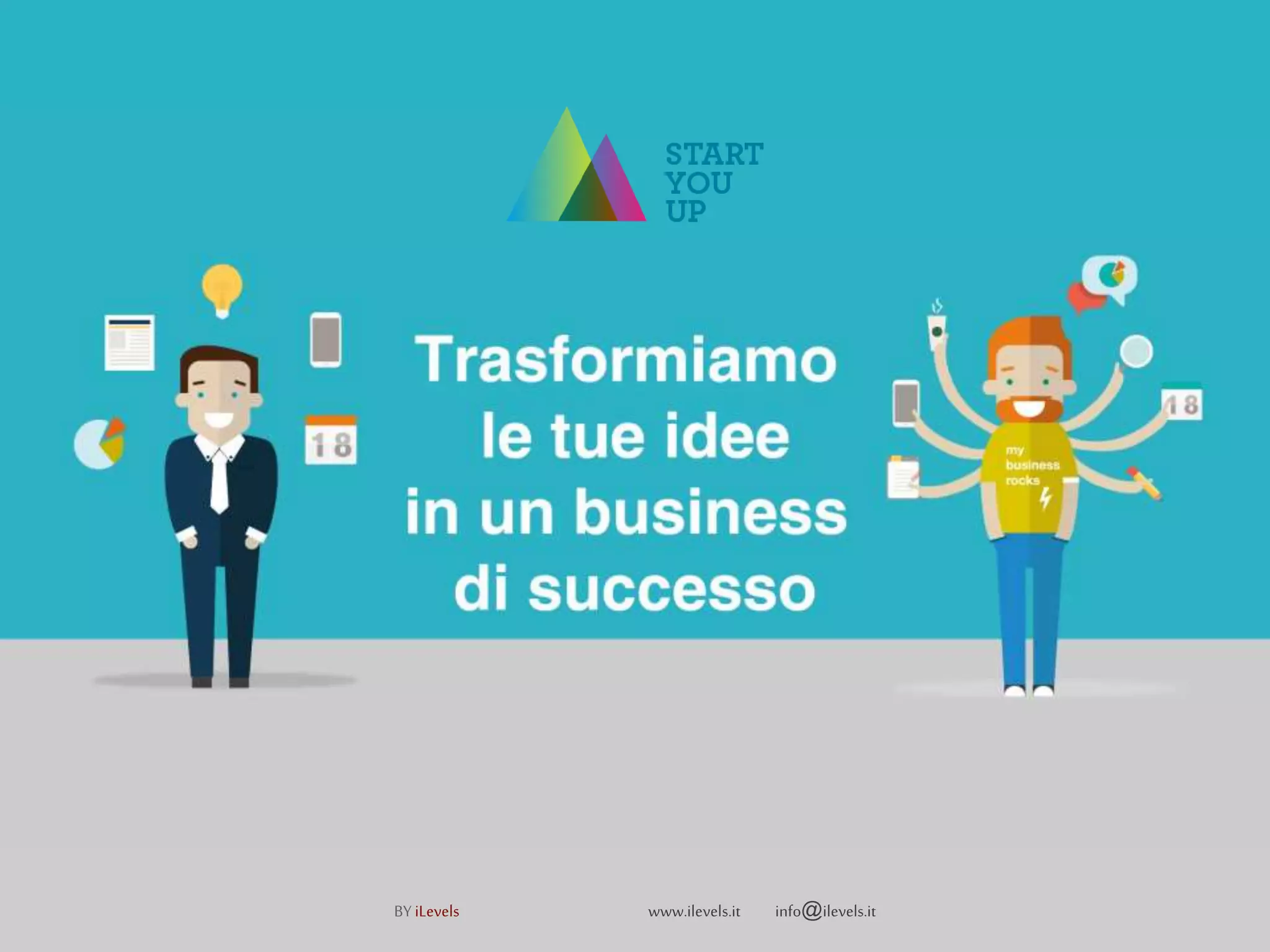
The cover slide features the company logo—a stylized multicolored triangle—and the tagline "Trasformiamo le tue idee in un business di successo" (We transform your ideas into a successful business). It establishes the brand identity and provides contact information for iLevels, including their website and email address. The visual style is clean, utilizing flat vector illustrations of a businessman and a multi-tasking entrepreneur.
Slide 2: Summary
Slide 2 introduces iLevels, the parent organization founded in 2014. It defines Start You Up as the "first web application developed to assist startups and investors in analyzing and developing business projects." The slide includes a call to action to "Try it free at iLevels.it," signaling that the platform was likely live or in beta at the time of the presentation. A progress bar at the bottom of the slide begins here, a design element that persists throughout the deck to orient the viewer.
Slide 3: The Problem
The problem slide uses quantitative data to establish urgency. It claims that entrepreneurs without a business plan are 50% less likely to grow and that only 18% of such founders secure loans or investment capital. The slide explicitly states the problem: "Startups and investors need help creating a successful business plan." A source link to a 2010 SmallBizTrends article is provided in the footer, though the data is somewhat dated relative to the 2014 founding of the company.
Slide 4: The Solution
The solution is presented as a dual-sided platform. For the "Start Up" persona, the tool develops a "Road Map" for business strategy. For the "Investor" persona, the tool "tracks and analyzes the performance of your start up projects." This positioning suggests the platform aims to be a standardized bridge between founders and capital providers.
Slide 5: Target Market
This slide narrows the focus to Italy. It cites a specific count of 3,654 startups and 37 incubators. It also notes a 32% growth in the startup sector since September 2014. While these numbers provide a clear snapshot of the local ecosystem, they represent a relatively small Total Addressable Market (TAM) if the platform is restricted to the Italian language and geography.
Slide 6 & 7: How It Works (Startups vs. Investors)
These two slides detail the user journey through three phases: Registration, Valuation, and Final Report. Slide 6 explains that startups are guided through an analysis of key elements, receive a value estimate, and download a report. Slide 7 mirrors this for investors, explaining that they can invite startups to complete the road map and then use the resulting report to evaluate potential success. This indicates a workflow where the investor acts as the lead generator for the platform.
Slide 8: Output
Business Road Map: A guided analysis of main elements. · Goal Builder: Tools for strategic business goals. · Company Valuation: Financial valuation of current and potential value. · Final Report: A summary including economic and financial evaluation.
Slide 9: Main Advantages
This slide serves as the competitive advantage and business model summary. It highlights that the platform factors in innovation and the startup team into its KPIs. Crucially, it outlines the pricing: the basic report is free, while the premium report requires a one-time payment. It also emphasizes that the platform is "user-friendly" and "available online."
Slide 10: Status and Timeline
The final slide provides a launch date of June 18, 2015. It lists two upcoming features: an "Online Elevator Pitch" and an "English version of Start You Up." The mention of an English version suggests an intent to scale beyond the Italian market, though no specific timeline or strategy for international expansion is provided.
What Works in This Deck
Clear Persona Differentiation: The deck does an excellent job of explaining the value proposition for both sides of its marketplace (startups and investors). By using Slides 6 and 7 to show the specific workflow for each, the founders demonstrate an understanding of how their tool fits into the existing ecosystem.
Specific Market Data: Rather than using vague "billions of dollars" market sizes, the deck uses specific counts of startups and incubators in Italy (Slide 5). This grounded approach makes the initial go-to-market strategy feel attainable and realistic.
Visual Consistency: The use of a progress bar at the bottom of every slide and a consistent color palette makes the deck easy to follow. The icons used for the "Road Map," "Valuation," and "Final Report" help reinforce the product's core features across multiple slides.
What Is Missing From This Deck
The Team Slide: This is the most significant omission. Investors fund people, especially at the early stage. There is no mention of the founders, their backgrounds, or why they are qualified to build a financial valuation tool. While iLevels is mentioned as the parent company, the individuals behind it remain anonymous.
The Ask: A pitch deck is generally intended to raise capital. This deck contains no information regarding how much money is being sought, the valuation of the company, or the intended use of funds. Without an "Ask," this functions more as a sales deck or a product brochure than a fundraising document.
Unit Economics and Traction: While the deck mentions a launch date, it provides no data on user acquisition costs, conversion rates from free to premium reports, or current user numbers. There is no evidence of product-market fit or revenue generated to date.
Competitive Analysis: The business planning software space is crowded with global players like LivePlan and Enloop. The deck fails to address why a founder or investor would choose Start You Up over established international competitors, other than the implication of local language support.
Founder Takeaways
Standardize Your Outputs: Founders building tools for investors should follow Start You Up's lead in defining exactly what the "output" is (Slide 8). Investors appreciate knowing exactly what data they will receive at the end of a process.
Use a Progress Bar: For decks with 10 or more slides, a simple navigation bar at the bottom helps keep the audience engaged and aware of how much of the story is left to be told.
Don't Forget the 'Who': Never leave out a team slide. Even if the product is revolutionary, the lack of a human face creates a barrier to trust that most investors will not cross. If you are a subsidiary of another company (like iLevels), you must still highlight the dedicated team members working on the specific project.
Define the Business Model Early: Slide 9 clearly states the freemium/one-time payment model. This is a good practice as it answers the "how do you make money" question before the investor has to ask it, though in this case, it would be strengthened by showing the actual price point of the premium report.
Frequently asked questions
- What is the core product of Start You Up?
- Start You Up is a web application designed to guide startups through business analysis and valuation. According to Slide 8, the platform produces four main outputs: a Business Road Map for strategic analysis, a Goal Builder for setting objectives, a financial valuation of the project's potential, and a comprehensive Final Report for economic evaluation.
- Who is the target audience for this platform?
- The deck identifies two primary user groups: startups and investors. Slide 5 specifies the Italian market, noting 3,654 startups and 37 incubators. For startups, it serves as a strategic planning tool; for investors, it acts as a screening and evaluation tool to locate high-potential projects and track their performance.
- How does the company plan to make money?
- As stated on Slide 9, the platform follows a freemium model. A 'basic report' is provided to startups at no cost to encourage user acquisition and data entry. Revenue is generated through a 'premium report,' which is described as a one-time payment rather than a recurring subscription model.
- What market data does the deck provide to justify the need?
- Slide 3 cites data (attributed to smallbiztrends.com) claiming that entrepreneurs without a business plan are 50% less likely to grow their business and that only 18% of such entrepreneurs successfully secure a loan or investment capital. This data is used to frame the 'business plan gap' as the primary problem.
- What is missing from this pitch deck for a professional investor?
- This deck lacks several critical sections required for fundraising. There is no 'Team' slide to verify founder expertise, no 'Financials' slide showing revenue projections, no 'Competition' slide to differentiate from global tools like LivePlan, and no 'Ask' slide detailing how much capital is being raised and how it will be spent.