DemandZilla is a product of Startup Weekend Columbus 2011, designed to aggregate consumer intent to influence business expansion and event booking. The deck relies heavily on a 'demo-first' approach, utilizing mockups to show how a 'Demand It!' button could be integrated into third-party sites like In-N-Out Burger or SXSW. While the presentation captures the emotional hook of consumer frustration—specifically the desire for unavailable local services—it lacks fundamental business data. There are no slides covering market size, competitive landscape, team bios, or financial projections. The de…
Key takeaways
- The presentation uses a narrative hook on slide 1 to identify the core problem: consumer desire for products or events not currently available in their city.
- The deck is structured around a live demo transition, as indicated by the 'OK It's Turbo Demo Time' placeholder on slide 2.
- Product integration is visualized through mockups on slide 4, showing a 'Demand submitted!' notification for an In-N-Out Burger in Hilliard, Ohio, citing 1,273 similar demands.
- Slide 5 demonstrates a B2B2C play by showing DemandZilla widgets embedded in a SXSW 2011 Film Awards page to gauge interest in specific film screenings.
- The business model is addressed only via a meme-style slide (slide 6) asking 'But how u make teh monies?', with no actual revenue data provided in the available slides.
- Social proof and viral loops are emphasized on slide 8, featuring an iPhone mockup with 'Share Your Demand' buttons for Facebook and Twitter.
- The deck completely omits a team slide, financial ask, market analysis, and unit economics.
- Geography-specific targeting is a core feature, with slide 8 showing a demand for a 'Motorsports Track in Hilliard, Ohio' alongside 36 similar demands.
Introduction: The Hackathon Pitch Aesthetic
The DemandZilla deck is a quintessential example of a Startup Weekend presentation from the early 2010s. Created for the Columbus, Ohio event in October 2011, the deck is light on text and heavy on visual storytelling. It follows a classic problem-solution-demo arc, designed to be delivered alongside a high-energy verbal pitch rather than read as a standalone document. Because this was produced in a 54-hour sprint, the omissions are as telling as the inclusions.
Slide 1: The Emotional Hook
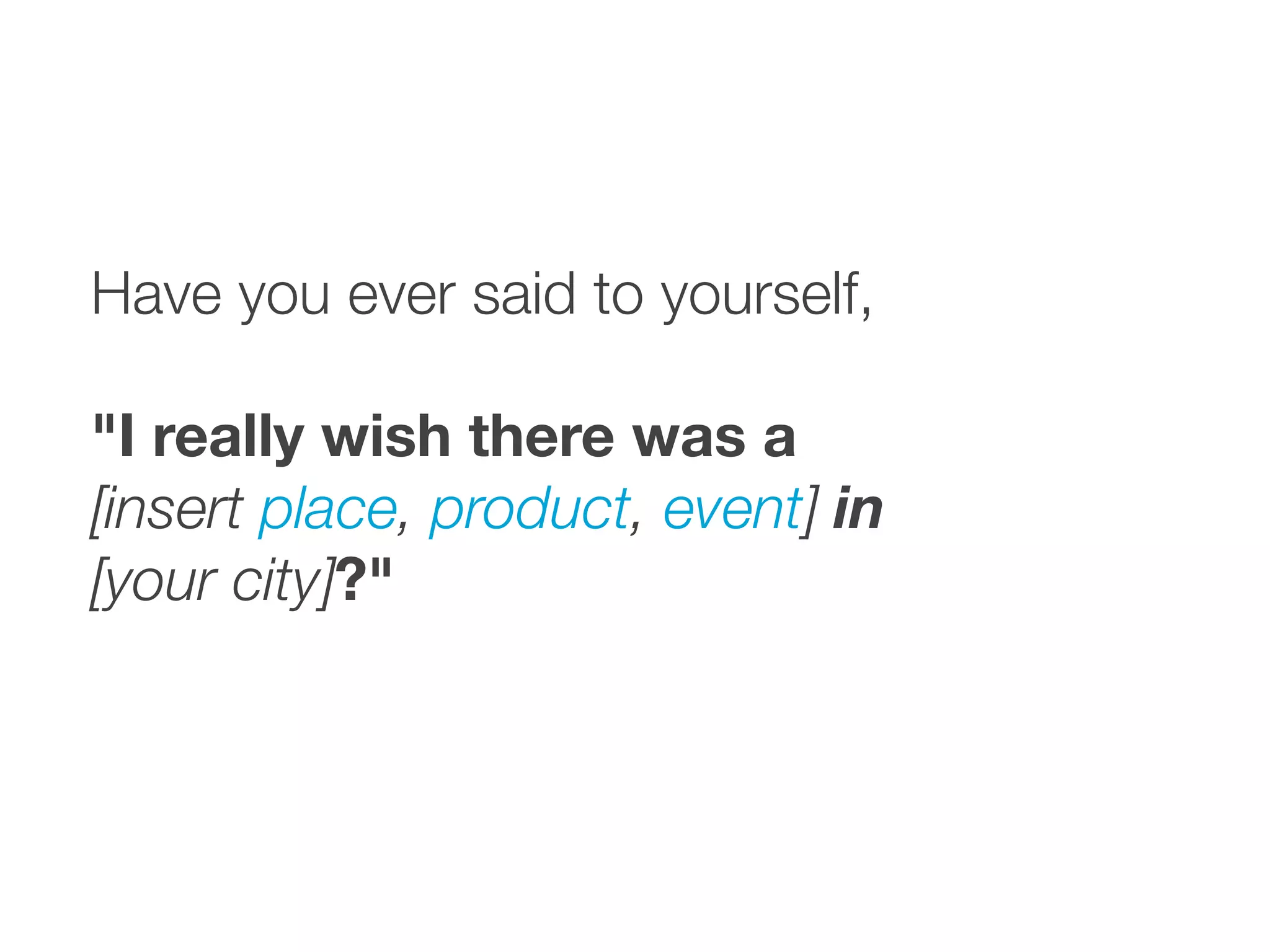
The deck opens with a relatable question: "Have you ever said to yourself, 'I really wish there was a [place, product, event] in [your city]?'" This slide establishes the user pain point immediately. It targets the frustration of geographic limitation—the idea that consumer choice is often dictated by corporate expansion teams rather than consumer demand. By using brackets like a Mad Libs prompt, the founders invite the audience to insert their own personal desires, making the problem feel universal.
Slide 2: The Demo Transition
Slide 2 is a simple transition slide: "OK It's Turbo Demo Time." In the context of a Startup Weekend, the 'demo' is the most critical component. It proves that the team didn't just talk for three days but actually built a functional prototype or a convincing high-fidelity mockup. The use of the word 'Turbo' suggests a fast-paced walkthrough, likely intended to keep the judges' attention during a short 5-minute time limit.
Slide 3: The Call to Action
Slide 3 introduces the primary UI element: a green button with a blue speech bubble icon labeled "Demand It!" This is the core 'unit' of the DemandZilla ecosystem. The simplicity of the button suggests a low-friction entry point for users. The branding is minimal, focusing entirely on the action the user is expected to take.
Slide 4: The In-N-Out Use Case
Slide 4 provides a concrete example of the product in action. It shows a mockup of an In-N-Out Burger location search page. When a user searches for a zip code where no location exists (in this case, 43228), a DemandZilla pop-up appears. The text reads: "Demand submitted! In and Out Burger in Hilliard, Ohio. 1,273 similar demands." This slide is crucial because it demonstrates the value proposition to the business: aggregate data. 1,273 demands represent a significant, quantified interest that could theoretically influence a company's real estate strategy.
Slide 5: The SXSW Integration
Slide 5 moves from physical retail to digital media and events. It shows a DemandZilla overlay on a SXSW 2011 Film Awards page. Users can click "Demand It!" next to specific film titles like The City Dark or Natural Selection to request a screening near them. This highlights a B2B2C model where event organizers or film distributors could use DemandZilla to optimize their touring or distribution schedules based on heat maps of user interest.
Slide 6: The Revenue Question
Slide 6 addresses the business model with a popular meme of the era, featuring a man's face and the caption "BUT HOW U MAKE TEH MONIES?" While this adds levity to the pitch, it serves as a placeholder for a discussion on monetization that is not detailed in the slides. In a professional VC deck, this would be a major red flag. In a hackathon setting, it acknowledges the elephant in the room—that a free 'Demand' button needs a way to generate profit, likely through selling the resulting data to the brands being demanded.
Slide 7: The 'One More Thing' Trope
Slide 7 features a black-and-white portrait of Steve Jobs with the text "There's one more thing." This is a direct reference to Apple's keynote style. It is used here to build anticipation for the mobile version of the product, signaling that DemandZilla is not just a web widget but a platform that lives in the user's pocket.
Slide 8: The Mobile Experience and Social Loop
The final slide in this set (Slide 8) shows an iPhone 4 mockup. The screen displays a confirmation: "Your demand has been submitted! 'Motorsports Track in Hilliard, Ohio' 36 similar demands." Below this are two primary buttons: "Share Your Demand" and "Make Another Demand." The inclusion of social sharing (Facebook and Twitter) indicates that the founders viewed virality as their primary growth lever. By sharing a demand, a user recruits others in their area to join the cause, thereby increasing the data's value to the potential business.
What DemandZilla Gets Right
For a 2011 hackathon deck, DemandZilla excels at visualizing the 'Magic Moment.' Instead of explaining the technology, slides 4 and 5 show exactly how a user interacts with the product in the wild. The choice of In-N-Out Burger as an example is a clever psychological play; the brand is famous for having a cult following in regions where it does not operate, making the 'demand' feel authentic and high-value.
The deck also understands the power of aggregated intent. By showing a specific number of 'similar demands' (1,273 on slide 4), the product moves from a simple feedback tool to a data-driven market research platform. This is the strongest part of the pitch: the promise of turning individual 'wishes' into actionable business intelligence.
What is Missing from the Deck
As is common with Startup Weekend decks, there are massive gaps in the business logic. The following elements are entirely absent from the 8 slides provided:
Market Size (TAM/SAM/SOM): There is no indication of how many businesses might pay for this data or the total addressable market for 'intent-based' advertising. · Competitive Landscape: In 2011, companies like Eventful (with its 'Demand it' feature for concerts) were already established. The deck does not explain how DemandZilla differs from existing players. · Team Slide: There is no mention of who is building this. In fundraising, the 'who' is often more important than the 'what,' especially at the seed stage. · Financials and Ask: There is no budget, no burn rate, and no specific request for capital. · Go-to-Market Strategy: While the deck shows widgets on other sites, it doesn't explain how DemandZilla would convince a giant like In-N-Out to install their code in the first place.
Founder's Playbook: What to Copy
Modern founders can learn from the contextual mockups used here. Rather than showing a screenshot of a dashboard, DemandZilla shows their product living on other famous websites. This helps investors visualize the 'plug-and-play' nature of the software. If you are building a tool that integrates with existing workflows, show it inside those workflows.
Additionally, the narrative arc of the first slide is a strong template for any pitch. Starting with a question that highlights a common frustration is a proven way to gain immediate empathy from an audience. However, founders should be wary of using memes (Slide 6) or celebrity tropes (Slide 7) in a serious fundraising environment; while they work for a high-energy hackathon, they can come across as unprofessional in a formal VC meeting.
Conclusion
DemandZilla is a product of its time—a lean, demo-focused pitch that prioritizes the user experience over the balance sheet. It captures the 'intent economy' before that term became a buzzword. While the deck lacks the rigor required for a Series A or even a formal Seed round, it serves as a masterclass in how to present a clear, simple idea to a live audience in under five minutes. The focus on 'demanding' what you want remains a potent concept in the age of social commerce, even if the business mechanics behind it were left for another weekend.
Frequently asked questions
- What is the core value proposition of DemandZilla?
- DemandZilla aims to bridge the gap between consumer desire and business supply. By providing a 'Demand It!' button for websites, it allows users to signal exactly what they want and where they want it (by zip code). This data is intended to help businesses make data-driven decisions about new locations or event stops based on verified local interest.
- How does the deck handle the business model or monetization?
- The deck largely ignores formal monetization strategies. Slide 6 uses a humorous image to acknowledge the question of revenue, but the provided slides do not contain a breakdown of fees, lead generation costs, or subscription models. It suggests a 'build audience first' mentality typical of early-stage hackathon projects.
- What specific integrations does DemandZilla propose?
- The deck showcases two primary use cases through mockups. Slide 4 shows an integration with a fast-food chain (In-N-Out) to track geographic demand for new franchises. Slide 5 shows an integration with a media/event site (SXSW) to let users vote for specific films to be screened in their local theaters.
- Is there any evidence of a functional team or traction in the deck?
- No. As a Startup Weekend project, the deck focuses on the 'pitch' and the 'demo.' There are no slides listing the founders' backgrounds, nor is there any mention of existing partnerships or user numbers beyond the hypothetical figures shown in the product mockups (e.g., the 1,273 demands on slide 4).
- What is the significance of the 'one more thing' slide?
- Slide 7 uses the iconic Steve Jobs 'One more thing' trope to transition into the mobile application reveal. Slide 8 then shows the iPhone interface, highlighting that the service is intended to be used on-the-go, allowing users to 'demand' things as they encounter a lack of services in real-time.