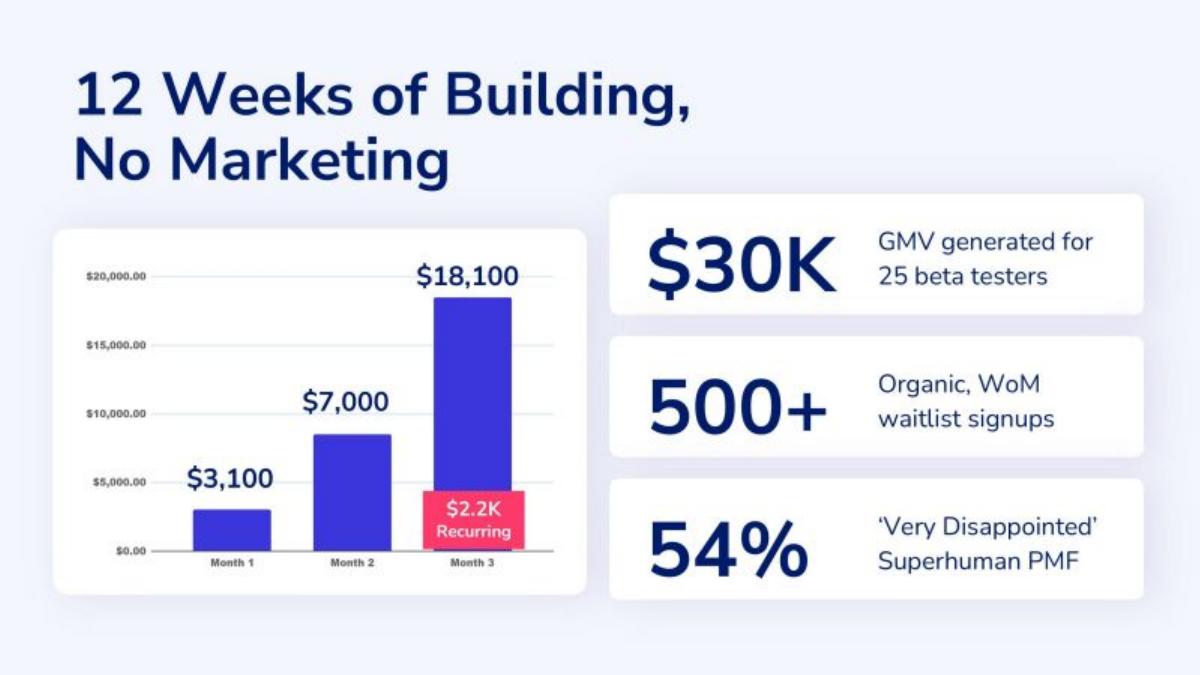
Stan.store’s 2021 Seed deck is a masterclass in identifying a fragmented market and positioning a product as the inevitable consolidator. The deck successfully raised $5M from Forerunner Ventures by focusing on the 'Knowledge Economy'—specifically coaches and analysts who were losing time and money to a bloated tech stack. With only 12 slides, the presentation moves quickly from the problem (juggling tools like Linktree, Calendly, and Kajabi) to a solution that claims to automate bookings and increase revenue. The most compelling evidence is a traction slide showing $30K in GMV from just 25 b…
Key takeaways
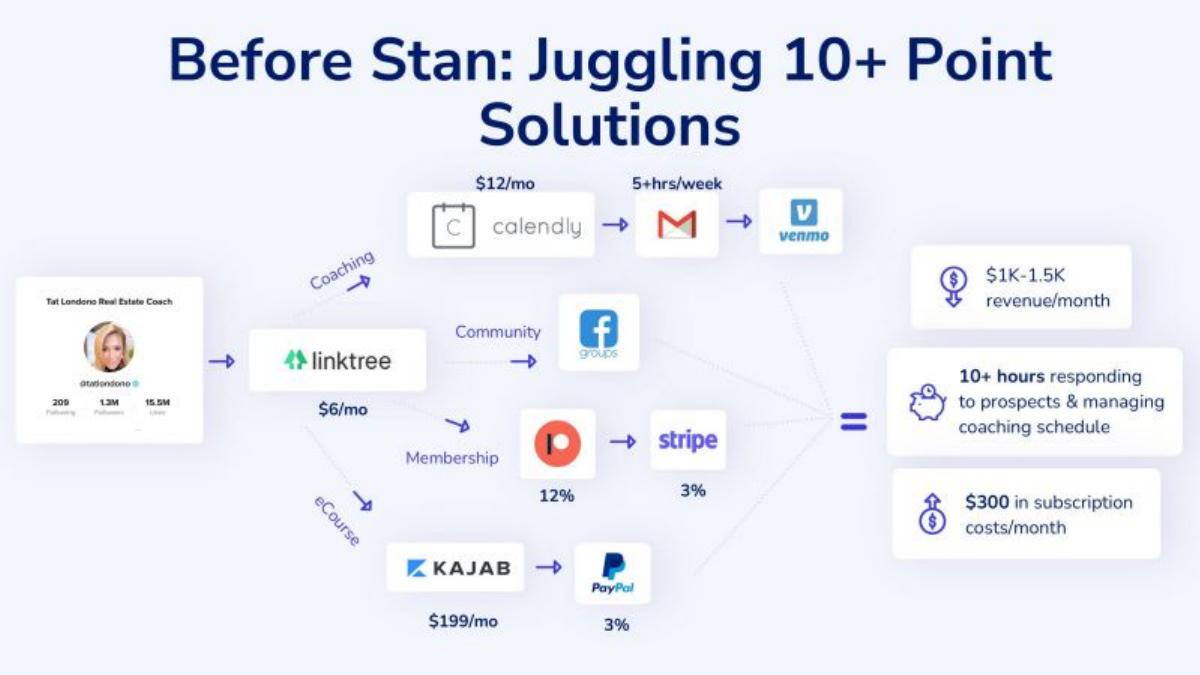
- The deck identifies a specific customer pain point: creators currently juggle 10+ point solutions, costing them $300/month and 10+ hours of manual work (Slide 3).
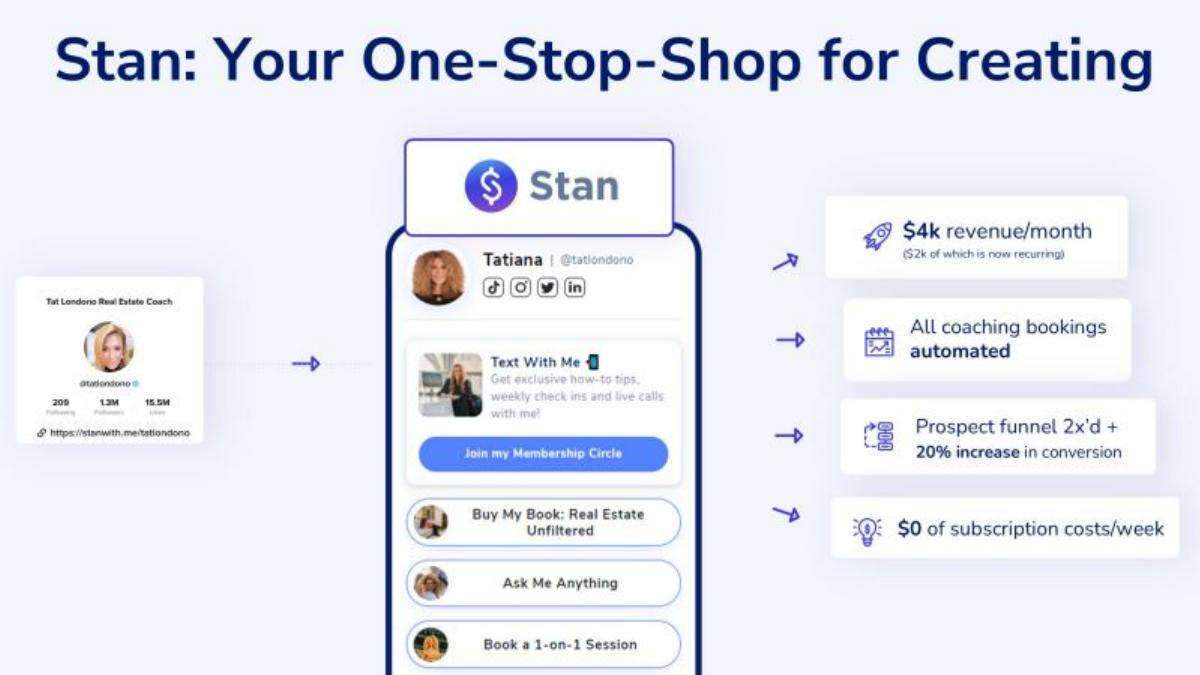
- Stan positions itself as the 'One-Stop-Shop,' claiming to double prospect funnels and increase conversion by 20% (Slide 4).
- Early traction is highly concentrated but efficient, generating $30K GMV from only 25 beta testers within 12 weeks (Slide 6).
- The product vision is framed as 'Shopify for Creators,' aiming to expand into CRM, Tax, and Brand Networks (Slide 7).
- Founder-market fit is established by the founder, John, who has 41.7K followers and 365.6K likes on TikTok (Slide 8).
- The $5M ask is clearly allocated toward team building, brand establishment, and community-driven distribution (Slide 9).
- Market differentiation is mapped on a 2x2 grid, placing Stan in the top-right quadrant for both 'Making Money' and 'Owning Your Brand' (Slide 11).
- The deck uses a 'Superhuman PMF' metric, stating 54% of users would be 'Very Disappointed' without the product (Slide 6).
Introduction: The Consolidation of the Creator Stack
The Stan.store pitch deck from 2021 is a lean, 12-slide presentation that successfully secured a $5M Seed round led by Forerunner Ventures. At a time when the 'link-in-bio' space was becoming crowded with players like Linktree and Beacons, Stan carved out a niche by focusing on monetization rather than just traffic routing. The deck is notable for its clarity, its use of specific creator personas, and its focus on the 'Knowledge Economy'—a subset of creators who sell expertise rather than just entertainment.
Slide-by-Slide Analysis
Slide 1: Title Slide
The deck opens with a simple, bold statement: "Monetizing the Creator Economy." The branding is clean, featuring the Stan logo (a purple dollar sign icon). It immediately establishes the company's sector and its primary objective. There is no fluff here; the focus is entirely on the value proposition of money-making.
Slide 2: The Knowledge Economy is Changing
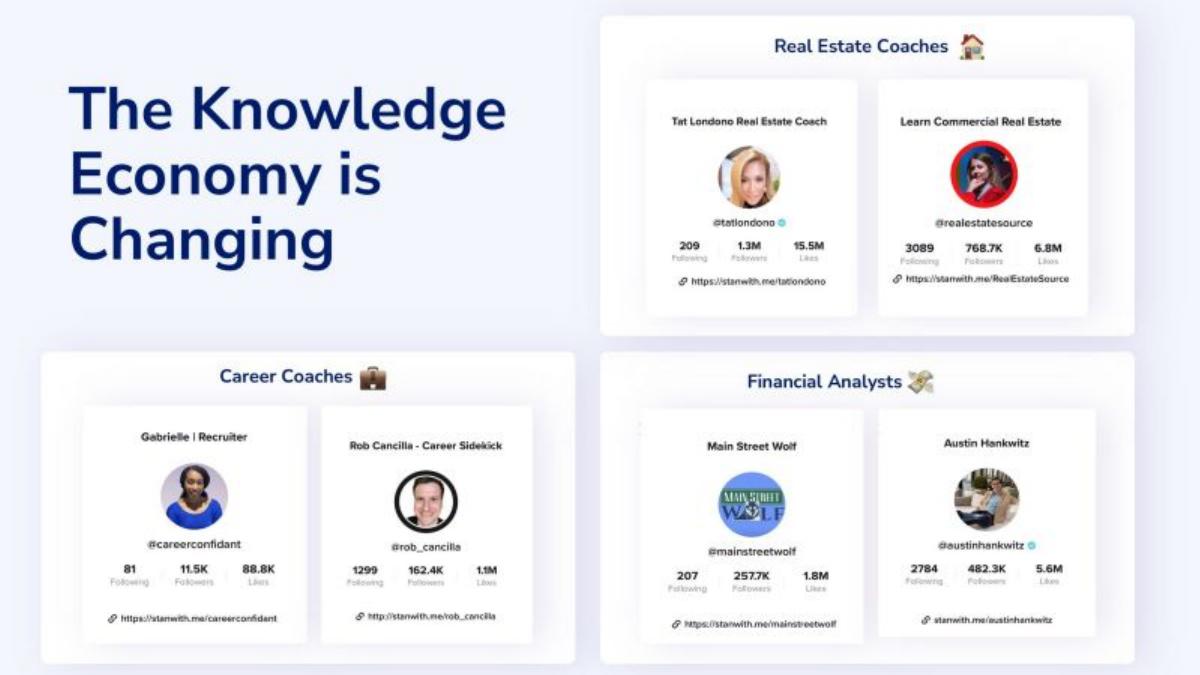
Stan uses this slide to define its initial target market. Instead of chasing every teenager on TikTok, they highlight three specific categories: Real Estate Coaches, Career Coaches, and Financial Analysts. By showing real profiles like Tat Londono (1.3M followers) and Austin Hankwitz (482.3K followers), they prove that high-value creators are already using their platform. This slide validates that there is a professional class of creators with significant audiences who need business tools.
Slide 3: Before Stan: Juggling 10+ Point Solutions
This is the 'Problem' slide, and it is exceptionally well-executed. It maps out the current workflow of a creator like Tat Londono. The slide shows a fragmented web of tools: Linktree ($6/mo), Calendly ($12/mo), Kajabi ($199/mo), plus Patreon, Stripe, and PayPal. The 'equals' sign at the end summarizes the pain: $1K-1.5K revenue/month is hampered by 10+ hours of manual work and $300 in monthly subscription costs. It frames the current state as inefficient and expensive.
Slide 4: Stan: Your One-Stop-Shop for Creating
The 'Solution' slide mirrors the previous one to show the 'After' state. By switching to Stan, the creator's revenue jumps to $4k/month ($2k of which is recurring), all coaching bookings are automated , the prospect funnel is 2x'd , and subscription costs drop to $0/week (implying the platform replaces the paid versions of the other tools). This direct comparison is a powerful way to demonstrate ROI.
Slide 5: Product Demo
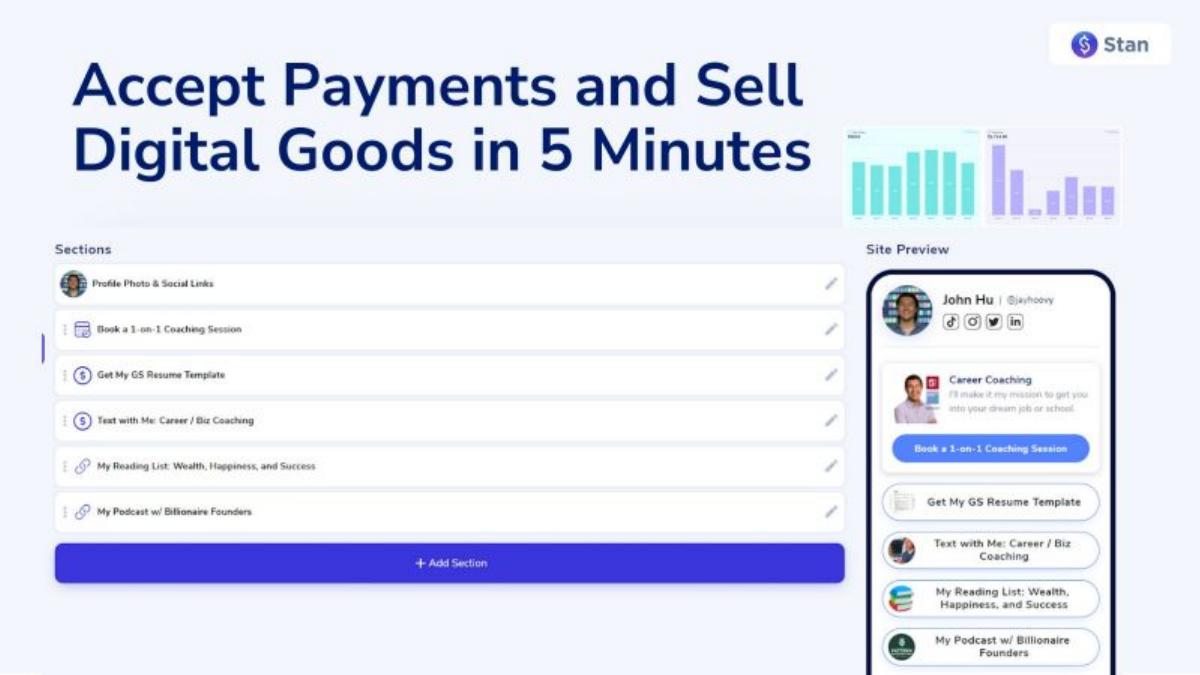
Slide 5 provides a glimpse into the user interface. The headline, "Accept Payments and Sell Digital Goods in 5 Minutes," emphasizes speed and ease of use. The visuals show a mobile-optimized storefront where users can book 1-on-1 sessions, buy resume templates, or join a membership circle. It proves the product is functional and designed for the mobile-first creator workflow.
Slide 6: Traction and PMF
This is the most critical slide for a Seed round. Stan reports 12 weeks of building with no marketing. The results are impressive: $30K GMV generated for 25 beta testers and 500+ organic waitlist signups. Most importantly, they cite a 54% 'Very Disappointed' Superhuman PMF score. This quantitative measure of user love is a strong signal that they have built something people actually want.
Slide 7: Product Vision - The Creator "SMB"
Stan expands the narrative from a simple tool to a platform. They position themselves as "Shopify for Creators: Automating Money Making." The vision includes expanding into Tax & Back Office, CRM, BI & Analytics, and Brand Networks. This slide tells investors that the current product is just the entry point into a much larger ecosystem, increasing the potential Total Addressable Market (TAM).
Slide 8: Founder-Market Fit
The founder, John, presents himself as his own customer. He shows his TikTok profile (@jayhoovy) with 41.7K followers and 365.6K likes. Alongside his creator credentials, he lists high-pedigree professional experience: Norwest Venture Partners, Goldman Sachs, and Stanford Business School. This combination of 'creator street cred' and 'institutional business rigor' is highly attractive to VCs.
Slide 9: Fundraise: Use of Proceeds
The ask is clearly stated as $5M. The funds are earmarked for three areas: Building a diverse founding team, establishing the brand, and investing in community-driven distribution. It is a standard but clear allocation of capital for a Seed stage company.
Slide 10: The Future of Work
This slide provides the macro-thesis. It shows a progression from Today: Knowledge Coaches to Tomorrow: All Creators to 2030: The Future of Work. It suggests that the trend of working for oneself is inevitable and that Stan will be the infrastructure supporting that shift. It’s a classic 'big picture' slide meant to excite investors about the long-term trend.
Slide 11: Differentiation Grid
The 2x2 grid compares Stan to competitors like Patreon, Kajabi, Linktree, and Discord. Stan places itself in the top-right quadrant, claiming to be the best at both "Making Money" and "Owning Your Brand & Audience." While these grids are always biased, it helps investors understand where Stan sits in the competitive landscape—more monetization-focused than Linktree, but more brand-centric than Patreon.
Slide 12: Closing Slide
The final slide is a promotional graphic for the source of the deck, bestpitchdeck.com. In the original presentation, this would likely have been a contact slide or a repeat of the mission statement.
What Stan.store Does Well
The deck’s greatest strength is its direct comparison between the 'Before' and 'After' states. By quantifying the hours lost and the dollars spent on fragmented tools, Stan makes the case for consolidation undeniable. The use of specific creator personas (Slide 2) makes the problem feel real and grounded, rather than theoretical. Furthermore, the inclusion of the Superhuman PMF score (Slide 6) provides a modern, data-driven way to prove early traction that goes beyond just revenue numbers.
What is Missing from the Deck
The most notable omission is a comprehensive team slide. While the founder is highlighted on Slide 8, there is no mention of co-founders, early engineers, or advisors. For a $5M raise, investors usually want to see the 'who' behind the 'what.' Additionally, there is no detailed breakdown of unit economics or the specific take-rate/subscription model Stan uses. While they mention $2.2K recurring revenue on Slide 6, the exact pricing tiers are not disclosed. Finally, the Total Addressable Market (TAM) is implied through the 'Future of Work' slide but never explicitly calculated with dollar figures.
Founder Lessons: What to Copy
Quantify the Friction: Don't just say the current way is hard. Show exactly how many tools, how many hours, and how many dollars your customer is wasting (Slide 3). · Use Personas: Showing real people with real follower counts makes your market segment tangible (Slide 2). · Leverage Modern Metrics: If you are pre-scale, use the 'Superhuman PMF' survey to show investor-ready qualitative data (Slide 6). · Position as a Platform: Even if you are a single-feature tool today, show the 'nodes' of how you will expand into a full operating system (Slide 7). · Prove Founder-Market Fit: If you are building for a specific community, show that you are a member of that community (Slide 8).
Frequently asked questions
- What is the primary value proposition of Stan.store?
- Stan.store positions itself as an all-in-one monetization platform for creators. According to Slide 3 and 4, the platform replaces a fragmented stack of tools like Linktree, Calendly, and Kajabi. By consolidating these services, Stan claims to eliminate $300 in monthly subscription costs and automate coaching bookings, allowing creators to focus on content rather than administrative overhead.
- How did Stan.store demonstrate product-market fit so early?
- The company utilized the 'Superhuman' product-market fit survey method. On Slide 6, they report that 54% of their beta users would be 'Very Disappointed' if they could no longer use the service. This is significantly higher than the 40% benchmark typically cited as the threshold for strong product-market fit, providing a quantitative signal to investors despite a small initial user base.
- Who is the target customer according to the deck?
- The deck specifically targets 'Knowledge Coaches' and 'Financial Analysts.' Slide 2 showcases real-world examples, including real estate coaches with 1.3M followers and recruiters with 11.5K followers. The strategy is to start with these high-intent knowledge workers before expanding to 'All Creators' as part of their 'Future of Work' roadmap shown on Slide 10.
- What is the 'Shopify for Creators' vision mentioned in the deck?
- Slide 7 outlines a product vision where Stan moves beyond simple link-in-bio functionality to become a full back-office suite. This includes adding features for Tax & Back Office, CRM, Business Intelligence & Analytics, and a Brand Network. The goal is to be the underlying infrastructure for the 'Creator SMB,' much like Shopify is for physical e-commerce brands.
- How does the founder's background contribute to the pitch?
- The founder, John Hu, uses Slide 8 to prove he is his own customer. By showing his personal TikTok profile (@jayhoovy) with over 41K followers and his educational background at Stanford Business School and Goldman Sachs, he demonstrates both the technical/business acumen and the first-hand experience of the creator struggles the product aims to solve.