StairWear is a 2017 Irish assistive-technology concept deck for custom-fit stair accessories that add foot space, grip and visual contrast to existing staircases. The first eleven slides — problem, solution, six-step operating chain, prototypes and a $950 configurator — are stronger than most seed decks. The business half collapses: a $350 average purchase contradicts the $950 product price, 52 million units at a $70 fee does not equal the $250M projected, market share is assumed at 15%, and there is no traction, no unit economics and no funding ask anywhere in the deck.
Key takeaways
- StairWear's 2017 deck is a 16-slide business-plan and concept deck, not a fundraising deck: it contains no ask, no use of funds, no timeline and no traction.
- The problem slide decomposes falls into three physical failures — shallow treads, poor grip, low visual contrast — and the solution slide maps one fix to each, a structure most seed decks never achieve.
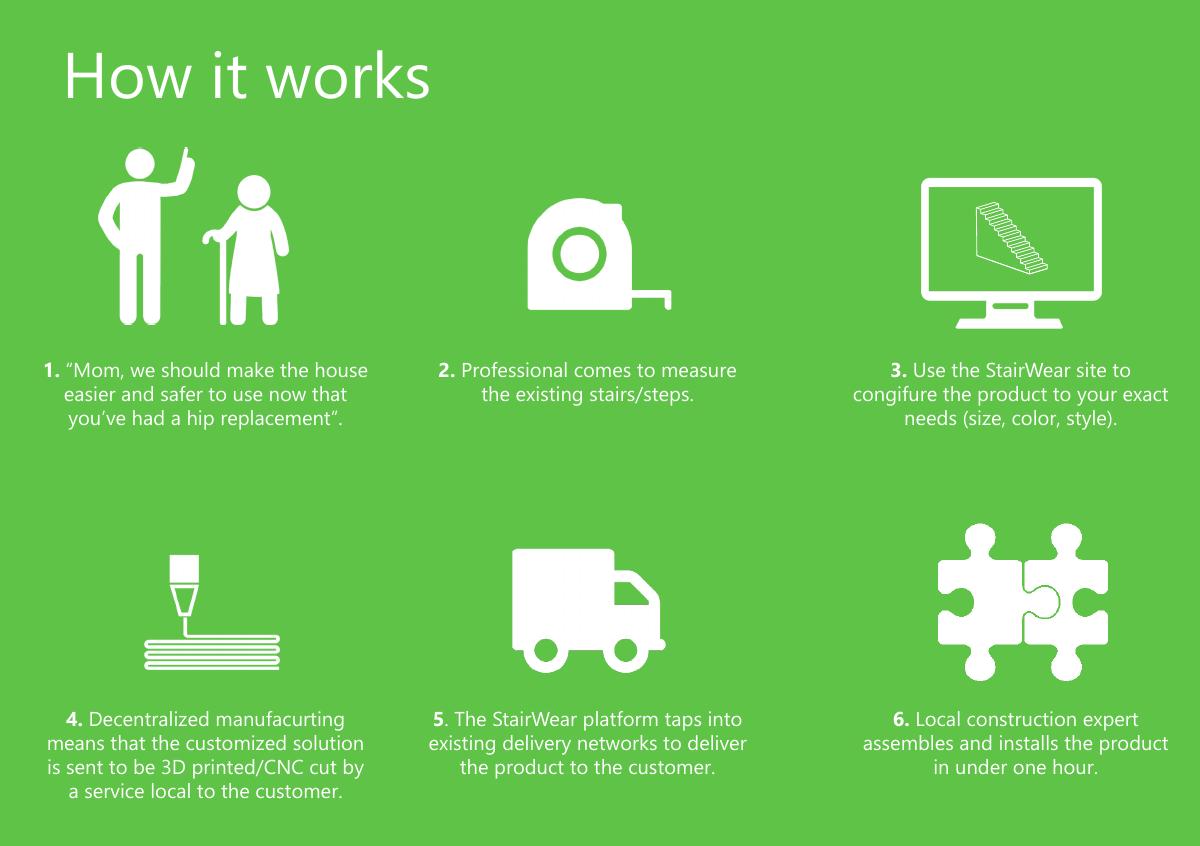
- Slide 4 describes the full operating chain in six steps: measuring visit, online configuration, local 3D printing or CNC cutting, existing delivery networks, and installation in under an hour by a local contractor.
- Decentralised local manufacturing is the deck's real strategic insight, because it removes the cost of shipping custom objects and gives every supply-chain partner a financial reason to promote the product.
- The deck contradicts itself: the configurator shows a $950 price while the business model slide assumes a $350 average purchase, and 52 million units at a $70 commission is $3.64 billion, not the $250 million projected for 2025.
- Assuming 15% share of an underived market is a red flag from a pre-revenue company; a bottom-up model from household counts would be worth more than the 52 million unit figure.
- For a product a fall-risk population stands on, the deck has no slip-resistance standard, no building-regulation position, no warranty stance and no quality-control answer for a decentralised printing network.
- The founder-market fit is buried on the last slide: the design engineer is a PhD researcher in 3D printing and mass customisation who already co-founded an open-source 3D-printed prosthetics community.
What this deck actually is
StairWear's deck is a 16-slide concept and business-plan presentation for an assistive-technology hardware startup: a suite of custom-fit stair accessories that add foot space, grip and visual contrast to existing staircases so that elderly people and people with disabilities can keep using them safely. The source file is named businessplanfinal , and that name is the most honest label on the whole document. This is a business-plan deck built to explain and defend an idea, not an investor deck built to raise a round.
The distinction matters because it changes what you are allowed to judge. There is no ask, no use of funds, no traction, no team-equity structure, no timeline and no financial statement — but there is a complete product, a working physical prototype, a designed e-commerce interface, a costed business model and a clearly reasoned manufacturing and installation chain. Judged as a fundraising deck it is missing its final third. Judged as a concept deck, it is one of the more coherent hardware-concept decks you will read, because the founders actually built the thing they are describing.
The team is three Irish designers: a design engineer doing a PhD in 3D printing and mass customisation, and two UX designers. That composition explains the deck exactly. The product logic, the manufacturing logic and the interface design are strong. The commercial logic is the part nobody in the room was trained to build.
Slide-by-slide walkthrough
Slide 1 — Title
"StairWear Pitch Deck. Providing safety through bigger steps, better grip, high visibility." The subtitle is the entire product in nine words, and it is specific rather than aspirational. It names three physical mechanisms, not an emotion. Compare that to the usual title-slide tagline about "empowering independent living" and you can see how much more work a mechanism-based one-liner does: a reader who stops after slide 1 still knows what the company makes.
The weakness is the phrase "Pitch Deck" itself sitting on the title slide. It is a small tell that this document was produced as a deliverable rather than as an instrument for a specific meeting with a specific reader.
Slide 2 — Problem
The problem slide does something most decks skip: it states a consequence, then decomposes the cause. The consequence is that stairs cause elderly users and people with disabilities to fall, and that they can force occupants to live entirely downstairs or move out of their home altogether. The causes are given as three physical failures — steps are not deep enough for users' feet, there is not enough grip, and steps blend together for people with visual impairments.
That three-part decomposition is the strongest structural move in the deck, because slide 3's solution maps one-to-one onto it. The problem is not "falls are bad"; it is three measurable deficiencies in a staircase, and each one gets a corresponding fix. What is missing is any number: no fall incidence rate, no cost of a fall to a health system, no share of over-65 households with stairs. The claim is intuitively true and completely unquantified, which means it cannot be used to size anything later.
Slide 3 — Solution
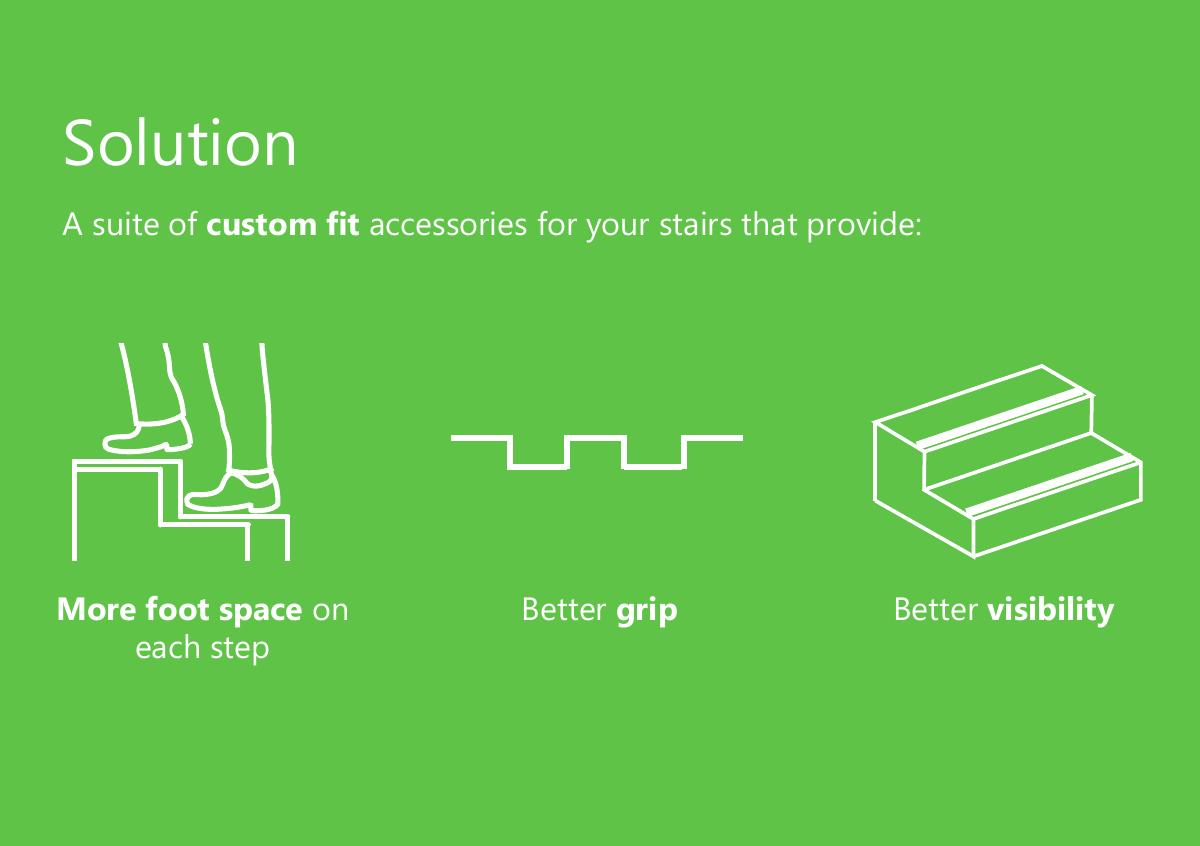
"A suite of custom fit accessories for your stairs that provide: more foot space on each step, better grip, better visibility." Three icons, three phrases, an exact mirror of slide 2. This is how a solution slide should be built — an investor reading slides 2 and 3 side by side can verify that nothing has been added and nothing dropped.
The word doing the most work is "custom fit". It is the reason the company needs a configuration platform, decentralised manufacturing and a measuring visit, and it is the reason the whole rest of the deck exists. The deck never tests it: nobody asks whether a semi-custom range of five or six standard tread depths would remove 80% of the operational complexity for 90% of the benefit. That unexamined choice is the deck's biggest strategic risk, and it is presented as a given.
Slide 4 — How it works
Six numbered steps, opening with a line of dialogue: "Mom, we should make the house easier and safer to use now that you've had a hip replacement." Then: a professional visits and measures the existing stairs; the customer configures size, colour and style on the StairWear site; the customised design is 3D printed or CNC cut by a manufacturing service local to the customer; existing delivery networks carry it; a local construction expert installs it in under an hour.
This is the best slide in the deck and it is not close. It names the buyer (the adult child, not the user), the trigger event (a hip replacement), and a full operational chain with no company-owned factory, warehouse or installation crew in it. "Under one hour" is a real, falsifiable claim about install time. "Decentralised manufacturing" is the actual business insight: the cost of customisation collapses if you never ship a custom object across a country.
What it lacks is any evidence that the chain has ever run end to end. Are there partner 3D printing bureaux? What does a bureau charge for a flight of treads? Who are the "local construction experts", and how are they recruited, vetted and paid? Every one of those five steps is a supplier relationship the company does not yet have, and the slide presents them as infrastructure rather than as a to-do list.
Slide 5 — Market Validation
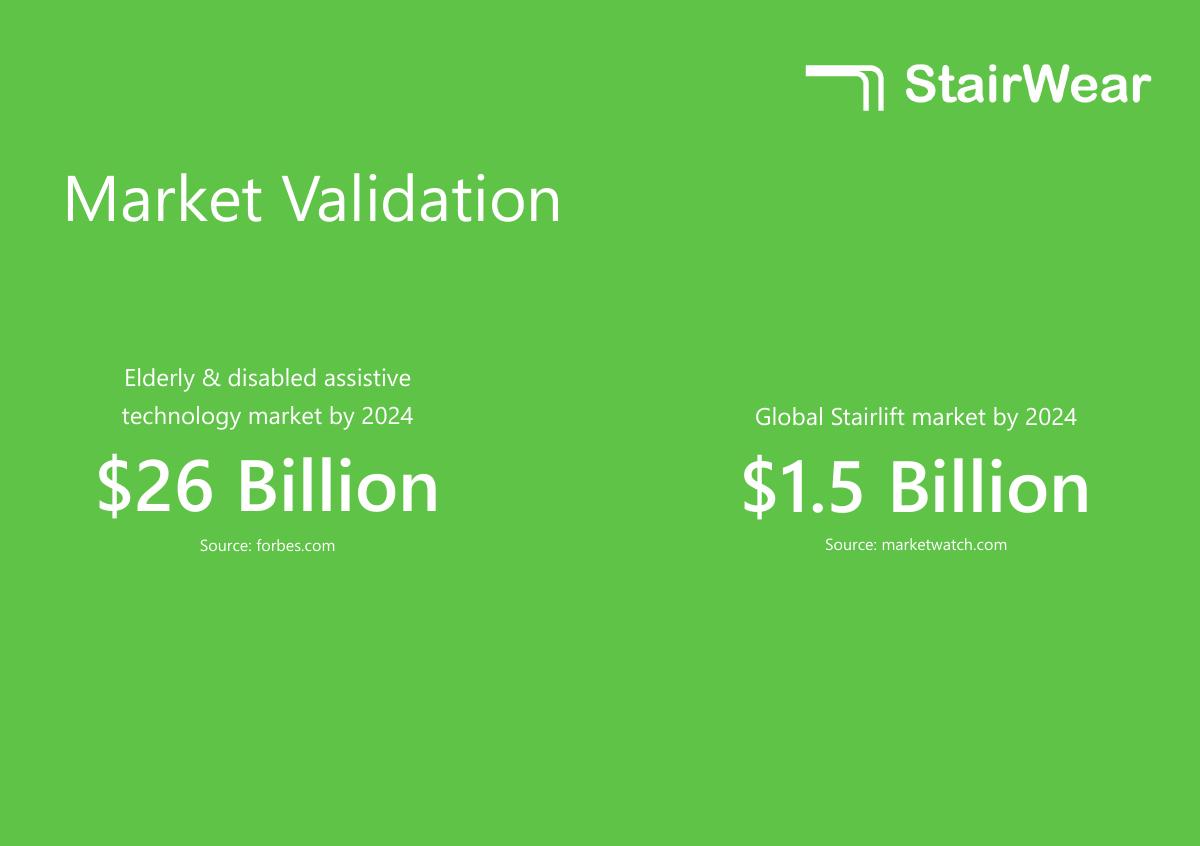
Two figures with sources: a $26 billion elderly and disabled assistive technology market by 2024 (Forbes) and a $1.5 billion global stairlift market by 2024 (MarketWatch). Citing sources on a market slide in 2017 puts this deck ahead of most decks written today, and the stairlift number is the genuinely useful one — it is the closest existing spend to what StairWear replaces.
But this is validation of a category, not of the product. Neither number tells you whether anyone will pay $950 for stair treads. The far stronger validation available to this team — they had a working prototype and a designed store — would have been ten conversations with occupational therapists or five pre-orders. The deck substitutes market size for demand evidence, which is the most common single error in early hardware decks.
Slide 6 — Market Size
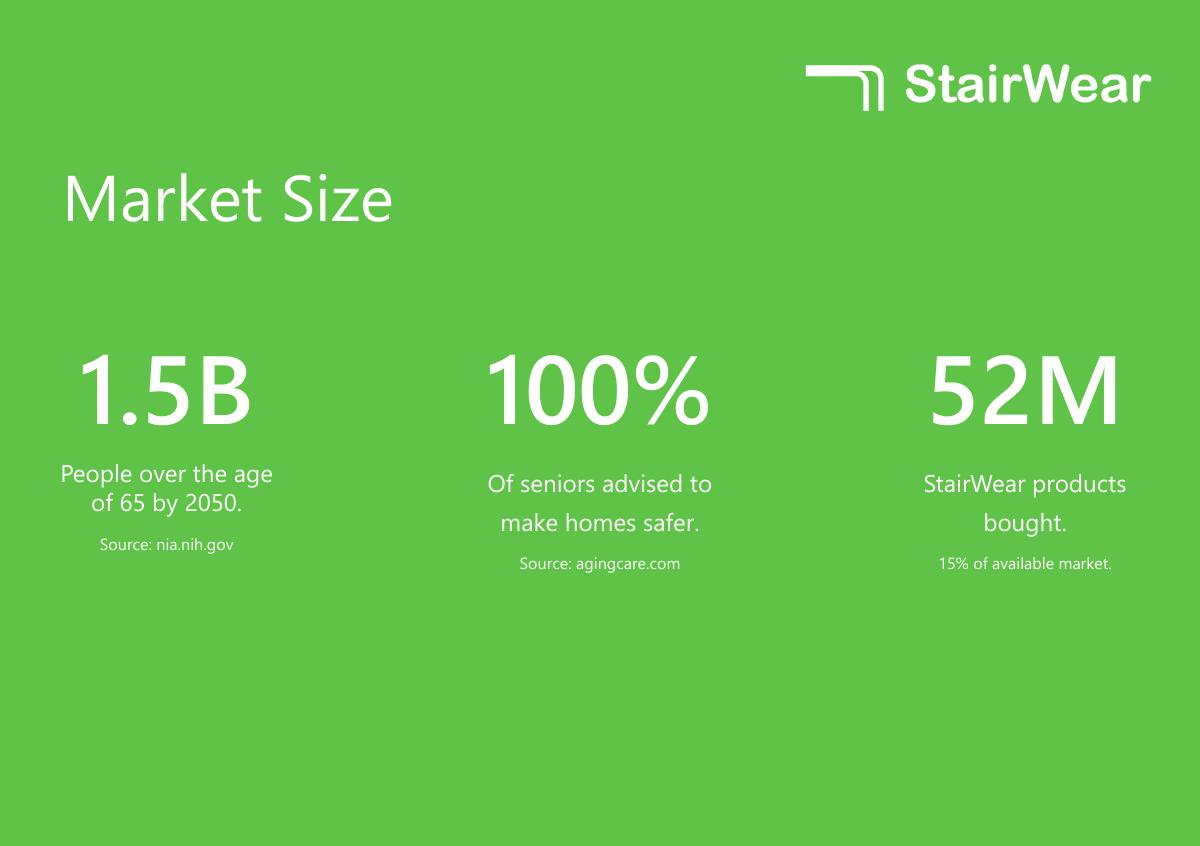
Three numbers: 1.5 billion people over 65 by 2050 (nia.nih.gov), 100% of seniors advised to make homes safer (agingcare.com), and 52 million StairWear products bought, described as 15% of the available market.
The first two are sourced. The third is where the deck breaks. "52 million products bought" is not a market size, it is a forecast of the company's own sales, presented in the same visual grammar as two cited external statistics. And 15% of an available market is not a market-share assumption any investor accepts from a pre-revenue concept — it is roughly the share Apple holds of the global smartphone unit market. The implied available market of about 347 million units also arrives with no derivation: no household count, no share with stairs, no share with an over-65 or mobility-limited occupant, no attach rate.
The fix is not a smaller number, it is a visible calculation. Households in target markets, times share with internal stairs, times share with a mobility-limited occupant, times a defensible annual conversion rate. A bottom-up figure of 200,000 units would be worth more to a reader than an unexplained 52 million.
Slide 7 — Product (section divider)
A single word on a green field. Section dividers are fine in a 40-slide plan; in a 16-slide deck they cost 6% of your total slide budget. This one buys nothing that a header on slide 8 would not.
Slide 8 — Website: home and about
A designed storefront: Shop / How It Works / Community navigation, Sign In and Join, a hero reading "Your Way — make your stairs easier, safer and more stylish", and a long About Us block. The copy is genuinely good — "we don't just want you to overcome obstacles in your everyday life, we want you to conquer them", and the reframe that almost everybody will have trouble with stairs at some point, so why wait for it to become a problem.
Note the "Community" tab. It is the only hint in the deck of a retention or word-of-mouth mechanism in a market that runs almost entirely on peer and clinician recommendation, and it is never mentioned again. That is a missed slide, not a missed tab.
The structural problem is that slides 8 to 11 spend a quarter of the deck on interface and product photography while the deck still has no traction, no ask and no financial model. Screenshots feel like evidence. They are not evidence; they are a design deliverable.
Slide 9 — Product configurator
The single most commercially useful slide after slide 4, because it contains a price. StairWear Indoor: size expressed as tread depth with 0.5" increments from a 12" default, colour, grip style, grip colour, a description promising more foot space, better grip and better visibility, and Price: $950 with an Add to Basket button.
$950 is a real, defensible number in this category — a stairlift runs several thousand dollars installed, so the deck's implicit positioning as the affordable effective option is credible at that price. But the deck never says whether $950 is a full flight or a single step, whether it includes the measuring visit and installation, or what it costs to make. A price with no bill of materials and no gross margin is a marketing asset, not a financial one, and slide 12 will quietly contradict it.
Slide 10 — Outdoor
A product image of the outdoor variant. Photographs of a real physical object are worth more than renders, and this deck has them, which places StairWear ahead of most concept-stage hardware decks. What the image does not carry is any caption: no material, no load rating, no weather or slip-resistance standard. For an outdoor product that people will stand on in the rain, the missing line is a compliance line.
Slide 11 — Indoor
Two scale models of staircases fitted with StairWear treads, in different colours and finishes. This slide proves the geometry works and that the "your style" claim is real rather than aspirational — the two models are visibly different products from the same system.
It also quietly reveals the stage of the company: these are scale models, not a full-size flight installed in an actual house. That is completely fine at this point, and the deck should have said so explicitly. Labelling a prototype as a prototype costs nothing and buys credibility; letting a reader work it out for themselves costs trust.
Slide 12 — Business Model
"We take a 20% commission on each transaction." Then three figures: 52 million StairWear products bought (15% of available market), $70 average fee on a $350 average purchase, and $250 million revenue projected by 2025.
Three problems, in ascending order of severity. First, the average purchase is $350 here and the listed product price is $950 on slide 9 — the deck contradicts itself four slides apart and never reconciles it. Second, 52 million units at a $70 fee is $3.64 billion, not $250 million, so the headline numbers on the slide do not connect to each other; the $250 million must come from a smaller, unstated unit volume. Third, and most importantly, the marketplace framing means StairWear books $70 per sale, not $350 — so the company is describing a hardware business with a services take rate, and the deck never states who bears the cost of the failed installation, the damaged tread or the return.
There is a genuinely interesting model hiding in here. A 20% commission on a distributed network of local printers and installers is asset-light, and it is the correct structural answer to custom hardware. It just needs one honest unit: one flight of stairs, its bureau cost, its delivery cost, its installer payment, its warranty reserve, and what is left for StairWear.
Slide 13 — Market Adoption
Three go-to-market routes: incentives (health insurance solutions, cheaper than alternatives, saves on hospital visits), recommendation by occupational and physical therapists with in-clinic use, and advertising through supply-chain partners — 3D printing providers, delivery services and construction services.
The middle route is the right answer and the deck buries it in the middle column. Occupational therapists are the actual purchase decision-makers in home-safety modification; a clinician-referral channel is how this category is genuinely won. The third route is the cleverest idea in the deck — the suppliers who make money from every order also advertise it — and it gets nine words.
What is absent is any evidence or sequencing. No named insurer, no reimbursement code, no therapist conversation, no first channel. Three parallel channels named at once is what a plan looks like before anyone has tried one.
Slide 14 — Competition
A two-by-two: affordable on the vertical axis, effective on the horizontal. Anti-slip tape sits affordable but ineffective; a stairlift sits effective but expensive; StairWear sits alone in the top-right quadrant.
This is the classic self-serving 2×2 and it always draws the same objection: the axes were chosen because they produce this picture. The deck omits every real competitor — stair-tread carpet and non-slip stair covers, handrail retrofits, contrast nosing strips, full stair remodels, and the option of a stair-free ground-floor conversion, which is what many families actually do. It also omits "who else could do this", when a flooring or stair-parts manufacturer with existing installer relationships could copy the concept faster than a three-person team could scale it.
Slide 15 — Competitive Advantage
Eight numbered advantages: more foot space, affordability via decentralised local manufacturing, tailor-fit sizing, customisable style, quick assembly and installation, an incentive structure where manufacturing, delivery and construction services all make money, tactile bumps for the visually impaired, and enabling users to keep living well.
Points 2 and 6 are the actual defensible ones, and they are the same idea seen from two sides: a decentralised supply chain that makes customisation cheap and gives every participant a financial reason to promote you. Points 1, 3, 4 and 7 are product features, not advantages — a competitor can copy a tactile bump in a week. Point 8 is a benefit statement.
Eight items with no ranking is a list, not an argument. Two items with evidence behind them would be a moat slide.
Slide 16 — Team
Three people. Michael O'Sullivan, design engineer, PhD researcher in 3D printing and mass customisation, BSc in Product Design and Technology, co-founder of a community producing open-source 3D printed prosthetics. Louise Clifford, UX design, digital media design student, professional photographer, previously an IT security consultant at Bank of Ireland. Natalie LeRoy, UX and interior design, over five years in branding and public art, previous finalist in an Open IDEO challenge.
Michael's bio is a near-perfect founder-market fit paragraph: the person building a mass-customisation hardware company is doing a doctorate in mass customisation and has already shipped custom 3D-printed medical devices to real people. The deck should have opened with that line, not closed with it.
The gap is equally clear. Three designers, no commercial, clinical or regulatory operator, and no advisor slot filled by an occupational therapist, a stair or flooring manufacturer, or anyone who has sold into home-care reimbursement. In a category where a product that fails causes a fall, the absence of a clinical or safety-standards voice on the team slide is the first thing a specialist investor will circle.
What this deck does better than most startup pitch decks
The problem decomposes into the solution. Three named physical failures on slide 2, three matching fixes on slide 3. Most decks state a mood and then solve something adjacent to it. · The mechanism is fully described. Slide 4 walks the entire chain from trigger event to installed product in six steps, with a named buyer and a falsifiable "under one hour" install claim. · It cites its sources. Forbes, MarketWatch, nia.nih.gov and agingcare.com are on the slides. Most 2026 decks still put an unattributed TAM circle on the page. · It shows a real price. $950, on a real configurator, with the configurable variables visible. Founders routinely hide price until the meeting; showing it invites the right argument. · It shows a physical prototype. Photographs of built stair models beat renders every time, and they prove the geometry claim is not theoretical. · Its supply chain is the strategy. Decentralised local manufacturing is not a logistics footnote here — it is the reason customisation can be affordable, and the reason partners have an incentive to sell for you.
Where this deck would fail in an investor meeting
No ask, no use of funds, no timeline. Sixteen slides and no number the reader is being asked to act on. A meeting ends with "so what do you need?" and the deck has no answer. · No traction of any kind. No pre-orders, no pilot install, no letter of intent from a clinic, no waitlist. The prototype exists; the demand evidence does not. · The revenue model contradicts the product page. $350 average purchase on slide 12 versus $950 on slide 9, and 52 million units at $70 is $3.64 billion, not the $250 million projected. Any of those three inconsistencies is enough to stall the conversation. · 15% market share, assumed. A pre-revenue company assuming a share that would make it the category leader, with no bottom-up derivation, tells the reader the model was reverse-engineered from a desired revenue figure. · No unit economics. No bill of materials, no bureau print cost, no delivery cost, no installer payment, no gross margin, no CAC. For a physical product sold through third parties, this is the whole question. · No regulatory or liability position. This is a product people stand on, sold to a fall-risk population. No slip-resistance standard, no building-regulation position, no insurance or warranty stance, no answer to what happens when a locally printed tread fails. · Quality control across a decentralised network is unaddressed. Different bureaux, different machines, different materials, one brand carrying the safety promise. · A quarter of the deck is interface. Four slides of storefront and product photography while traction, financials and the ask get zero.
Concept deck versus investor deck
Element StairWear's deck (concept / business plan) What a seed investor deck needs
Problem Three named physical failures, unquantified Same, plus fall incidence and cost-of-fall data
Solution Custom-fit accessory suite, mapped to the problem Same — this is already investor-grade
Evidence Scale prototypes and a designed store Installed flights, pilot users, clinician feedback
Market $26B and $1.5B category figures, cited Bottom-up unit model from household data
Business model 20% commission, three inconsistent figures One flight: revenue, COGS, fulfilment, margin
Go-to-market Three channels named in parallel One channel, tested, with a cost per acquisition
Competition Self-serving 2×2 with two competitors Full alternative set including doing nothing
Team Three designers, strong founder-market fit Same, plus a clinical or commercial advisor
How you would rebuild this deck for a seed round
Open on the founder-market fit. A PhD researcher in mass customisation who has already shipped custom 3D-printed medical devices is the reason to believe this team can do this. Move it from slide 16 to slide 2. · Quantify the problem. Falls among over-65s, the health-system cost per fall, and the number of households where stairs have forced a move. Three sourced numbers turn an intuitive problem into a fundable one. · Keep slides 3 and 4 nearly untouched. The problem-solution mapping and the six-step chain are the deck's spine. Add supplier names and one real cost to slide 4 and it becomes the best slide in any deck in this category. · Replace slide 6 with a bottom-up model. Households, share with stairs, share with a mobility-limited occupant, annual conversion. Land on a number you can defend for ten minutes, even if it is 1,000× smaller than 52 million. · Rebuild slide 12 around one staircase. $950 retail, printing cost, delivery, installer fee, warranty reserve, StairWear's $70 — or whatever the real numbers are. Then reconcile it with the $350 figure or delete one of them. · Compress the four interface slides into one. A single configurator screenshot with the price and options visible makes the point. Reclaim three slides. · Add a traction slide, even if it is small. Two installed flights, five occupational therapists interviewed, one clinic pilot. Small real numbers beat large projected ones every time at this stage. · Add a safety, standards and liability slide. Slip-resistance testing, load rating, building-regulation position, quality control across the printing network, insurance. In assistive hardware, this slide is a feature, not a compliance chore. · Pick one channel. Occupational-therapist referral. Show the funnel and the cost per install, and park insurance reimbursement as a later slide. · Close on the ask. The amount, the milestones it buys — say twenty installed flights, one bureau partnership and slip-resistance certification — and the runway.
The transferable lesson
StairWear's deck fails at exactly the point most designer-founded decks fail: it explains the product beautifully and then stops. Slides 1 through 11 are better than the median seed deck in their category. Slides 12 through 16 are where a reader looks for the ask, the economics and the evidence, and finds a contradicted revenue figure, an assumed 15% market share and no request.
The lesson is that the second half of a deck is the half that gets funded. Investors do not lose interest because the product is unclear; they lose interest because the product is clear and the business behind it is not. If your own deck spends four slides on your interface and zero on your unit economics, you have the same imbalance StairWear had — and it is a fixable one, usually in an afternoon, because the numbers already exist somewhere in your head or your spreadsheet. Getting them onto the page is the work.
The fastest way to find out whether your deck has the same shape is to have it read the way an investor reads it: section by section, checking whether the ask, the economics and the evidence are actually present rather than implied.
Frequently asked questions
- What is StairWear?
- StairWear is an Irish assistive-technology concept from 2017 that makes custom-fit accessories for existing staircases. The products add depth to each step, improve grip and increase visual contrast between steps, so elderly people and people with disabilities can keep using stairs safely instead of moving downstairs or out of the house. The units are 3D printed or CNC cut locally and installed in under an hour.
- Is the StairWear deck a pitch deck for investors?
- Not really. The source file is named 'businessplanfinal' and the document behaves like a business-plan presentation: it explains and defends the concept but contains no funding ask, no use of funds, no timeline and no traction. It would work as a concept or competition deck, but an investor would reach the last slide without being asked for anything.
- How much does StairWear cost according to the deck?
- The configurator slide lists StairWear Indoor at $950, configurable by tread depth in 0.5-inch increments from a 12-inch default, plus colour, grip style and grip colour. The business model slide separately assumes a $350 average purchase with a $70 commission at a 20% take rate, and the deck never reconciles the two figures.
- What is wrong with StairWear's market size slide?
- Two of the three figures are sourced external statistics, but the third — 52 million products bought, described as 15% of the available market — is the company's own sales forecast presented in the same visual style. There is no derivation of the available market from household data, and a pre-revenue company assuming 15% share is a share that would make it the category leader.
- Which StairWear slides should founders copy?
- Slides 2, 3 and 4. The problem slide names three specific physical failures rather than a mood, the solution slide maps one fix to each failure so nothing is added or dropped, and the how-it-works slide walks the entire chain from trigger event to installed product in six steps with a named buyer and a falsifiable one-hour install claim.
- Why would investors pass on the StairWear deck?
- Because the second half is missing the things funding decisions are made on: no traction of any kind, no bill of materials or gross margin, a revenue model that contradicts the product price, an assumed 15% market share, no safety-standards or liability position for a product a fall-risk population stands on, and no ask.