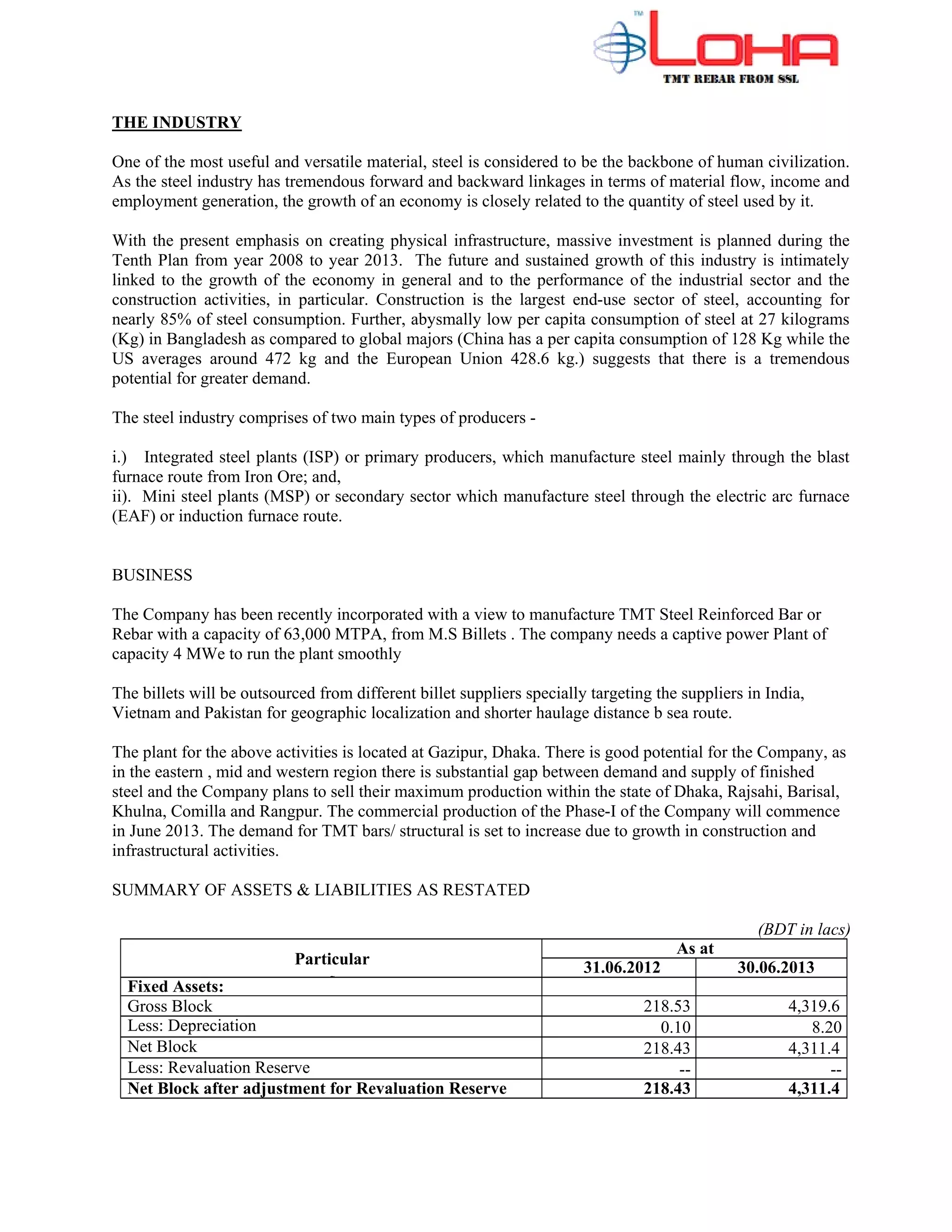
The SSL Project Profile deck, representing the 'LOHA' brand, is a comprehensive industrial project report rather than a standard venture capital pitch. Focused on the Bangladeshi steel market, the company aims to produce 63,000 MTPA of TMT rebar. The deck is notable for its extreme technical granularity, detailing everything from furnace insulation thickness (Slide 6) to the exact number of copper electrodes required for branding machines (Slide 9). While it lacks a traditional 'Ask' or valuation, it provides a robust look at the fixed asset growth from 2012 to 2013, showing a jump in Net Blo…
Key takeaways
- The project targets a manufacturing capacity of 63,000 MTPA of TMT Steel Reinforced Bar (Slide 1).
- Fixed assets grew significantly between June 2012 and June 2013, with the Gross Block increasing from 218.53 to 4,319.6 BDT in lacs (Slide 1).
- The facility includes a captive 4 MWe power plant to ensure uninterrupted production and potential surplus sales to the grid (Slide 1, Slide 3).
- Raw materials (M.S. Billets) are outsourced from India, Vietnam, and Pakistan to leverage shorter sea-route haulage (Slide 1).
- The HR policy outlines a lean management structure with 57 total proposed employees, dominated by 25 in Production & Engineering (Slide 3).
- Technical specifications for the furnace include detailed refractory zones, such as a 575mm hearth thickness and 510mm side walls (Slide 6).
- The product range covers TMT bars from 8mm to 32mm in diameter, with lengths ranging from 6 to 12 meters (Slide 5).
- The organizational structure is a traditional hierarchy led by a Board of Directors and a single Director, overseeing six distinct functional managers (Slide 10).
Executive Summary and Market Context
Slide 1: Business Overview and Financial Summary
The deck opens with a dense summary of the industry and the specific business case for SSL (LOHA). The company identifies steel as the 'backbone of human civilization' and notes that construction accounts for 85% of steel consumption. A key market driver cited is the low per capita consumption of steel in Bangladesh (27 kg) compared to China (128 kg) and the US (472 kg), suggesting significant room for growth. The business itself is a recently incorporated entity focused on manufacturing TMT Steel Reinforced Bar with a capacity of 63,000 MTPA. The slide also includes a 'Summary of Assets & Liabilities' table showing a massive jump in Fixed Assets. The Gross Block rose from 218.53 BDT in lacs in 2012 to 4,319.6 BDT in lacs by June 2013. This indicates a period of heavy capital expenditure and plant construction.
Slide 2: Bangladesh Scenario and Means of Finance
This slide provides macro-economic context, stating that Asia accounts for 40% of global steel demand. It highlights that the construction sector in Bangladesh is expected to grow at approximately 12% according to the Tenth Five-Year Plan. A critical data point mentioned is that Bangladesh is the 19th largest recycler of steel in the world. Under the 'Means of Finance' section, the deck states the project is funded by Promoter's Contribution, Foreign Direct Investment (FDI), and Term Loans from banks. However, it does not provide the specific breakdown or percentages for these funding sources.
Operational and Technical Specifications
Slide 3: Power Plant and Human Resources
SSL emphasizes its 4 MW captive power plant. The slide details the use of a condensing-type steam turbine and a generator rated for 5 MVA. The 'Advantage of the Power Plant' section lists eight bullet points, focusing on the utilization of waste heat gases to remove the need for pollution control equipment and the potential for carbon credits under the Clean Development Mechanism (CDM). The slide also transitions into HR policy, listing a total of 57 employees. The breakdown is highly operational: 25 in Production, 15 in Maintenance, and only 1 in HR and Administration, reflecting a lean, production-heavy overhead structure.
Slide 4: Technical Support and Cooling Bed
This slide features a 3D architectural rendering of an 'Automatic Rake Type Cooling Bed.' It positions the company's technical approach as a solution to 'low realization on finished products' and 'higher manufacturing costs.' The company claims to achieve better quality through enhanced production, lower specific power consumption, and roll pass designing. The text invites potential partners to intimate their requirements for plant up-gradation, suggesting the company may also act as a consultant or equipment provider in addition to a manufacturer.
Slide 5: Raw Materials and Product Range
Slide 5 provides specific engineering tables. The raw material section lists four sizes of Billets/Pencil Ingots, ranging from 100x100 to 4x5, with corresponding weights per meter. The 'Finish Product' section defines the output: Round (Plain) Bar, De-formed Bar, and TMT Bar. The size range is comprehensive, covering 8mm to 32mm diameters. The slide notes that all products are rolled to relevant international standards, though it does not specify which ones (e.g., ASTM or ISO).
Slide 6: Furnace Specifications
This is perhaps the most technical slide in the deck, detailing the 'Furnace Inspection Doors,' 'Furnace Skids,' and 'Refractories & Insulations.' It lists specific materials like C.I. Casting and Alloy Cast Iron. A detailed table breaks down the insulation thickness for the Hearth, Side Walls, and Roof across different zones (Soaking, Heating, Pre-Heating). For example, the total thickness for the Soaking Zone hearth is 575mm. This level of detail is typical of a project profile intended for engineering audits or industrial bank loans.
Slides 7 & 8: Mill Components and Miscellaneous Items
Slide 7 serves as a section header for the '310 MM PCD Intermediate-Cum-Finishing Mill.' Slide 8 is a header for 'Miscellaneous Items.' These slides indicate the deck's structure as a modular technical manual. The presence of these headers suggests the full 82-slide deck contains deep dives into every specific piece of machinery on the factory floor.
Slide 9: Branding and Weighing Equipment
Continuing the technical inventory, Slide 9 details the 'CNC Rib Cutting Machine' and 'Weigh Bridge.' It lists the quantity of copper electrodes (6 nos. each for 8mm, 10mm, and 12mm) and the specifications for a 60,000 Kg capacity electronic weigh bridge. The weigh bridge is described as being mounted on six shear beam type load cells. This granularity reinforces the document's purpose as a complete project blueprint.
Slide 10: Management Organisation Structure
The final slide provided is a traditional organizational chart. It shows a Board of Directors at the top, followed by a single Director. The reporting lines split into six functional areas: Company Secretary, Manager (Commercial & Stores), Manager Works, Manager Works (SMS), Foreman (Rolling), and Manager Works (Power Plant). The chart descends into granular roles like 'Cashier,' 'Technician,' and 'Unskilled Workers.' This structure is highly rigid and reflects a traditional industrial hierarchy common in large-scale manufacturing.
What SSL Project Profile Does Well
The deck is exceptionally thorough regarding technical specifications. For an industrial project requiring significant capital for machinery, providing the exact dimensions, material types (e.g., C.I. Casting), and utility requirements (4 MW power) is essential. It demonstrates that the founders have moved past the conceptual stage and have a fully engineered plan. The inclusion of the 3D rendering of the cooling bed (Slide 4) provides a visual anchor for the scale of the operation.
Furthermore, the market analysis on Slide 1 and 2 effectively uses the 'low per capita consumption' argument to justify the need for more domestic production capacity. By identifying Bangladesh as the 19th largest recycler, they position the industry as a sustainable and growing part of the national economy.
What is Missing from the SSL Project Profile Deck
As a fundraising tool for venture capital, this deck is missing almost every standard requirement. There is no 'Ask' slide—we do not know how much money they are looking for or what terms are being offered. There is no mention of the founding team's background or their specific expertise in the steel industry. While there is an org chart, it lacks names or bios.
The financial data is also incomplete. While the asset growth is shown, there are no revenue projections, EBITDA margins, or unit economics for a ton of steel. The 'Means of Finance' section (Slide 2) is a placeholder that mentions FDI and loans but provides no figures. Finally, there is no competitive analysis; the deck assumes that the demand-supply gap is enough to guarantee success without naming other local mills or international importers.
What a Founder Should Copy
Founders in the 'hard tech' or industrial sectors should emulate the technical rigor shown in the furnace and machinery slides. If you are building a physical product, showing that you understand the 'refractory insulation thickness' (Slide 6) or the 'copper electrode requirements' (Slide 9) builds immense credibility with technical auditors and project financiers.
The use of a captive power plant (Slide 3) as a competitive advantage is also a smart move. In regions where the grid is unreliable or expensive, showing how you will achieve energy independence and lower your cost of production is a powerful narrative for long-term sustainability.
Final Assessment
The SSL Project Profile is a 'Project Report' in the truest sense. It is designed to satisfy the requirements of a bank's technical appraisal department or a joint-venture partner looking for an engineered manufacturing plan. It is not a 'pitch' meant to excite a Silicon Valley investor. However, for its specific context—heavy industry in an emerging market—it provides the necessary technical foundation to prove that the project is feasible and the capital expenditure is accounted for down to the last electrode.
Frequently asked questions
- What is the primary product and capacity of SSL?
- SSL produces TMT Steel Reinforced Bar (Rebar) under the brand LOHA. According to Slide 1, the plant has a manufacturing capacity of 63,000 MTPA (Metric Tonnes Per Annum). The product line includes plain, de-formed, and TMT bars in sizes ranging from 8mm to 32mm, as detailed on Slide 5.
- Where is the manufacturing facility located?
- The plant is located in Gazipur, Dhaka, Bangladesh. Slide 1 notes that this location was chosen to address the demand-supply gap in the eastern, mid, and western regions of the country, specifically targeting sales in Dhaka, Rajshahi, Barisal, Khulna, Comilla, and Rangpur.
- How does the company handle its power requirements?
- SSL utilizes a captive power plant with a capacity of 4 MWe (Slide 1). Slide 3 explains that this is a Waste Heat Recovery Boiler (WHRB) based plant that uses exhaust gases from the sponge iron plant. This setup is intended to ensure energy efficiency, reduce thermal pollution, and provide a competitive cost of production.
- What are the financial highlights mentioned in the deck?
- The deck provides a summary of assets and liabilities as of June 30, 2013. The Net Block after adjustment for Revaluation Reserve is listed at 4,311.4 BDT in lacs, a significant increase from 218.43 BDT in lacs the previous year (Slide 1). The project is funded through a mix of promoter contribution, foreign direct investment, and term loans (Slide 2).
- What is the proposed workforce size and structure?
- Slide 3 lists a total of 57 proposed employees. The largest department is Production & Engineering with 25 staff, followed by Plant Maintenance with 15. The management structure shown on Slide 10 follows a rigid hierarchy, branching from a Director down to specific supervisors and skilled/unskilled workers for various plant sections.