Sriyog.Com is a Nepal-based digital marketplace connecting part-time workers with employers, targeting a total of 500,000 professionals across 50 cities. Launched in September 2016, the platform had grown to over 18,000 working professionals by the time of this 2019 deck. The company positions itself as a social impact venture, aligning with UN Sustainable Development Goals, specifically Goal 8 (Decent Work and Economic Growth). The deck utilizes a 'Uber for X' narrative to explain its value proposition, emphasizing geolocation-based bookings for services ranging from plumbing to tutoring. Wh…
Key takeaways
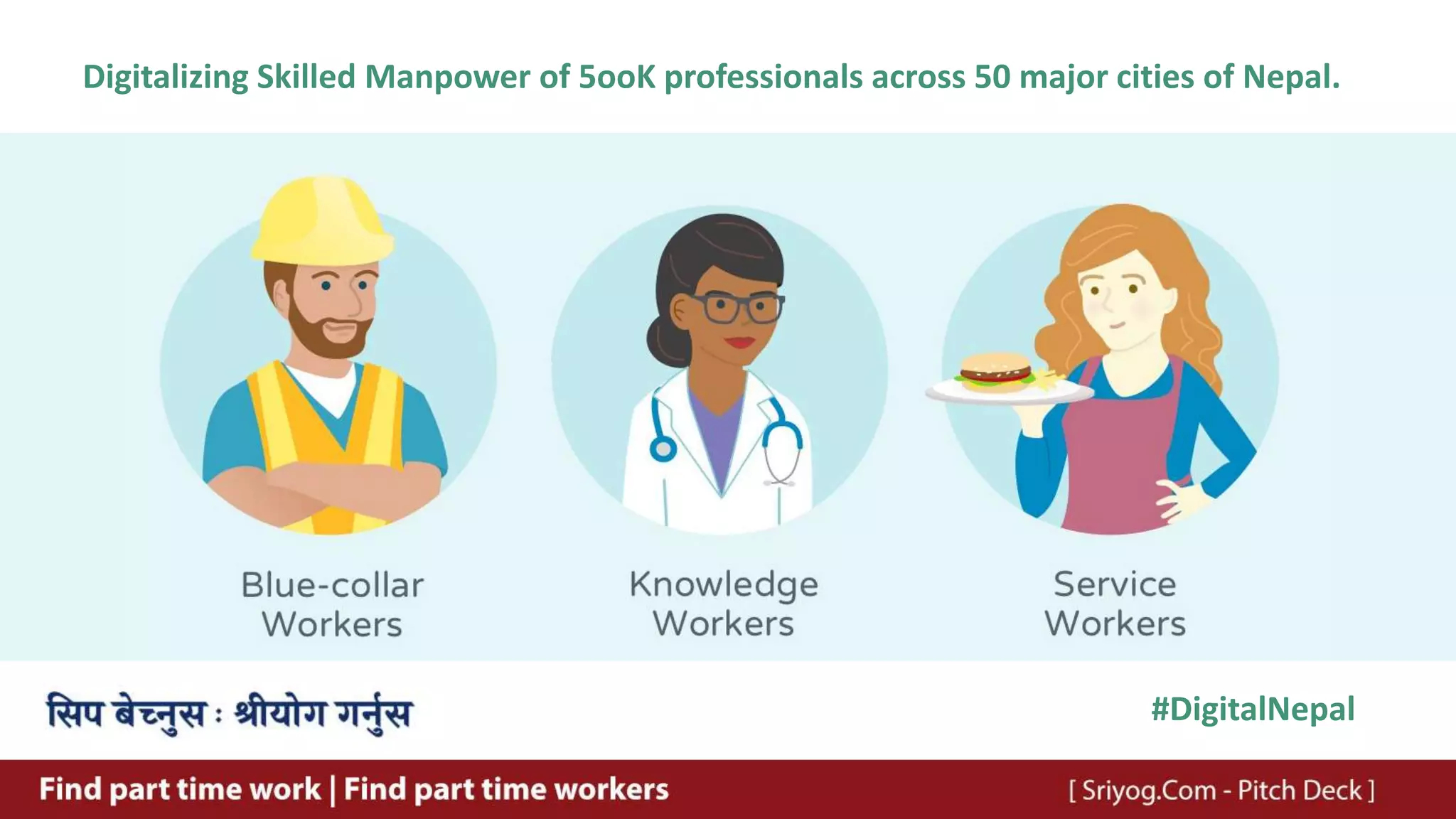
- The platform targets the digitalization of 500,000 professionals across 50 major cities in Nepal (Slide 1).
- Sriyog.Com segments its workforce into three categories: Blue-collar, Knowledge, and Service workers (Slide 1).
- The business model is framed as a solution for underutilized time, using Uber as a conceptual anchor (Slide 2).
- A geolocation-based booking system is the core technical feature enabling nearby professional discovery (Slide 3).
- Traction data shows the company launched on September 12, 2016, and reached 18,000+ professionals by 2019 (Slide 6).
- The service catalog is broad, covering 18+ categories and 150+ sub-categories (Slide 6).
- Revenue is generated through six streams: Featured Submissions, Banner Ads, User Verification, SMS Verification, Referral Commissions, and Payment Commissions (Slide 7).
- The company explicitly aligns its mission with the UN Sustainable Development Goal 8 for Decent Work and Economic Growth (Slide 5).
Executive Summary: The Localized Gig Economy
Sriyog.Com represents a classic 'Uber for X' adaptation tailored for the Nepalese market. By the time this deck was circulated in 2019, the company had already moved past the conceptual stage, boasting a three-year operational history and a database of 18,000 professionals. The deck focuses heavily on the social utility of the platform, framing it as a tool for economic empowerment and digital transformation in a region where informal labor is often fragmented and difficult to access.
Slide 1: The Vision and Scope
The opening slide sets a high-level target: digitalizing 500,000 professionals across 50 major cities in Nepal. It uses simple vector illustrations to categorize the workforce into three buckets: Blue-collar Workers, Knowledge Workers, and Service Workers. The footer introduces the dual value proposition: "Find part time work | Find part time workers," and utilizes the hashtag #DigitalNepal to align with national development narratives. This slide effectively communicates the scale of the ambition and the breadth of the service categories.
Slide 2: The Conceptual Anchor
Slide 2 uses a full-bleed image of a driver holding a smartphone with the Uber logo. The text states, "People drive UBER to make extra income on their FREE TIME." This is a standard pitch deck tactic: using a globally recognized success story to explain a business model by analogy. It establishes the 'gig economy' framework immediately, reducing the cognitive load on the investor to understand how the platform functions.
Slide 3: The Value Proposition and Use Cases
Titled "Why Sriyog.Com," this slide lists five specific examples of how the platform creates value. It highlights flexibility for students (tutoring), vocational opportunities for trained workers (plumbing), and income for women (babysitting). Notably, it mentions a specific earning potential of "Nrs 12 Thousand easily" for babysitters. The final bullet point introduces the technical solution: a "geolocation based booking system," which is the functional heart of the marketplace.
Slide 4: The Persona Story
This slide attempts to humanize the platform through a persona named Shova. It describes her filling in details as a babysitter in Bhaktapur. It uses the phrase "by birth skills" to describe childcare, suggesting the platform aims to monetize innate or traditional skills that might not be captured by formal resumes. While the slide is visually sparse, it reinforces the hyper-local nature of the service by naming a specific city (Bhaktapur).
Slide 5: Social Impact and SDGs
Sriyog.Com leans heavily into the 'Impact Investing' space here. By displaying the UN Sustainable Development Goals (SDGs) and highlighting Goal 8 (Decent Work and Economic Growth), the company signals that it is not just a commercial venture but a social one. This is often a strategic move to attract grants, impact funds, or government partnerships in developing economies.
Slide 6: Traction and Milestones
This is the most data-dense slide in the set. It provides a timeline and current status:
Launch Date: September 12, 2016. · Professional Count: 18,000+. · Categories: 18+ main categories and 150+ sub-categories. · Geographic Reach: 50+ cities, with a curious mention of Texas and Sydney, which may refer to diaspora usage or early international testing. · Origin: A 2013 icon suggests the idea or initial development began three years prior to the official launch.
Slide 7: The Revenue Model
The final slide in this set outlines how the company intends to capture value. It lists six distinct streams: 1. Featured Submission: A premium visibility model for workers. 2. Banner Ads: Traditional display advertising. 3. User Verification: Likely a one-time or recurring fee for a 'verified' badge. 4. SMS Verification: Passing through or charging for the cost of secure login/notifications. 5. Referral Commission: Incentivizing growth through user acquisition. 6. Payment Commission: A percentage of the transaction value.The slide notes this as a "Sustainability plan," which might imply that not all these streams were fully active at the time of the pitch.
What Works in This Deck
The deck excels at clarity of purpose . Within the first three slides, the reader knows exactly what the product is, who it is for, and how it works. The use of the Uber analogy is well-placed to bridge the gap between a local Nepalese context and global business standards. Furthermore, the traction slide provides enough evidence of product-market fit to move the conversation beyond a mere idea. The segmentation of workers (Blue-collar vs. Knowledge) shows a sophisticated understanding of the labor market, suggesting the platform isn't just for 'handymen' but for anyone with a marketable skill.
What Is Missing
The most glaring omissions in these seven slides are unit economics and financial projections . While we see how they plan to make money, there is no data on the average transaction value, the take rate, or the cost of customer acquisition (CAC). Additionally, there is no team slide in this selection. In early-stage startups, the founders' ability to execute is often more important than the idea itself. Finally, there is no competitive analysis . The deck operates as if Sriyog.Com is in a vacuum, ignoring local competitors or the threat of global platforms like Upwork or Freelancer moving into the local service space.
Founder's Guide: What to Copy
Founders should emulate the specific use-case examples found on Slide 3. Instead of saying "we help people find work," Sriyog.Com says "An 11 Class student can be a tutor." Specificity builds credibility. The alignment with SDGs (Slide 5) is also a smart move for startups in emerging markets, as it opens doors to a wider variety of capital sources. Lastly, the revenue diversification shown on Slide 7 is a good template for a marketplace; relying on a single commission fee is risky, and showing multiple 'sustainability' levers demonstrates a more robust business mindset.
Conclusion
Sriyog.Com presents a compelling case for a localized labor marketplace. The deck is functional and straightforward, though it lacks the visual polish of modern Silicon Valley decks. Its strength lies in its 2016-2019 growth data and its clear identification of the 'Digital Nepal' opportunity. To be truly 'investment ready' for a Series A or similar, the missing slides would need to address the burn rate, the specific technology stack, and a clear roadmap for how they get from 18,000 to the 500,000 professionals targeted on the cover slide.
Frequently asked questions
- What is the primary problem Sriyog.Com is trying to solve?
- Based on Slide 3, the company addresses the lack of easy access to local skilled labor and the need for flexible income opportunities. It enables students, trained tradespeople, and stay-at-home parents to monetize their 'free time' or 'by birth skills' by connecting them with nearby customers through a geolocation-based booking system, effectively formalizing the informal labor market in Nepal.
- How does Sriyog.Com make money?
- According to Slide 7, the company employs a multi-faceted revenue model. This includes charging for 'Featured Submissions' (visibility), 'Banner Ads' (advertising), 'User Verification' and 'SMS Verification' fees (trust/security), and taking a 'Referral Commission' or 'Payment Commission' on transactions. The slide notes this as a 'Sustainability plan,' suggesting these streams are intended to ensure long-term viability.
- What is the current scale of the platform according to the deck?
- Slide 6 reports that as of the deck's publication, the platform had 18,000+ working professionals registered. It operated across 50+ cities, including international mentions of Texas and Sydney, though the primary focus remains Nepal. The service offering is highly granular, featuring over 18 main categories and 150 sub-categories of work.
- Who are the target users for this platform?
- Slide 1 and Slide 3 identify a broad spectrum of users. On the supply side, it targets blue-collar workers (plumbers), knowledge workers (tutors), and service workers (babysitters). The deck specifically mentions 11th-class students, women seeking part-time work, and vehicle owners (jeep drivers) as primary beneficiaries of the platform's flexible work model.
- Is there an investment ask or team information in the deck?
- The provided seven slides do not include a team slide, a financial breakdown, or a specific investment ask (funding amount or valuation). While the full deck is noted to have 21 slides, the core sections visible here focus on the value proposition, traction, and revenue model rather than the capital requirements or founder backgrounds.