StackGen’s 9-slide deck is a masterclass in 'founder-market fit' for a Seed round. Raising $12.3M in 2024, the company relies on a heavy-hitting leadership team with multiple exits to Qualys, Tenable, and Akamai to bridge the gap left by a lack of detailed product screenshots or financial metrics. The deck identifies a specific 'pinch point'—the 1:10 ratio between DevOps and Developers—and proposes a shift from declarative templates to generative, context-aware infrastructure. While the deck is light on unit economics and competitive landscape, it successfully sells a vision of 'Infrastructur…
Key takeaways
- The deck identifies a critical 1:10 ratio between DevOps and Developers as a primary market bottleneck (Slide 2).
- StackGen positions 'Infrastructure from Code' as a disruptive evolution over traditional declarative templates (Slide 3).
- The mission is specifically defined as auto-generating infrastructure from application code with 'golden standards' applied (Slide 4).
- The product vision emphasizes being cloud-agnostic and developer-first to enable secure deployment to any cloud (Slide 6).
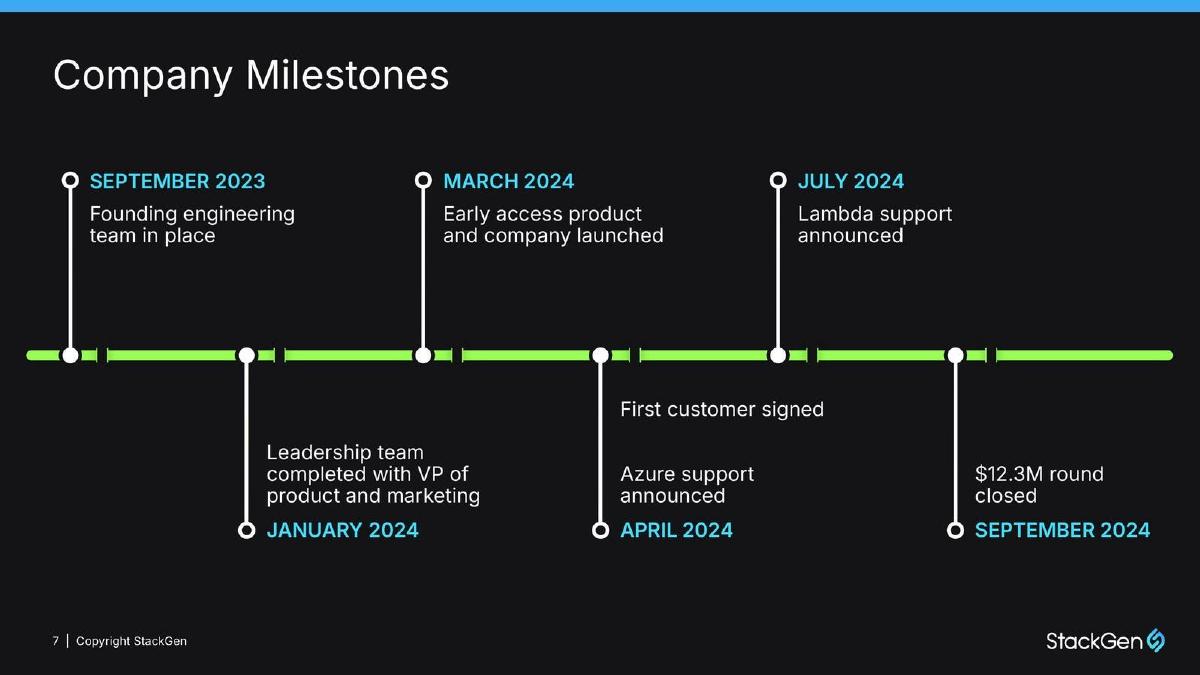
- The company reached its first signed customer and a $12.3M round within one year of forming the founding engineering team (Slide 7).
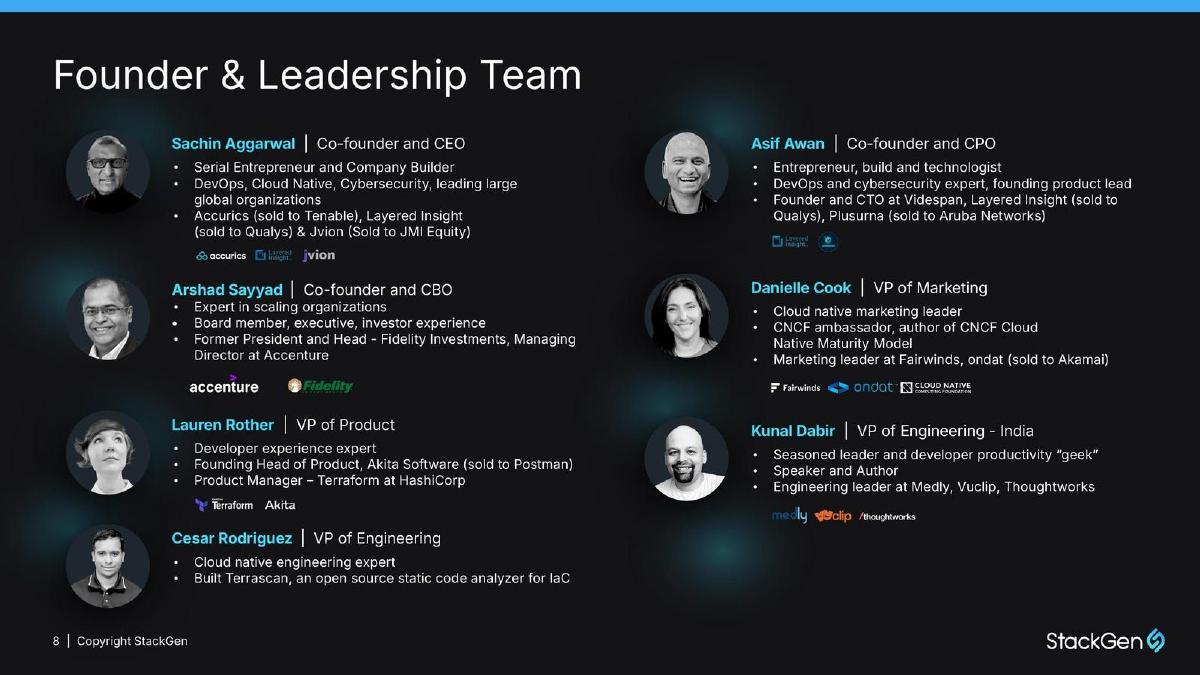
- The leadership team features deep exit experience, including sales to Tenable, Qualys, Aruba Networks, and Postman (Slide 8).
- The deck omits traditional Seed-stage components like a business model, pricing, or a detailed competitive matrix.
- Market validation is supported by Gartner data predicting 80% of engineering orgs will establish platform teams by 2026 (Slide 2).
The Narrative: Selling the Evolution of DevOps
StackGen’s pitch deck is a concise, 9-slide presentation that prioritizes market thesis and team pedigree over granular product features. Raising $12.3M at the Seed stage in a difficult 2024 venture market suggests that the 'Who' and the 'Why Now' were exceptionally strong. The deck follows a classic problem-solution-vision arc, but it is tailored specifically for the technical infrastructure space, using industry-standard terminology like 'Platform Engineering' and 'Cognitive Overload' to signal deep market awareness.
Slide 1-2: The Market Shift and the 1:10 Bottleneck
The presentation opens with a clear title: "Generative Infrastructure from Code" (Slide 1). This immediately positions the company within the Generative AI wave while grounding it in a specific technical category. Slide 2, titled "Software Engineering Undergoing Seismic Shift," does the heavy lifting of establishing the problem. It uses a three-column layout to contrast 'Development' (Velocity) with 'Platform Engineering' (Governance at Scale).
The most compelling data point on Slide 2 is the "1:10 Ratio between Dev and DevOps is a pinch point." By quantifying the human bottleneck, StackGen makes the case for automation. They supplement this with Gartner projections, noting that by 2025, 80% of the product development lifecycle will incorporate Gen AI code generation. This slide effectively argues that while AI is making developers faster at writing code, the infrastructure side is still stuck in manual, 'contextless' processes, creating a widening gap that StackGen intends to fill.
Slide 3-4: The Disruptive Technology and Mission
Slide 3, "Alignment Requires Disruptive Technology," introduces the transition from the old way of working to the StackGen way. It sets up four key evolutions:
Declarative > Generative · Contextless > Context-Aware · Templates > Standardization/Hyper-personalization · Manual > Streamlined
This is a strategic positioning move. By labeling existing solutions (like Terraform or CloudFormation) as 'Declarative' and 'Contextless,' they frame the current industry standard as a legacy burden. Slide 4 then delivers the Mission : "Remove the burden of infrastructure as code by auto-generating it from the application code with golden standards applied." This is a punchy, one-sentence value proposition that clearly defines the product's function.
Slide 5-6: Defining 'Infrastructure from Code' and Vision
Slide 5 provides a more technical definition of the category. It explains that Infrastructure from Code (IfC) uses the application's own code to determine the required infrastructure. The benefit highlighted here is security: because the infrastructure is derived from the app, it is "automatically least privileged" and "minimum viable infrastructure." This appeals to the 'Security and Compliance Risks' mentioned in the problem slide.
Slide 6 outlines the Vision : "Enable any user to securely deploy applications to any clouds without delay by being application-centric, cloud-agnostic and developer-first." The keywords here—'cloud-agnostic' and 'developer-first'—are critical for enterprise software. They signal that StackGen isn't just a tool for AWS or Azure, but a horizontal layer that prevents cloud lock-in.
Slide 7: Rapid Execution Milestones
The Company Milestones on Slide 7 show a very aggressive timeline. The founding engineering team was in place in September 2023. By March 2024, they launched the company and an early access product. Crucially, they signed their "First customer" in April 2024, just one month after launch. The timeline concludes with the "$12.3M round closed" in September 2024. This slide demonstrates execution speed—a key metric for Seed investors when revenue is still in the early stages.
Slide 8: The Powerhouse Team
Slide 8, "Founder & Leadership Team," is arguably the most important slide in this deck. For a $12.3M Seed round, investors are betting on the people. The team listed has an extraordinary track record:
Sachin Aggarwal (CEO): Previous exits include Accurics (sold to Tenable) and Layered Insight (sold to Qualys). · Asif Awan (CPO): Co-founder of Layered Insight and Videspan. · Arshad Sayyad (CBO): Former President at Fidelity Investments and MD at Accenture. · Lauren Rother (VP Product): Former PM for Terraform at HashiCorp (the very tool StackGen aims to evolve).
The inclusion of a former Terraform PM is a massive signal of 'insider' knowledge. This team has built, scaled, and sold companies in the exact same domain (DevOps and Cloud Security) multiple times. This slide alone likely justified the valuation and round size.
What StackGen Does Well
Category Creation: The deck doesn't just say they are a 'better' DevOps tool; it argues for a new category called 'Infrastructure from Code.' By contrasting it against 'Infrastructure as Code,' they make their solution feel like an inevitable evolution rather than a marginal improvement.
Quantifying the Pain: Using the 1:10 ratio of DevOps to Developers is a brilliant way to illustrate the 'pinch point.' It’s a metric that every engineering leader understands and feels daily.
Leveraging Pedigree: The team slide is perfectly executed. It uses recognizable logos (Accenture, Fidelity, HashiCorp) and clearly states previous exit outcomes. It answers the question "Why this team?" with overwhelming evidence.
What is Missing from the Deck
Product Visuals: There are zero screenshots of the actual tool. While the conceptual diagrams are clean, a Seed deck usually benefits from showing how a developer actually interacts with the product. Is it a CLI? A web portal? An IDE plugin? The deck remains silent on the 'How.'
Business Model: There is no mention of how StackGen intends to make money. While Seed rounds often focus on product-market fit, a slide on pricing strategy (e.g., per developer, per resource, or open-core) would have provided more clarity on the path to $100M ARR.
Competitive Landscape: The deck ignores competitors. While they frame IaC as the 'old way,' they don't address other emerging players in the IfC or 'Internal Developer Portal' (IDP) space. Investors would certainly have asked about their moat against incumbents like HashiCorp or Pulumi.
What Other Founders Should Copy
The 'Mission' Slide: Slide 4 is a perfect example of a mission statement. It is one sentence, contains no jargon, and explains exactly what the product does and what the benefit is. Every founder should strive for this level of clarity.
The Contrast Framework: Slide 3 uses a 'Current State vs. Future State' table. This is a highly effective way to communicate a value proposition quickly. It allows an investor to see the 'delta' between the status quo and the startup's vision in seconds.
Third-Party Validation: StackGen uses Gartner data and industry white papers (Slide 2) to validate that the problem they are solving is recognized by the broader market. This shifts the narrative from "we think there is a problem" to "the industry experts agree there is a problem."
Frequently asked questions
- Why is the deck so short at only 9 slides?
- At the Seed stage, especially with a highly experienced founding team, the goal is often to establish the 'Why Now' and 'Who.' StackGen focuses on the seismic shift in software engineering and their team's unique ability to solve it. The brevity suggests a high-conviction round where the founders' previous exits (Accurics, Layered Insight) did much of the heavy lifting.
- Does the deck show the actual product?
- No. The deck is entirely conceptual and visionary. It uses abstract diagrams to represent infrastructure flows but does not include dashboard screenshots or CLI output. This is common for 'deep tech' or developer tool startups where the underlying logic and team pedigree are more important than the UI at the Seed stage.
- What is the '1:10 ratio' mentioned in the problem slide?
- Slide 2 highlights that for every 10 developers, there is typically only 1 DevOps/Platform engineer. This creates a 'pinch point' where developers are slowed down by infrastructure bottlenecks. StackGen uses this metric to justify the need for automation that allows developers to provision their own infrastructure without needing a dedicated DevOps specialist for every task.
- How does StackGen differentiate from Infrastructure as Code (IaC)?
- The deck argues that IaC is 'declarative' and leads to 'cognitive overload' and 'contextless' security risks. StackGen proposes 'Infrastructure from Code' (IfC), which is 'generative' and 'context-aware.' Instead of a developer writing a separate Terraform script (IaC), StackGen's tool analyzes the application code itself to generate the necessary infrastructure (IfC).
- Is there any mention of revenue or traction?
- Slide 7 (Milestones) notes that the 'First customer signed' occurred in April 2024, just one month after the early access product launched. However, there are no specific revenue figures, user counts, or growth percentages. The $12.3M raise was likely predicated on this early signal and the team's track record.