The ForgeRock deck from early 2020 serves as a high-level executive summary for a company preparing for its final private stages. It successfully communicates massive scale, citing over 1,100 enterprise customers and 2.0 billion managed identities on slide 2. The deck is notable for its brevity, omitting traditional early-stage elements like a specific 'Ask' or detailed unit economics in favor of highlighting a 75% growth in new ARR and a powerhouse executive team from companies like Symantec, Oracle, and Sun. While it lacks a competitive matrix, it compensates by framing the market as a '3rd…
Key takeaways
- ForgeRock reported ending 2019 with over $100M in ARR, as stated on slide 2.
- The company achieved a 75% growth rate in new ARR between 2018 and 2019 (slide 2).
- The platform manages over 2.0 billion identities for more than 1,100 enterprise customers (slide 2).
- The executive team is heavily weighted with veterans from Symantec, Oracle, and Sun Microsystems (slide 3).
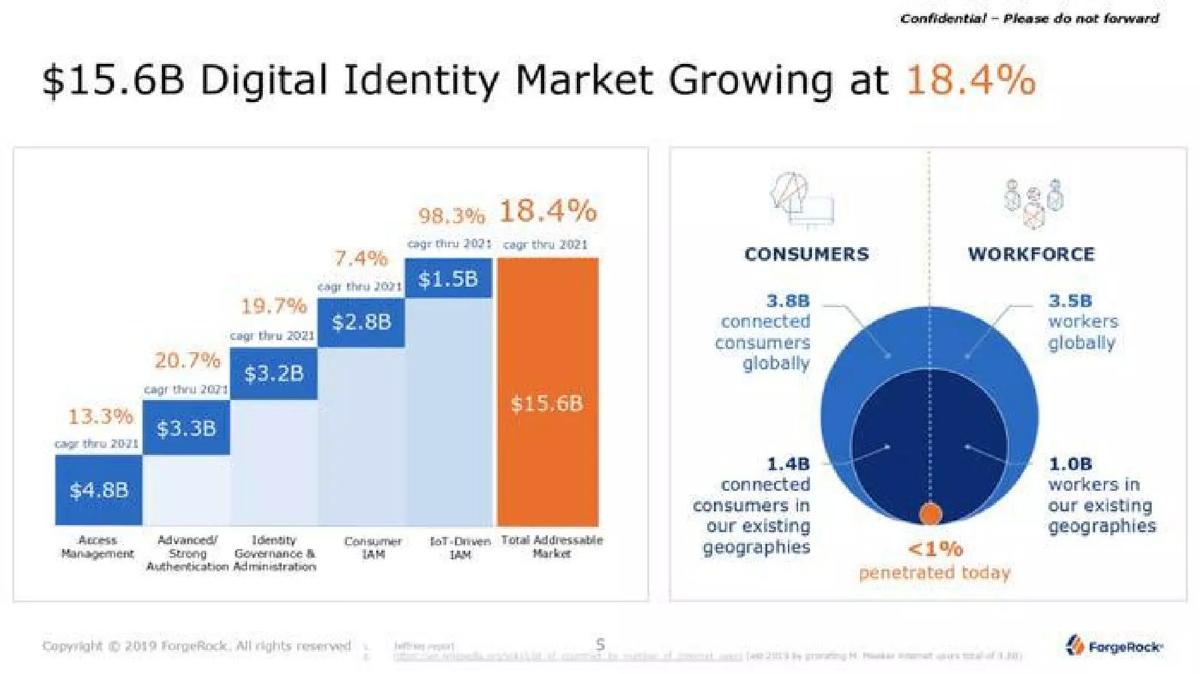
- ForgeRock identifies a $15.6B Total Addressable Market growing at 18.4% annually (slide 5).
- The deck claims a market penetration of less than 1% in their existing geographies despite their scale (slide 5).
- The platform supports four distinct deployment models: On-Premises, Public Cloud, Hybrid/Multi-Cloud, and ForgeRock Identity Cloud (slide 8).
- The 'Trust Network' includes over 80 pre-integrated partner technologies across biometrics, risk management, and proofing (slide 9).
The Late-Stage Authority: ForgeRock’s 2020 Overview
The ForgeRock pitch deck is a distinct departure from the narrative-heavy presentations typical of Seed or Series A startups. By January 2020, ForgeRock was already a titan in the Identity and Access Management (IAM) space. This 9-slide deck is designed to validate a massive scale-up, focusing on high-level metrics, executive pedigree, and market maturity. It is a document intended for institutional investors who are looking for stability, market leadership, and an exit path.
Slide 1: Title and Timing
The cover slide is minimalist, featuring the ForgeRock logo and the title 'The ForgeRock Overview.' The date 'January - February 2020' is significant, as it places the deck just before the global pandemic shifted digital identity into an even higher priority for enterprises. The background uses a blue, data-centric aesthetic that aligns with corporate security branding.
Slide 2: The Executive Summary and Traction
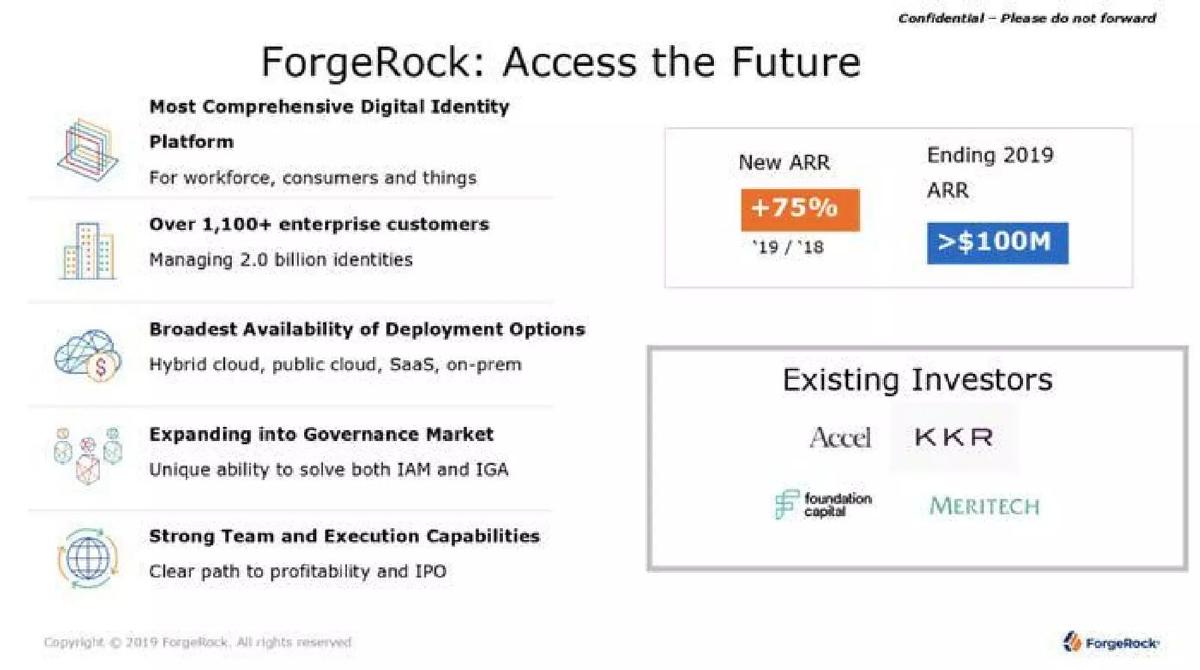
Slide 2 is the most information-dense slide in the deck, serving as a 'TL;DR' for the entire business. It lists five key pillars: a comprehensive platform for workforce and consumers, 1,100+ enterprise customers managing 2.0 billion identities, broad deployment options, expansion into the governance market, and a strong team. Crucially, it highlights two major financial milestones: a 75% growth in new ARR ('19/'18) and an ending 2019 ARR of >$100M. It also lists blue-chip investors Accel, KKR, Foundation Capital, and Meritech, providing immediate social proof. The slide concludes with the strategic intent: a 'clear path to profitability and IPO.'
Slide 3: The Executive Team
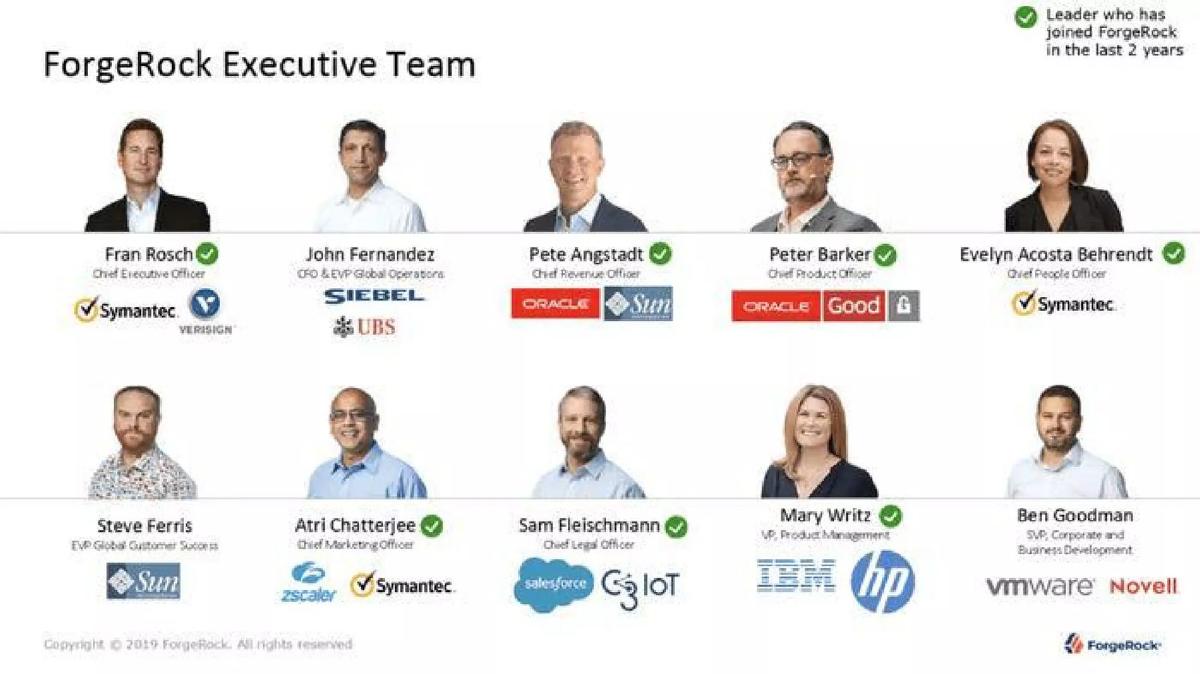
For a company at this stage, the team slide is less about 'founder passion' and more about 'corporate experience.' The slide features ten executives, with a green checkmark indicating those who joined in the last two years. This suggests a deliberate 'professionalization' of the C-suite in preparation for public markets. The logos under each name—Symantec, Oracle, Sun, Salesforce, IBM, and VMware—demonstrate that the company is run by veterans of the exact industry they are disrupting.
Slide 4: The Market Need
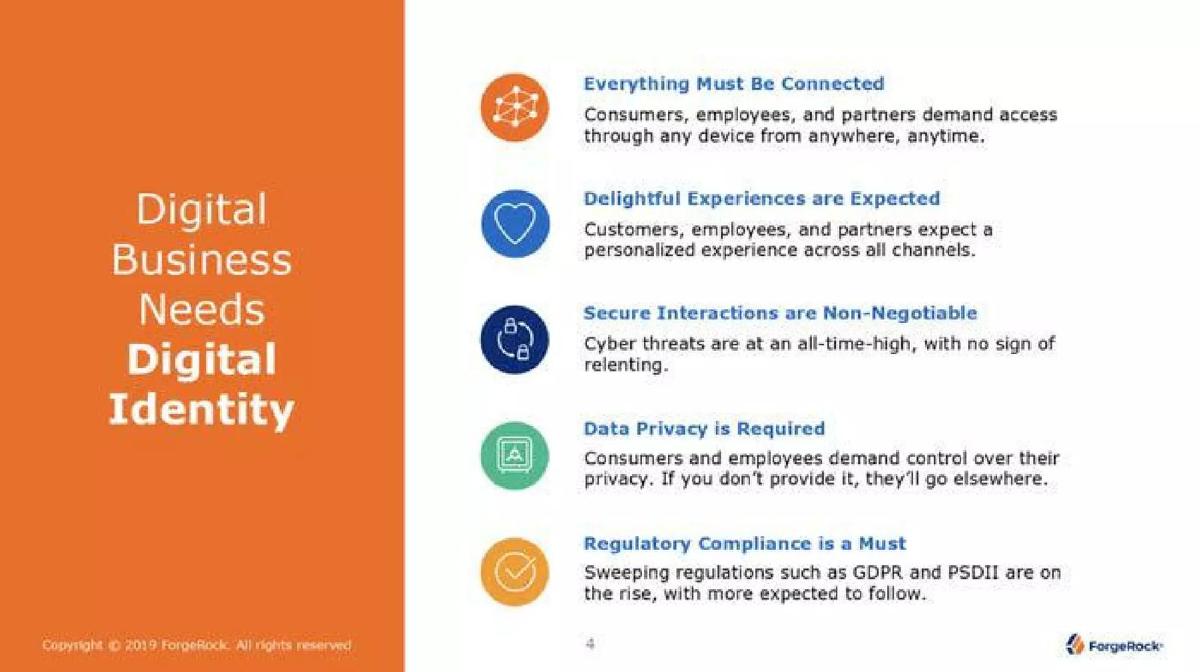
Slide 4 outlines the drivers for digital identity. It lists five requirements: connectivity across all devices, personalized experiences, secure interactions, data privacy, and regulatory compliance (specifically mentioning GDPR and PSD2). This slide serves to align the investor with the current macro environment, framing identity not as a luxury but as a 'non-negotiable' and 'must-have' for modern business.
Slide 5: Market Size and Penetration
This slide quantifies the opportunity. It claims a $15.6B Total Addressable Market growing at 18.4% . The bar chart breaks this down into sub-sectors, with Access Management being the largest at $4.8B. The right side of the slide uses a concentric circle graphic to show that despite having 1.4B connected consumers in their existing geographies, they have penetrated less than 1% of the market today . This is a classic late-stage pitch tactic: showing that despite being a $100M+ ARR company, the 'ceiling' is still miles away.
Slide 6: The 3rd Wave of Identity
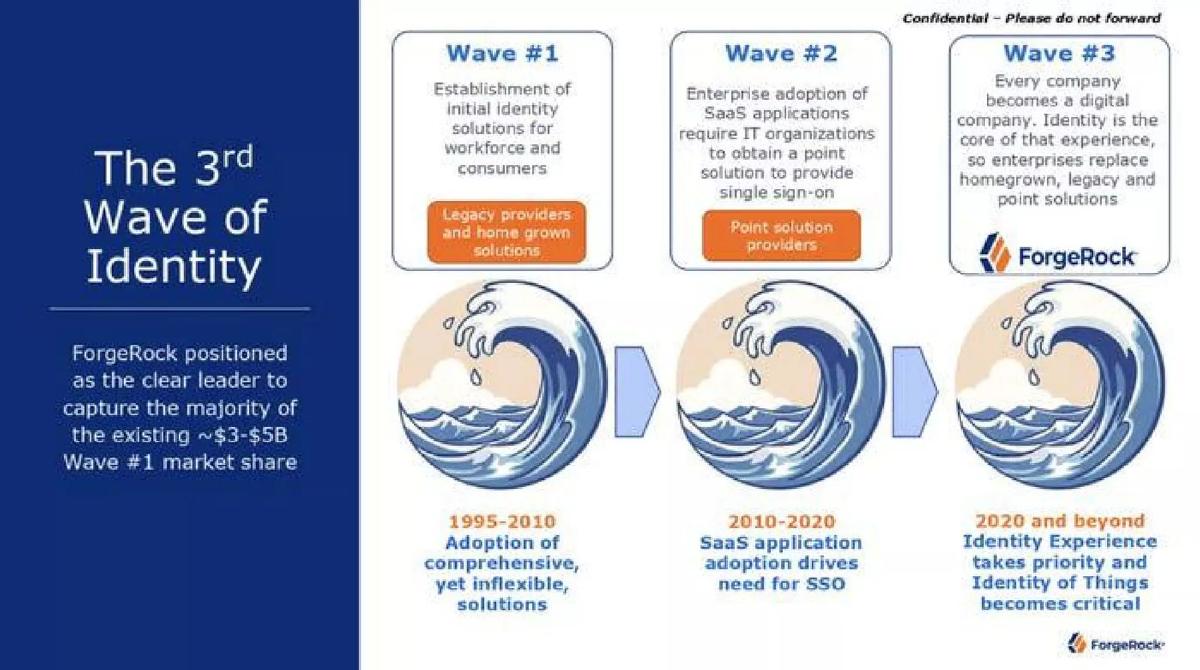
ForgeRock uses a 'Wave' analogy to describe market evolution. Wave 1 (1995-2010) was legacy/homegrown. Wave 2 (2010-2020) was point solutions for SSO. Wave 3 (2020+) is the 'Identity Experience' where ForgeRock claims leadership. This slide attempts to position ForgeRock as the modern alternative to both outdated legacy systems and limited point solutions, specifically targeting a $3-$5B market share currently held by Wave 1 providers .
Slide 7: Game Changing Innovation
This slide focuses on the future product roadmap. It highlights four areas: AI-driven 'Autonomous Identity,' Identity Governance, a Cloud PaaS, and 'ZeroTouch SDKs.' By highlighting AI and Cloud PaaS, ForgeRock is signaling to investors that they are not just maintaining a legacy product but are actively innovating in high-multiple technology areas.
Slide 8: Deployment Flexibility
One of ForgeRock's key differentiators is its deployment versatility. Slide 8 illustrates this with four icons: On-Premises, Public Cloud (AWS, Google Cloud, Azure), Hybrid/Multi-Cloud, and the ForgeRock Identity Cloud. This addresses a major pain point for large enterprises that cannot move entirely to the cloud overnight and require a 'bridge' solution.
Slide 9: The Trust Network
The final slide showcases the ecosystem. A circular 'Trust Network' diagram displays over 80 partner technologies categorized by Identity Proofing, Risk Management, Biometrics, and Strong Authentication. Logos like Symantec, Yubico, and Jumio are visible. This slide communicates that ForgeRock is a platform, not just a tool, and that its value is 'evergreen' because it integrates with the entire security industry.
What Works in the ForgeRock Deck
The deck’s greatest strength is its unapologetic focus on scale . By placing the $100M ARR and 75% growth figures on the very first content slide, they immediately filter for investors who can handle a deal of that magnitude. The use of recognizable corporate logos—both for the executive team’s history and the partner ecosystem—creates a sense of inevitability. The '3rd Wave' narrative is also highly effective; it simplifies a complex technical shift into a logical progression that makes ForgeRock look like the only modern choice for large-scale enterprises.
What is Missing from the ForgeRock Deck
As a late-stage overview, this deck is intentionally high-level, but it leaves several stones unturned. There is no mention of specific competitors like Okta or Ping Identity, which were major rivals at the time. A competitive matrix or 'Why We Win' slide would have been standard. Additionally, the deck omits specific customer case studies . While it mentions 1,100+ customers, it doesn't detail how a specific brand like GEICO or Vodafone uses the platform to save money or increase revenue. Finally, there is no financial forecast or detailed breakdown of gross margins and LTV/CAC, which are usually required for a deep-dive investment analysis.
What a Founder Should Copy
Founders of growth-stage companies should emulate ForgeRock’s clarity of traction . If you have impressive numbers, do not bury them on slide 12; put them on slide 2. The 'Market Penetration' graphic on slide 5 is also a brilliant way to frame a large company as still having 'early-stage' upside. Furthermore, the way they categorized their executive team by their previous 'Big Tech' experience is a powerful way to signal that the company has the 'adults in the room' necessary to go public. Lastly, the 'Trust Network' slide is a great example of how to show you are a platform player rather than a siloed product.
Final Thoughts
The ForgeRock deck is a 'pre-IPO' document. It isn't trying to explain what identity management is; it is trying to prove that ForgeRock is the dominant, most professional, and fastest-growing player in that space. It succeeds by being brief, data-heavy, and focused on the macro trends that justify a multi-billion dollar valuation. For founders, the lesson here is that as your company matures, your deck should move away from 'how it works' and toward 'how big it can get.'
Frequently asked questions
- What is the primary value proposition of ForgeRock according to the deck?
- ForgeRock positions itself as the most comprehensive digital identity platform capable of serving workforce, consumers, and 'things' (IoT). Slide 2 emphasizes their ability to solve both Identity and Access Management (IAM) and Identity Governance and Administration (IGA), offering the broadest availability of deployment options including hybrid, public cloud, SaaS, and on-premises.
- How does ForgeRock justify its market opportunity?
- On slide 5, the company breaks down a $15.6B Total Addressable Market. They segment this into Access Management ($4.8B), Advanced Authentication ($3.3B), Identity Governance ($3.2B), Consumer IAM ($2.8B), and IoT-Driven IAM ($1.5B). They argue that despite their $100M+ ARR, they have penetrated less than 1% of the potential market in their current geographies.
- Who are the key people leading ForgeRock?
- The team is led by CEO Fran Rosch (formerly of Symantec and Verisign). Other key executives include CFO John Fernandez (Siebel, UBS), CRO Pete Angstadt (Oracle, Sun), and CPO Peter Barker (Oracle, Good). Slide 3 highlights that many of these leaders joined within the two years prior to the deck, suggesting a leadership refresh for the scale-up phase.
- What is the '3rd Wave of Identity' mentioned in the deck?
- Slide 6 defines the market evolution in three stages. Wave 1 (1995-2010) was about inflexible legacy solutions. Wave 2 (2010-2020) was driven by SaaS and point solutions for SSO. Wave 3 (2020 and beyond) focuses on 'Identity Experience' and the 'Identity of Things,' where ForgeRock aims to replace homegrown and legacy systems.
- Does the deck mention any specific financial goals or an 'Ask'?
- The deck does not include a specific 'Ask' slide or a dollar amount for a funding round. However, slide 2 explicitly states there is a 'clear path to profitability and IPO.' This suggests the deck was used for late-stage strategic discussions or a pre-IPO mezzanine round rather than an early-stage capital raise.