Fortanix's Series C deck is a masterclass in establishing enterprise credibility through institutional validation. By the second slide, the company has already listed 125+ customers including PayPal, Google, and the CDC, alongside a heavy-hitting investor roster featuring Intel Capital and Foundation Capital. The deck shifts the security narrative from protecting infrastructure to protecting data itself, leveraging their 'Confidential Computing' technology. While the deck is light on specific financial unit economics or a detailed use-of-funds breakdown, it compensates with massive momentum i…
Key takeaways
- The company claims a 522% three-year growth trajectory and a 70% year-over-year increase in personnel to 225+ employees (Slide 13).
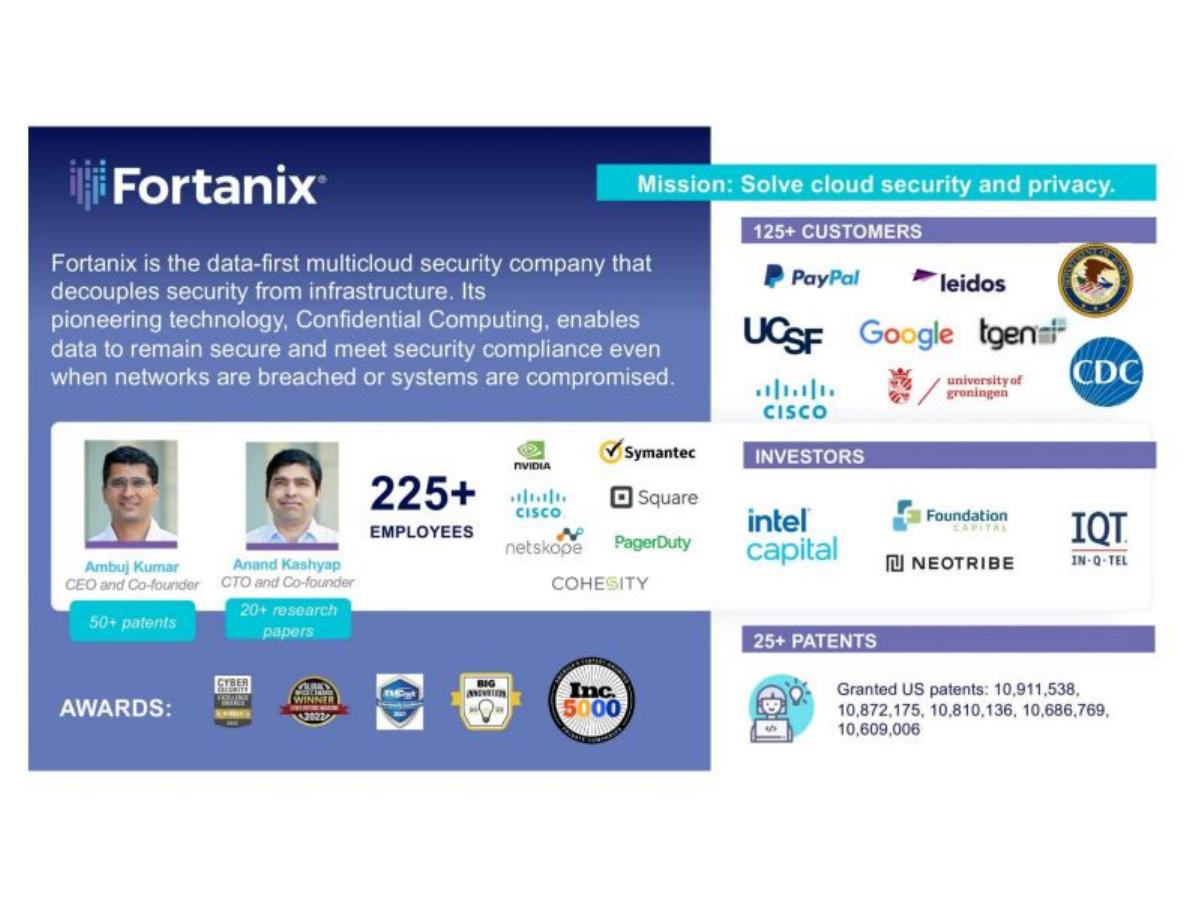
- Fortanix emphasizes its intellectual property moat by listing 25+ patents, specifically citing five granted US patent numbers (Slide 2).
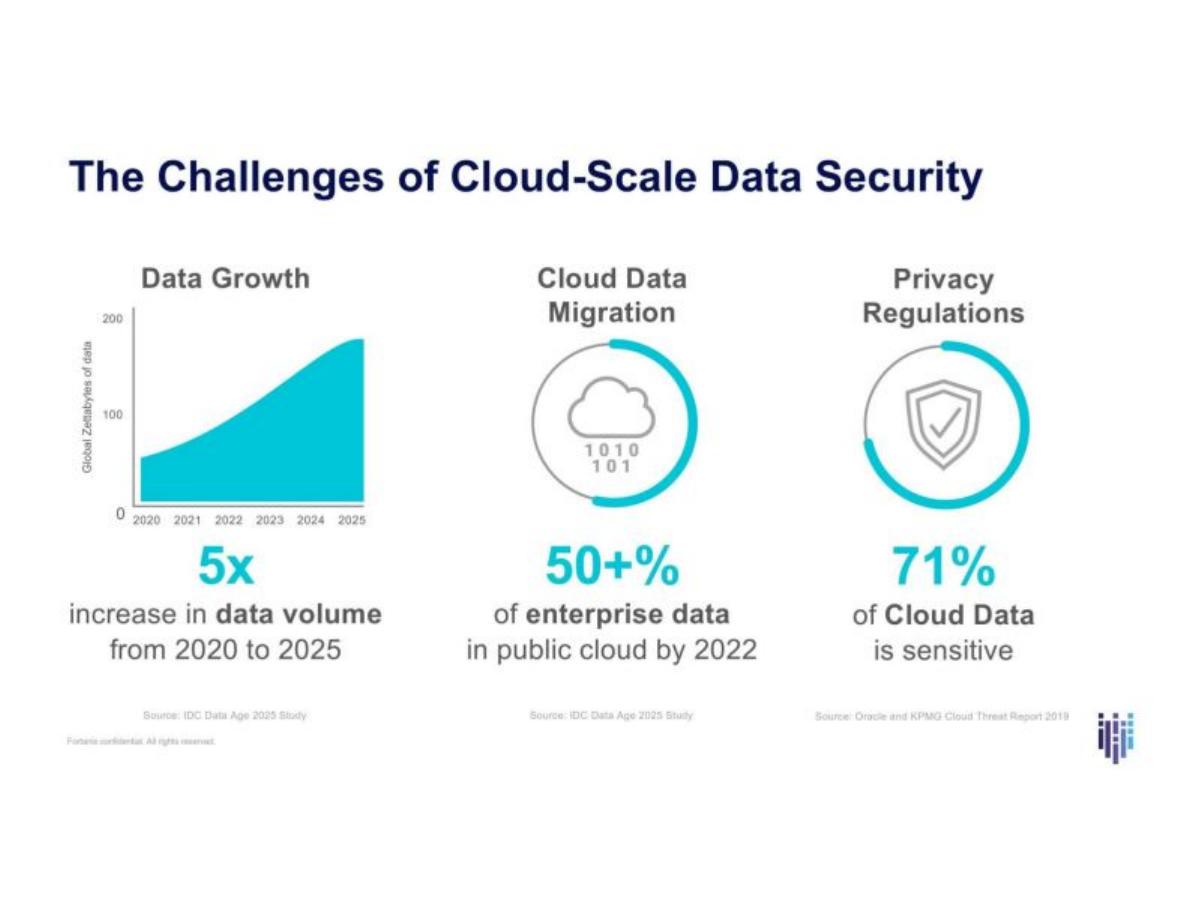
- The deck identifies a massive market tailwind, citing a 5x increase in data volume from 2020 to 2025 (Slide 3).
- Strategic validation is central to the pitch, noting Intel as a strategic investor and launch partner for Intel SGX (Slide 12).
- The product architecture slide shows a comprehensive 'Data Security Manager' that integrates with major platforms like AWS, Azure, and Salesforce (Slide 9).
- The company positions itself as a pioneer in 'Confidential Computing,' claiming all major cloud providers are partners (Slide 7).
- Global reach is demonstrated through a map of service regions across the Americas, EMEA, and Asia-Pacific (Slide 10).
- The deck lacks a specific 'Ask' slide detailing the exact dollar amount or valuation sought for the Series C round.
Executive Summary: The Power of Institutional Validation
The Fortanix Series C pitch deck is a high-density document that prioritizes credibility over storytelling. For a company operating in the deep-tech cybersecurity space, particularly one specializing in 'Confidential Computing,' the primary hurdle is proving that the technology works at scale and is trusted by the 'gatekeepers' of data. Fortanix achieves this by front-loading the deck with logos of the world's most sensitive organizations, from the CDC to the Department of Justice.
Slide 1: Title and Accolades
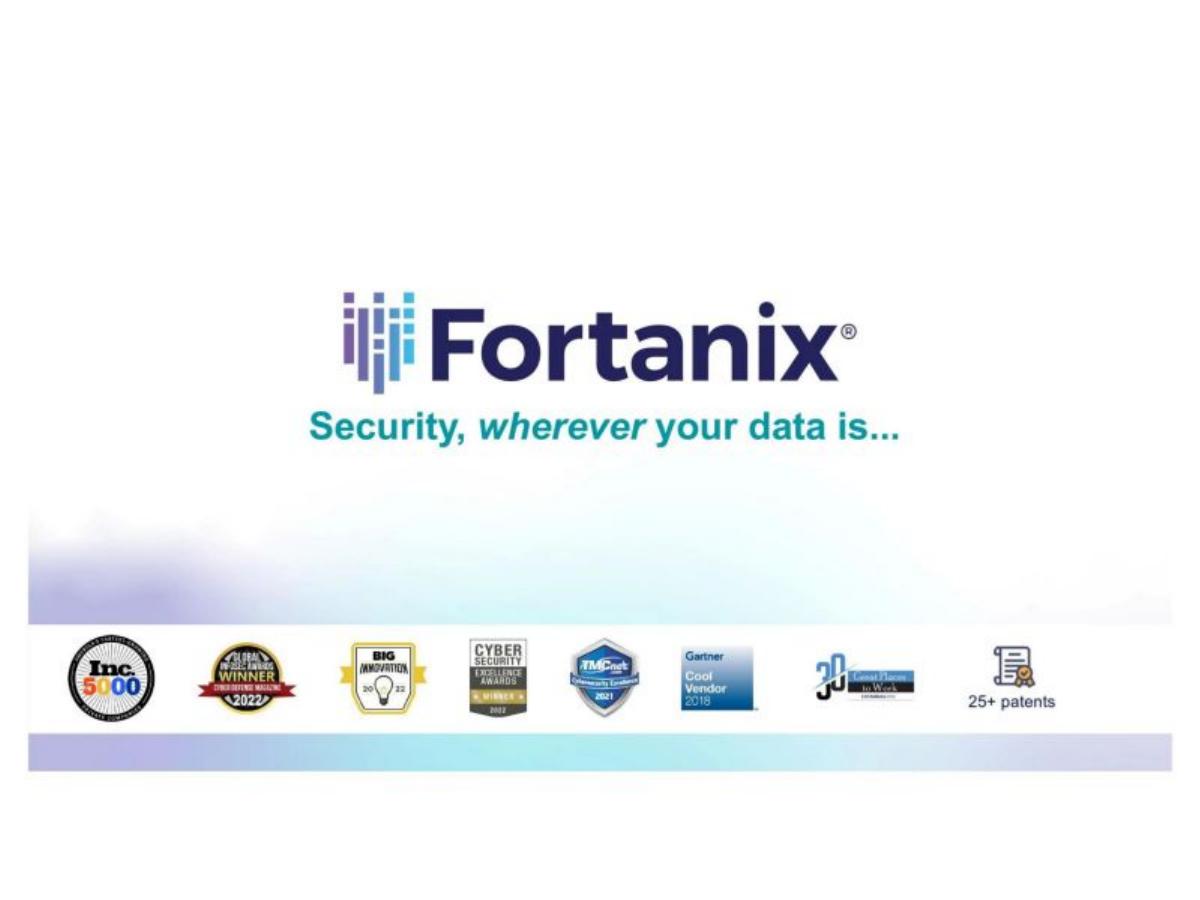
The cover slide sets the tone immediately. Beyond the logo and the tagline 'Security, wherever your data is...', the bottom of the slide is lined with eight industry awards and recognition badges. These include the Inc. 5000, Global InfoSec Award 2022, and Gartner Cool Vendor 2018. The inclusion of '25+ patents' on the cover slide signals that this is an IP-heavy play, which is critical for a Series C valuation.
Slide 2: The 'Everything' Slide
Slide 2 is an information-dense overview that could almost stand alone as a one-pager. It defines the mission ('Solve cloud security and privacy') and introduces the founders, Ambuj Kumar and Anand Kashyap. The slide lists 125+ customers, featuring massive logos like PayPal, Google, Cisco, and Leidos. It also highlights their investor base, including Intel Capital and In-Q-Tel. By listing specific patent numbers (e.g., 10,911,538), they move past vague claims of 'proprietary tech' into verifiable legal assets.
Slide 3: The Challenges of Cloud-Scale Data Security
This slide establishes the 'Why Now?' using three pillars: Data Growth, Cloud Data Migration, and Privacy Regulations. It cites a 5x increase in data volume from 2020 to 2025 and notes that 71% of cloud data is sensitive. This frames the problem not as a niche security concern, but as a systemic risk to the modern enterprise.
Slide 4: Risk Landscape: Data Privacy Regulations
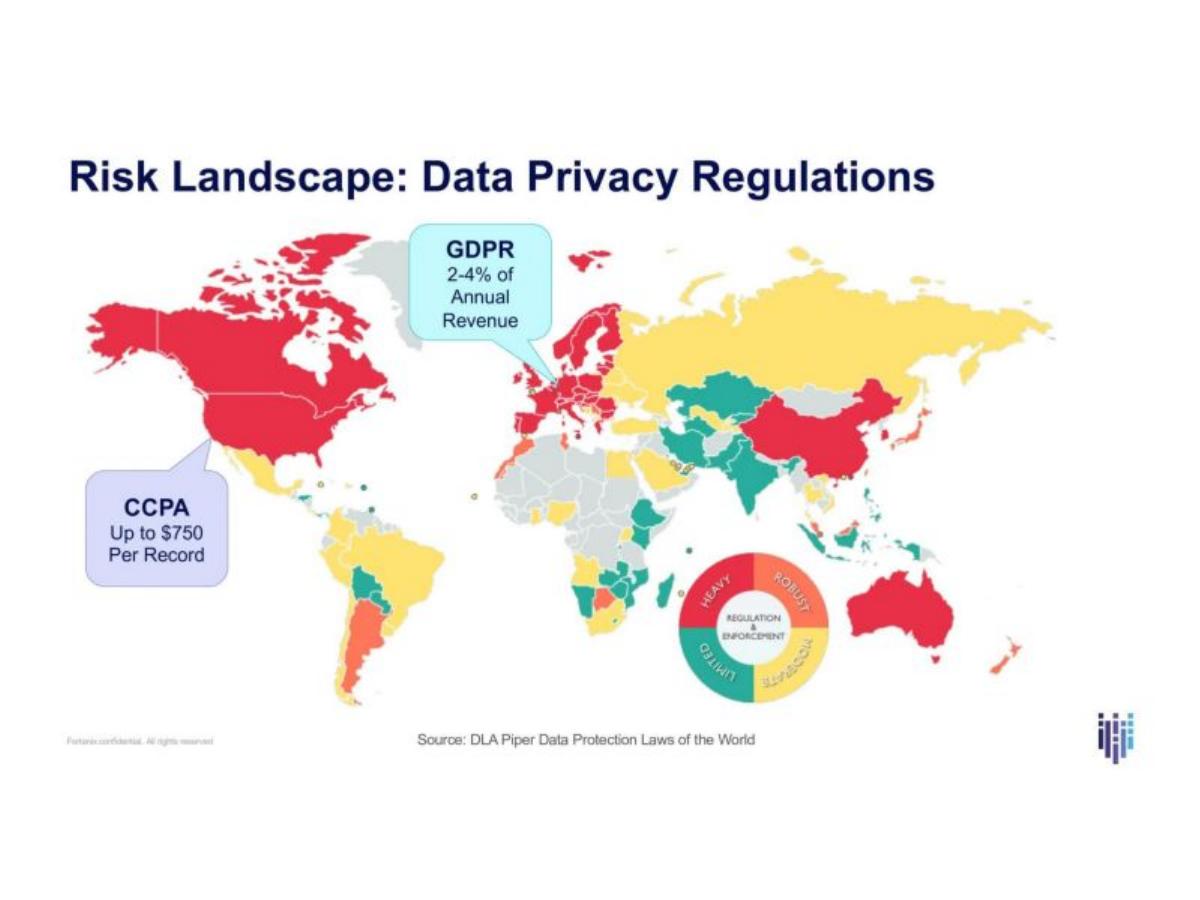
Fortanix uses a heat map of the world to show the 'Robust' and 'Heavy' regulation environments. They specifically call out the financial penalties for non-compliance: 2-4% of annual revenue for GDPR and up to $750 per record for CCPA. This translates the technical problem of data security into a direct bottom-line risk for a Chief Financial Officer or General Counsel.
Slide 5: Data-first Security Evolution
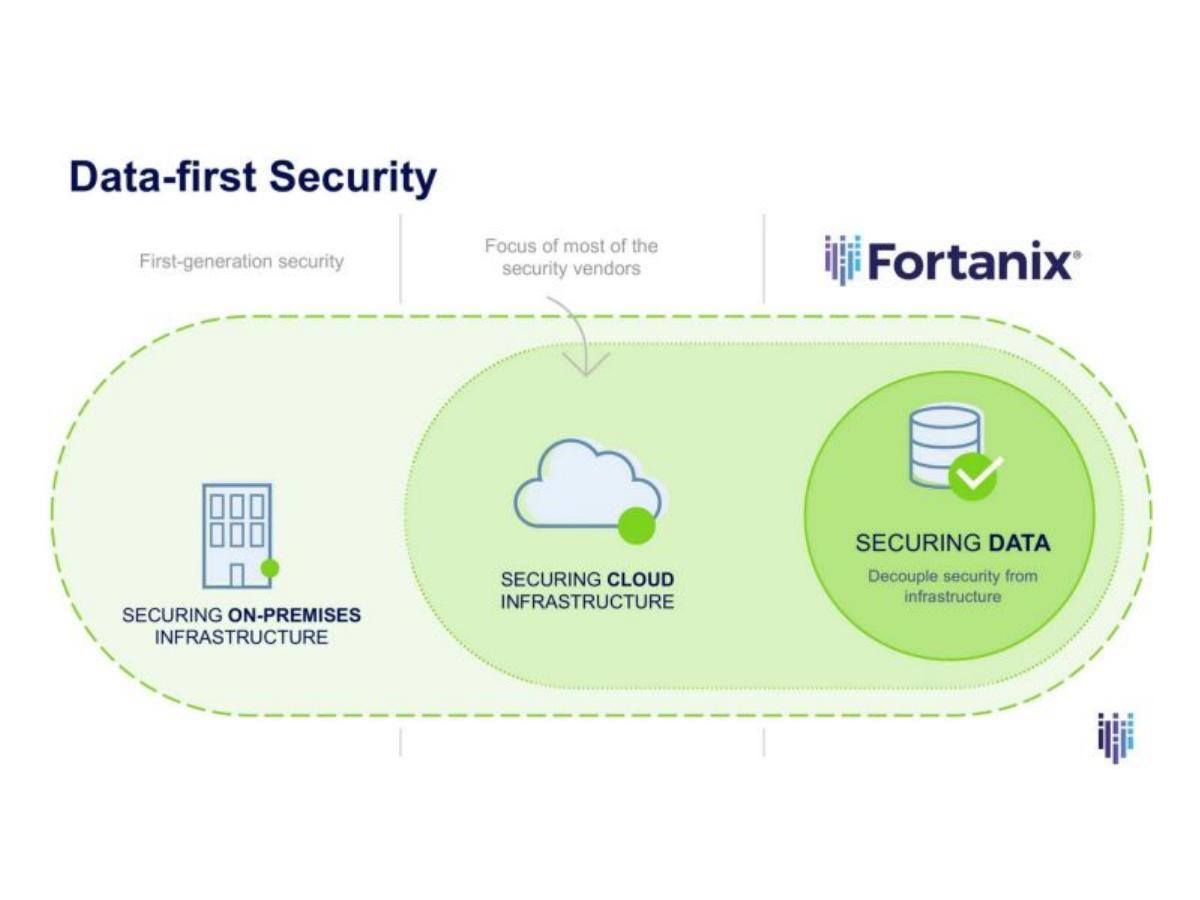
This is the conceptual heart of the deck. It visualizes the shift from 'First-generation security' (on-premises) to 'Cloud Infrastructure' security, and finally to Fortanix's 'Securing Data' approach. The key phrase here is 'Decouple security from infrastructure,' which suggests that even if the cloud provider is compromised, the data remains safe.
Slide 6: The 'Even When' Value Proposition
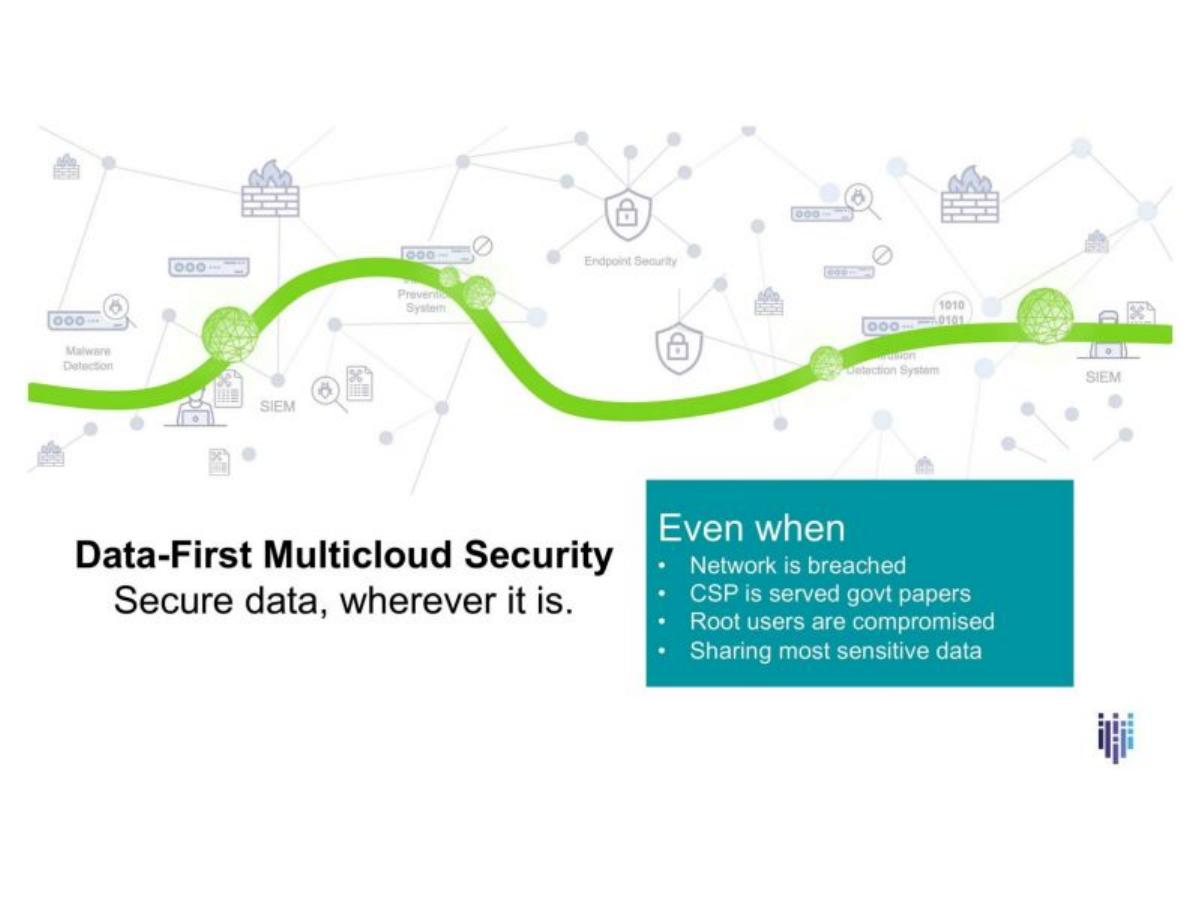
Slide 6 uses a network diagram to show how Fortanix protects data 'Even when' the network is breached, the Cloud Service Provider (CSP) is served government papers, or root users are compromised. This is a bold claim that addresses the 'insider threat' and 'subpoena risk' that many enterprises fear when moving to the cloud.
Slide 7: Confidential Computing Leadership
Fortanix claims the title of 'pioneer and leading vendor of Confidential Computing.' This slide reinforces their partnership with all major cloud providers (Intel, Microsoft, Google, AWS, VMware, Red Hat). It repeats the patent count, emphasizing the 20+ pending patents, which suggests ongoing R&D and a widening moat.
Slide 8: Centralized Control Visualization
This slide shows a laptop running the Fortanix interface, with a large arrow pointing toward a cloud of logos including Salesforce, Oracle, Snowflake, and SAP. The message is simple: one dashboard to control data across all third-party SaaS and database environments.
Slide 9: Fortanix Data Security Manager (DSM)
This is the technical architecture slide. It breaks down the 'Functions' (Key Management, Encryption, Tokenization, Secrets Management) and the 'Interfaces' (REST API, PKCS#11, etc.). It shows how the DSM sits between applications/HSMs and enterprise tools like SIEM and SSO. This slide is likely intended for the technical due diligence team at a VC firm.
Slide 10: Global Service - Multiple Regions
To serve global enterprises, a security company must have global infrastructure. This map shows Equinix locations and partner data centers across the Americas, EMEA, and APAC. It lists specific cities like Chicago, London, Amsterdam, and Singapore, proving they can meet data residency requirements worldwide.
Slide 11: Fortanix Confidential AI
Recognizing the 2022 trend toward AI, this slide introduces a SaaS platform for performing AI on sensitive data. It mentions support for tabular data (Gradient Boost, Random Forest) and images (PyTorch). This positions Fortanix as an enabler for the next wave of enterprise innovation, not just a defensive tool.
Slide 12: Key Strategic Partners
This slide provides deeper detail on their relationships with the 'Big Three' clouds and Intel. It notes that Fortanix was the launch partner for Intel SGX and is the lead partner for Google Cloud's EKMS service. These aren't just 'marketplace listings'; they are deep technical integrations that would be difficult for a competitor to displace.
Slide 13: Strong Momentum
The penultimate slide delivers the 'hard' growth metrics. The 522% three-year growth trajectory is the headline figure. They also mention a 70% Y/Y increase in personnel and the hiring of new C-suite executives (VP of Legal, CRO, CMO). This signals that the company is 'scaling up' its go-to-market engine, which is exactly what Series C capital is typically used for.
Slide 14: Closing
A standard closing slide with the logo and a 'confidential' footer. It lacks a call to action or contact information, which is common in decks shared after an initial meeting.
What Works in This Deck
Institutional Credibility: The sheer volume of high-tier logos (Intel, Google, DOJ, PayPal) makes it very difficult for an investor to dismiss the technology. If these organizations have vetted and deployed Fortanix, the 'technical risk' is effectively off the table.
Clear Categorization: The deck does an excellent job of defining a new category ('Confidential Computing') and then positioning Fortanix as the undisputed leader of that category. By framing the evolution of security (Slide 5), they make their approach seem like the inevitable next step in the industry.
IP Moat: By listing specific patent numbers, Fortanix appeals to the 'defensibility' requirement of late-stage VCs. In a crowded cybersecurity market, showing a deep, granted patent portfolio is a significant advantage.
What Is Missing
The Ask: There is no slide detailing how much money is being raised or how it will be spent. While the catalogue listing says $90M, the deck itself is silent on the terms. This suggests the deck was used as a general 'Company Overview' for late-stage investors rather than a cold pitch.
Unit Economics: For a Series C round, investors usually want to see LTV/CAC ratios, churn rates, and net revenue retention (NRR). While '522% growth' is impressive, it doesn't tell the story of capital efficiency or the health of the underlying SaaS business.
Competitive Landscape: The deck mentions partners, but it doesn't explicitly show a competitor matrix. It assumes the reader agrees that 'Confidential Computing' is a unique category where Fortanix has no direct peers, which is a bold assumption in the fast-moving security space.
What Founders Should Copy
The 'Even When' Slide: Slide 6 is a brilliant way to communicate a value proposition. Instead of listing features, it lists the catastrophic scenarios that the product mitigates. This is highly effective for selling 'peace of mind' in the enterprise space.
Strategic Partner Deep-Dives: Slide 12 goes beyond just showing logos. It explains why the partnership matters (e.g., 'Launch partner for Intel SGX'). Founders should always explain the depth of their partnerships to prove they aren't just 'integrated' but are 'essential' to the partner's ecosystem.
Translating Tech to Risk: Slide 4's use of regulatory fines (2-4% of revenue) is a perfect example of how to turn a technical feature (data encryption) into a business necessity. Founders should always look for the 'dollar cost of the problem' to motivate investors.
Frequently asked questions
- How much did Fortanix raise with this deck?
- According to the catalogue listing, Fortanix raised $90M in a Series C round in 2022. The deck itself focuses on momentum and technology rather than the specific terms of the raise, which is common for late-stage companies where the lead investor is often already secured or in deep due diligence.
- Who are the key investors in Fortanix?
- Slide 2 and the catalogue listing identify a high-profile group of investors including Goldman Sachs Asset Management, Intel Capital, Foundation Capital, Neotribe Ventures, GiantLeap Capital, and In-Q-Tel (the investment arm of the CIA). This mix of traditional VC, corporate VC, and government-linked funds reinforces their security credentials.
- What is the core technology value proposition?
- Fortanix pitches 'Data-first Security.' As shown on Slide 5, they argue that while previous generations focused on on-premises or cloud infrastructure, Fortanix 'decouples security from infrastructure.' Their 'Confidential Computing' allows data to remain encrypted even while in use, protecting it even if the network or root users are compromised (Slide 6).
- What market problems does the deck address?
- Slide 3 and Slide 4 highlight three primary pressures: exponential data growth (5x by 2025), the migration of 50%+ of enterprise data to the public cloud, and tightening global regulations like GDPR (2-4% of annual revenue fines) and CCPA ($750 per record).
- Is there a team slide in the Fortanix deck?
- Yes, Slide 2 functions as a combined 'Company at a Glance' and team slide. It features CEO Ambuj Kumar (50+ patents) and CTO Anand Kashyap (20+ research papers). Slide 13 also mentions recent executive additions, including a VP of Legal, CRO, and CMO, signaling a transition from a purely technical team to a commercial scale-up team.