Forklyft presents a three-sided marketplace connecting social media influencers, consumers, and grocery retailers. The deck positions the company as a solution to the friction between seeing a recipe online and purchasing the specific ingredients needed to make it. By leveraging the high conversion rates of 'Foodies' and 'Mom Bloggers,' Forklyft proposes a model where influencers earn a 10% commission on grocery sales driven through the app. The deck relies heavily on industry analogies, specifically citing the success of fashion apps like LiketoKnow.it, to validate the shoppable content tren…
Key takeaways
- The platform targets three distinct personas: users who want to shop recipes, influencers seeking monetization, and retailers like InstaCart and Amazon PrimeNow (Slide 2).
- Influencers are promised a 10% commission from retailers for purchases made through their recipe links (Slide 35).
- The deck cites that 94% of consumers buy new food ingredients based on recipes seen on social media (Slide 3).
- Forklyft explicitly models its business after fashion industry successes, comparing itself to LiketoKnow.it and ScreenShop (Slide 4).
- The long-term vision involves evolving from a tool into an independent food and recipe content producer with dedicated chefs (Slide 5).
- Target market analysis focuses on Amazon's top-selling food cities, identifying New York, Seattle, and Los Angeles as primary rollout locations (Slide 8).
- Blue Apron is analyzed as a competitor or industry benchmark, noting their 34% customer acquisition rate from referrals (Slide 7).
- The influencer workflow requires creators to link each ingredient to a specific retailer page to enable the shoppable functionality (Slide 35).
Executive Summary
Forklyft is a social commerce platform designed to bridge the gap between food influencers and grocery retailers. The deck positions the company as the 'LiketoKnow.it for food,' leveraging the massive volume of food-related content on Instagram to drive direct sales for grocery delivery services. The following teardown analyzes the strategic positioning, market data, and operational flow presented in their 39-slide deck.
Slide 1: Title and Contact
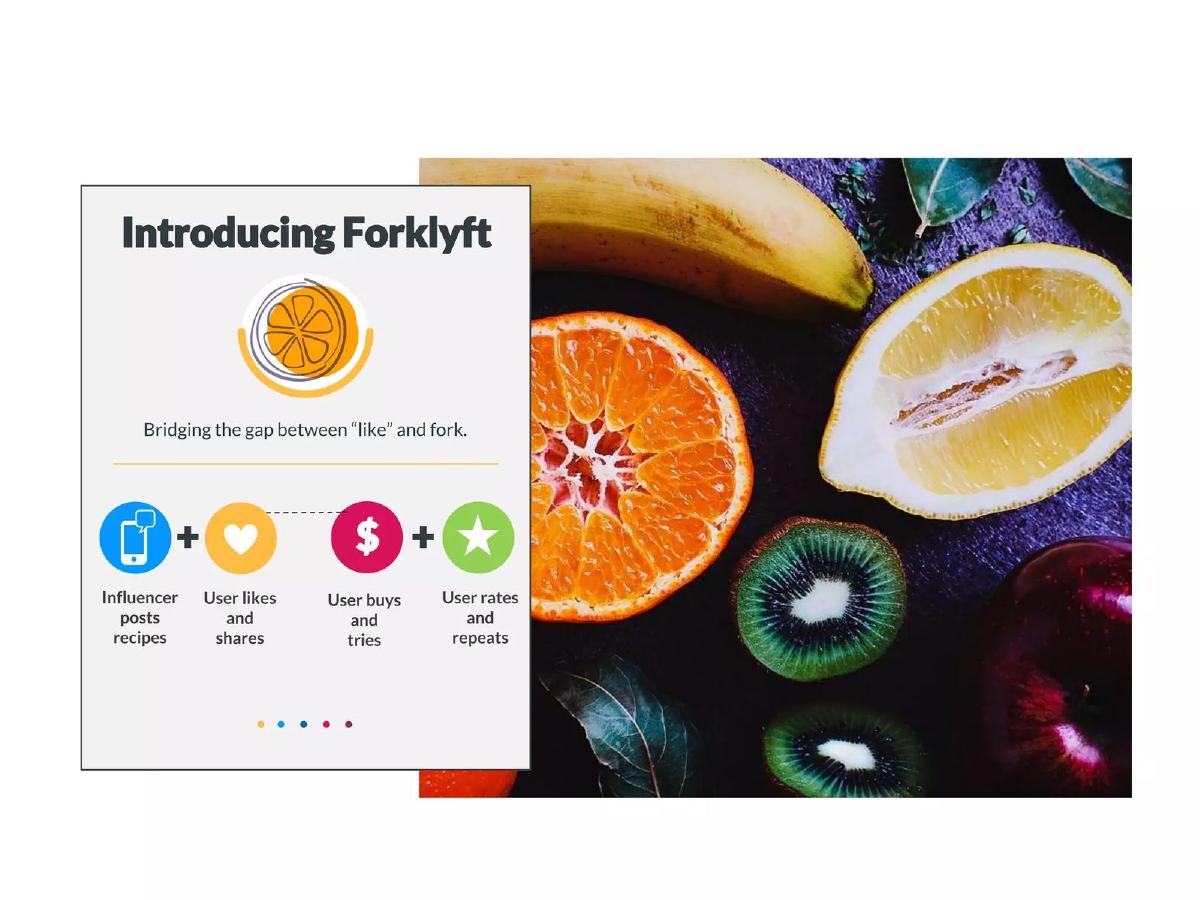
The cover slide introduces the brand name, Forklyft, accompanied by a forklift icon carrying a crate of food. The tagline, Taking Online Recipes From "Like" to Fork , clearly communicates the value proposition of moving from social media engagement to physical consumption. The slide includes a Philadelphia address and a Gmail contact address, suggesting an early-stage or pre-seed status at the time of the deck's creation.
Slide 2: What is Forklyft?
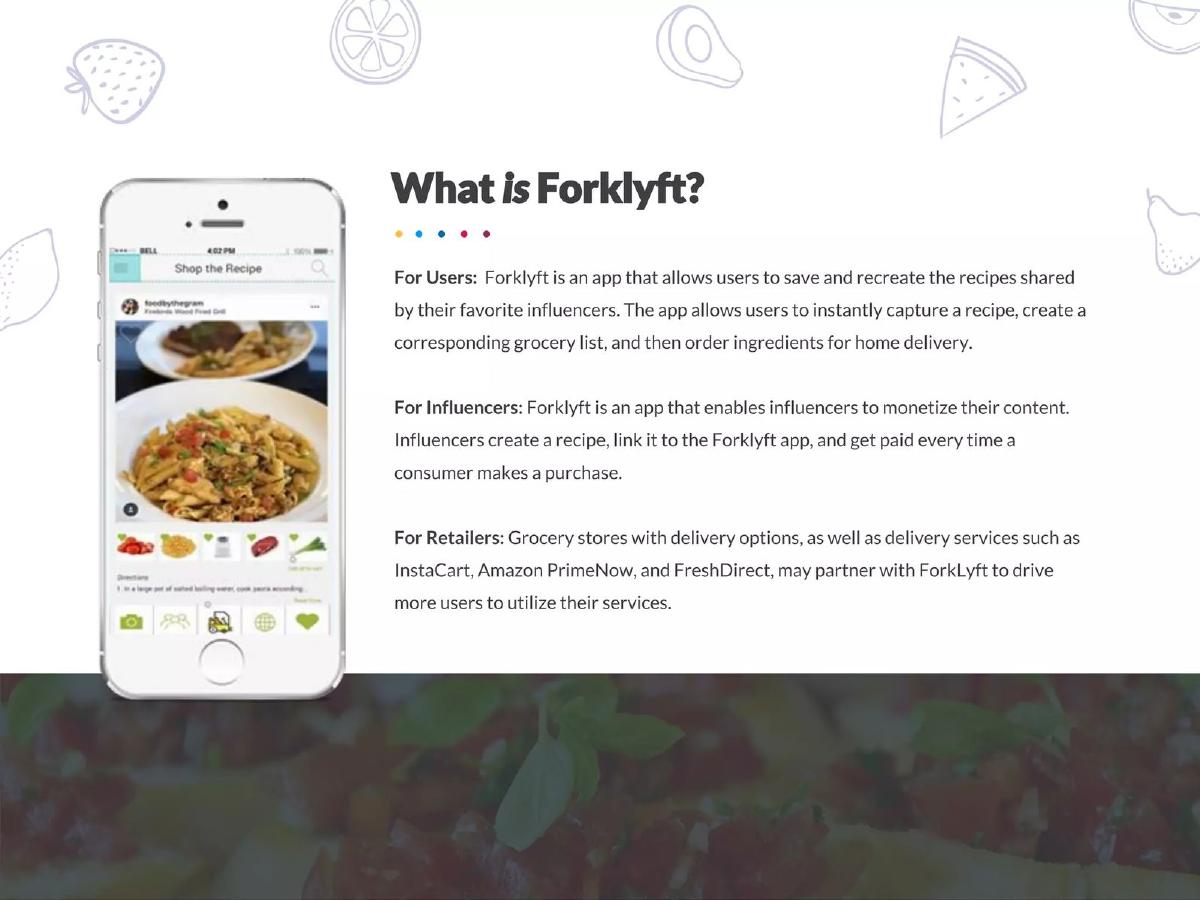
This slide breaks down the value proposition for three key stakeholders. For Users , it is a tool to save recipes and order ingredients for home delivery. For Influencers , it is a monetization engine that pays them when consumers make a purchase. For Retailers (specifically naming InstaCart, Amazon PrimeNow, and FreshDirect), it is a customer acquisition channel. The inclusion of a mobile mockup shows a recipe feed with shoppable ingredient icons at the bottom.
Slide 3: Market Validation - Food Influencers
Forklyft uses this slide to establish the 'Why Now?' factor. It claims companies earn $7.65 on average for every $1 spent on influencer marketing. The slide highlights that 94% of consumers buy new food ingredients based on social media recipes and that 60% of women cite social media as the main driving force for grocery shopping. It also notes the scale of the market with over 301 million #food posts and 176 million #foodporn posts on Instagram.
Slide 4: The Fashion Model Analogy
To prove the viability of shoppable content, Forklyft points to the fashion industry. They cite LiketoKnow.it (1.8M+ users) and ScreenShop (100k+ users) as successful precursors. A quote from Forbes reinforces the idea that social media platforms are evolving into sales platforms by creating seamless purchase interfaces. This is a classic 'X for Y' strategy, attempting to de-risk the investment by showing the model works in an adjacent vertical.
Slide 5: The Forklyft Brand and Evolution
This slide outlines the brand's function to 'actionize' recipes. It lists key differentiators: no subscription, less waste, and community. Most notably, it shares a future vision under Evolution : Forklyft intends to become an independent content producer with dedicated chefs and influencers promoting brands directly. This suggests the founders see the current app as a wedge into a larger media and data play.
Slide 6: Transition Slide
A simple 'Thank You' slide that repeats the core mission: 'Forklyft is [the] only app that magically transforms food influencer recipes into meals made at home.' While labeled as a thank you, in the context of a 39-slide deck, this likely serves as a transition between the pitch and the deep-dive appendix or industry analysis sections.
Slide 7: Industry Analysis - Blue Apron
The deck analyzes Blue Apron's digital strategy, noting their 2 million+ Facebook likes and their reliance on referrals, which represented 14.75% of marketing spend but 34% of customers in Q1 2017. By highlighting Blue Apron's high customer acquisition costs and referral success, Forklyft positions itself as a more efficient, influencer-led alternative that taps into existing social communities rather than buying expensive display ads.
Slide 8: Target Market Analysis
Using a map of 'Amazon's Top Selling Markets for Food,' Forklyft identifies its initial rollout targets. The top six cities are New York, Seattle, Los Angeles, Brooklyn, San Francisco, and Chicago . This data-driven approach shows the founders are targeting high-density areas where grocery delivery infrastructure is already mature and consumer behavior is already aligned with their service.
Slide 35: Process Model - Influencer Experience
This is a highly technical flow chart detailing how an influencer interacts with the app. Key steps include: uploading a recipe image, adding step-by-step directions, and linking each ingredient to a specific retailer page . The system then adds tracking links. The loop concludes with the influencer receiving a 10% commission from the retailer via 'DD' (likely Direct Deposit). This slide is crucial as it explains the manual effort required by influencers to make the content 'shoppable.'
Slide 39: Marketing Personas - Retailers
The final slide focuses on the Retailer persona, using FreshDirect as the example. It notes FreshDirect's annual revenue of $100.2M+ and their goal to overcome consumer distrust regarding food quality. Forklyft positions itself as a partner that can provide 'higher visibility on social' and 'repeat customers' for these retailers. The slide identifies the retailer's motivation as increasing market share and catering to last-minute shoppers.
What Works in This Deck
Clear Analogy: Comparing the business to LiketoKnow.it immediately helps an investor understand the mechanics of the platform without needing a complex technical explanation. · Three-Sided Value: The deck clearly articulates why a user, an influencer, and a retailer would all want to participate, which is essential for a marketplace business. · Data-Backed Targeting: Using Amazon's top-selling food cities to justify a rollout strategy shows a logical approach to geographic expansion. · Detailed Operations: Slide 35 removes the 'magic' from the pitch by showing exactly how the data is entered and how the commission is tracked.
What Is Missing
The Funding Ask: None of the provided slides state how much capital the company is seeking or how they intend to use the funds. · Team Slide: There is no information regarding the founders' backgrounds, technical expertise, or prior experience in the food or social media industries. · Unit Economics: While a 10% commission is mentioned, there is no data on the expected Average Order Value (AOV) or the platform's net margin after paying the influencer. · Traction Metrics: The deck relies on industry-wide stats (e.g., Blue Apron's revenue) rather than Forklyft's own pilot data, user growth, or signed letters of intent (LOIs) from retailers.
Founder Takeaways
Use 'X for Y' Wisely: Forklyft's use of the fashion industry comparison is a strong way to validate a new behavior (shopping via social media) by showing it has already reached scale in a different category. · Define the Loop: The process model on Slide 35 is a great example of showing the 'plumbing' of a startup. Investors want to see that you have thought through the manual steps required to make the user experience feel 'magical.' · Identify the Wedge: By starting as a tool for influencers and planning to evolve into a content producer, Forklyft shows they have a vision beyond just being a utility app. · Address the Friction: The deck acknowledges that influencers must manually link ingredients. A modern founder should explain how AI or computer vision might eventually automate this to reduce friction for the creators.
Frequently asked questions
- How does Forklyft generate revenue according to the deck?
- The deck outlines a commission-based model. On slide 35, the process flow indicates that influencers receive a 10% commission from the retailer for purchases made through the app. While it does not explicitly state the platform's take-rate, it implies a revenue-share agreement with grocery retailers like FreshDirect or InstaCart based on driven sales volume.
- What is the primary problem Forklyft is solving?
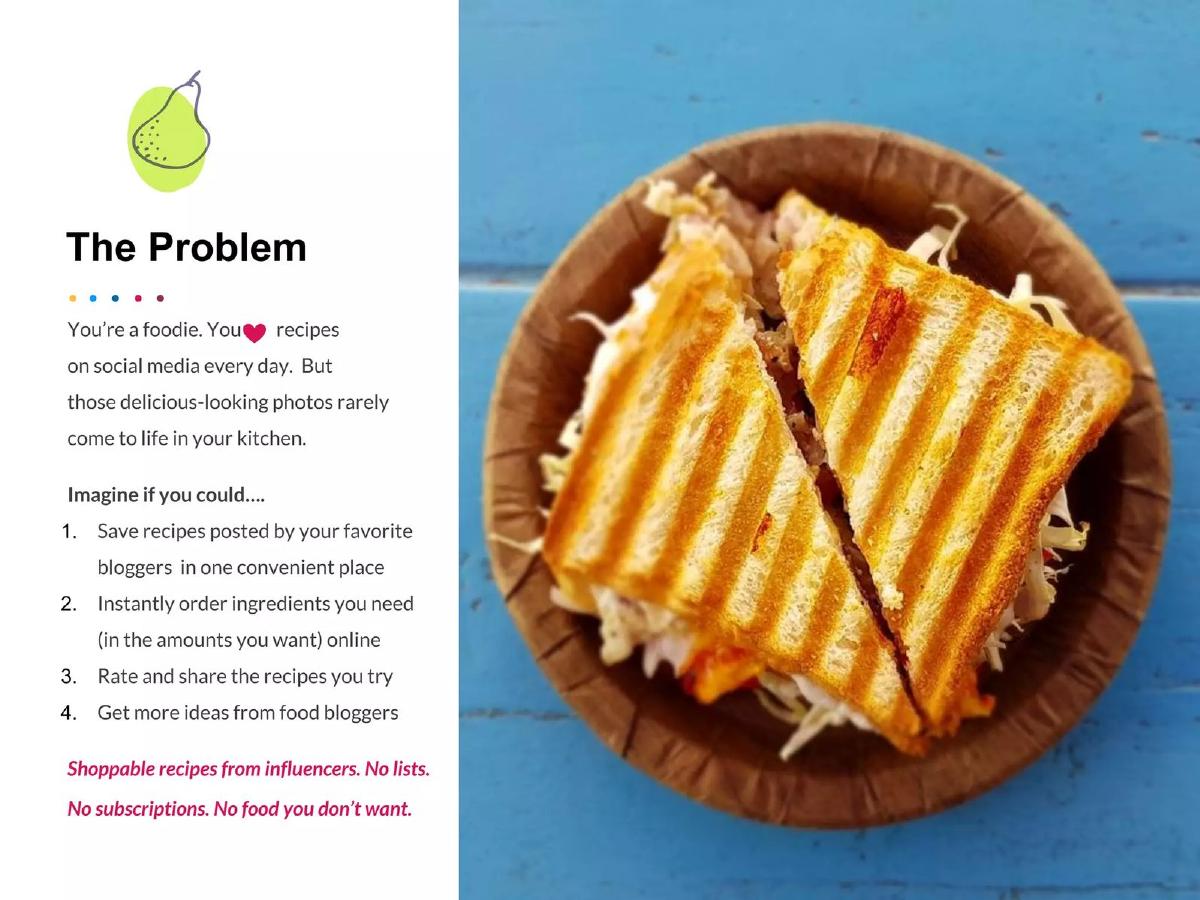
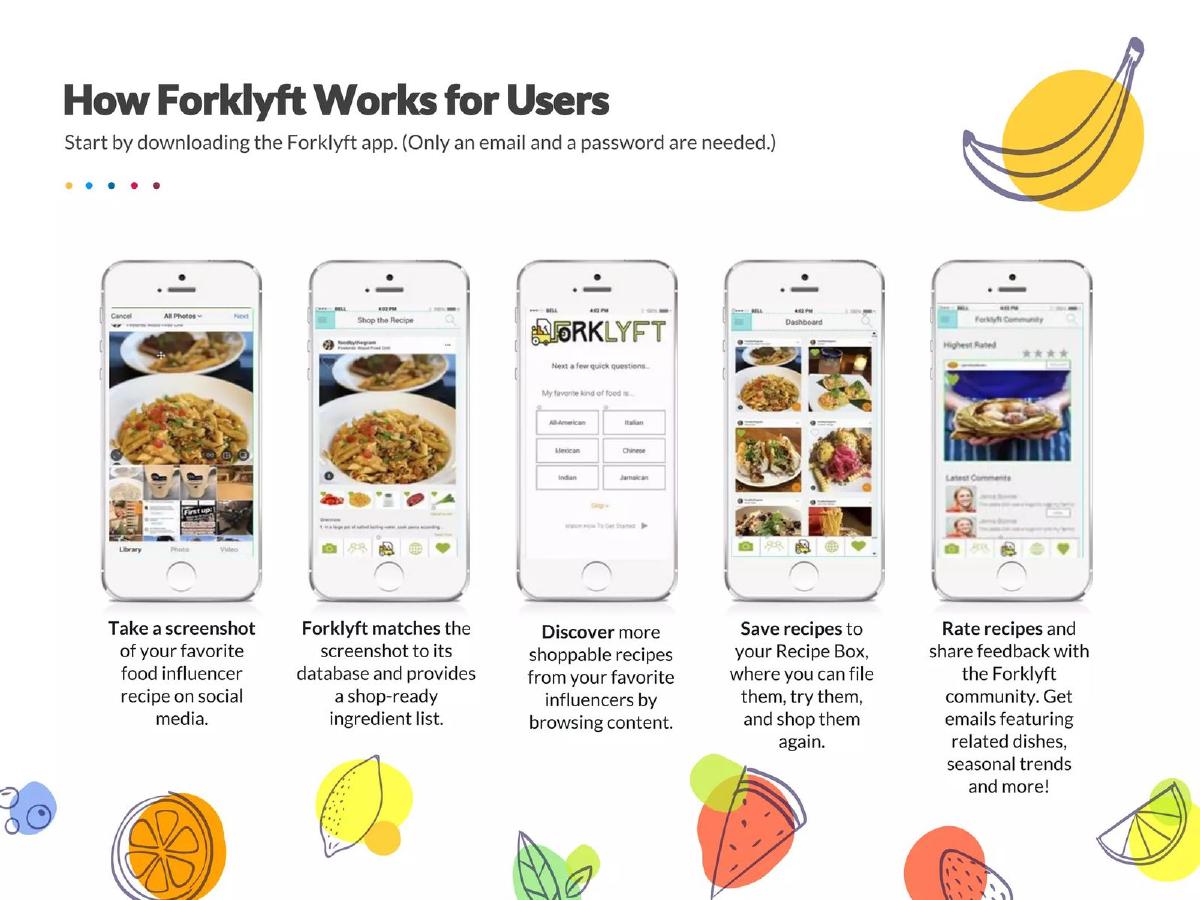
- Forklyft addresses the 'intent-to-action' gap in digital food content. Slide 2 explains that while users 'like' recipes on social media, they often lack an easy way to buy the ingredients. The app 'actionizes' these recipes by creating instant grocery lists and connecting them to home delivery services, reducing the friction of manual shopping.
- Which market segments does the company prioritize for growth?
- The company focuses on 'Foodies' and 'Mom Bloggers,' who are ranked as the top two groups for helping consumers discover products (Slide 3). Geographically, slide 8 identifies high-density urban areas like New York, Seattle, Los Angeles, Brooklyn, San Francisco, and Chicago as the 'Top Selling Cities' for food delivery.
- What competitive advantages does Forklyft claim over meal kits?
- Slide 5 highlights 'Key Points of Difference,' specifically noting that Forklyft requires 'No subscription needed' and offers 'More choice, less waste' compared to traditional models. By allowing users to shop only the specific ingredients they need for a discovered recipe, they position themselves as a more flexible alternative to services like Blue Apron.
- What technical integrations are required for the platform to work?
- According to the process model on slide 35, the platform requires integration with social media (Instagram login) and retail APIs. Influencers must manually link ingredients to specific retailer pages, and the system must generate influencer-specific tracking links to ensure commissions are correctly attributed when a user completes a purchase in the retailer's cart.