Fortune Minerals Limited’s 2012 investor presentation is a technical, asset-heavy deck designed for institutional investors in the natural resources sector. Rather than focusing on software metrics, the deck emphasizes geological certainty, infrastructure readiness, and strategic partnerships. With two primary projects—the Mount Klappan Anthracite Coal Project and the NICO Gold-Cobalt-Bismuth-Copper Project—the company highlights $190 million in combined work already completed to de-risk the assets. The presentation effectively utilizes feasibility study data, including a 32.3% pre-tax IRR fo…
Key takeaways
- The company highlights significant capital already deployed, citing $90 million spent on Mount Klappan (Slide 6) and $100 million on NICO (Slide 21).
- Strategic validation is provided by a joint venture with POSCO, one of the world's largest steel producers (Slide 6).
- Infrastructure is a core theme, with a $317.8 million railway extension plan included in the feasibility study to lower operational risk (Slide 16).
- The NICO project is positioned as a diversified hedge, featuring a 32.3% pre-tax IRR and a $361 million NPV at an 8% discount rate (Slide 21).
- Market demand for cobalt is framed around supply chain instability, noting that 51% of global supply comes from the Congo (Slide 26).
- The company demonstrates execution capability by acquiring and dismantling the Golden Giant Mine mill for a net cost of ~$20 million (Slide 31).
- Vertical integration is emphasized as a key advantage, allowing the company to control the process from mine to finished product (Slide 36).
Fortune Minerals: A Deep Dive into Industrial De-Risking
The Fortune Minerals investor presentation from June 2012 is a quintessential example of a 'hard asset' pitch. Unlike the lean, metric-light decks often seen in the technology sector, this presentation relies on geological data, infrastructure logistics, and macroeconomic supply-demand curves. The company, listed on the TSX under the symbol FT, uses these 44 slides to move the conversation from 'if' the minerals exist to 'how' they will be brought to market profitably.
Slide 1: Title and Positioning
The cover slide establishes Fortune Minerals Limited as an "Emerging Strategic Metal & Coal Producer." The choice of the word "Emerging" is critical; it suggests the company has moved past the pure exploration phase and is nearing production. The imagery—a globe and industrial site photos—reinforces the scale of the operation. The inclusion of the TSX-FT ticker immediately signals to investors that this is a publicly-traded entity with existing regulatory oversight.
Slide 6: Mount Klappan Anthracite Coal Project
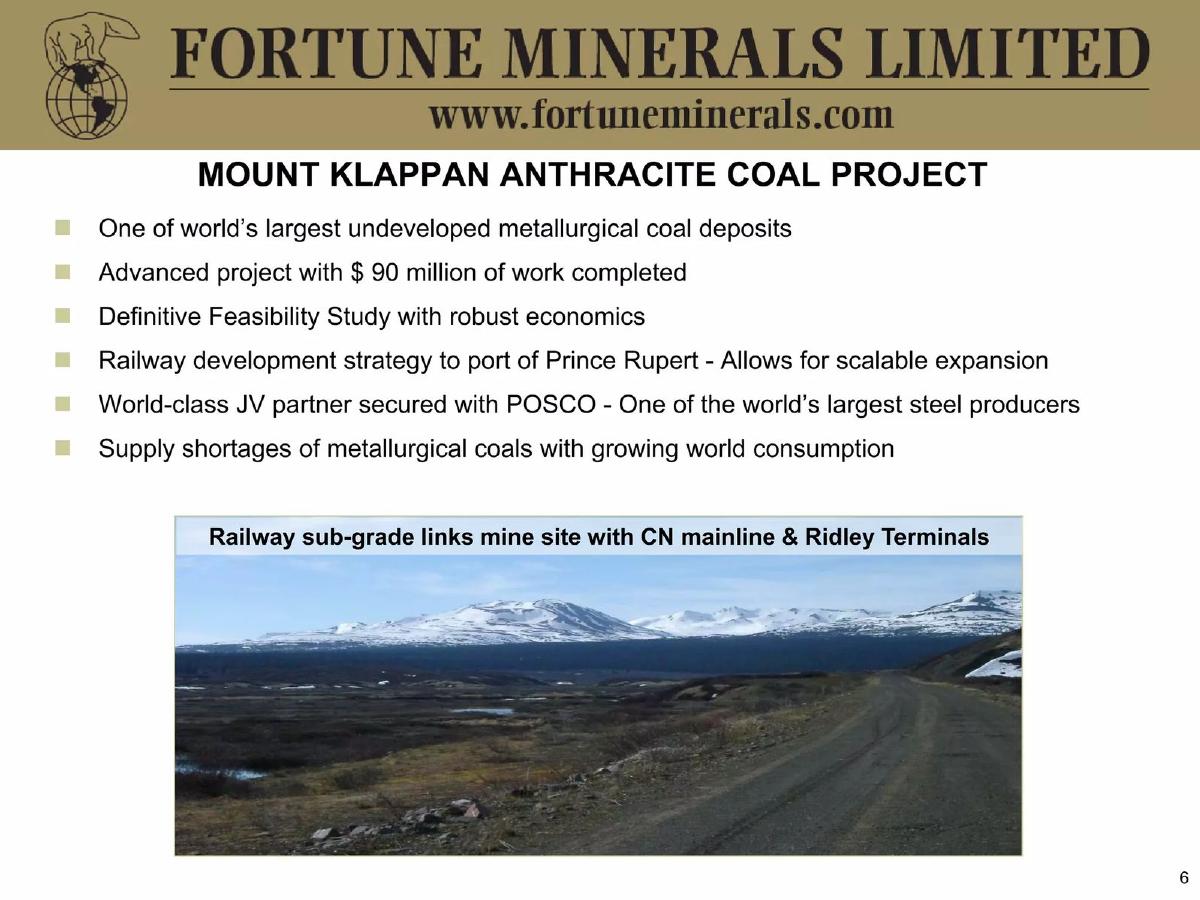
This slide introduces one of the company's flagship assets. The key takeaway here is the scale and the level of advancement. Fortune claims "$90 million of work completed" and a "Definitive Feasibility Study with robust economics." The most significant credibility marker on this slide is the mention of a "World-class JV partner secured with POSCO," one of the world's largest steel producers. For an investor, a partnership with an industry titan like POSCO serves as a massive third-party validation of the project's quality.
Slide 11: Anthracite Products and Pricing
Fortune moves from the asset to the market. They note that Anthracite represents only "1% of world coal reserves," establishing scarcity. The slide lists various applications and their corresponding price points, ranging from "US$ ~ 150-175 / tonne" for Sinter to "US$ ~ 1000 / tonne" for Filter Media. This demonstrates that the company isn't just selling a commodity; they are selling a high-value industrial input with diverse applications in steelmaking, fertilizers, and heating.
Slide 16: Railway Upgrade & Expansion
In mining, the resource is only as valuable as the ability to move it. Slide 16 addresses the logistics of the Mount Klappan project. It details a "$317.8 million capital cost" for a railway extension, included in the 2010 DFS. The slide emphasizes that "CN collaborating on railway upgrade" and that the railway provides "lower operational risk over trucking." By showing a map of the 1390 km route to Prince Rupert, the company proves it has a concrete plan for the 'last mile' of the supply chain.
Slide 21: NICO Gold-Cobalt-Bismuth-Copper Project
The deck shifts to its second major asset, the NICO project in the Northwest Territories. This slide is dense with financial metrics: a "32.3% Pre-tax IRR" and a "Pre-tax $361 million 8% NPV." The company highlights "100% Ownership" and "$100 million work completed to date." The mention of a "31 Million tonne reserve" equivalent to "4 Million eq gold ozs" provides a clear sense of the project's magnitude. This slide effectively balances technical mining data with the financial outcomes investors care about.
Slide 26: The Cobalt Market Opportunity
This is a classic 'Problem/Market' slide adapted for the mining sector. Fortune highlights that "Congo (DRC) currently accounts for 51% of global supply," framing it as a region that is "politically unstable or prone to export restrictions." By contrast, they position NICO as a "reliable North American producer." The slide also points to the growth in lithium-ion batteries for electronic devices and electric vehicles as a primary demand driver, with the market growing by "~8% / year."
Slide 31: Golden Giant Mine Mill Acquisition
To mitigate the risk of building a new processing plant from scratch, Fortune acquired an existing mill from Newmont Canada. This slide highlights the "net cash cost of ~$20 million" for dismantling and removal. This is presented as a "Demonstration of project execution on budget & schedule." It is a strategic move that shows the management team is focused on capital efficiency and reducing the lead time to production.
Slide 36: Advantages of NICO Project
This summary slide consolidates the value proposition. It emphasizes "Vertical Integration," noting that Fortune controls the process from the mine to the finished product, thereby "reducing risk of third party metal supplier or custom processors." They also highlight the "diversified product mix" (Cobalt, Bismuth, Gold, Copper) as a way to reduce exposure to the price volatility of any single metal. The technical mention of an "Exothermic reaction in autoclave" reducing energy consumption is a nod to operational efficiency.
Slide 41: Notes
This slide is blank, likely intended for the presenter to add specific context or for investors to take notes during a live pitch. While it contains no data, its presence in the 44-slide deck suggests a structured, professional presentation format.
What Fortune Minerals Does Well
The deck is exceptionally strong at quantifying progress . By repeatedly citing the dollar amounts already spent on development ($90M and $100M), Fortune makes it clear that they are not a 'lifestyle' exploration company, but a serious developer. They also excel at macro-positioning ; they don't just say they have cobalt, they explain why having cobalt in North America is a strategic geopolitical advantage. Finally, the use of third-party validation —specifically the POSCO JV and the CN Rail collaboration—provides a layer of security that is essential for projects requiring hundreds of millions in capital.
What is Missing from the Deck
In the nine slides provided, there is a notable absence of a team slide . In mining, the track record of the engineers and the management team in bringing mines into production is paramount. There is also no explicit 'Ask' slide in this selection. While we know this is an investor presentation, the specific terms of the current funding round or the intended use of the next tranche of capital are not detailed. Furthermore, while the IRR and NPV are provided, a detailed timeline to first production across both projects would help investors understand the liquidity horizon.
What Other Founders Should Copy
Founders in capital-intensive industries should emulate Fortune’s approach to de-risking through infrastructure . They don't just talk about the resource; they talk about the rails, the mills, and the processing plants. Another takeaway is the diversification of the pitch . By having two distinct projects (Coal and Strategic Metals), Fortune protects itself against a downturn in any single commodity market. Finally, the use of specific market growth data (like the 8% CAGR for cobalt) tied to a specific global problem (DRC instability) is a highly effective way to create a sense of urgency and necessity for the project.
Frequently asked questions
- How does Fortune Minerals justify the high capital expenditure required for mining?
- The deck focuses on 'de-risking' through massive upfront investment and technical validation. By citing $190 million in work already completed across two projects (Slides 6 and 21), they show investors that the most speculative exploration phase is over. They further justify costs by presenting robust economics from Definitive Feasibility Studies, such as a 32.3% IRR for the NICO project, suggesting that the eventual returns outweigh the high barrier to entry.
- What is the strategic importance of the Mount Klappan project?
- Mount Klappan is presented as one of the world's largest undeveloped metallurgical coal deposits (Slide 6). Its value lies in the rarity of Anthracite, which makes up only 1% of world coal reserves (Slide 11). By securing a JV with POSCO, Fortune Minerals aligns itself with a major end-user, ensuring a path to market for a product that commands prices as high as $1,000 per tonne for filter media.
- Why does the deck focus so heavily on cobalt and bismuth?
- The deck positions these as 'strategic metals' with high demand and supply chain risks. Slide 26 highlights that 51% of cobalt comes from the politically unstable Congo, while Slide 36 notes Fortune holds the world's largest bismuth deposit. This frames the NICO project not just as a mine, but as a critical, reliable North American source for the battery and aerospace industries, which are growing at ~8% per year.
- What role does infrastructure play in this fundraising pitch?
- Infrastructure is treated as a primary value driver rather than a secondary concern. Slide 16 details a $317.8 million railway upgrade and extension plan in collaboration with CN Rail. By focusing on rail over trucking, the company argues for lower operational risk and the ability to scale production, which is essential for attracting the large-scale institutional capital required for these projects.
- How does the company demonstrate its ability to execute complex projects?
- Fortune Minerals uses the acquisition of the Golden Giant Mine mill as a case study in execution (Slide 31). They highlight that the dismantling and removal were completed 'on budget & schedule' for a net cost of ~$20 million. This serves as a proof of concept for their management of large-scale industrial relocations and construction, which is a major risk factor in mining investments.