Humming Homes successfully raised a $7.9M Seed round in 2022 by targeting the 'modern homeowner'—specifically tech-forward millennials who are accustomed to on-demand services like Uber and DoorDash but find home maintenance opaque and stressful. The deck excels at problem framing, using a 'maze' metaphor to describe the current state of home services. They introduce a new category, 'Home Management as a Service' (HMaaS), which combines a subscription-based membership for homeowners with a vetted vendor marketplace. While the deck is strong on market tailwinds and value proposition, it notabl…
Key takeaways
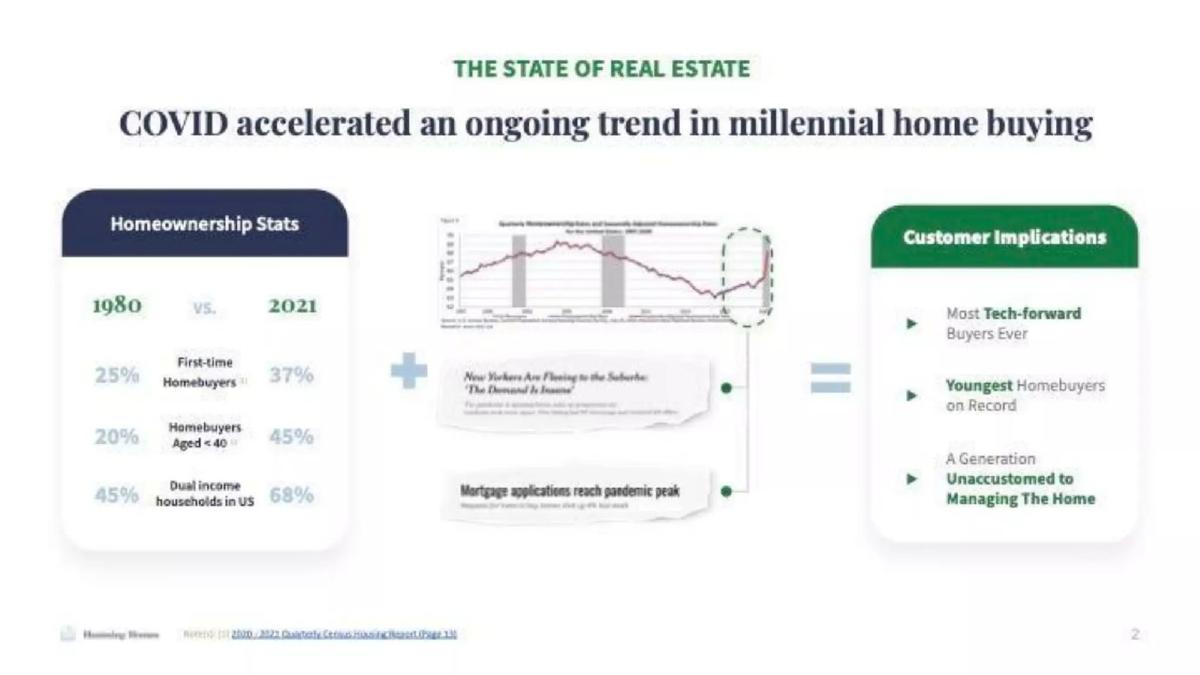
- The deck identifies a specific demographic shift, noting that first-time homebuyers increased from 25% in 1980 to 37% in 2021 (Slide 2).
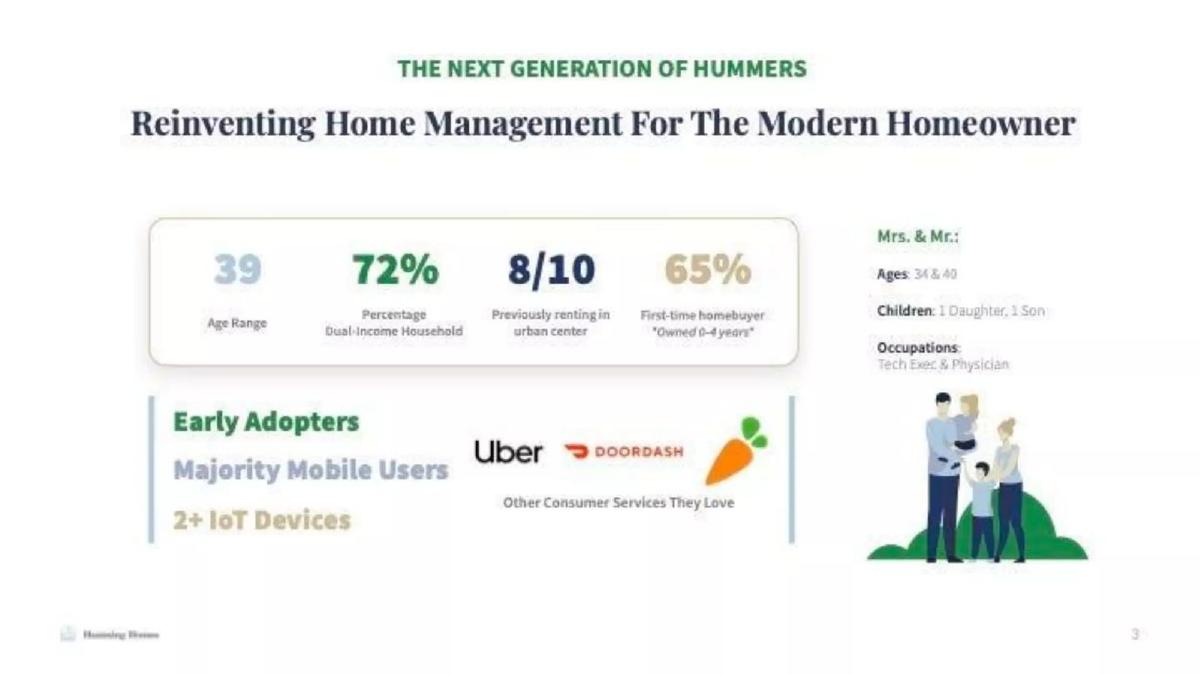
- Humming Homes targets 'Early Adopters' who are majority mobile users and own 2+ IoT devices (Slide 3).
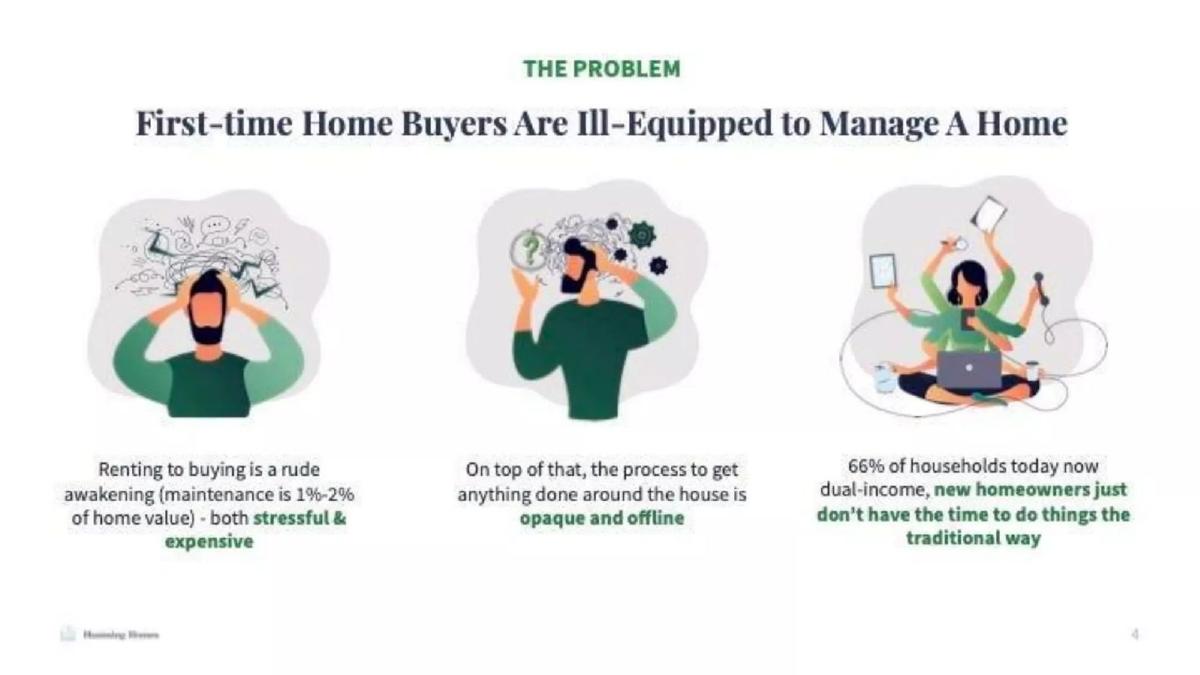
- The problem is quantified by the 'rude awakening' that maintenance costs 1%-2% of home value annually (Slide 4).
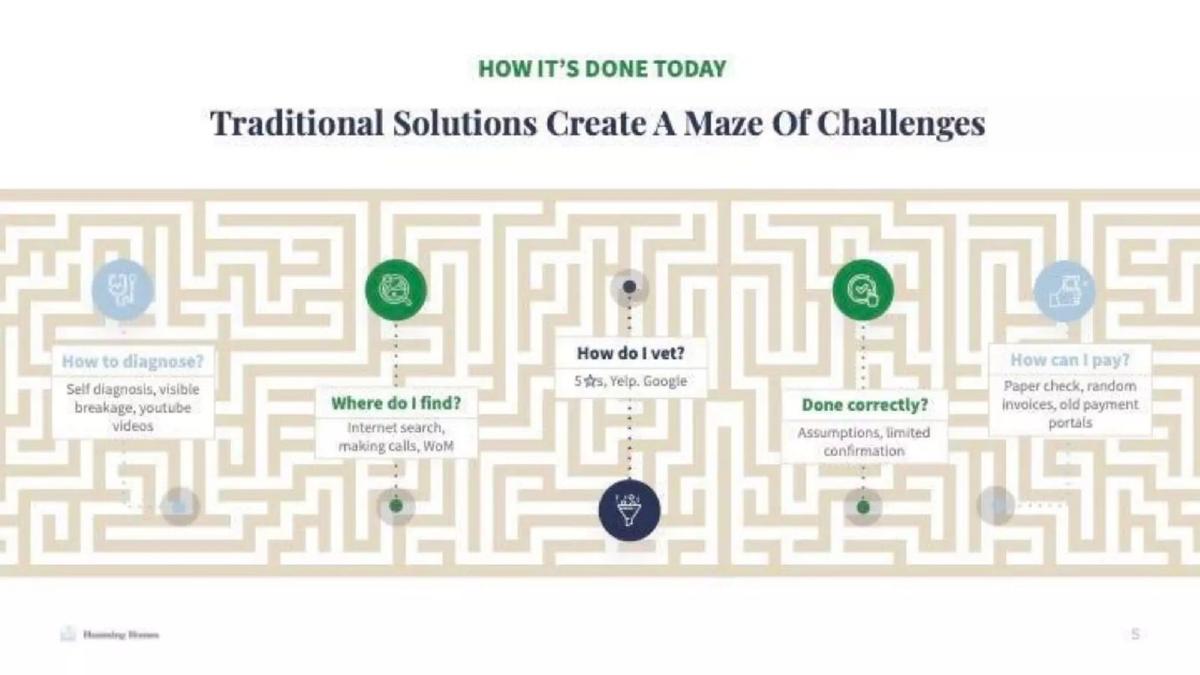
- The current solution is visualized as a 'Maze of Challenges' covering diagnosis, vetting, and payment (Slide 5).
- The market opportunity is segmented into a $100BN maintenance market for 8M single-family homes and a broader $500BN total home spend (Slide 8).
- The business model is a dual-sided 'HMaaS' platform: a membership for homeowners and a marketplace for vendors (Slide 10).
- Distribution strategy relies on B2B2C partnerships with brokerages like Compass and home builders like Toll Brothers (Slide 11).
- The deck lacks a dedicated team slide, instead featuring three 'Home Experts' as the 'Secret Sauce' (Slide 12).
The Narrative: From Urban Renters to Suburban Homeowners
Humming Homes positions itself at the intersection of a massive demographic shift and a stagnant service industry. The deck, used for their 2022 Seed round, focuses heavily on the 'why now'—specifically how the COVID-19 pandemic accelerated millennial homeownership. By framing home maintenance as a 'maze,' they set the stage for a digital-first platform that mirrors the convenience of the gig economy apps their target audience already uses.
Slide 1: Title Slide
The deck opens with a simple, clean illustration of a modern home and the tagline: "Making Homeownership Easier And More Enjoyable." It establishes the brand as a consumer-facing service focused on the emotional and functional aspects of owning a home.
Slide 2: The State of Real Estate
This slide provides the macro-economic justification for the business. It compares homeownership stats from 1980 to 2021, noting that first-time homebuyers have risen from 25% to 37% and dual-income households have jumped from 45% to 68% . The 'Customer Implications' column argues that this new generation is the 'Most Tech-forward Buyers Ever' but is 'Unaccustomed to Managing The Home.'
Slide 3: The Next Generation of Hummers
Humming Homes defines its user persona here. The 'Modern Homeowner' has an average age of 39, and 8/10 previously rented in urban centers. Crucially, they link their users to other consumer services like Uber, DoorDash, and Instacart , suggesting that these homeowners expect a similar level of on-demand, mobile-first service for their houses.
Slide 4: The Problem
The problem is broken down into three pillars: the 'rude awakening' of maintenance costs ( 1%-2% of home value ), the 'opaque and offline' process of getting work done, and the lack of time in dual-income households. It uses relatable illustrations of stressed homeowners to drive home the emotional pain point.
Slide 5: How It’s Done Today
This is the 'Maze of Challenges' slide mentioned in the editorial context. It maps out the current fragmented journey: self-diagnosis via YouTube, searching on Yelp/Google, making assumptions about quality, and paying via paper checks or random portals. It effectively visualizes the friction Humming Homes intends to remove.
Slide 6: Our Solution
A simple transition slide with the bold statement: "Make Every Home, A Humming Home."
Slide 7: The Humming Homes Way
This slide showcases the product interface. It breaks the solution into four steps: End-to-end project management, Identify & Diagnose, Communicate & Coordinate, and Resolution & Payment. The app screenshots show a 'Projects' list (e.g., Alarm System Install, Repair Oven Light) and a chat interface, positioning the app as the central hub for all home needs.
Slide 8: Market Opportunity
The deck sizes the market with three tiers: a $100BN maintenance market (8M homes spending 1.5% of value), a $390BN broader maintenance and improvement market (80M homes), and a $500BN total spend including emergency repairs. This slide uses a nested circle graphic to show the scale of the 'New Category of Home Management.'
Slide 9: A New Approach in Home Services
This is a competitive positioning slide. It places Humming Homes at the top of a value chain that includes Data-centricity, Virtual Diagnosis, Focused demand, Vetted Vendor Network, and Pricing Reliability. It contrasts Humming Homes against existing players like Hippo, Super, HomeX, Porch, and Angi , implying that while others handle insurance or lead generation, Humming Homes owns the entire experience.
Slide 10: Business Model Today
The company introduces the term "Home Management as a Service (HMaaS)." The model is split between a Membership for homeowners (providing a dedicated coordinator and service experts) and a Marketplace for the vendor network (covering everything from HVAC to housekeeping). This dual-sided approach suggests two distinct revenue streams.
Slide 11: Customer Acquisition & Distribution Strategy
This slide outlines a three-stage growth path. It starts with Seed Market (B2C) via direct sales and referrals, moves to Grow Market (B2B2C) through brokerages like Compass and Douglas Elliman and insurance providers like Chubb , and eventually scales to Home Builders like Toll Brothers and retailers like The Home Depot .
Slide 12: Marketplace & Expert Network
Instead of a traditional team slide, this slide highlights the 'Secret Sauce': Experienced Home Service Professionals. It shows three headshots of 'Home Experts' who act as advisors. It also reiterates the revenue model: Monthly Subscribers from homeowners and Revenue Share Partnerships from the marketplace.
Slide 13: Mass Market Distribution
The final content slide sets a long-term goal: "Reach Every Home In America By 2030." It lists strategic objectives like building a self-service app and establishing white-label partnerships with HOAs and insurance providers. It functions as a vision statement rather than a tactical roadmap.
Slide 14: Closing Slide
A standard closing slide directing viewers to a library of pitch decks, not specific to Humming Homes' contact information.
What Humming Homes Does Well
The deck is a masterclass in problem framing . By using the 'maze' analogy and contrasting the modern homeowner's digital expectations with the 'paper check' reality of home services, they make the need for the product feel inevitable. They also do an excellent job of category creation . By coining 'HMaaS,' they move the conversation away from being 'just another marketplace' (like Angi) and toward a recurring-revenue service model that VCs find much more attractive.
What is Missing from the Deck
The most glaring omission is a traditional Team Slide . While they mention 'Home Experts,' there is no information on the founders' track records in scaling tech companies or their specific expertise in operations. Additionally, the deck lacks Unit Economics . There are no mentions of Customer Acquisition Cost (CAC), Lifetime Value (LTV), or the specific price point of the monthly subscription. Finally, there is no 'The Ask' slide . While we know from external data they raised $7.9M, the deck itself does not specify how much they were seeking or how they planned to spend the capital (e.g., hiring, geographic expansion, or R&D).
What Other Founders Should Copy
Founders should emulate the 'Customer Persona' slide (Slide 3) . Instead of just listing demographics, Humming Homes lists the other apps their customers use. This tells an investor exactly where the company fits in the user's lifestyle. The 'Distribution Strategy' slide (Slide 11) is also worth copying; it shows a clear evolution from expensive B2C acquisition to high-leverage B2B2C partnerships, which demonstrates a sophisticated understanding of how to scale a service business efficiently.
Frequently asked questions
- How much did Humming Homes raise with this deck?
- According to the catalogue facts, Humming Homes raised $7.9M in a Seed round in 2022. The deck itself does not state the specific amount raised or the valuation.
- What is the 'HMaaS' model mentioned in the deck?
- HMaaS stands for 'Home Management as a Service.' As shown on Slide 10, it involves a monthly membership for homeowners that provides a dedicated home coordinator and managed projects, paired with a marketplace that connects them to a vetted network of service pros (HVAC, landscaping, etc.).
- Who is the primary target customer for Humming Homes?
- The deck specifically targets the 'Modern Homeowner.' Slide 3 defines this as a dual-income household (72%), often first-time buyers (65%) who previously rented in urban centers and are accustomed to digital services like Uber and DoorDash.
- What are the primary revenue streams for the company?
- The revenue model is multi-pronged. It includes monthly subscription fees from the 'Core Customer' (homeowners) and revenue-share partnerships from the 'Marketplace' (service providers), as detailed on Slide 12.
- Does the deck include a team slide?
- Not in the traditional sense. Slide 12 mentions 'Home Experts' as the 'Secret Sauce' and shows three headshots, but it does not list the founders, their backgrounds, or the broader leadership team's experience in tech or real estate.