Hypernatural’s pitch deck is a masterclass in focusing on user behavior over technical jargon. While many AI startups lead with model architecture, Hypernatural leads with the user experience, positioning itself as the 'Midjourney for video.' The deck highlights a 5-person team and uses high-volume usage stats—such as individual creators producing over 1,200 videos—to prove product-market fit. By targeting 'storytellers' like novelists and niche TikTokers who previously lacked video capabilities, the company demonstrates a clear wedge into a massive market. The $7M ask, led by AIX Ventures, i…
Key takeaways
- The company positions itself as the 'Midjourney (or Canva) for video,' emphasizing a zero learning curve and sub-one-minute creation times (Slide 5).
- Hypernatural identifies its current focus as writers and novelists who previously produced 'no videos,' representing a $320B market opportunity (Slide 7).
- Traction is demonstrated through high-frequency usage, citing specific creators who have produced between 129 and 1,238 videos using the platform (Slide 9).
- The deck highlights a 'unique, scaled data signal' where the company defines 'good' content as that which is actually exported by the user (Slide 13).
- The team is lean, consisting of only 5 people, which suggests high capital efficiency for a company raising a $7M round (Slide 4).
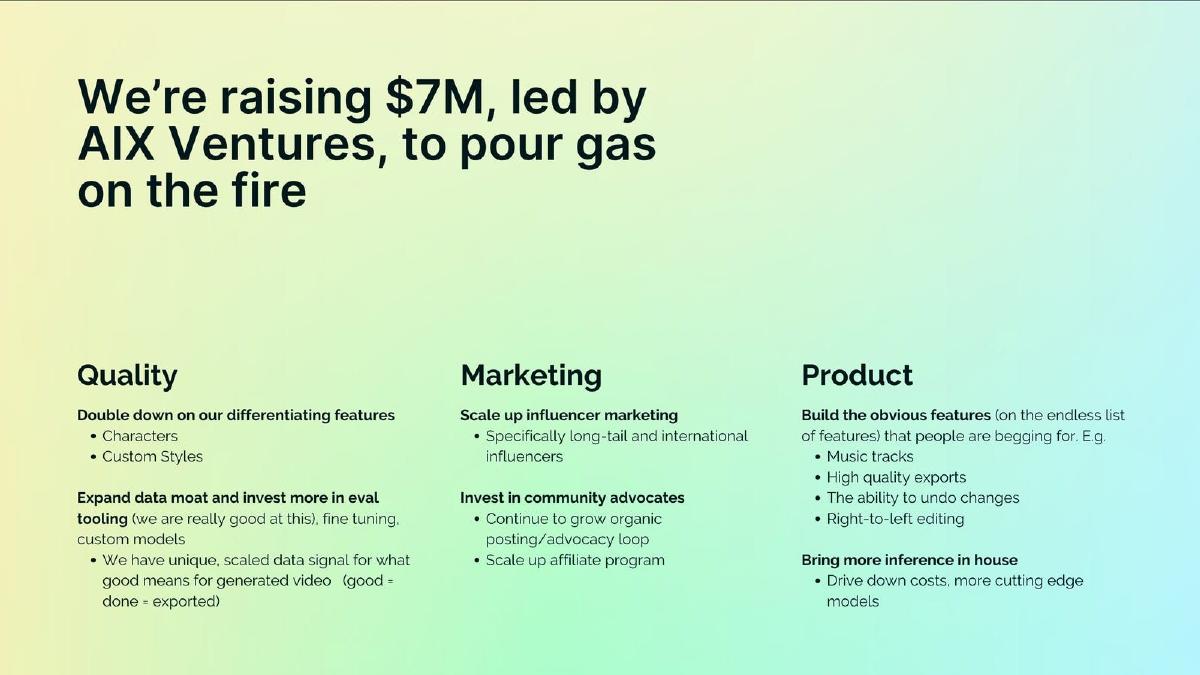
- The 'Ask' slide is highly detailed, breaking down future spend into Quality, Marketing, and Product categories, including specific features like right-to-left editing (Slide 13).
- Hypernatural uses three consecutive slides for customer testimonials, emphasizing the emotional impact and 'fun' of the tool (Slides 10-12).
- The business model relies on expanding the audience on video platforms by enabling 'videos every day' for users who were previously uncomfortable on-camera (Slide 7).
Hypernatural: The $6.8M Seed Deck Analysis
Hypernatural’s pitch deck, used to secure a $6.8M Seed round in 2024, is a concise 14-slide presentation that prioritizes user experience and traction over technical complexity. In an era where many generative AI startups are competing on the raw power of their underlying models, Hypernatural differentiates itself by focusing on the 'storyteller'—the user who has a message but lacks the technical skill to produce video. The deck is visually consistent, using a soft gradient background and clean typography that reflects the 'fun' and 'easy' nature of the product described within.
Slides 1-3: The Vision and Transformation
The deck opens with a minimalist title slide (Slide 1) featuring the company logo against a vibrant, grainy gradient. This is immediately followed by a video example (Slide 2), which serves as a functional demonstration of the product's output. By placing the output second, the founders ensure that investors see the 'what' before the 'how.'
Slide 3 delivers the core mission statement: "Hypernatural is transforming video creation for everyone." This is a standard high-level vision slide, but it sets the stage for the democratization narrative that follows. It suggests that the current state of video creation is exclusionary and that Hypernatural is the solution to that friction.
Slide 4: The Lean Team
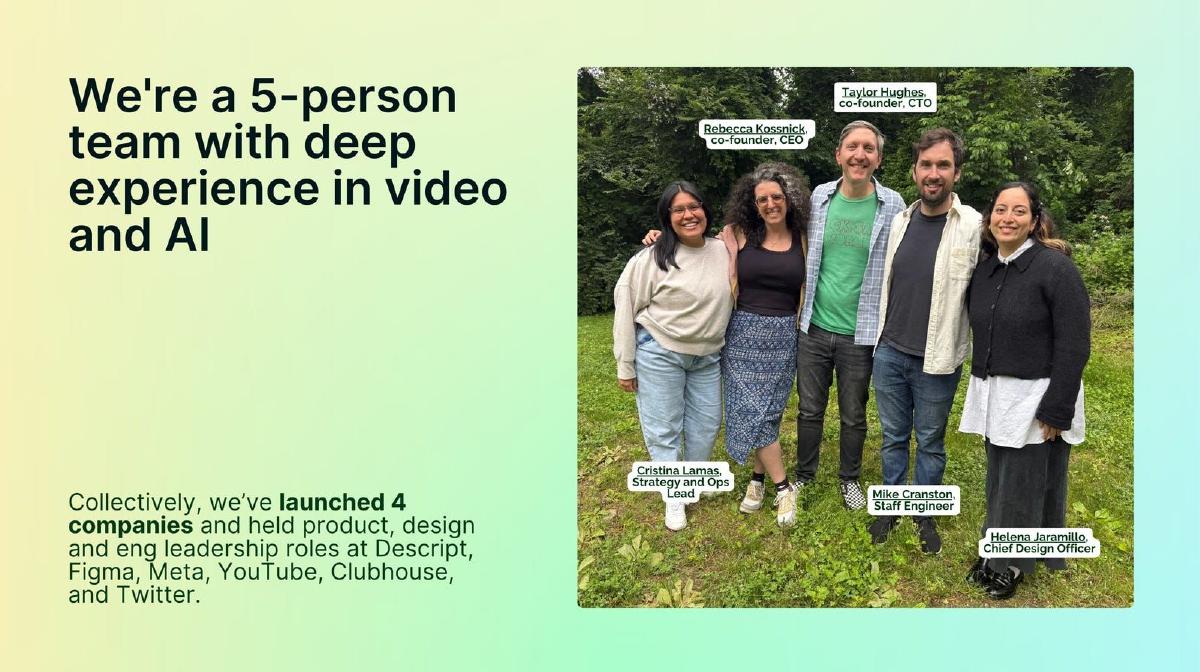
Slide 4 introduces the team, described as a "5 person team with deep experience in video and AI." While the slide text provided is brief, the emphasis on a small team size is a strategic choice. It signals to investors that the company is lean and that the $7M raise will provide a significant runway. In the context of a Seed round, a small team with 'deep experience' suggests that the capital will be spent on scaling a proven concept rather than figuring out the basic technology.
Slides 5-6: Product Positioning and Philosophy
Slide 5 contains one of the most important framing devices in the deck: "We're building the Midjourney (or Canva) for video." This comparison is powerful because it anchors the product in two highly successful, user-friendly precedents. The slide lists four key differentiators: a zero learning curve, speed (making a video in < 1 minute), utility (repeat usage), and fun. By claiming that "Fun IS the point" on Slide 6, the company leans into the consumer software aspect of their business, suggesting that engagement is driven by the joy of creation rather than just professional necessity.
Slide 7: Market Segmentation and Size
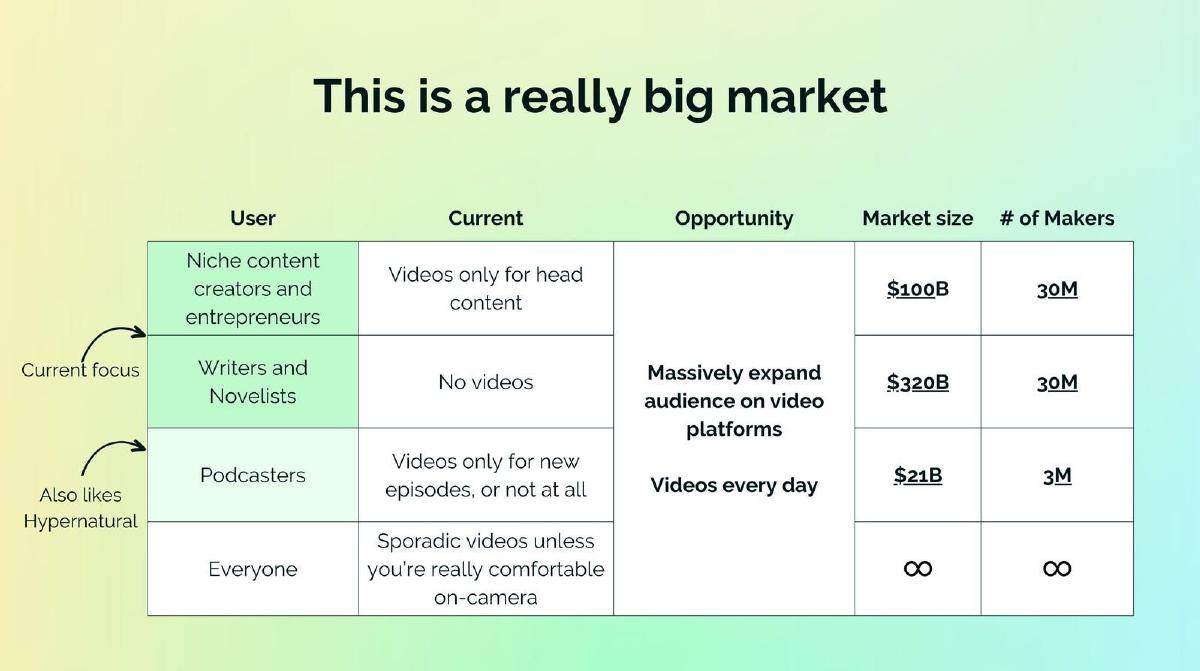
The market slide (Slide 7) is notably detailed. Instead of a generic TAM/SAM/SOM circle, Hypernatural uses a table to break down specific user personas and their current pain points. They identify their 'Current focus' as:
Niche content creators and entrepreneurs: $100B market, 30M makers. · Writers and Novelists: $320B market, 30M makers.
The slide also notes that podcasters ($21B market) already like the tool. The 'Opportunity' column emphasizes 'Massively expand audience on video platforms' and 'Videos every day.' This slide successfully argues that Hypernatural isn't just competing for existing video budgets; it is creating a new market by enabling people who currently produce 'no videos' to become video creators.
Slide 8: Growth and Traction
Slide 8 is a chart showing growth. While the specific numbers aren't detailed in the text provided, the presence of a growth chart at the Seed stage is a critical validator. It moves the conversation from 'this might work' to 'this is working.' For a generative AI tool, growth often correlates with the lowering of the 'barrier to entry,' which aligns with the company's 'zero learning curve' promise.
Slide 9: The Power User Evidence
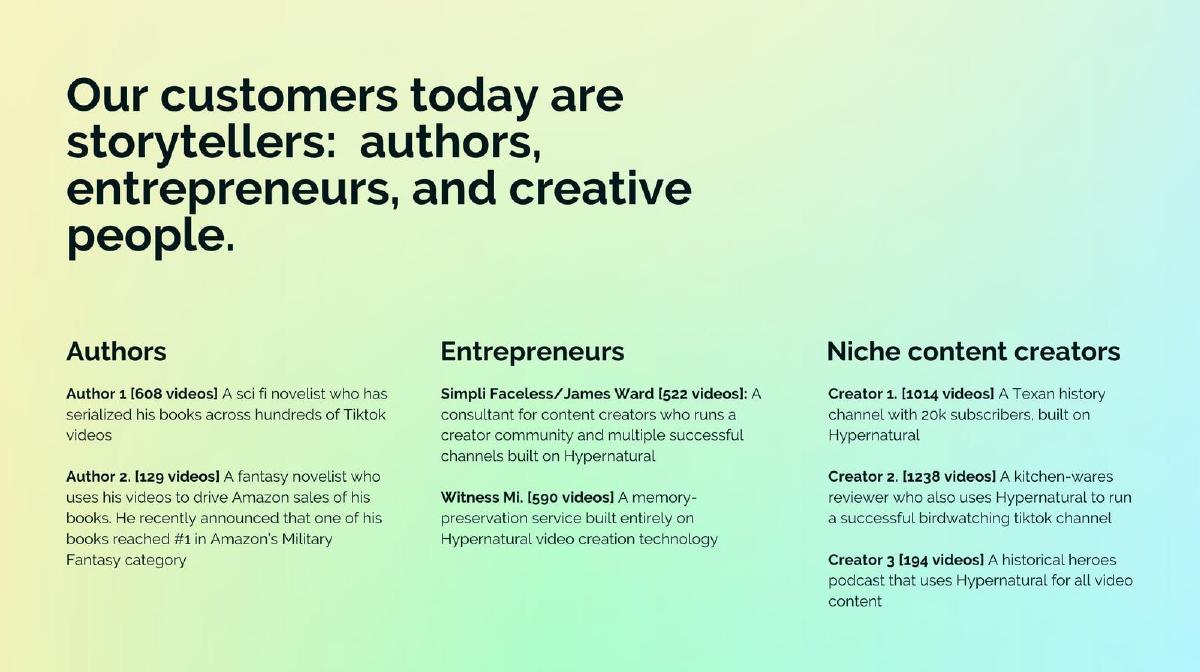
Slide 9 is perhaps the strongest slide in the deck for proving product-market fit. It lists specific, albeit anonymized, users and their staggering output levels:
Author 1: 608 videos (serialized books on TikTok). · Author 2: 129 videos (driving Amazon sales). · Creator 1: 1,014 videos (history channel). · Creator 2: 1,238 videos (kitchen-wares and birdwatching).
These figures are exceptional. In traditional video production, creating 1,000+ videos would require a massive team and years of work. Showing that individual users are producing this volume on Hypernatural proves that the tool is both fast and 'actually useful,' as claimed on Slide 5.
Slides 10-12: Social Proof
The deck devotes three full slides (10, 11, and 12) to customer testimonials. Slide 10 features a quote from Melissa Trujillo, who describes herself as "blown away" and "completely speechless." She notes that the experience made her "feel like a creator in a way I never have before." This emotional resonance is key for consumer software. It reinforces the 'Fun' and 'Transformation' themes introduced earlier in the deck.
Slide 13: The Ask and Roadmap
The final substantive slide (Slide 13) outlines the $7M raise, led by AIX Ventures. The phrase "to pour gas on the fire" is a classic startup trope indicating that the model is working and just needs capital to scale. The slide breaks down the use of funds into three clear pillars: Quality: Doubling down on differentiating features like characters and custom styles. It also mentions expanding a 'data moat' by using exports as a signal for quality. Marketing: Scaling influencer marketing, specifically for long-tail and international creators, and building an affiliate program. Product: Adding 'obvious features' like music tracks, high-quality exports, and right-to-left editing. Crucially, it mentions bringing 'more inference in house' to drive down costs, which addresses the primary margin concern for AI companies.
What Works in the Hypernatural Deck
1. Extreme Clarity of Persona: The deck doesn't just say 'everyone.' It specifically identifies novelists and niche history creators. This specificity makes the market opportunity feel real and attainable.
2. Usage as the Primary Metric: By highlighting users with over 1,000 videos, Hypernatural bypasses the skepticism often directed at 'toy' AI apps. High volume equals high utility.
3. The 'Midjourney for Video' Anchor: This is a perfect high-concept pitch. It tells an investor exactly what the product does, who it's for, and what the potential scale looks like in four words.
4. Strategic Use of Funds: The mention of bringing inference in-house shows that the founders are thinking about unit economics and long-term sustainability, not just user growth.
What is Missing from the Hypernatural Deck
1. Competitive Landscape: The deck mentions Midjourney and Canva as inspirations, but it does not explicitly address direct competitors in the generative AI video space (such as Runway, Pika, or Sora). Investors would likely ask how Hypernatural maintains its 'data moat' against these well-funded incumbents.
2. Unit Economics: While the deck mentions driving down costs, it does not provide current COGS (Cost of Goods Sold) or a pricing model. For a Seed round, this is often omitted, but in the resource-heavy world of AI video, a hint at the business model would have been beneficial.
3. Technical Architecture: The deck is very 'top-of-stack.' It doesn't explain if they are building their own foundation models or wrapping existing ones (though the mention of 'multiple AI models' in the publisher summary and 'fine tuning' on Slide 13 suggests a hybrid approach).
Founder Takeaways: Lessons to Copy
Lead with the Output: If you are building a creative tool, show the creation immediately. Hypernatural’s Slide 2 is a video example, which is the best way to prove the product exists.
Quantify Engagement: If you don't have millions in revenue yet, show 'obsessive' usage. A single user making 1,200 videos is a more compelling story than 1,200 users making one video each.
Define 'Good' Data: Hypernatural’s insight that 'good = exported' is a clever way to explain their data moat. Founders should look for similar 'natural signals' in their own user behavior that can be used to improve their product.
Keep the Team Slide Simple: Especially in the early stages, you don't need a wall of text. '5 people with deep experience' is enough to show you are a high-talent, low-overhead operation.
Frequently asked questions
- What is Hypernatural's core value proposition?
- Hypernatural focuses on speed and accessibility. According to Slide 5, the platform offers a 'zero learning curve' and allows users to create a video in less than one minute. It positions itself as a tool for people who are not professional video editors, specifically targeting those who find traditional video creation too difficult or time-consuming.
- How does the company demonstrate product-market fit?
- Instead of traditional revenue metrics, Slide 9 showcases high-volume usage from specific personas. It lists an author with 608 videos, a history channel creator with 1,014 videos, and a kitchen-wares reviewer with 1,238 videos. This data suggests that once users adopt the tool, it becomes a core part of their daily content production workflow.
- What is the specific market opportunity identified in the deck?
- Slide 7 breaks down the market into four segments. The largest 'current focus' is writers and novelists, which they value at $320B. They also target niche content creators ($100B) and podcasters ($21B). The ultimate goal is to reach 'everyone,' which they represent with an infinity symbol for both market size and number of makers.
- How does Hypernatural plan to use the $7M investment?
- As detailed on Slide 13, the funds are earmarked for three areas: Quality (improving characters and custom styles), Marketing (scaling influencer and affiliate programs), and Product (adding music, high-quality exports, and undo functionality). A key strategic goal mentioned is bringing more inference in-house to reduce operational costs.
- What is the 'data moat' mentioned in the deck?
- Slide 13 mentions a 'unique, scaled data signal for what good means for generated video.' The company defines 'good' as a video that is 'done = exported.' By tracking which AI-generated outputs users choose to finalize and download, Hypernatural can fine-tune its models to produce higher-quality results that align with user preferences.