Friday Finance, operating under the name Airbank at the time of this 2022 raise, successfully navigated a $20 million Series A by positioning itself as a software layer rather than a bank. The deck identifies a massive European market of 23 million target customers, specifically targeting the 99% of SMBs still using incumbent banks. By focusing on bank-agnostic integration with over 2,000 institutions, the company avoids the high customer acquisition costs and regulatory hurdles of neobanks. The narrative is heavily supported by top-tier social proof, featuring logos from New Wave, Speedinves…
Key takeaways
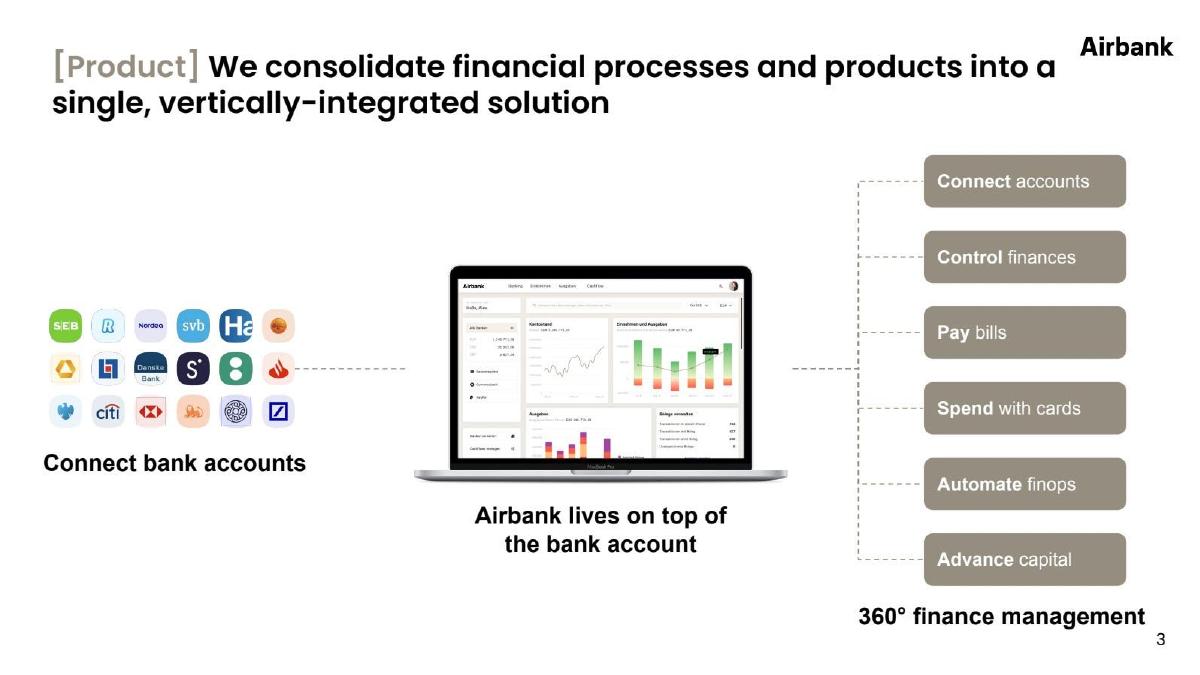
- The company positions itself as a 'software-first' platform that lives on top of existing bank accounts rather than replacing them (Slide 3).
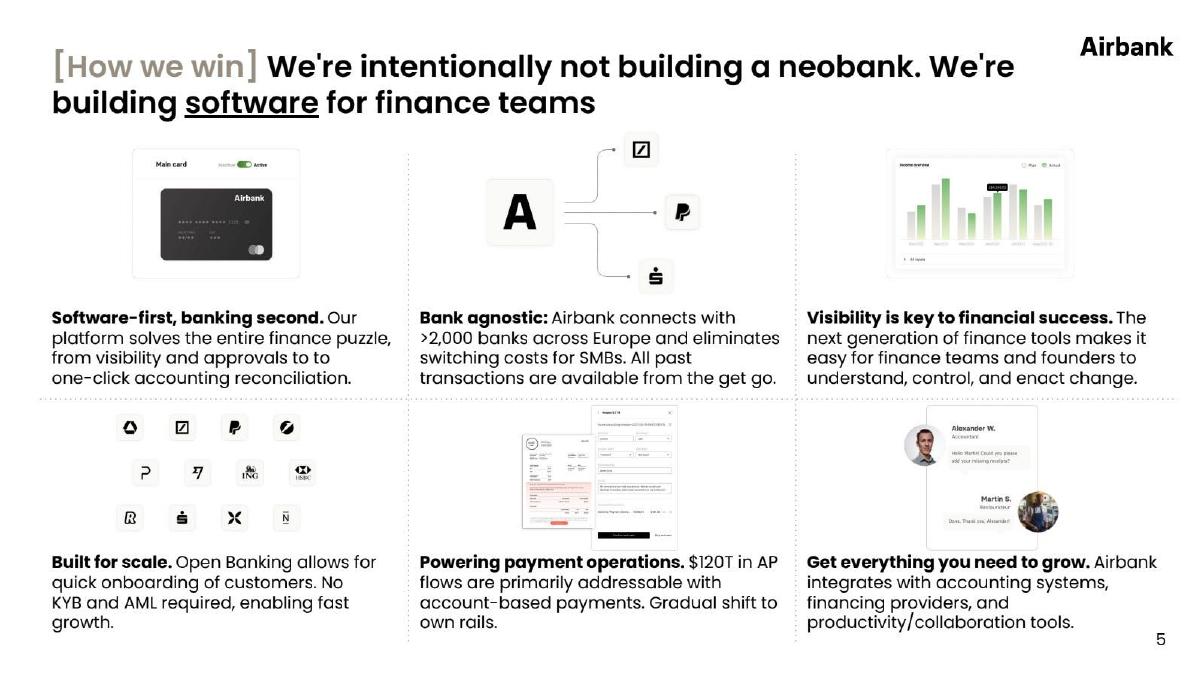
- Airbank claims connectivity to over 2,000 banks across Europe, which they argue eliminates switching costs for SMBs (Slide 5).
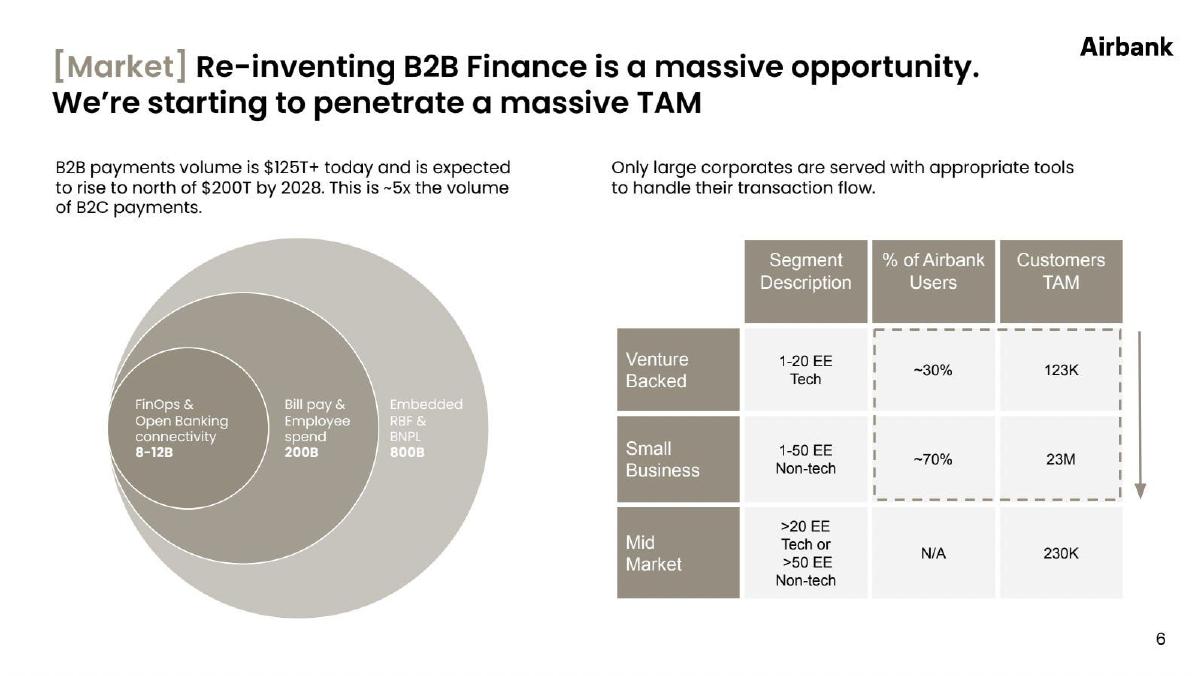
- The deck identifies a total addressable market of 23 million+ target customers in Europe, spanning startups to traditional mid-market firms (Slide 7).
- A key competitive differentiator is the avoidance of KYB and AML requirements through Open Banking, which the company claims enables faster growth (Slide 5).
- The platform targets a specific pain point: 90% of their target SMB segment currently has insufficient cash visibility (Slide 7).
- The vision slide sets an ambitious three-year goal to automate everything touching a business's finances from inception to post-IPO (Slide 9).
- Social proof is a primary driver, with Slide 11 listing lead investors from New Wave, Speedinvest, and Entrepreneur First, alongside scouts from Accel and Sequoia.
- The deck highlights a massive $120T in AP flows as the primary addressable market for their payment operations (Slide 5).
The Aggregator Strategy: A Teardown of Friday Finance’s $20M Series A Deck
In 2022, German fintech Friday Finance (then known as Airbank) raised $20 million in a Series A round led by Molten Ventures. The deck used for this raise is a masterclass in positioning a software layer over a commoditized service. By choosing not to be a bank, the company carved out a niche that appealed to investors looking for scalable, low-friction fintech growth in the fragmented European market.
Slide 1-2: The Branding and Identity
The opening slides are minimalist, featuring the original brand name 'Airbank' and the tagline 'All-in-one finance for businesses.' Notably, Slide 1 includes a 'Backed by' section at the bottom, immediately establishing credibility with logos from New Wave, Speedinvest, and the scout funds of Accel and Sequoia. This is a common tactic for Series A decks—leading with social proof to signal that the 'smart money' has already de-risked the early stages.
Slide 3: The Product Architecture
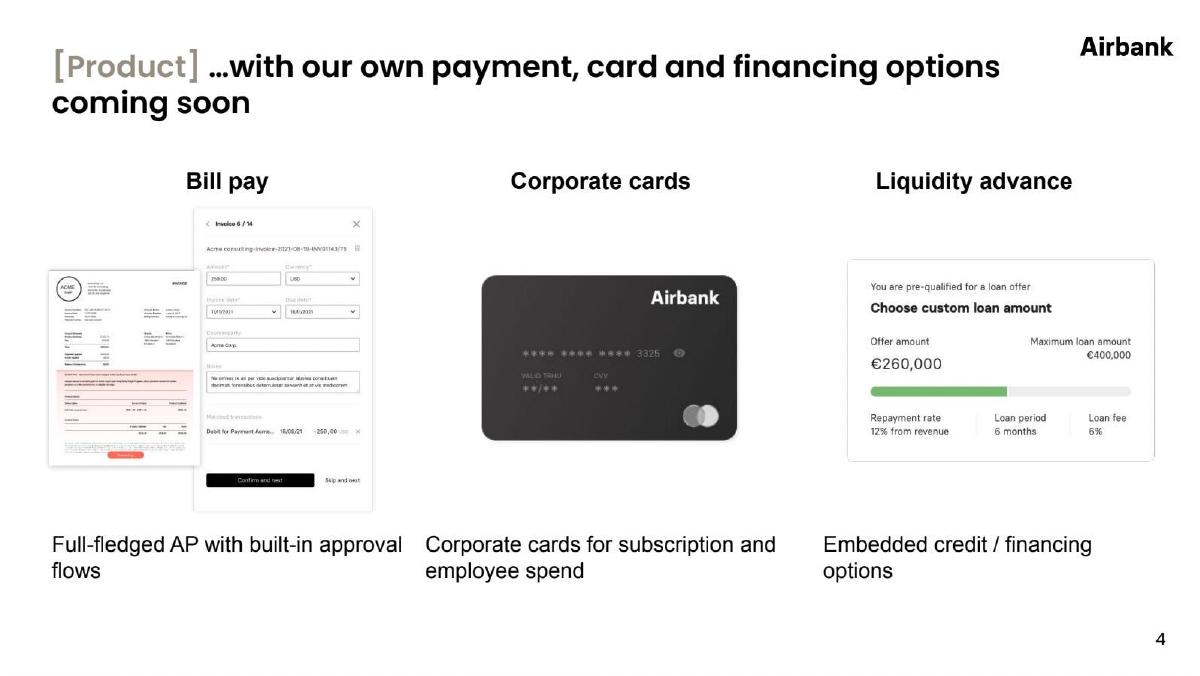
Slide 3 defines the product's core function: consolidation. The slide uses a visual flow showing various bank logos (including SEB, Revolut, SVB, and Deutsche Bank) feeding into a central laptop interface. The text states, 'We consolidate financial processes and products into a single, vertically-integrated solution.' To the right, a list of six functional pillars defines their '360° finance management' vision: Connect accounts, Control finances, Pay bills, Spend with cards, Automate finops, and Advance capital. This slide effectively communicates that the product is a comprehensive dashboard, not just a viewing tool.
Slide 5: The 'How We Win' Strategy
This is arguably the most important slide in the deck. It outlines the competitive strategy under the header '[How we win] We're intentionally not building a neobank. We're building software for finance teams.' The slide is divided into six key points:
Software-first, banking second: Solving the 'finance puzzle' from visibility to one-click reconciliation. · Bank agnostic: Connecting with over 2,000 banks across Europe to eliminate switching costs. · Visibility: Providing tools for finance teams to understand and control change. · Built for scale: Using Open Banking to bypass KYB/AML requirements for faster onboarding. · Powering payment operations: Targeting $120T in addressable AP flows. · Growth integrations: Connecting with accounting systems and financing providers.
This positioning is a direct response to the 'neobank fatigue' in the VC market, suggesting a more capital-efficient path to market dominance.
Slide 7: Ideal Customer Profile (ICP)
Slide 7 quantifies the opportunity. It claims a target of '23 million+ target customers in Europe.' The slide lists various industries, from e-commerce to hospitality, but the real insight is in the 'SMB segment traits' list. The company identifies that 99% of the market still banks with incumbents and 90% have 'insufficient cash visibility.' By highlighting that these businesses still use 'Excel or still on pen & paper,' Friday Finance paints a picture of a massive, underserved market ripe for digital transformation.
Slide 9: The Three-Year Vision
Slide 9 is a simple text-based vision statement: 'Three years from now, businesses across all stages, from inception to post-IPO, will connect to Airbank to automate everything that touches their finances.' This slide serves to expand the scope of the company beyond just SMBs, suggesting an enterprise-grade future that justifies a Series A valuation and sets the stage for future rounds.
Slide 11: The Investor Roster
The final content slide is a dense display of social proof. It lists lead investors and individuals, including partners at Hedosophia and co-founders of Sorare and Auxmoney. By listing specific names like Pia d’Iribarne (New Wave) and Matt Clifford (Entrepreneur First), the deck anchors its success to the reputations of established European tech figures. This slide is designed to make a new investor feel like they are joining an elite group.
What Works in This Deck
Strategic Differentiation: The explicit rejection of the 'neobank' label is brilliant. It tells investors that the company won't be burning cash on heavy regulatory compliance or fighting for primary account status. Instead, it positions the product as a necessary utility that works with a customer's existing setup.
Market Sizing: By citing 23 million customers and $120T in AP flows, the deck provides the 'billion-dollar company' narrative that VCs require. They don't just say the market is big; they explain why it is currently inefficient (Excel, pen and paper).
Clarity of Product: Slide 3 provides a very clear 'before and after' visual. Investors can immediately understand that the product takes a mess of fragmented bank accounts and turns them into a single, actionable dashboard.
What is Missing
Traction and Metrics: The public version of this deck is notably missing a traction slide. There are no mentions of Monthly Recurring Revenue (MRR), number of active users, or growth rates. While these may have been in a supplemental data room, their absence in the main narrative makes it hard to judge the actual momentum of the business at the time of the raise.
Unit Economics: There is no mention of Customer Acquisition Cost (CAC) or Lifetime Value (LTV). For a fintech company, understanding how they make money (SaaS fees vs. interchange vs. lending) is crucial, and this deck remains vague on the revenue model.
The Team: Surprisingly, there is no dedicated team slide in this 12-slide sequence. While the investors are highlighted, the founders' backgrounds are not, which is unusual for a Series A deck where the leadership team's ability to execute is a primary concern.
What Founders Should Copy
The 'Anti-Category' Positioning: If you are entering a crowded space (like fintech), follow Friday Finance's lead by explicitly stating what you are not . By saying 'We are not a neobank,' they immediately answered the most common objection an investor would have.
High-Density Social Proof: If you have notable angels or scouts from major firms, don't just list the firms—list the people. Slide 11 shows how to leverage the 'Scout Fund' logos of Accel and Sequoia effectively without claiming a direct institutional investment from their main funds.
Focus on Friction: The deck repeatedly mentions 'eliminating switching costs' and 'no KYB/AML required.' Founders should always highlight how their product reduces the time-to-value for the customer, as this is a key indicator of potential viral growth and low churn.
Frequently asked questions
- Why does the deck say Airbank if the company is Friday Finance?
- Friday Finance was originally founded and funded under the name Airbank. The company rebranded to Friday Finance following its growth stages to better reflect its broader financial management mission. The deck analyzed here represents the materials used during the Series A round prior to the name change.
- What is the primary value proposition for SMBs according to the deck?
- The primary value proposition is '360° finance management.' As shown on Slide 3, this includes connecting accounts, controlling finances, paying bills, spending with cards, automating finance operations, and advancing capital. The goal is to consolidate fragmented financial processes into a single, vertically integrated software solution.
- How does Friday Finance differentiate itself from neobanks like Qonto or Revolut Business?
- Slide 5 explicitly states, 'We're intentionally not building a neobank.' Unlike neobanks that require customers to switch their primary banking relationship, Friday Finance is 'bank agnostic.' It connects to existing accounts at incumbent banks, where 99% of the market currently resides, thereby reducing friction and switching costs.
- What specific market segments does the company target?
- Slide 7 lists six specific segments: Startups & Technology companies, E-commerce, Consulting & Agencies, Retail & Manufacturing, Hospitality & Services, and Mid-market. They characterize these segments as having low fintech adoption and a reliance on Excel or paper for cash planning.
- Who were the key investors in the Series A round?
- According to Slide 11 and publisher reports, the round was backed by New Wave (Lead Seed), Speedinvest (Seed & Pre-Seed), TinyVC, and Entrepreneur First. The deck also highlights individual backing from scouts at Accel and Sequoia, as well as founders from Sorare and HomeToGo.