In 2022, JetBlue launched a hostile $3.8B all-cash bid for Spirit Airlines, aiming to disrupt a pre-existing merger agreement between Spirit and Frontier. This deck is a high-stakes litigation and investor relations tool designed to convince Spirit shareholders to vote against the Frontier deal. It relies heavily on a 'value gap' argument, highlighting a 60% premium over the Frontier offer (Slide 13) and attacking the Spirit Board for alleged conflicts of interest (Slide 31). While the deck successfully swayed shareholders to reject Frontier, the subsequent JetBlue-Spirit deal was eventually…
Key takeaways
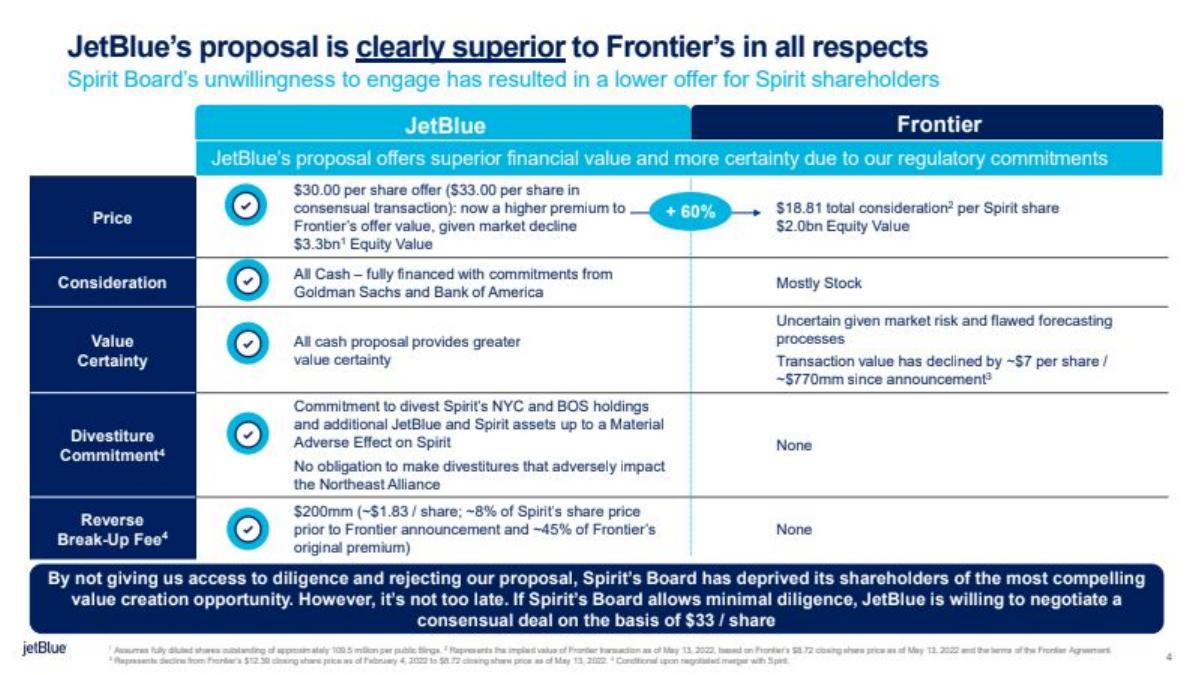
- JetBlue offered a $30 per share all-cash proposal, positioning it as a superior alternative to Frontier's stock-heavy bid (Slide 1).
- The deck claims the JetBlue offer represents a 60% premium to the implied value of the Frontier transaction as of May 13, 2022 (Slide 13).
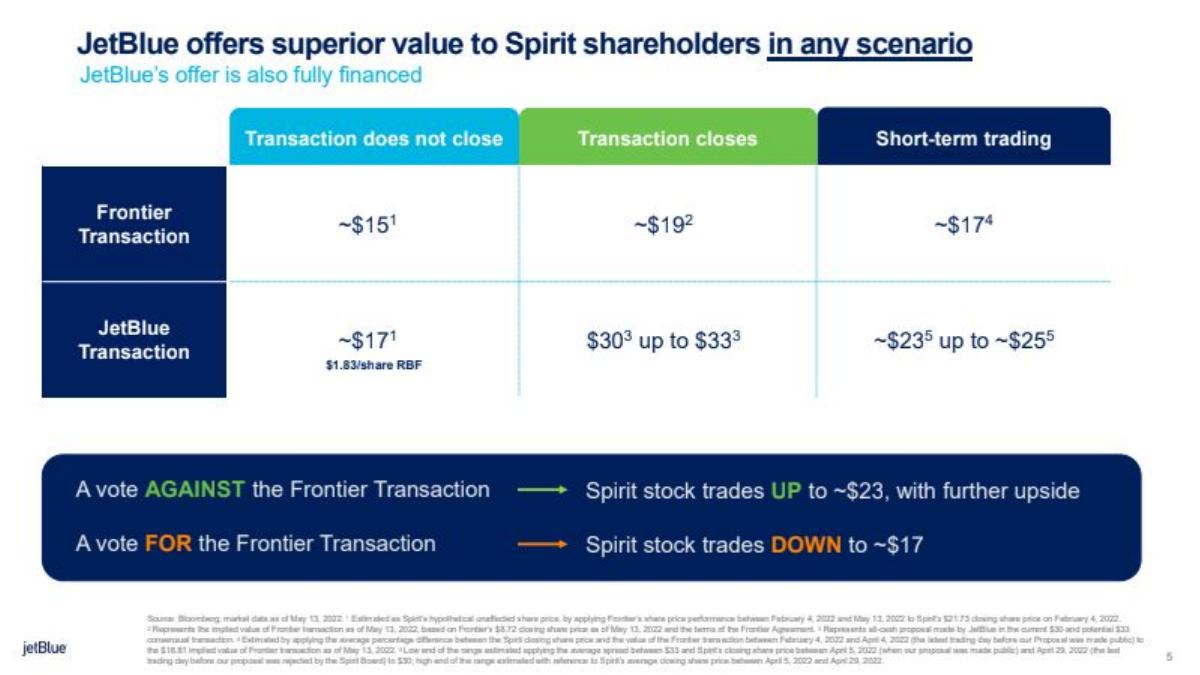
- JetBlue highlights a 'Reverse Break-up Fee' (RBF) of $1.83 per share to provide certainty if the deal fails to close (Slide 5).
- The presentation accuses the Spirit Board of entrenchment, noting that 5 out of 8 Spirit Directors were promised seats on the combined Frontier-Spirit entity (Slide 7).
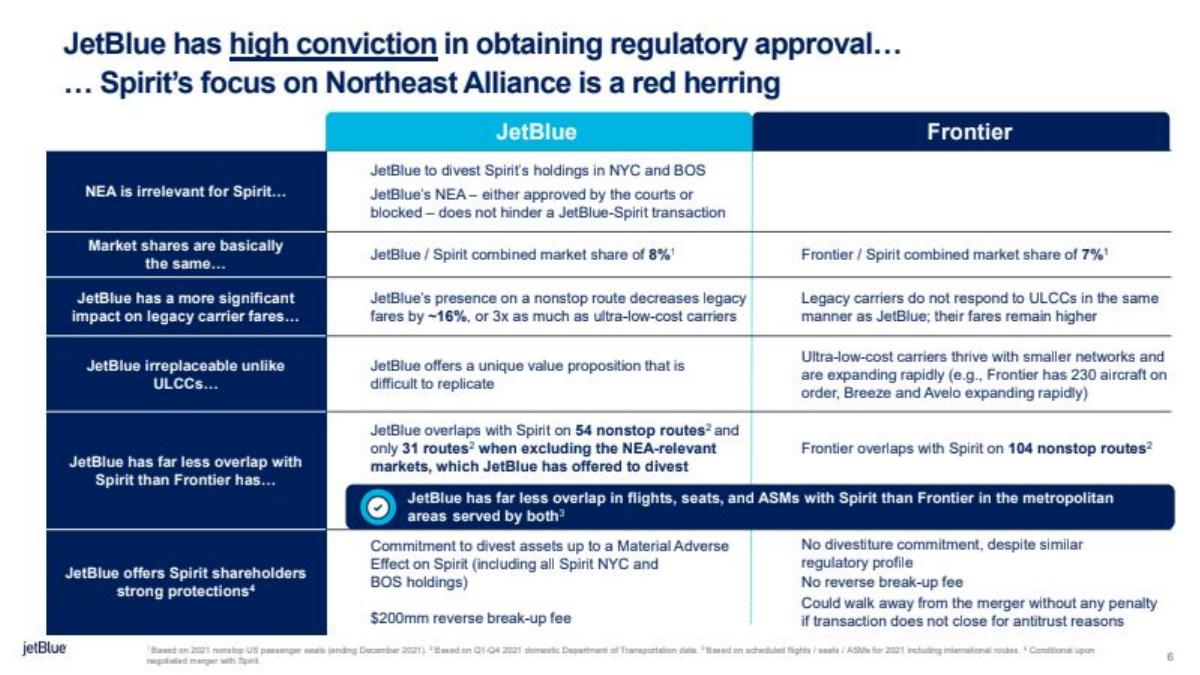
- JetBlue argues that both deals create a 'Number 5' player with similar market shares—8% for JetBlue-Spirit vs. 7% for Frontier-Spirit (Slide 27).
- The 'JetBlue Effect' is cited as a regulatory defense, claiming the airline has saved consumers over $10 billion since its founding (Slide 19).
- The deck lists specific asset advantages, including a combined fleet size of 455 aircraft and 312 aircraft in the order book (Slide 21).
- JetBlue explicitly encourages Spirit shareholders to exercise appraisal rights under Section 262 of the Delaware General Corporation Law (Slide 9).
The Hostile Bid: JetBlue’s Strategic Play for Spirit
This investor presentation, dated May 16, 2022, represents a pivotal moment in aviation history. JetBlue was not just pitching a merger; they were launching a hostile takeover attempt to break up a planned merger between Spirit Airlines and Frontier Airlines. The deck is designed to speak directly to Spirit shareholders, bypassing a board that JetBlue claimed was refusing to act in good faith. The primary objective is to prove that JetBlue’s $30 all-cash offer is objectively superior to Frontier’s stock-based proposal.
Slides 1-3: The Value Proposition
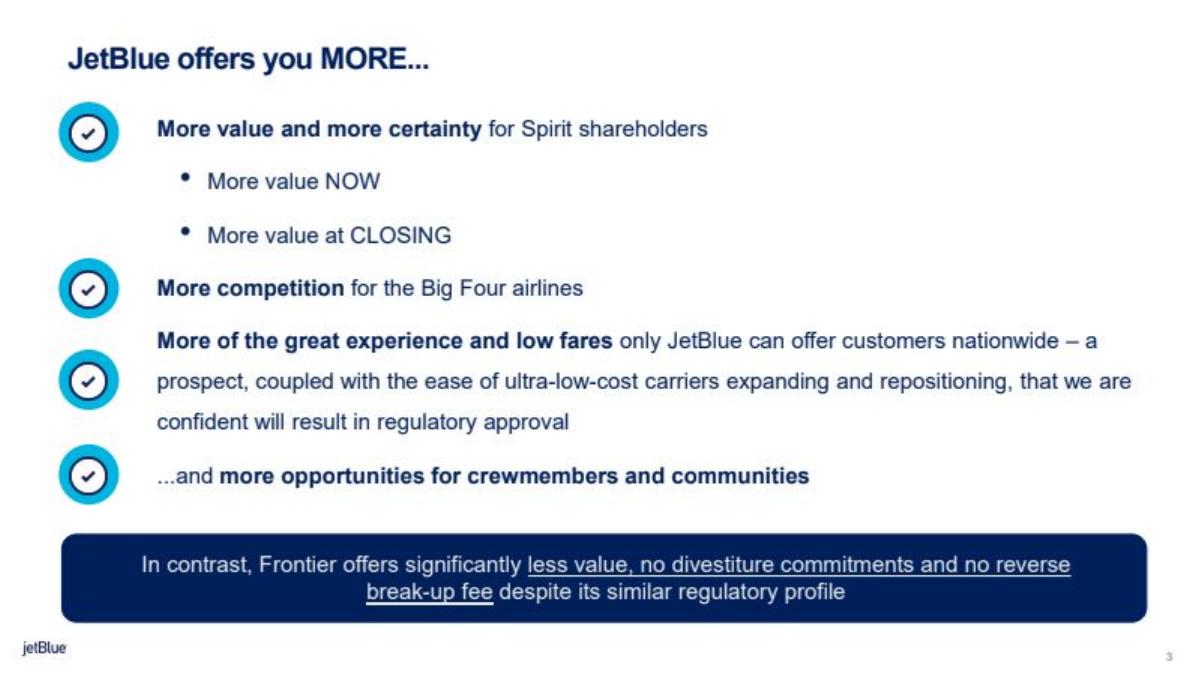
The deck opens with a bold declaration on Slide 1 : "JetBlue’s $30 all-cash proposal offers MORE." This sets the tone for the entire presentation—a focus on quantifiable, immediate value. Slide 3 expands on this by promising "More value NOW" and "More value at CLOSING." It also introduces the competitive angle, claiming the merger would create a stronger challenger to the "Big Four" airlines (American, Delta, United, and Southwest). Crucially, the bottom of Slide 3 contains a direct attack on Frontier, noting that their offer provides "significantly less value" and lacks divestiture commitments or a reverse break-up fee.
Slides 5-9: Financial Comparisons and Legal Rights
Slide 5 is one of the most important slides for a shareholder. It provides a side-by-side comparison of the Frontier and JetBlue transactions across three scenarios: if the transaction does not close, if it closes, and short-term trading. JetBlue highlights that if the deal fails to close, Spirit shareholders would still receive a ~$1.83 per share Reverse Break-up Fee (RBF) from JetBlue, whereas Frontier offered no such protection at the time. Slide 7 introduces the theme of "Board Entrenchment," alleging that the Spirit Board failed to perform a market check and was influenced by ties to Frontier’s Bill Franke. Slide 9 takes a legalistic turn, educating shareholders on their "appraisal rights" under Delaware law, essentially telling them they can go to court to get a fair price if they believe the Frontier deal undervalues the company.
Slides 11-15: The Premium Argument
Slide 11 summarizes the key takeaways, reiterating the "superior value" and "strong conviction" in closing. Slide 13 provides the mathematical core of the deck. It shows that JetBlue’s $30 offer represents a 60% premium over the implied value of the Frontier transaction ($18.81) as of May 13, 2022. It also notes that the Frontier offer had already declined by $7.02 per share due to market risk. Slide 15 uses a probability matrix to show that even at low probabilities of closing, the JetBlue deal offers higher expected value than the Frontier deal.
Slides 17-19: The Regulatory Defense and the "JetBlue Effect"
The presentation shifts to address the biggest hurdle: regulatory approval. Slide 17 calls the Spirit Board’s regulatory concerns a "red herring." Slide 19 introduces the "JetBlue Effect," citing DOJ and MIT studies to prove that JetBlue is a "uniquely disruptive" force that lowers fares. This is a strategic move to frame the merger as pro-consumer, a key requirement for antitrust clearance.
Slides 21-23: Scale and Competition
Slide 21 outlines the industrial logic of the deal. A combined JetBlue-Spirit would have 455 aircraft, 130+ destinations, and 312 aircraft on order. This scale is positioned as necessary to challenge the Big Four. Slide 23 argues that even if Spirit is absorbed by JetBlue, competition in the Ultra-Low-Cost Carrier (ULCC) segment will remain healthy due to the rapid growth of Frontier, Sun Country, Allegiant, Avelo, and Breeze.
Slides 25-29: Debunking the Spirit Board’s Arguments
Slide 25 addresses the Northeast Alliance (NEA) with American Airlines, which Spirit’s Board cited as a regulatory blocker. JetBlue argues the NEA is irrelevant to the Spirit acquisition and that they are willing to divest assets in key cities to satisfy regulators. Slide 27 uses pie charts to show that a JetBlue-Spirit merger only results in an 8% market share, compared to 7% for a Frontier-Spirit merger. The message is clear: the difference is negligible. Slide 29 quotes analysts from Deutsche Bank and Raymond James who support the view that both deals have similar regulatory profiles.
Slides 31-33: The Attack on Board Fiduciary Duty
Slide 31 is a direct character attack on the Spirit Board. It features a diagram showing the ties between Spirit Chairman Mac Gardner, other directors, and Frontier’s Bill Franke. It explicitly states that "Frontier has promised Board seats on the combined entity to 5 out of the 8 current Spirit Directors." Slide 33 accuses the Board of "stonewalling" JetBlue and misleading investors about their willingness to negotiate.
Slides 35-37: Customer Experience and Conclusion
Slide 35 pivots to the consumer, highlighting JetBlue’s award-winning service, including "most legroom in coach" and free Wi-Fi. This contrasts with Spirit’s reputation as a no-frills carrier, suggesting that JetBlue will upgrade the Spirit experience. Finally, Slide 37 repeats the opening message: JetBlue offers more value, more certainty, and more competition.
What Works in This Deck
The "Value Gap" Visuals: Slide 13 is a masterclass in showing, not just telling, why one offer is better than another. The use of color-coded bars to show the declining value of the Frontier bid is highly effective. · Aggressive Transparency: By listing the names and affiliations of the Spirit Board (Slide 31), JetBlue creates a narrative of "Shareholders vs. The Board," which is a powerful tool in a hostile bid. · Regulatory Pre-emption: Instead of waiting for regulators to complain, JetBlue uses Slide 27 to show that their market share impact is nearly identical to the deal the Board already approved. · The Reverse Break-up Fee: Highlighting the $1.83 per share cash protection (Slide 5) provides a "floor" for investors, making the risk of the deal failing more palatable.
What is Missing or Obscured
Integration Risk: The deck glosses over the massive difficulty of merging a premium service airline (JetBlue) with an ultra-low-cost carrier (Spirit). The fleet commonality is mentioned, but the cultural and operational clash is ignored. · The NEA Legal Reality: While Slide 25 calls the NEA litigation "irrelevant," it was a major factor in the DOJ's eventual opposition to the merger. The deck downplays the cumulative antitrust scrutiny of having both the NEA and the Spirit merger. · Long-term Debt: The deck focuses on the $3.8B cash offer but does not detail the debt load JetBlue would take on to finance this acquisition, which was a concern for JetBlue’s own shareholders.
What a Founder Should Copy
The "Superior Alternative" Framework: If you are in a competitive fundraising or M&A situation, use the side-by-side comparison format from Slide 5. It forces the viewer to choose between two sets of data rather than evaluating you in a vacuum. Anticipating Objections: JetBlue dedicated nearly a third of the deck (Slides 17-29) to regulatory concerns. Founders should similarly dedicate significant space to their most likely "no" reasons. Third-Party Validation: Using analyst quotes (Slide 29) and DOJ/MIT studies (Slide 19) adds a layer of objectivity that internal company claims lack. Clear Call to Action: The deck is very clear about what it wants shareholders to do: vote AGAINST the Frontier transaction and exercise appraisal rights. Every pitch deck should have a similarly clear and singular "Ask."
Frequently asked questions
- Why did JetBlue make an all-cash offer instead of a stock merger?
- JetBlue used an all-cash offer of $30 per share to provide 'value certainty' and 'immediate liquidity' to Spirit shareholders. As shown on Slide 13, Frontier’s stock-based offer was subject to market volatility and had already declined in value by approximately $770 million. By offering cash, JetBlue removed market risk for the sellers, making their bid mathematically harder for the Spirit Board to ignore.
- How did JetBlue address the risk of the deal being blocked by regulators?
- JetBlue argued that the regulatory profiles of both the Frontier and JetBlue deals were nearly identical. On Slide 27, they showed that a JetBlue-Spirit merger would result in an 8% market share, only one percentage point higher than a Frontier-Spirit merger. They also cited the 'JetBlue Effect' (Slide 19) to argue that their presence in a market actually lowers fares, which is a pro-competitive outcome.
- What were the specific allegations against the Spirit Board of Directors?
- JetBlue alleged that the Spirit Board was 'entrenched and conflicted.' Specifically, Slide 31 points out that Chairman Mac Gardner and other directors were originally appointed by Bill Franke, the majority shareholder of Frontier. JetBlue argued that the Board's refusal to negotiate was a result of these personal ties rather than a pursuit of maximum shareholder value.
- What is the 'JetBlue Effect' mentioned in the deck?
- The 'JetBlue Effect' is a term recognized by the DOJ and MIT researchers (Slide 19) describing JetBlue's tendency to significantly lower legacy airline fares when it enters a new market. JetBlue used this as a core pillar of their argument to prove that their acquisition of Spirit would benefit consumers more than a merger with Frontier, an Ultra-Low-Cost Carrier (ULCC).
- What happened to the Northeast Alliance (NEA) during these negotiations?
- The NEA was a partnership between JetBlue and American Airlines that Spirit's Board claimed would prevent a JetBlue-Spirit merger from being approved. JetBlue countered on Slide 25, stating that the NEA was 'pro-competitive' and that they were committed to divesting Spirit’s holdings in NYC and Boston to address any overlap, making the NEA litigation irrelevant to the merger.