FriendlyData’s 2018 seed deck is a study in extreme brevity, consisting of only seven slides. At a time when natural language processing (NLP) was becoming a primary focus for enterprise business intelligence, the company secured $530,000 by focusing on a clear value proposition: 'Communicate With Databases Like A Human.' The deck avoids dense technical jargon, opting instead for a clean UI mockup and a high-level architectural diagram showing compatibility with major database providers like Amazon Redshift and Oracle. While it lacks traditional sections like a detailed competition slide or a…
Key takeaways
- The deck leads with a clear, human-centric value proposition on Slide 1: 'Communicate With Databases Like A Human.'
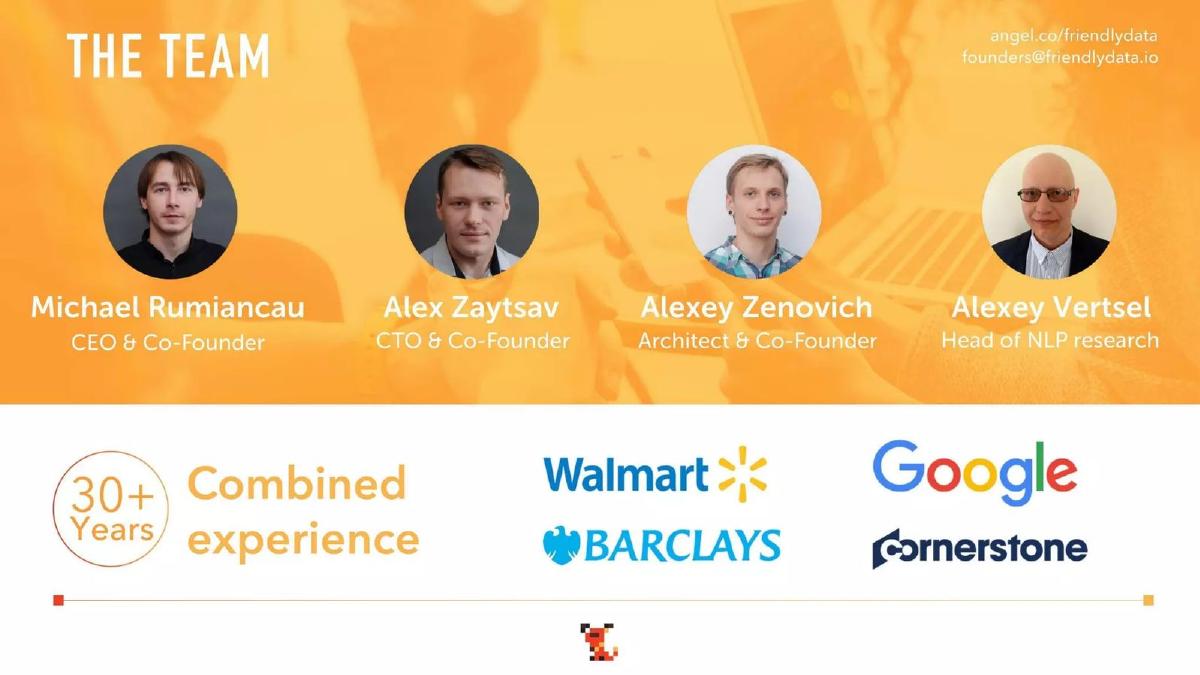
- The team slide (Slide 2) emphasizes '30+ Years Combined experience' and features logos from Google, Walmart, and Barclays to establish immediate technical credibility.
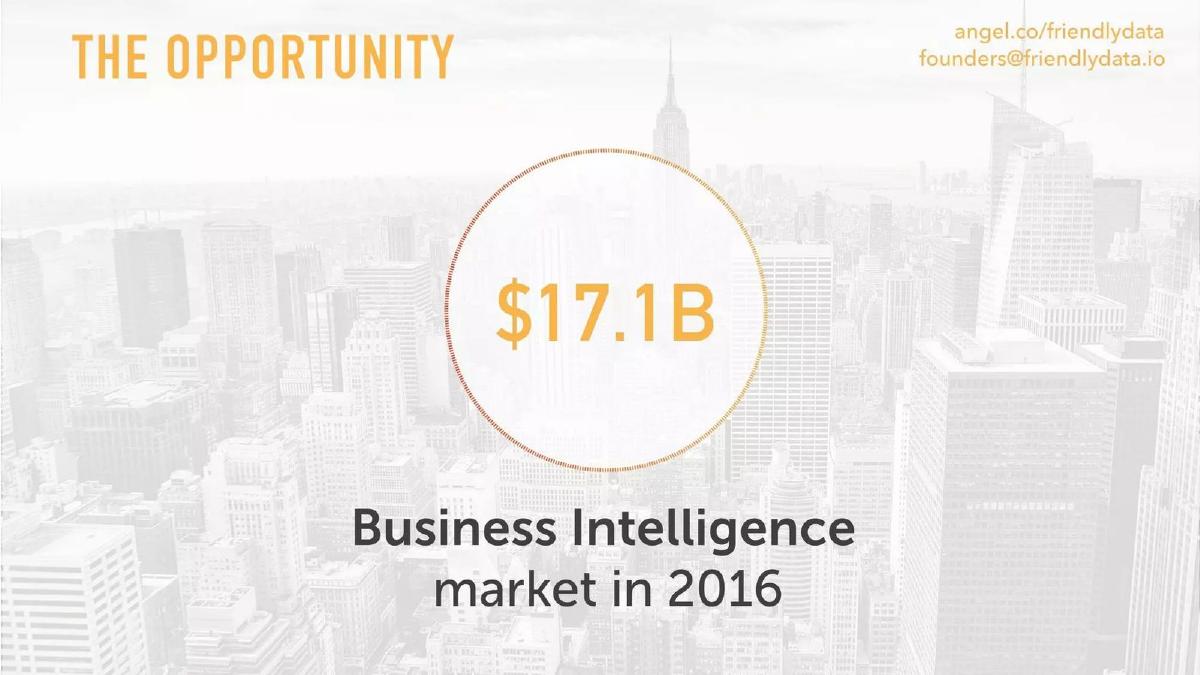
- Market size is presented as a single, massive figure: $17.1B for the Business Intelligence market in 2016 (Slide 3).
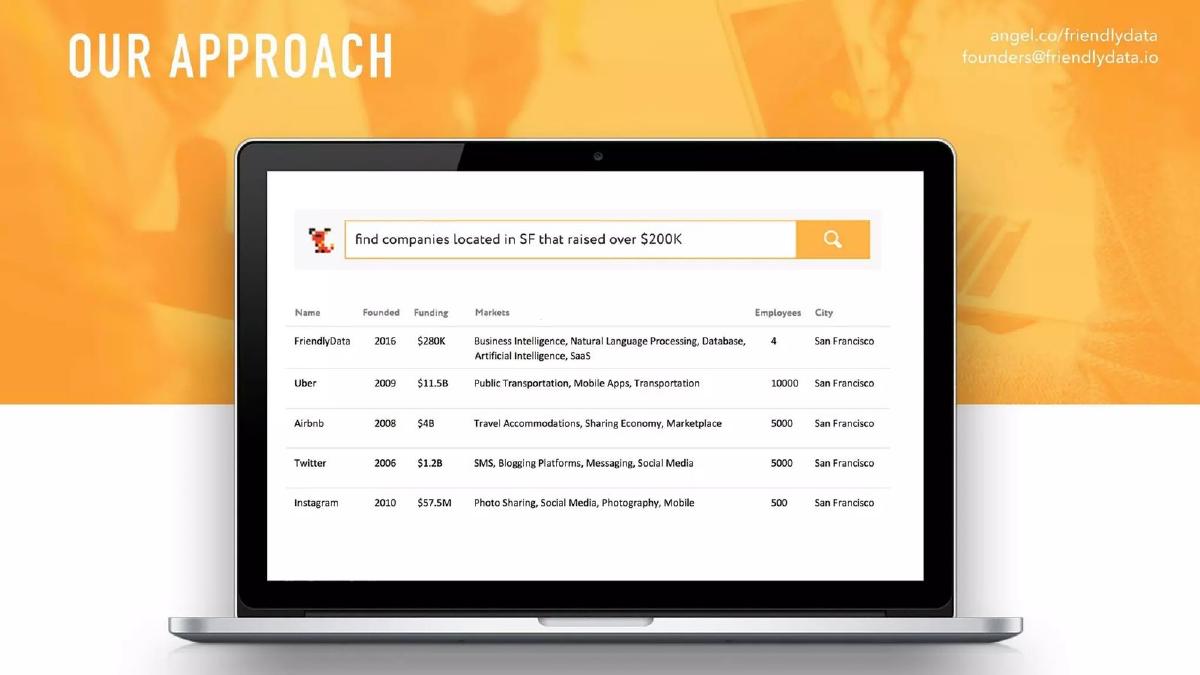
- Product functionality is demonstrated through a simple search bar mockup on Slide 4, showing a natural language query returning structured data.
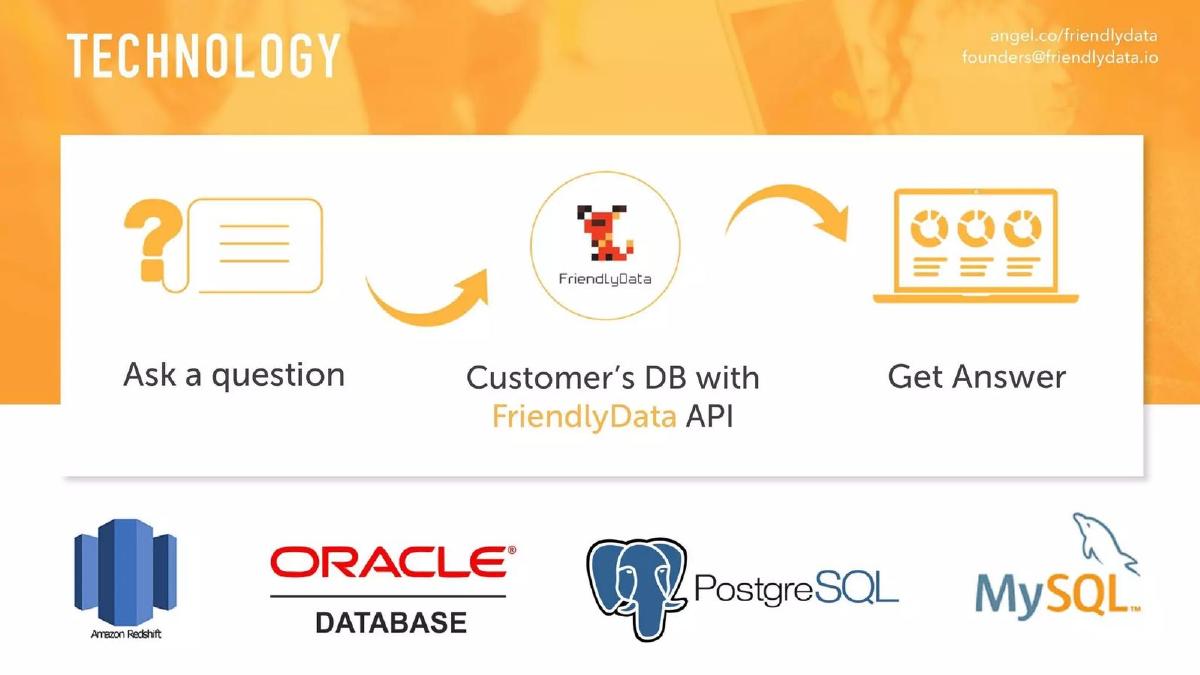
- The technology stack (Slide 5) highlights interoperability with major enterprise databases including Amazon Redshift, Oracle, PostgreSQL, and MySQL.
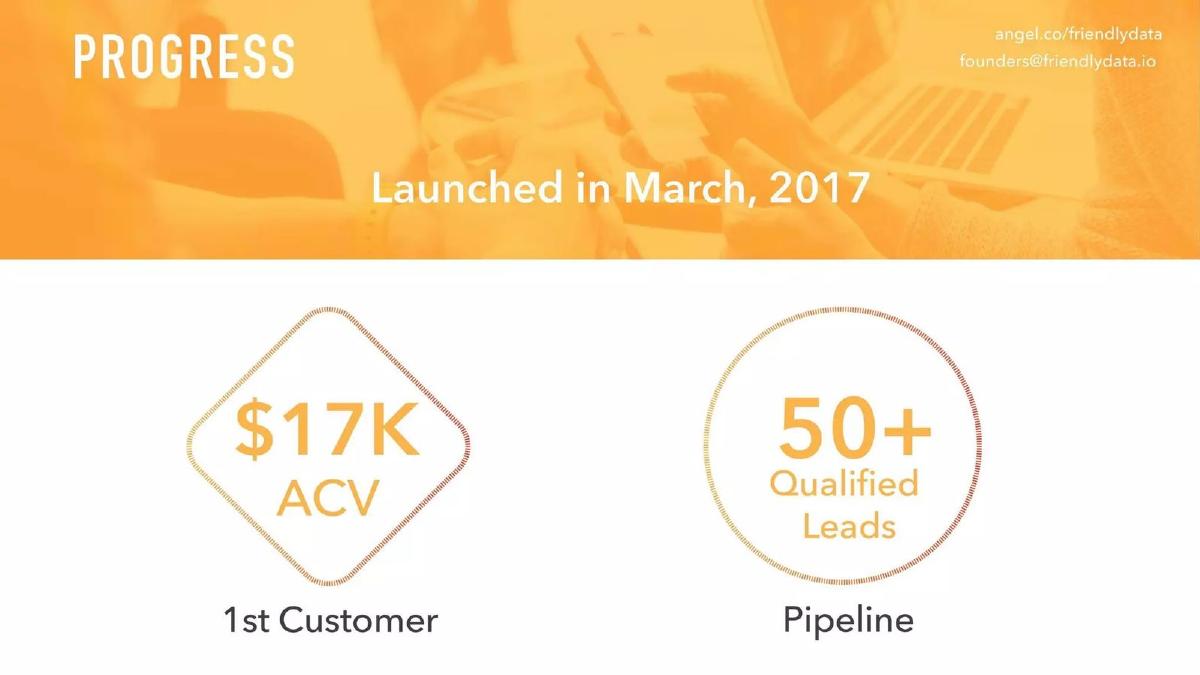
- Traction is quantified on Slide 6 with a specific $17K ACV from the first customer and a pipeline of 50+ qualified leads.
- The deck completely omits a formal 'Ask' slide, business model details, and a competitive landscape analysis.
- The design remains consistent throughout, using a high-contrast orange and white color palette with a recurring pixel-art fox mascot.
The 7-Slide Seed Deck: FriendlyData’s Minimalist Pitch
FriendlyData’s 2018 pitch deck is an exercise in restraint. In an industry often bogged down by complex architectural diagrams and dense data science terminology, this San Francisco-based startup opted for a high-level, visual-first approach. The goal was simple: prove that they could make enterprise data accessible to non-technical users through a natural language interface.
By the time this deck was in circulation, the company had already secured backing from 500 Startups. The narrative focuses heavily on the 'who' and the 'what,' leaving the 'how' and the 'how much' for the follow-up meeting. This teardown explores how seven slides were sufficient to secure over half a million dollars in seed funding.
The Hook and the Team
Slide 1: Title The deck opens with a clear, punchy tagline: "Communicate With Databases Like A Human." The branding is friendly, featuring a pixelated fox mascot and a warm orange color palette. It immediately identifies the problem space—database accessibility—and the solution—natural language processing—without using a single buzzword.
Slide 2: The Team Placement of the team slide at the beginning of a deck is a common tactic for technical founders with strong pedigrees. FriendlyData lists four key members: Michael Rumiancau (CEO), Alex Zaytsav (CTO), Alexey Zenovich (Architect), and Alexey Vertsel (Head of NLP research). The bottom half of the slide is dedicated to social proof, highlighting "30+ Years Combined experience" and featuring logos for Walmart, Barclays, Google, and Cornerstone. This tells the investor that while the startup is new, the people building it have survived at the highest levels of enterprise tech.
Market and Product Vision
Slide 3: The Opportunity The market slide is perhaps the most minimalist in the deck. It features a single figure: "$17.1B Business Intelligence market in 2016." While it lacks a Bottom-Up TAM/SAM/SOM analysis, it serves its purpose in a seed round by establishing that the company is playing in a massive, established category. The background image of a city skyline reinforces the enterprise scale of the ambition.
Slide 4: Our Approach Instead of a feature list, Slide 4 uses a clean UI mockup. It shows a search bar with the query "find companies located in SF that raised over $200K." Below the bar, a structured table displays results including FriendlyData, Uber, and Airbnb. This is a highly effective way to demonstrate the product's value proposition: it takes a complex SQL-style query and allows a user to type it as a sentence, receiving a clean data visualization in return.
Technical Foundation and Traction
Slide 5: Technology This slide bridges the gap between the user interface and the backend. It uses a simple three-step flow: "Ask a question" -> "Customer’s DB with FriendlyData API" -> "Get Answer." Crucially, it lists the logos of Amazon Redshift, Oracle, PostgreSQL, and MySQL at the bottom. For an enterprise investor, this slide answers the most important technical question: "Does this work with the legacy systems my customers already use?"
Slide 6: Progress Traction is the heartbeat of any seed deck. FriendlyData notes a launch date of March 2017. They highlight two key metrics: a "$17K ACV" from their first customer and a pipeline of "50+ Qualified Leads." For a seed-stage company, having a five-figure ACV from the very first customer is a strong signal of willingness to pay in the enterprise sector. It suggests that the product isn't just a 'nice-to-have' tool but a value-generating asset.
The Closing
Slide 7: Thank You The deck ends with a contact slide. It provides the AngelList profile, the website URL, and a general founder email address. Notably, there is no 'Ask' slide in this version of the deck. This is common when decks are used as 'teasers' to get a meeting rather than the full presentation used during the meeting itself.
What Works in This Deck
Clarity of Purpose: Within ten seconds of looking at Slide 1 and Slide 4, an investor knows exactly what the product does. · Pedigree: The team slide uses recognizable logos to offset the risk of a young founding team. · Integration Focus: By showing logos like Oracle and Redshift, the founders acknowledge that they are an 'add-on' to existing workflows rather than a 'rip-and-replace' solution, which is a much easier sell in enterprise. · Visual Consistency: The deck is professional, uncluttered, and uses a consistent design language that feels 'friendly,' matching the company name.
What is Missing
The Ask: There is no mention of how much capital is being raised or how it will be allocated (e.g., hiring more NLP engineers vs. sales). · Competition: The BI space is crowded with giants (Tableau, Looker) and other NLP startups. The deck doesn't explain why FriendlyData’s approach is superior or more defensible. · Business Model: Beyond the $17K ACV mention, there is no explanation of the pricing tiers or the 'land and expand' strategy. · Case Study: While they mention a first customer, a brief quote or a specific use case (e.g., 'Reduced data request turnaround from 2 days to 2 seconds') would have added significant weight.
What a Founder Should Copy
The 'Approach' Slide: Using a mockup of a search bar to explain a complex backend technology is brilliant. It focuses on the user's experience rather than the code. · The Traction Diamond/Circle: Slide 6 uses simple geometric shapes to highlight key numbers. This is much more readable than a dense table of metrics. · The Tagline: "Communicate With Databases Like A Human" is an A+ example of a value proposition. It is devoid of jargon and describes the end-state for the user. · Brevity: If you can tell your story in 7 slides, don't use 20. This deck respects the investor's time and focuses only on the highest-leverage information.
Frequently asked questions
- How much did FriendlyData raise with this deck?
- According to the catalogue facts, FriendlyData raised $530,000 in 2018 during their Seed round. The deck itself does not state the amount being raised, which is a common omission in decks shared publicly after a round closes.
- What is the core technology behind FriendlyData?
- As shown on Slide 5, the core technology is a Natural Language Processing (NLP) API that sits between the user and the customer's database. It translates human questions into queries for databases like Oracle, Redshift, and MySQL, then returns the answer in a structured format.
- Does the deck show any revenue or traction?
- Yes, Slide 6 (Progress) indicates that the company launched in March 2017. It lists their first customer with an Annual Contract Value (ACV) of $17,000 and claims a pipeline of over 50 qualified leads.
- Who are the founders of FriendlyData?
- Slide 2 identifies the leadership team: Michael Rumiancau (CEO), Alex Zaytsav (CTO), Alexey Zenovich (Architect), and Alexey Vertsel (Head of NLP research). The slide highlights their collective 30+ years of experience.
- What is missing from this pitch deck?
- The deck is missing several standard components: a competitive landscape, a detailed business model/pricing strategy, a roadmap of future features, and a specific 'Ask' slide detailing how the funds will be used.