FreightRoll’s 2017 deck is an exercise in extreme brevity, relying on large-scale imagery and high-level market figures to sell a vision of a digital 'Operating System for Trucking.' The company identifies a massive $700B market plagued by $100B in waste, positioning its platform as the solution to archaic, paper-based processes. Despite the lack of specific product feature breakdowns or a detailed business model, the deck successfully communicates momentum through a 20% week-over-week increase in its carrier base and a jump to over $550K in annualized revenue. By focusing on the 'who' (a tea…
Key takeaways
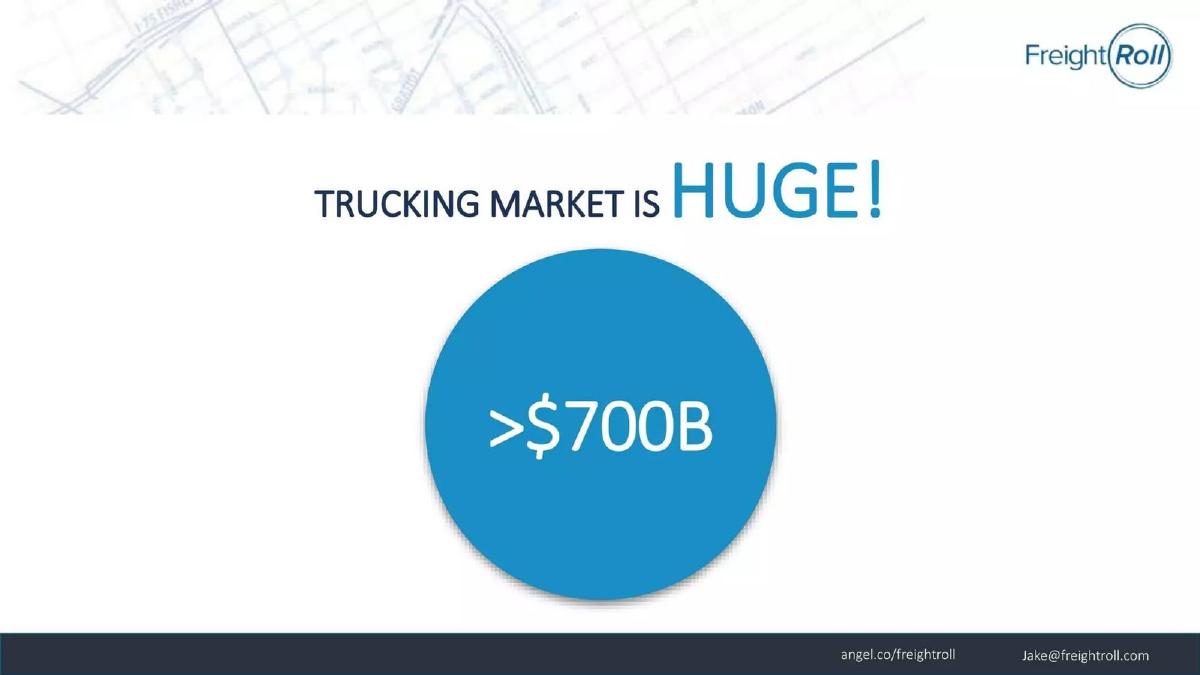
- The trucking market is valued at over $700 billion, with an estimated $100 billion lost to waste (Slide 7).
- The company positions itself as an 'Operating System for Trucking' rather than just another freight matching app (Slide 10).
- The trucker base grew by 20% week-over-week starting in July, reaching a total of almost 14,000 trucks (Slide 12).
- Gross revenues exceeded $30,000 in September, representing a 30% month-over-month growth rate (Slide 14).
- The business reached an annualized revenue run rate of over $550,000 by the time of the deck's creation (Slide 15).
- The core team features leaders with experience from major firms like Citadel, XPO Logistics, and Con-way (Slide 11).
- Total staff experience is cited as over 70 years, emphasizing deep domain expertise in a complex industry (Slide 16).
- Current customers and pilots include Universal Forest Products, Griffon, and Man Crates (Slide 13).
Executive Summary: The Minimalist Vision for Logistics
FreightRoll’s 2017 pitch deck is a striking example of 'less is more.' In an industry as complex and data-heavy as logistics, the founders chose to strip away the jargon and technical diagrams in favor of a high-level narrative. The deck uses 16 slides to establish a massive market opportunity, identify a specific pain point (waste), and demonstrate early revenue acceleration. By positioning themselves as an 'Operating System' rather than a simple marketplace, FreightRoll attempts to claim a more foundational role in the supply chain ecosystem.
Slides 1-5: Setting the Scene and the Problem
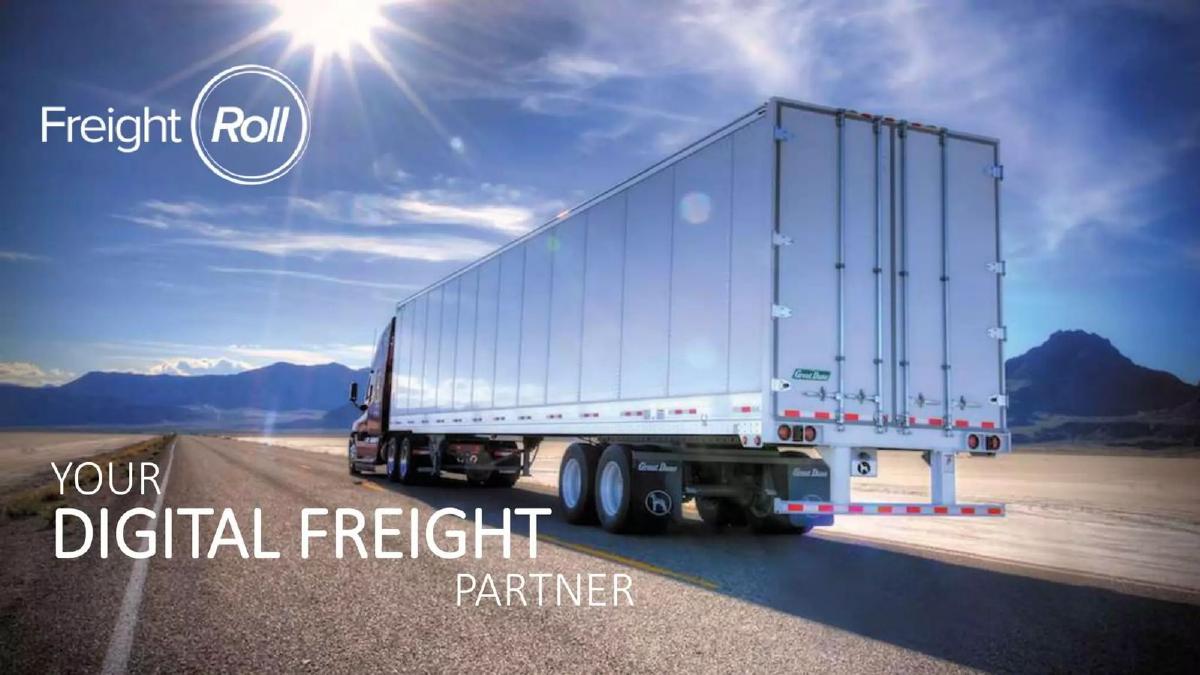
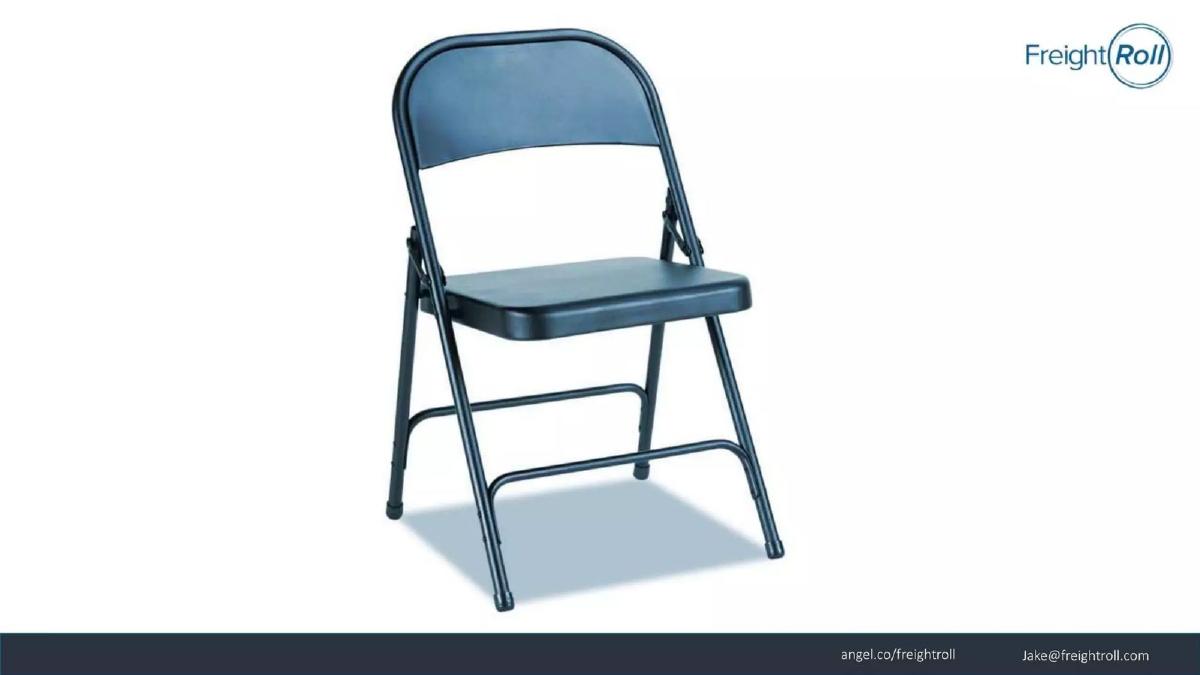
Slide 1 serves as the title card, featuring a high-quality image of a semi-truck on an open highway with the tagline 'YOUR DIGITAL FREIGHT PARTNER.' It establishes the industry immediately without clutter. Slide 2 is an unusual choice: a simple image of a folding chair. In a live presentation, this likely served as a prop for a story about the 'waiting game' or the low-tech nature of current operations, but as a standalone slide, it is cryptic. Slide 3 introduces the market size, stating the 'TRUCKING MARKET IS HUGE!' and citing a figure of >$700B . This is a standard 'TAM' (Total Addressable Market) slide designed to anchor the investor in the scale of the opportunity.
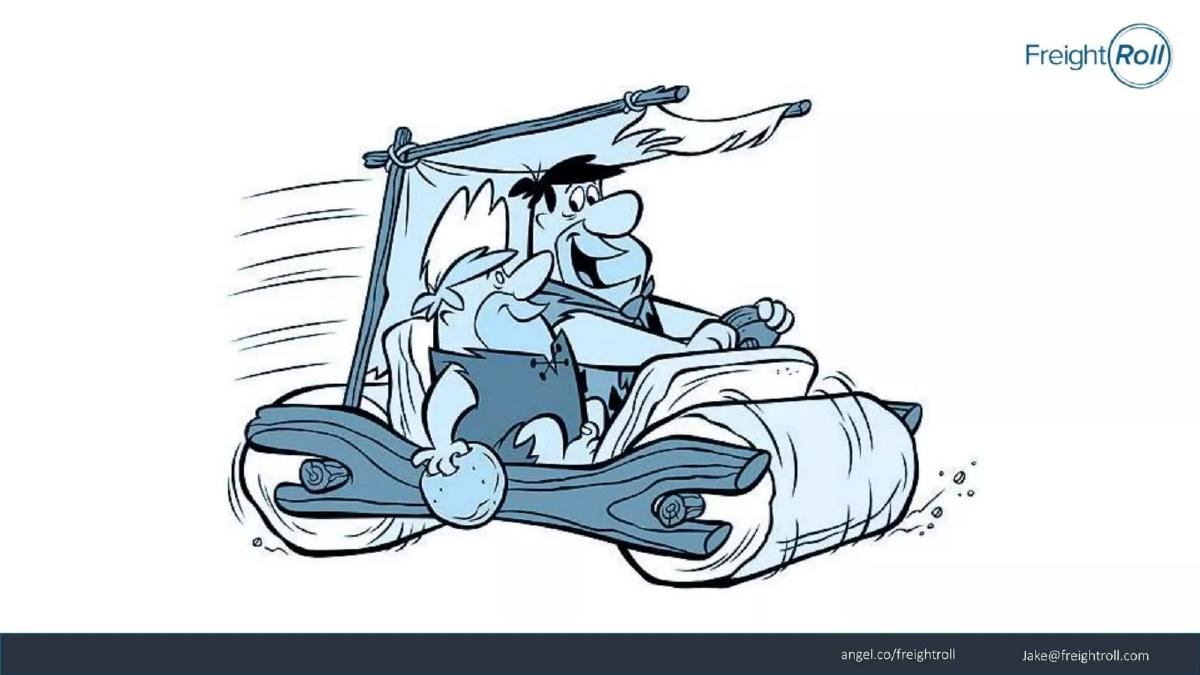
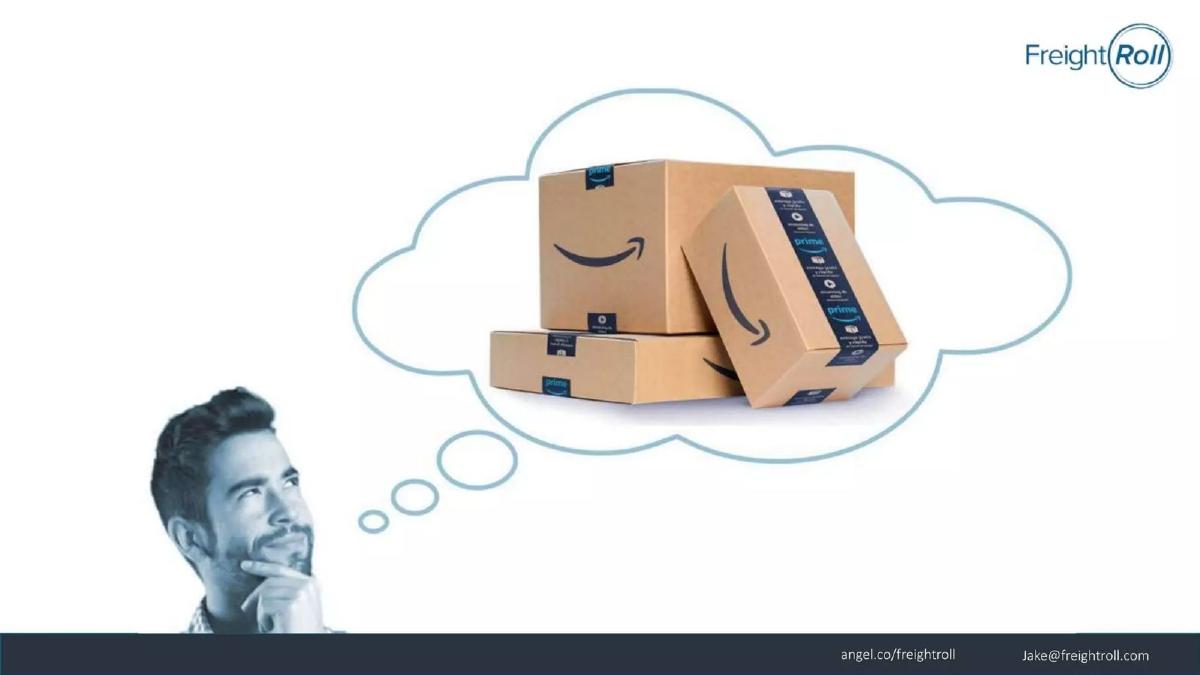
Slide 4 uses a cartoon of The Flintstones in their stone-wheeled car, a visual metaphor for the archaic, 'stone age' technology currently used in the freight industry. Slide 5 shifts to the modern consumer expectation, showing a man thinking about Amazon Prime boxes. This contrast highlights the 'Amazon Effect'—the gap between modern consumer logistics and the outdated B2B trucking infrastructure.
Slides 6-9: Defining the Opportunity and the Pivot
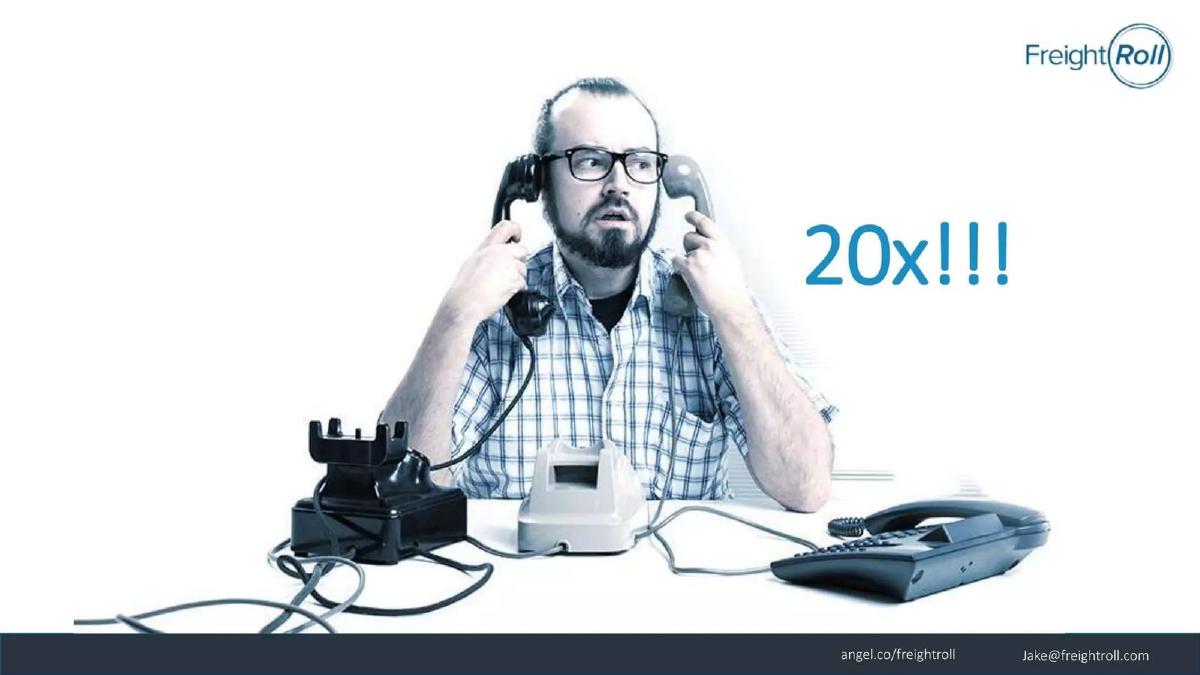
Slide 6 features a man overwhelmed by multiple landline telephones, with the text '20x!!!' . This likely refers to the inefficiency of manual communication in freight brokerage. Slide 7 quantifies the 'Problem' slide by stating there is >$100B in Waste within that $700B market. This is a crucial slide because it moves the conversation from market size to the specific value FreightRoll intends to capture. Slide 8 repeats the cover image, acting as a transition back to the solution.
Slide 9 is perhaps the most important strategic slide in the deck. It states in bold letters: 'WE ARE NOT ANOTHER FREIGHT MATCHING APP!' In 2017, the 'Uber for Trucking' space was incredibly crowded. By explicitly distancing themselves from freight matching, FreightRoll signals to investors that they are solving a different, perhaps more defensible, problem.
Slides 10-11: The Product and The People
Slide 10 introduces the 'OPERATING SYSTEM FOR TRUCKING.' It shows the product interface across a tablet and a smartphone. The UI appears to include map tracking, shipment info, and chat functionality. While it doesn't list features like 'FreightBOL' or 'FreightLEDGER' by name (those are found in the catalogue description), it visually communicates a centralized digital hub for logistics data. Slide 11 introduces the team using avatars instead of photos. The slide highlights >40 YEARS OF EXPERIENCE at companies like Citadel, Con-way, and XPO Logistics . It also notes TWO VC EXITS , which is a significant trust signal for early-stage investors.
Slides 12-16: Traction and Summary
Slide 12 shows a growth chart of the 'Trucker base,' noting it is up 20% WoW (Week-over-Week) since July . A footer adds that this 'REPRESENTS ALMOST 14K TRUCKS!' This is a strong indicator of supply-side adoption. Slide 13 lists 'CURRENT CUSTOMERS' and 'PILOTS.' Notable names include Universal Forest Products, Griffon, and Man Crates . Showing a mix of established industrial firms and modern e-commerce brands suggests broad product-market fit.
Slide 14 focuses on 'Gross revenues,' which are up 30% MoM (Month-over-Month) . The chart shows a jump from under $5,000 in July to >$30K in September. Slide 15 extrapolates this into an >$550K ANNUALIZED run rate. Finally, Slide 16 provides a summary of the key pillars: >70 years of experience on staff (an increase from the 40 years cited for the core team earlier), the $700B+ industry with $100B+ in waste , and the $550K annualized revenue with 30% MoM growth .
What Works in This Deck
The primary strength of this deck is its clarity of momentum . By focusing on week-over-week and month-over-month growth rates, the founders create a sense of urgency. The revenue chart on Slide 14 is particularly effective because it shows a clear 'hockey stick' inflection point starting in July. Another success is the anti-positioning on Slide 9. By telling investors what they are not , they avoid being lumped in with dozens of failing freight-matching startups and force the investor to ask, 'If not matching, then what?' This opens the door for the 'Operating System' pitch.
What Is Missing
The most glaring omission is a detailed business model . While the deck mentions 'Gross revenues,' it does not explain how the company makes money. Is it a SaaS fee per truck? A transaction fee per Bill of Lading? A percentage of the shipping cost? Without this, it is hard to judge the quality of the $550K run rate. Additionally, there is no 'Ask' slide . A pitch deck should typically conclude with how much money is being raised and what milestones that capital will achieve. Finally, the technical 'how' is absent . The catalogue mentions 'patent-pending technology' and 'FreightLEDGER,' but the deck itself is entirely silent on the underlying tech stack or how they actually eliminate the $100B in waste.
What a Founder Should Copy
Founders should emulate the visual hierarchy used here. Each slide has one main point, usually expressed in a large, bold font. This ensures that even a distracted investor skimming the deck will catch the $700B market size, the 20% WoW growth, and the $550K revenue figure. The use of social proof on Slide 13 is also well-executed; by grouping logos into 'Current Customers' and 'Pilots,' the founders show both existing stability and a future pipeline. Lastly, the summary slide (Slide 16) is an excellent way to reinforce the three most important reasons to invest: team expertise, market opportunity, and proven traction.
Final Thoughts
FreightRoll’s deck is designed for a high-level introductory meeting. It relies heavily on the presenter to fill in the gaps regarding product functionality and unit economics. While the lack of an 'Ask' and a clear business model might be frustrating for a cold-read investor, the sheer speed of their 2017 growth likely served as a powerful hook to get a second meeting. It is a deck that sells a 'train leaving the station' rather than a technical manual.
Frequently asked questions
- What is FreightRoll's primary product according to the deck?
- While the slides are minimalist, the company describes itself as an 'Operating System for Trucking' on Slide 10. The catalogue listing clarifies that this includes FreightBOL (a paperless bill of lading), FreightVISION (tracking), and FreightLEDGER (a secure data repository). The deck focuses on the transition from archaic paper processes to a digital platform.
- How does FreightRoll differentiate itself from competitors?
- On Slide 9, the company explicitly states, 'WE ARE NOT ANOTHER FREIGHT MATCHING APP!' This suggests they are moving away from the crowded marketplace model to focus on the underlying infrastructure and documentation of the freight industry, which they call the 'Operating System' on Slide 10.
- What evidence of market traction does the deck provide?
- The deck provides three key metrics: a 20% week-over-week growth in the trucker base (Slide 12), a 30% month-over-month growth in gross revenue (Slide 14), and reaching an annualized revenue run rate exceeding $550,000 (Slide 15). They also list several active customers and pilot programs on Slide 13.
- Who are the key members of the FreightRoll team?
- The team is led by CEO Jake K. (formerly of Citadel) and includes CTO Nick F., Lead Ops Matt K. (Con-way), and sales leadership from XPO Logistics. Slide 11 highlights that the team has over 40 years of experience at top trucking companies and two previous VC exits.
- What is the specific 'ask' or valuation mentioned in the deck?
- The deck completely omits a specific 'ask' slide. There is no mention of the amount of capital being raised, the intended use of funds, or the company's current valuation. This is common in decks intended for initial interest-piquing rather than final closing.