FoxType raised $225,000 in 2014 with a remarkably lean 10-slide deck that eschews traditional business slides like 'Market Size' or 'Competition.' Instead, the deck leans heavily on a personal narrative—the founder's relationship with his mother—to establish the emotional 'why' behind the product. The technical 'how' is delivered through a series of four progressive product screenshots that illustrate real-time rephrasing and politeness scoring. Despite the lack of financial projections or a formal 'ask,' the deck leverages significant social proof, citing 300,000 prototype users and press me…
Key takeaways
- The deck uses a personal narrative involving the founder at age 6 and his mother to humanize the problem of language barriers (Slides 2-3).
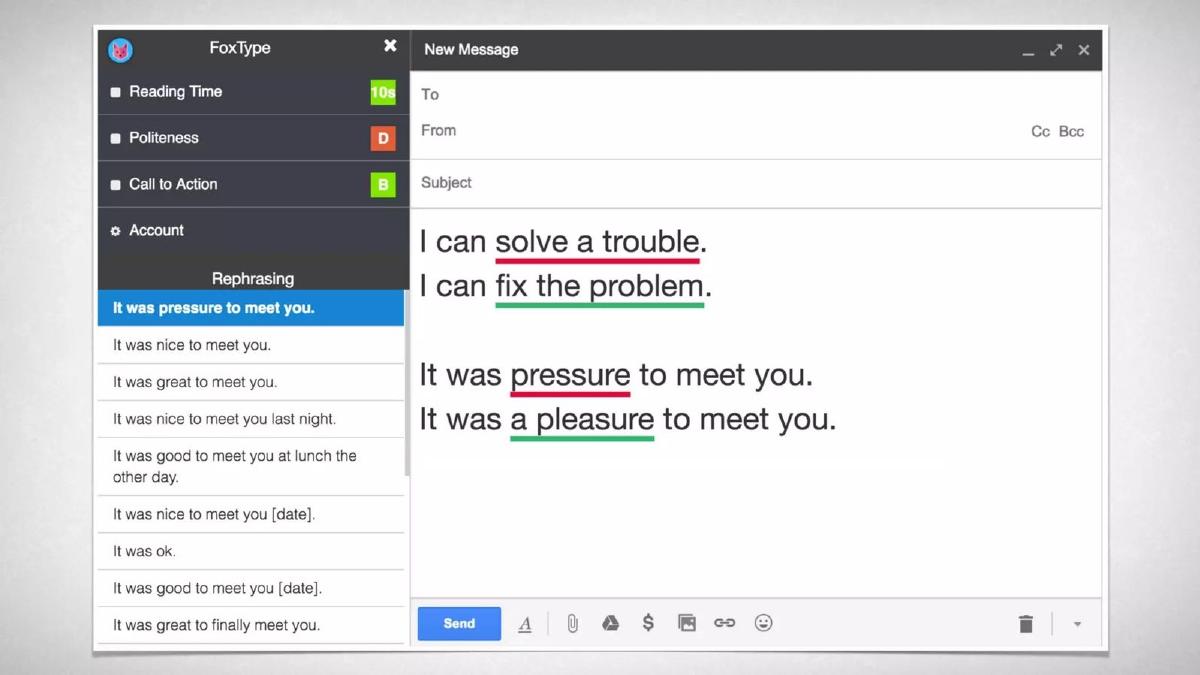
- Product functionality is demonstrated through a sidebar that scores 'Reading Time,' 'Politeness,' and 'Call to Action' (Slide 4).
- The 'Rephrasing' feature is the core value proposition, showing how 'It was pressure to meet you' is corrected to 'It was a pleasure to meet you' (Slide 6).
- Traction is quantified by a single, powerful metric: 300,000 people have used their prototypes (Slide 8).
- The company secured significant media validation early on, listing TNW, CNET, Fast Company, and Lifehacker (Slide 8).
- The team slide emphasizes a specific 'founder-problem fit' by identifying as '1st-gen immigrants, all technical' (Slide 9).
- The deck completely omits a business model, market sizing (TAM/SAM/SOM), and a specific funding ask (Slides 1-10).
- The visual design is extremely consistent, using a minimalist grey background and a specific blue/black color palette throughout.
The Power of Narrative: FoxType’s $225k Seed Deck
In 2014, the landscape for AI writing tools was far less crowded than it is today. FoxType entered the market with a clear, narrow focus: helping people write better emails. Their 10-slide pitch deck is a study in minimalism. It doesn't use buzzwords, it doesn't show a hockey-stick revenue graph, and it doesn't claim to be a 'platform.' Instead, it tells a story about human connection and backs it up with a massive user base for a prototype.
Slides 1-3: The Personal Hook
Slide 1 introduces the brand with a simple logo and the tagline: "A.I. for writing." It includes a direct contact email, setting a professional but accessible tone. The branding is clean, utilizing a fox icon that feels friendly rather than clinical.
Slide 2 and Slide 3 are unconventional for a tech deck. Slide 2 shows a childhood photo of the founder labeled "Me: age 6," and Slide 3 shows a photo of his mother labeled "Mom: age 40." There is no text explaining these slides, but in a live pitch, this is where the founder would describe the struggle of a first-generation immigrant family trying to navigate a new language. It establishes an emotional 'why' that makes the subsequent technology feel like a solution to a real human problem rather than just a utility.
Slides 4-7: The Product in Action
The middle section of the deck is a four-part progressive reveal of the product interface. This is a highly effective way to demonstrate UX without needing a video.
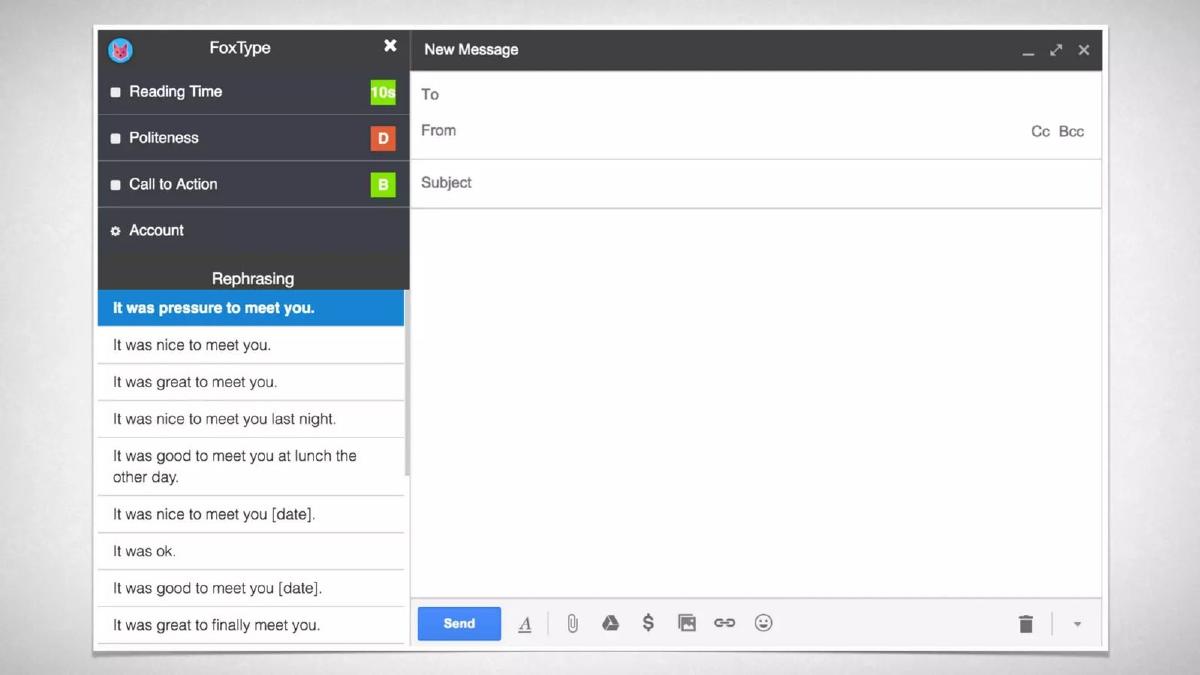
Slide 4 shows the FoxType interface integrated into a standard email compose window. We see three primary metrics: Reading Time (10s), Politeness (D), and Call to Action (B). Below this is a "Rephrasing" section. The email body is empty, but the sidebar is ready to analyze.
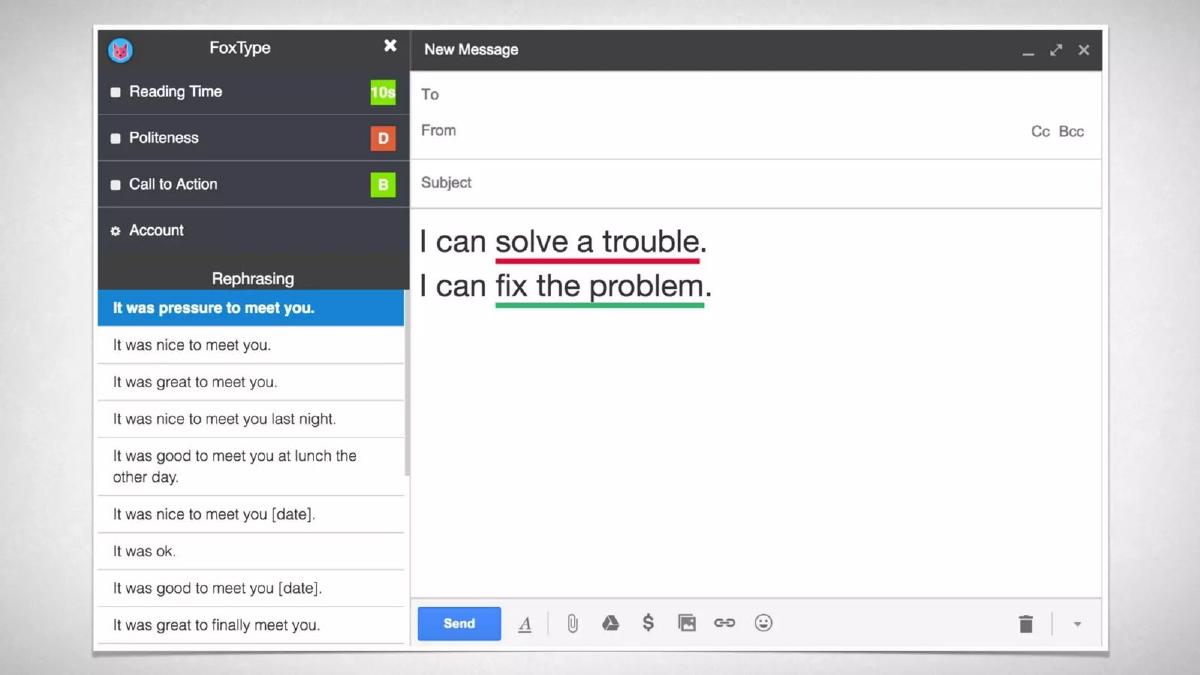
Slide 5 introduces the first error. The user writes "I can solve a trouble." FoxType underlines "solve a trouble" in red and suggests "I can fix the problem" underlined in green. This immediately demonstrates the tool's ability to handle collocations—words that naturally go together—which is a common struggle for non-native speakers.
Slide 6 addresses the emotional nuance. The user writes "It was pressure to meet you." This is a classic 'false friend' or translation error where the user likely meant 'pleasure.' The tool identifies the error and suggests "It was a pleasure to meet you." This ties back to the 'Politeness' score shown in the sidebar, which remains at a 'D' for the initial draft.
Slide 7 adds a third example: "Thanks for the hands up" corrected to "Thanks for the heads up." By the end of this four-slide sequence, the investor understands exactly what the product does: it acts as a real-time linguistic coach that understands idiom, tone, and grammar.
Slide 8: Validation and Traction
Slide 8 is the 'heavy hitter' slide. It contains one large-font sentence: "300,000 people have used our prototypes." In the world of seed-stage fundraising, 300k users is an enormous number, even if they are 'prototype' users. It proves that there is a massive, organic demand for this specific type of writing assistance. Below the text are logos for TNW, CNET, Fast Company, and Lifehacker, providing third-party media validation that the tool is noteworthy.
Slide 9: The Technical Team
Slide 9 introduces the founders: Scott Li (CEO), Alex Jiang (President/COO), and Motoki Wu (Head of Data Science). The headline "Team: 1st-gen immigrants, all technical" is a masterstroke of positioning. It tells the investor two things: 1) The team has the technical 'chops' to build AI (Data Science, COO, CEO all technical), and 2) They have the 'lived experience' to understand the nuances of the problem they are solving. This creates a high level of founder-problem fit.
Slide 10: The Close
Slide 10 is a duplicate of Slide 1. It brings the presentation full circle, leaving the contact information on the screen for the Q&A session. It maintains the minimalist aesthetic of the entire deck.
What Works in the FoxType Deck
Visual Storytelling: The use of the founder's mother creates an immediate empathetic link. Investors invest in people and missions; this deck provides both. · Clarity of Product: Many AI decks get bogged down in technical architecture. FoxType ignores the 'how' of the AI and focuses entirely on the 'what' for the user. The red/green underlining is a universal symbol for 'wrong/right' that requires no explanation. · Social Proof: Leading with 300,000 users is a bold move that offsets the lack of revenue data. It suggests that the 'top of the funnel' is already solved. · Brevity: At only 10 slides, the deck respects the investor's time. It provides just enough information to trigger a second meeting.
What is Missing from the FoxType Deck
Business Model: There is no mention of how FoxType intends to make money. Is it a SaaS subscription? A freemium Chrome extension? Enterprise licensing? This is a significant omission for a seed round. · Market Size: The deck assumes the investor knows that 'everyone writes emails.' However, it fails to quantify the specific target market (e.g., ESL professionals, sales teams, or students). · Competition: In 2014, Grammarly was already gaining traction. Failing to acknowledge the competitive landscape can sometimes make a team look naive or overconfident. · The Ask: The deck does not state how much money they are raising or what the milestones for the next 18 months will be. While this is often left for the verbal pitch, having a 'use of funds' slide is standard practice.
What a Founder Should Copy
The Progressive Reveal: If your product is a tool or a workflow, use 3-4 slides to show a 'before and after' state. It is much more effective than a single cluttered screenshot. · The 'All Technical' Tag: If you have a technical team, highlight it. In AI and deep tech, investors are often betting on the team's ability to iterate on the technology. · The Narrative Hook: Find the personal reason you are building your company. If you can distill it into one or two photos, you will be more memorable than 90% of the founders who start with a 'Market Trends' slide. · Minimalist Design: Use a consistent color palette and plenty of white space. It makes the few words you do use carry more weight.
Frequently asked questions
- How much did FoxType raise with this deck?
- According to catalogue facts, FoxType raised $225,000 in a Seed round in 2014. The deck itself does not state the amount raised or the valuation sought, which is common for decks used in demo days or as introductory teasers.
- What is the primary problem FoxType is solving?
- The deck suggests the problem is the difficulty of nuanced communication, particularly for non-native speakers or those struggling with tone. By showing a photo of the founder as a child and his mother, it implies a personal mission to bridge the gap between intent and expression in written English.
- Does the deck include a competitive analysis?
- No. The deck contains zero mention of competitors like Grammarly or Hemingway. It focuses entirely on its own unique 'Politeness' scoring and 'Rephrasing' engine to differentiate itself through product demonstration rather than a comparison matrix.
- What is the 'Politeness' score mentioned in the slides?
- On slide 4, the UI shows a 'Politeness' metric with a letter grade (in this case, a 'D'). This suggests an algorithmic approach to analyzing the tone of an email, helping users avoid sounding overly blunt or rude, which is a key feature of their 'A.I. for writing' positioning.
- Who are the founders of FoxType?
- The team consists of Scott Li (CEO), Alex Jiang (President/COO), and Motoki Wu (Head of Data Science). Slide 9 highlights that they are all technical and first-generation immigrants, reinforcing their expertise in both the technology and the personal pain point of language acquisition.