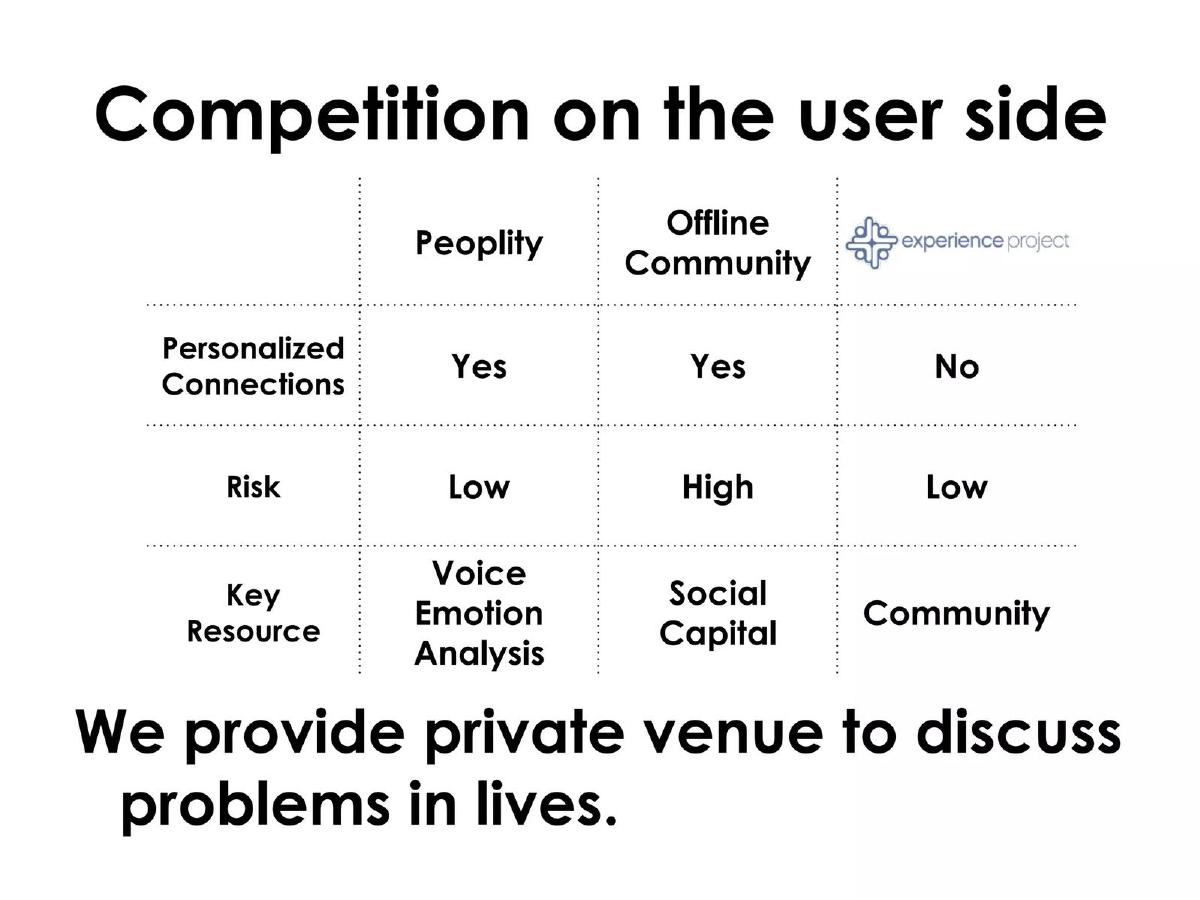
The FounderSchool pitch deck, representing a team called Peoplity, proposes a business model centered on the extraction and sale of 'emotional data.' By targeting stressed students via mobile phones, the company aims to provide manufacturers and retailers with real-life consumer insights that traditional lab-based neuromarketing firms cannot scale. The deck claims a 20% profit margin and projects revenue growing from $0.8M to $16M by Year 5 based on market penetration of the $16B market research industry. While the competitive analysis effectively highlights their use of voice emotion recogni…
Key takeaways
- The company identifies its primary users as stressed students, utilizing an image of a head emitting smoke to illustrate the problem on slide 2.
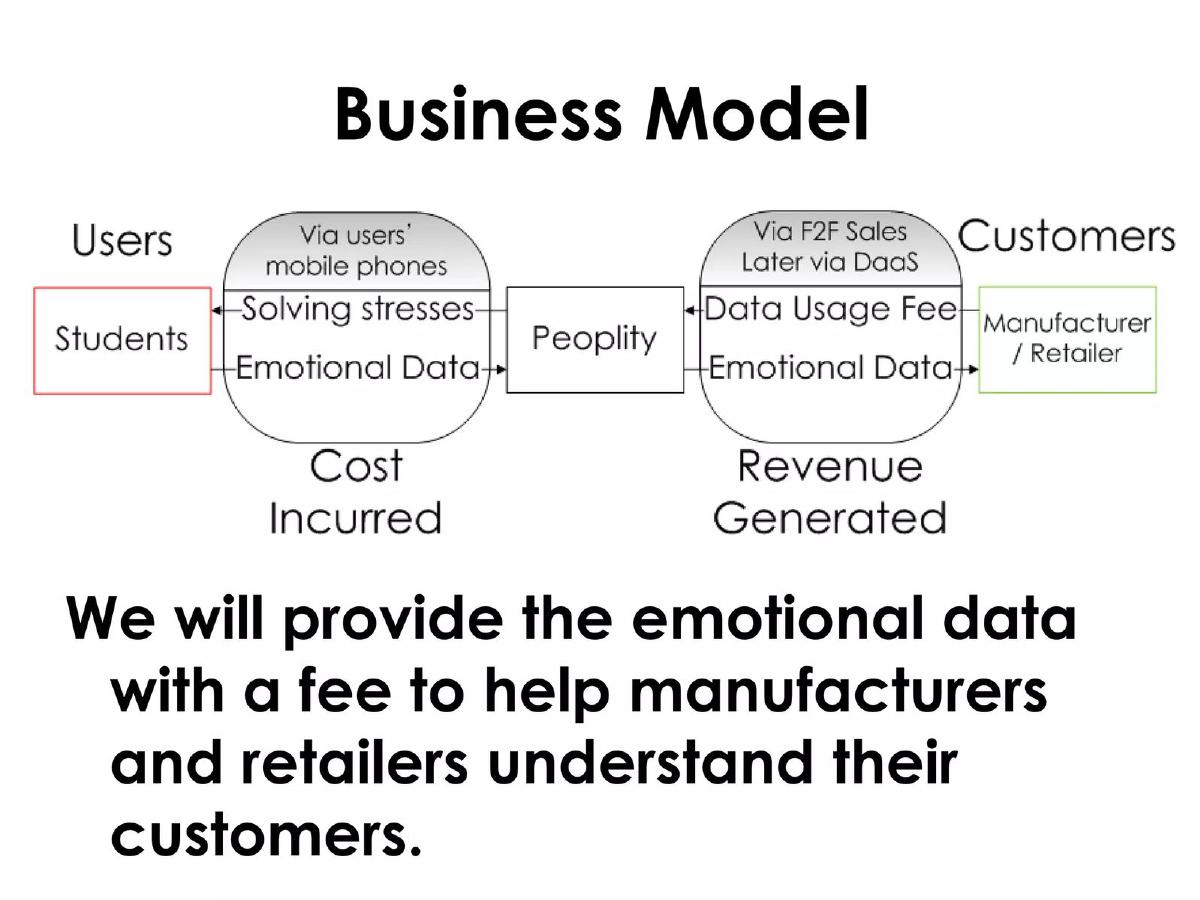
- The business model relies on a dual-sided flow: solving stresses for users via mobile phones while charging manufacturers a data usage fee for the resulting emotional data, as shown on slide 3.
- Peoplity differentiates itself from competitors like NeuroFocus and Affectiva by using voice emotion recognition rather than lab-based fMRI or facial recognition (slide 4).
- The deck positions its technology as a 'cheap way to gather emotion data in real lives,' claiming higher scalability than competitors (slide 4).
- Financial projections are based on a $16B/year market research market size, targeting 0.1% penetration by Year 5 (slide 5).
- Revenue is projected to double from Year 1 ($0.8M) to Year 2 ($1.6M) and reach $16M by Year 5 (slide 5).
- The deck claims a 20% margin, resulting in a projected $3.2M profit by the fifth year of operation (slide 5).
- There is no mention of the specific funding amount sought or the intended use of proceeds within the provided slides.
Executive Summary: The Emotional Data Broker
The FounderSchool pitch deck, representing the Peoplity team, presents a provocative and somewhat clinical approach to the neuromarketing space. The core thesis is that current market research is too expensive and too artificial. By harvesting voice-based emotional data from a high-stress demographic—students—Peoplity intends to build a scalable data-as-a-service (DaaS) platform for global retailers. While the financial projections are modest compared to typical 'unicorn' pitches, the deck focuses heavily on the technical differentiation of voice recognition over biometric hardware.
Slide 1: Title Slide
The deck opens with the title 'FounderSchool Pitch Deck' but identifies the creators as the 'Peoplity Team.' It includes a URL for peoplity.com and a colorful, overlapping circular logo. The branding is minimal, suggesting an early-stage or student-led project rather than a mature corporate entity.
Slide 2: The Problem
Slide 2 uses a stark, grayscale image of a human head with the top removed, emitting thick black smoke. The text reads: 'Problem: Students are stressed. (Everyone is).' This slide establishes the emotional state of the target user base. However, it does not explain why student stress is a business opportunity, only that the state exists. It relies on the audience to make the connection between stress and the need for emotional monitoring.
Slide 3: Business Model
This slide provides a flow chart of the Peoplity ecosystem. On the left, 'Users' (Students) provide 'Emotional Data' via their mobile phones in exchange for 'Solving stresses.' In the center, Peoplity processes this data. On the right, 'Customers' (Manufacturers/Retailers) pay a 'Data Usage Fee' to receive this emotional data. The slide explicitly states: 'We will provide the emotional data with a fee to help manufacturers and retailers understand their customers.' It notes that sales will move from 'F2F Sales' to 'DaaS' over time. This confirms the company is a data broker at its core.
Slide 4: Competition on Neuromarketing
Peoplity uses a comparison table to position itself against NeuroFocus and Affectiva. The key differentiators cited are 'Scalability' (High for Peoplity vs. Low/Medium for others), 'Environment' (Real life vs. Lab/In-Home), and 'Key Technology.' Peoplity claims to use 'Voice Emotion Recognition,' whereas competitors rely on 'fMRI, EEG, Eye tracking' or 'Facial Recognition, GSR.' The takeaway at the bottom is clear: 'We provide a cheap way to gather emotion data in real lives.' This is the strongest slide in the deck as it identifies a specific technical moat (voice vs. hardware).
Slide 5: Projected Financials
The financial slide sets the Total Addressable Market (TAM) at $16B for market research. It claims Peoplity will achieve a 'better margin than others' at 20%. The table lists three milestones:
Year 1: 0.005% penetration, $0.8M Revenue, $0.16M Profit. · Year 2: 0.01% penetration, $1.6M Revenue, $0.32M Profit. · Year 5: 0.1% penetration, $16M Revenue, $3.2M Profit.
The projections are linear and conservative, which is unusual for a venture-backed pitch but perhaps more realistic for a niche data service.
Slide 6: Contact Information
The final slide is a simple 'Thank you' with contact details for Young Kim. It includes a professional email, a personal Gmail address, a Skype handle, and a phone number with a 510 (East Bay, California) area code. The inclusion of 'gchat' and 'Skype' dates the deck to an era where these were primary business communication tools.
What Works in This Deck
Clear Value Proposition: The deck does not hide its intent. It is a data brokerage play. The business model slide (Slide 3) clearly explains who pays, who uses, and what the product is (emotional data).
Technical Differentiation: By focusing on 'Voice Emotion Recognition' on Slide 4, the founders address the primary barrier to entry in neuromarketing: the cost and friction of hardware. Claiming a 'Real life' environment is a compelling selling point for retailers who find lab data too sterile to be actionable.
Realistic Market Penetration: Unlike many decks that claim they will capture 5% of a trillion-dollar market, Peoplity targets 0.1% of a $16B market. This makes the $16M revenue goal feel attainable and grounded in a specific calculation.
What Is Missing from This Deck
The Team: There is no team slide. Investors fund people, especially in high-tech fields like 'Voice Emotion Recognition.' Without knowing if the founders have backgrounds in linguistics, data science, or psychology, the technical claims lack credibility.
The Product: There are no screenshots or mockups of the mobile app. How does the app 'solve stresses' for students? If the user experience is poor, they won't get the data. The 'cost incurred' side of the business model is a black box.
The Ask: The deck ends without asking for money. There is no mention of how much capital is needed, what milestones that capital will hit, or the current stage of the company (Seed, Series A, etc.).
Privacy and Ethics: Selling the 'emotional data' of 'stressed students' to 'retailers' raises significant ethical and privacy concerns. A modern deck would require a slide on data anonymization and compliance (GDPR/CCPA), which is entirely absent here.
Founder's Takeaway
If you are building a data-centric startup, the Peoplity deck offers a good lesson in competitive positioning . They successfully frame their competitors' strengths (high-tech sensors) as weaknesses (low scalability). However, the lack of a Team slide and a Product visual makes this feel like a theoretical exercise rather than a fundable business. Founders should ensure that for every 'data output' they promise to sell, they clearly demonstrate the 'value input' that keeps users engaged enough to provide that data in the first place.
Frequently asked questions
- What is the core technology behind Peoplity?
- According to slide 4, Peoplity utilizes 'Voice Emotion Recognition' as its key technology. This is contrasted against competitors who use more invasive or expensive methods such as fMRI, EEG, eye tracking, or facial recognition. The deck emphasizes that this allows for data collection in 'Real life' environments rather than controlled lab or in-home settings.
- How does the company plan to make money?
- The business model on slide 3 describes a 'Data Usage Fee.' The company acts as an intermediary, collecting 'Emotional Data' from students via their mobile phones. This data is then sold to 'Customers' defined as manufacturers and retailers. The slide notes that sales will initially be 'Face to Face' (F2F) and later transition to a 'Data as a Service' (DaaS) model.
- Who is the target audience for the product?
- The deck identifies two distinct groups. The 'Users' are students, specifically those who are stressed (slide 2). The 'Customers' are manufacturers and retailers who need to understand their customers' emotional states to improve marketing or product development (slide 3).
- What are the projected financials for the startup?
- Slide 5 projects Year 1 revenue of $0.8M with a profit of $0.16M. By Year 2, revenue is expected to reach $1.6M. The long-term goal for Year 5 is $16M in revenue and $3.2M in profit, based on capturing 0.1% of the $16B market research industry.
- What critical information is missing from this deck?
- The deck lacks several standard components: a team slide detailing founder expertise, a product slide showing the app interface, a marketing/acquisition strategy for reaching students, and a clear 'Ask' slide stating how much capital is being raised and at what valuation.