FORMEL Skin’s 8-slide deck is a masterclass in narrative brevity, focusing on the emotional and clinical transformation of the patient rather than dense financial modeling. By centering the pitch on a massive addressable problem—1.5 billion people with treatable skin conditions—and showcasing a founder with deep clinical roots (Dr. Sarah Bechstein), the company establishes immediate authority. The deck relies on high-quality 'before and after' imagery to prove product efficacy, a strategy that clearly resonated as they raised $39.8 million. However, the deck is notably silent on unit economic…
Key takeaways
- The deck identifies a global market of 1.5 billion people suffering from dermatological conditions that can be treated remotely (Slide 2).
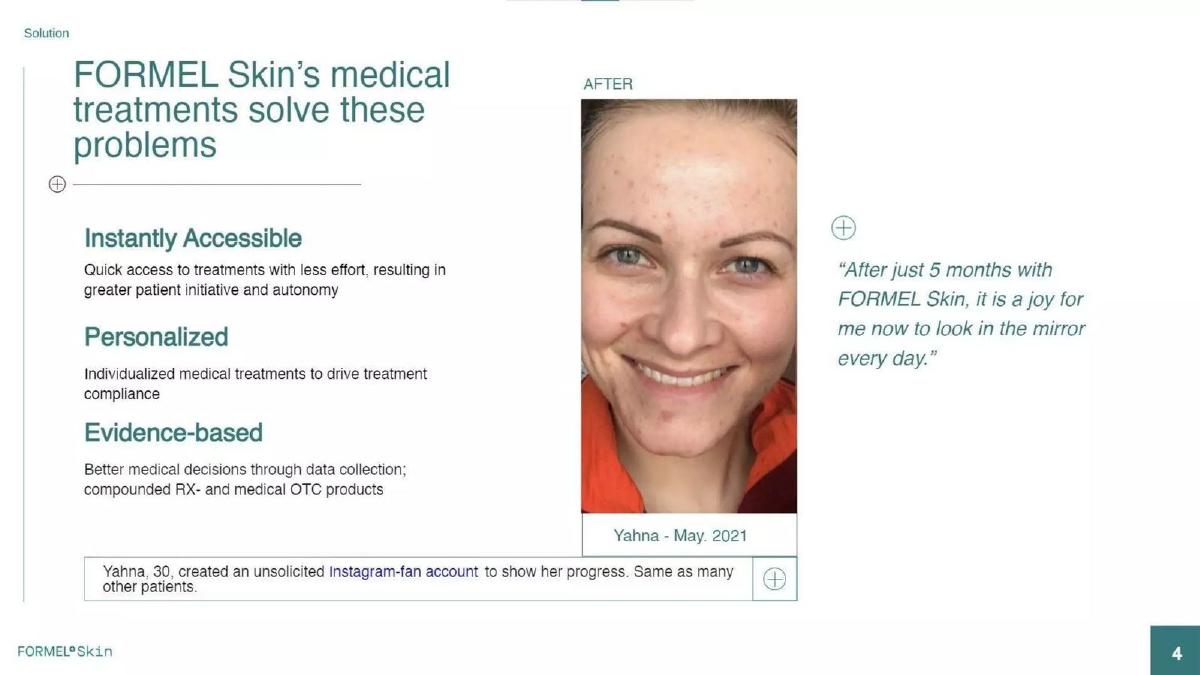
- Patient testimonials and 'before and after' photos are used as primary evidence for product efficacy (Slides 3 and 4).
- The 'Problem' is framed as a structural undersupply of dermatologists and inefficient market reimbursement (Slide 3).
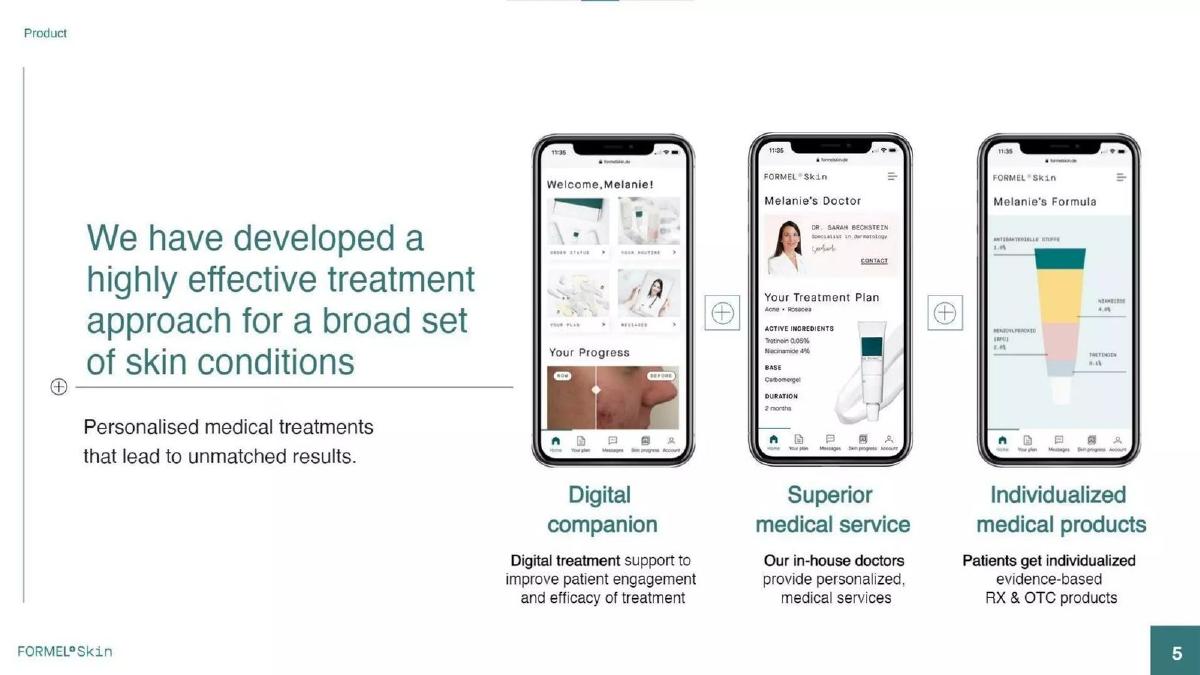
- The product is presented as a three-part ecosystem: a digital companion, superior medical service, and individualized products (Slide 5).
- Medical credibility is anchored by co-founder Dr. Sarah Bechstein, a PhD in Dermatology from Charité Berlin (Slide 7).
- The founding team combines medical expertise with scaling experience from BCG, Siemens, and Caroobi (Slide 7).
- The deck completely omits financial metrics, revenue figures, and a specific funding 'Ask' (Slides 1-8).
- The presentation uses a high-contrast, minimalist design that prioritizes patient-centric imagery over text-heavy data (Slides 1-8).
The 8-Slide Series A: FORMEL Skin’s Minimalist Approach
FORMEL Skin, a Berlin-based healthtech startup, raised a significant $39.8 million Series A in 2020. Looking at the deck, the most striking feature is its brevity. At only eight slides, it ignores the traditional 12-15 slide template in favor of a highly visual, patient-first narrative. This teardown examines how the company leveraged medical credibility and clear problem-solution framing to secure high-level venture interest.
Introduction and Market Opportunity (Slides 1-2)
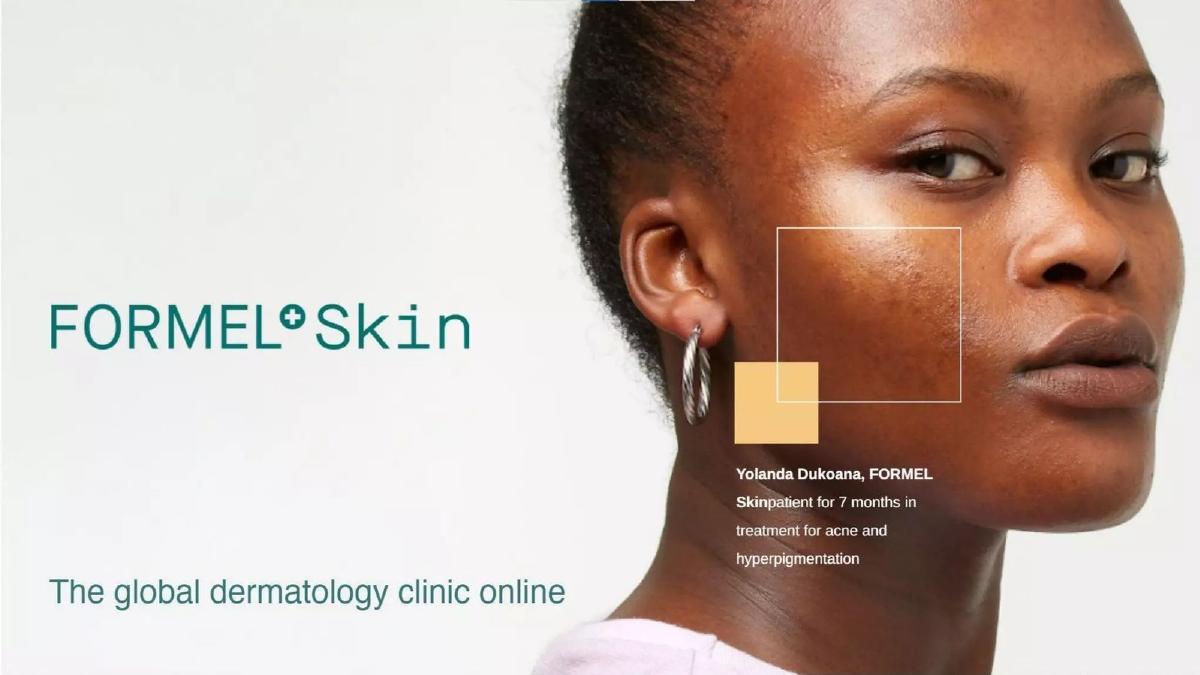
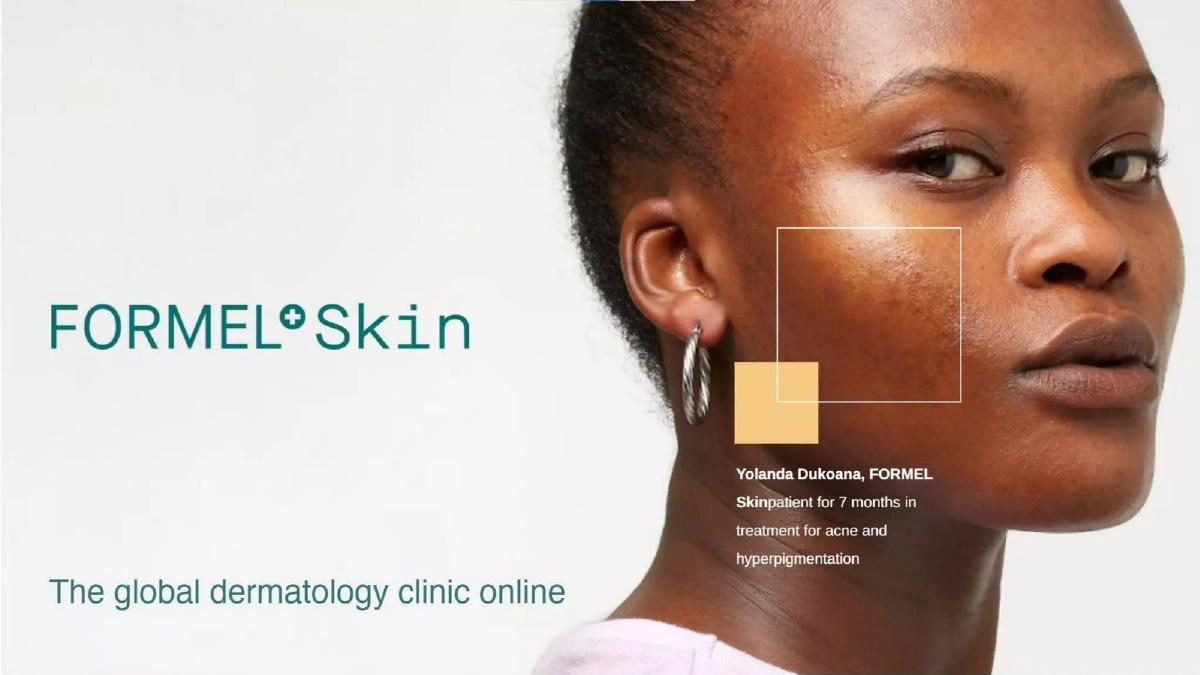
Slide 1: Title The deck opens with a high-quality lifestyle image of a patient, Yolanda Dukoana, who is identified as a patient for 7 months. The tagline is simple: "The global dermatology clinic online." This immediately positions the company as a healthcare provider rather than just a skincare brand.
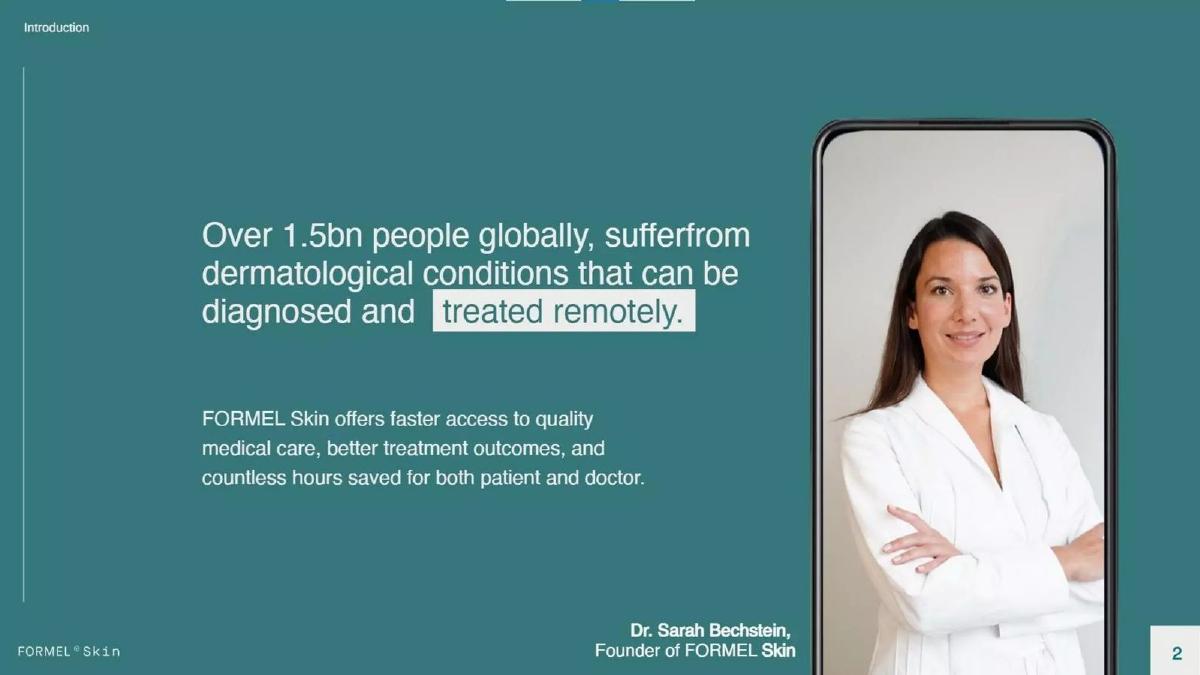
Slide 2: Introduction Slide 2 sets the scale. It claims that over 1.5bn people globally suffer from conditions that can be "treated remotely." By highlighting the word "treated," FORMEL Skin emphasizes the clinical nature of their work. The slide also introduces Dr. Sarah Bechstein, the founder, via a smartphone mockup, reinforcing the mobile-first delivery of their medical care. The value proposition is summarized as faster access, better outcomes, and time saved for both parties.
The Problem and the Patient Journey (Slides 3-4)
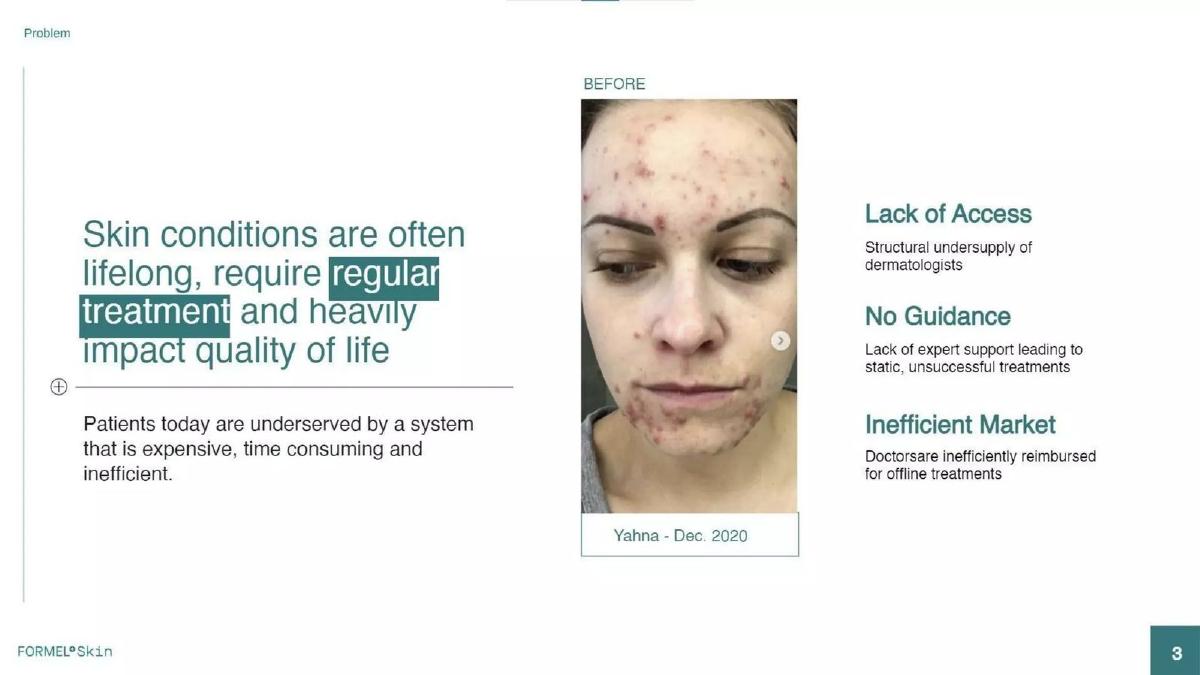
Slide 3: Problem The problem is defined through three lenses: Lack of Access (undersupply of doctors), No Guidance (unsuccessful static treatments), and Inefficient Market (reimbursement issues). To make this visceral, the slide features a 'Before' photo of a patient named Yahna from December 2020, showing severe skin inflammation. This humanizes the 'structural undersupply' mentioned in the text.
Slide 4: Solution Slide 4 presents the 'After' photo of Yahna from May 2021, showing clear skin. The text highlights three solution pillars: Instantly Accessible, Personalized, and Evidence-based. A notable piece of social proof is included at the bottom: "Yahna, 30, created an unsolicited Instagram-fan account to show her progress." This suggests high organic virality and patient satisfaction without the company needing to provide a chart of NPS scores.
Product Deep-Dive (Slides 5-6)
Slide 5: Product This slide breaks down the 'how.' It shows three smartphone screens representing the 'Digital companion' (app interface), 'Superior medical service' (doctor interaction), and 'Individualized medical products.' The third screen is particularly important as it shows a formula breakdown including Tretinoin (0.1%) and Niacinamide (4.0%). This proves they are dealing with prescription-grade (RX) and medical OTC products, not just cosmetic moisturizers.
Slide 6: Product deep-dive Slide 6 is a transition slide that leans into the emotional outcome. It features a patient, Nikola, laughing while applying the product. The headline, "Our patients are longing for a trusted skin health partner who accompanies them throughout their entire life," signals a high-LTV (Lifetime Value) subscription model, even though no financial data is explicitly shared.
Team and Vision (Slides 7-8)
Slide 7: Team For a Series A, the team slide is often the most scrutinized. FORMEL Skin presents a balanced trio. Dr. Sarah Bechstein provides the clinical 'moat' with a PhD in Dermatology and research experience at Charité Berlin. Florian Semler and Anton Kononov provide the operational 'engine,' with backgrounds at BCG, Roland Berger, and experience scaling Caroobi to a $100M valuation. The logos at the bottom (Siemens, WHU, Heidelberg) serve as institutional validation.
Slide 8: Closing The final slide returns to the patient imagery, showing two women (Yildiz and Yolanda) interacting. The call to action is "Become part of the FORMEL Skin story." It is an emotional close rather than a data-driven one.
What Works in This Deck
1. Clinical Authority: By featuring a founder who is a medical doctor and researcher from a prestigious institution like Charité, the deck bypasses the skepticism often directed at 'D2C skincare' startups. They aren't selling soap; they are selling a 'medical treatment approach.' 2. Visual Proof of Efficacy: In healthtech, results matter most. The use of Yahna’s 5-month transformation (Slides 3-4) is more persuasive than a generic bar chart. It proves the product works for the most difficult cases. 3. Clear Product Taxonomy: Slide 5 clearly explains that this is a three-part system. Many startups fail by not explaining if they are a software company, a service company, or a hardware/product company. FORMEL Skin explicitly states they are all three, integrated into one experience.
What is Missing from This Deck
1. Financial Metrics: There is zero mention of revenue, growth rates, or unit economics. For a Series A raise of nearly $40 million, investors would typically expect to see a 'Traction' slide showing MoM (Month-over-Month) growth and CAC/LTV ratios. 2. Competitive Landscape: The deck does not address other players in the teledermatology space. Given the presence of companies like Curology or Dermatica, an investor would need to know FORMEL Skin’s specific competitive advantage in the European market. 3. The Ask: There is no slide detailing the amount of capital being raised or the milestones that capital will unlock. This suggests this version of the deck was likely a 'teaser' or a high-level vision deck used to open doors, rather than the full due-diligence deck. 4. Market Expansion Strategy: While slide 2 mentions a 'global' clinic, there is no roadmap for how they move from Berlin to the rest of the world, especially considering the regulatory hurdles of prescription medicine in different jurisdictions.
What a Founder Should Copy
1. The 'Problem' Framing: Instead of just saying "skin care is hard," they frame it as a systemic failure of the medical market (Slide 3). Founders should look for the 'structural' reason their business needs to exist. 2. High-Quality Imagery: The deck feels premium. The photography is consistent, the color palette (teal and white) is clinical yet modern, and the layouts are uncluttered. This builds immediate brand trust. 3. The 'Evidence-Based' Tag: In any regulated industry, using the term "Evidence-based" (Slide 4) and backing it up with a founder’s PhD (Slide 7) is a powerful way to de-risk the investment in the eyes of a VC.
Conclusion
The FORMEL Skin deck is a testament to the power of a strong founding team and a clear, emotional problem. While it lacks the data density usually required for a Series A, its focus on patient outcomes and medical legitimacy clearly paved the way for their $39.8 million round. It serves as a reminder that at the early stages, the story and the 'who' are often more important than the 'how much'—provided the data room is ready to back up the vision.
Frequently asked questions
- How does FORMEL Skin justify its market size?
- On slide 2, the company states that over 1.5 billion people globally suffer from dermatological conditions that can be diagnosed and treated remotely. They frame the opportunity not just as a convenience play, but as a solution to a 'structural undersupply' of specialists and an 'inefficient market' where doctors are poorly reimbursed for offline treatments, as noted on slide 3.
- What is the core technology or product being pitched?
- Slide 5 details the product as a 'highly effective treatment approach' consisting of three pillars: a Digital Companion (app for engagement), Superior Medical Service (in-house doctors), and Individualized Medical Products (compounded RX and OTC products). The focus is on the personalization of the formula, illustrated by a graphic showing specific ingredients like Tretinoin and Niacinamide.
- Who are the founders and what is their background?
- As shown on slide 7, the team consists of Florian Semler (Strategy, ex-BCG and Siemens), Dr. Sarah Bechstein (Medical, MD/PhD from Charité Berlin), and Anton Kononov (Product/Marketing, ex-Caroobi and Roland Berger). This mix of clinical authority and venture-scaling experience is a key highlight of the deck's closing slides.
- Does the deck show any actual patient results?
- Yes, the deck uses 'Yahna' as a primary case study. Slide 3 shows her 'Before' photo from December 2020 with severe acne, and slide 4 shows the 'After' result from May 2021. The deck notes she was a patient for 5 months and even created an 'unsolicited Instagram-fan account' to document her progress.
- What is missing from this pitch deck?
- This deck is missing almost all standard Series A financial data. There are no slides covering revenue, CAC (Customer Acquisition Cost), LTV (Lifetime Value), churn rates, or market competition. Additionally, there is no 'Ask' slide detailing how much capital is being raised or how it will be deployed, though catalogue facts indicate they raised $39.8 million.