ForbesCoal’s 2011 investor presentation serves as a technical roadmap for a publicly traded mining entity (TSX: FMC) seeking to capitalize on global coal demand. The deck emphasizes operational maturity, showcasing a management team with deep roots in Anglo Coal and Rio Tinto, and specific asset summaries for the Magdalena and Aviemore projects. A critical component of the narrative is the company's logistical breakthrough: securing a milestone agreement to increase export capacity at Richards Bay to 1,157,000 tonnes by 2013. By blending granular geological data with macro-level global trade…
Key takeaways
- The company is a member of the Forbes & Manhattan Group, a merchant bank specializing in resource projects (Slide 1).
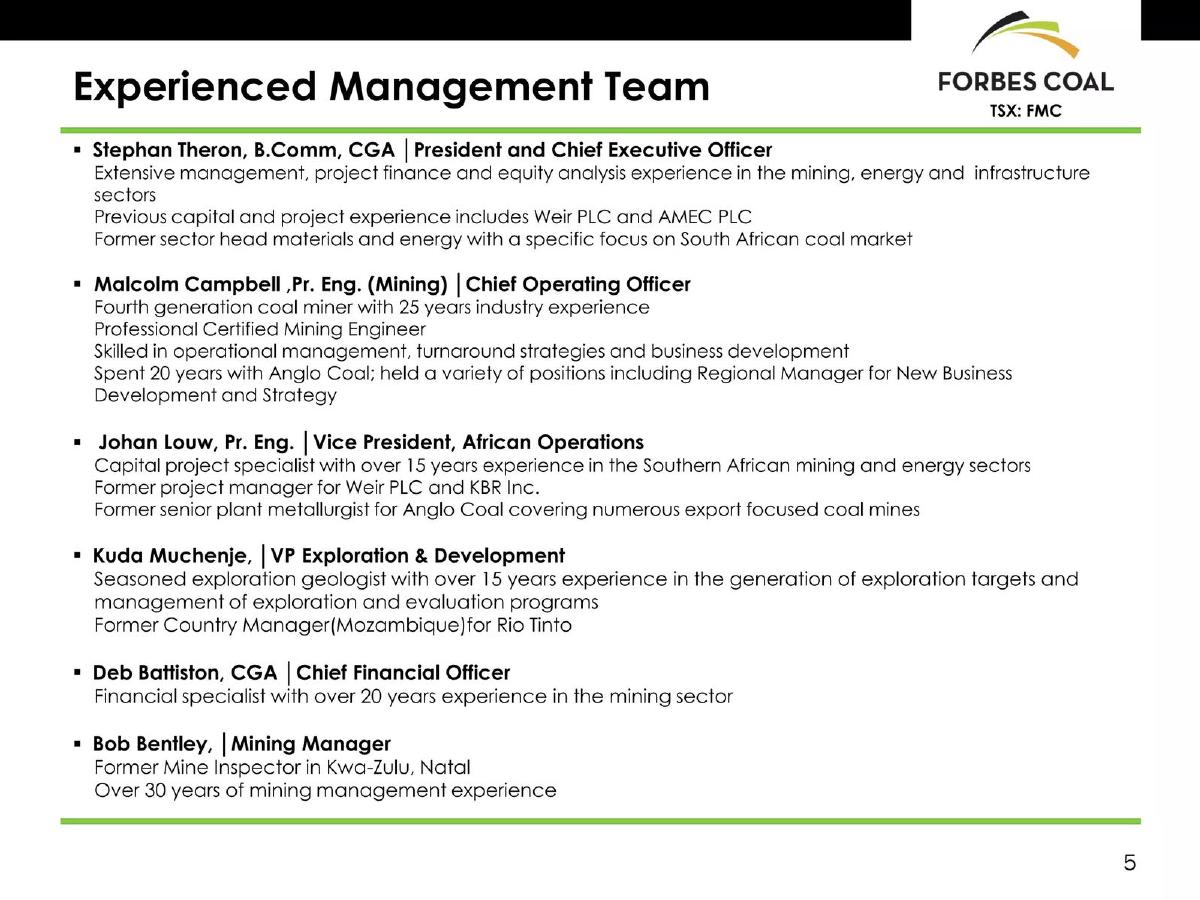
- The management team is heavily comprised of former Anglo Coal and Rio Tinto executives, emphasizing industry-specific operational experience (Slide 5).
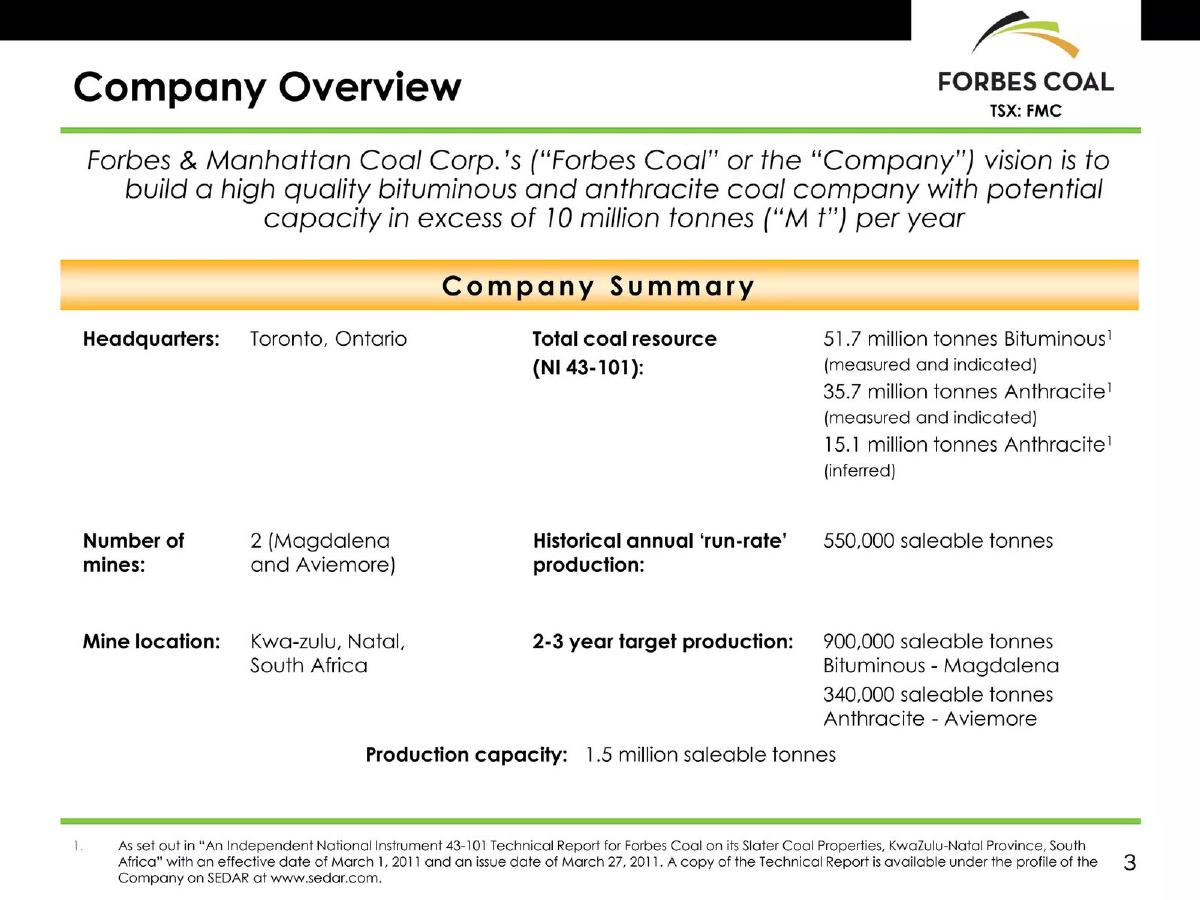
- ForbesCoal operates in the established South African coalfields, specifically the Magdalena and Aviemore projects near Dundee (Slide 9).
- A key value driver is the secured export capacity at Richards Bay, projected to reach 1,157,000 tonnes per annum in 2013 (Slide 13).
- The Magdalena Bituminous Coal operation boasts a 51.7 million tonne resource with an estimated mine life of over 20 years (Slide 17).
- Aviemore Anthracite production is projected to grow significantly, targeting 420,000 tonnes in 2013E from just 92,000 tonnes in 2011 (Slide 21).
- The deck identifies India and China as the primary global importers, with South Africa exporting 23 million tonnes to India in 2010 (Slide 29).
- Market analysis forecasts a metallurgical coal deficit through 2014, supporting a premium pricing environment (Slide 33).
Executive Summary and Corporate Identity
Slide 1: Title Slide
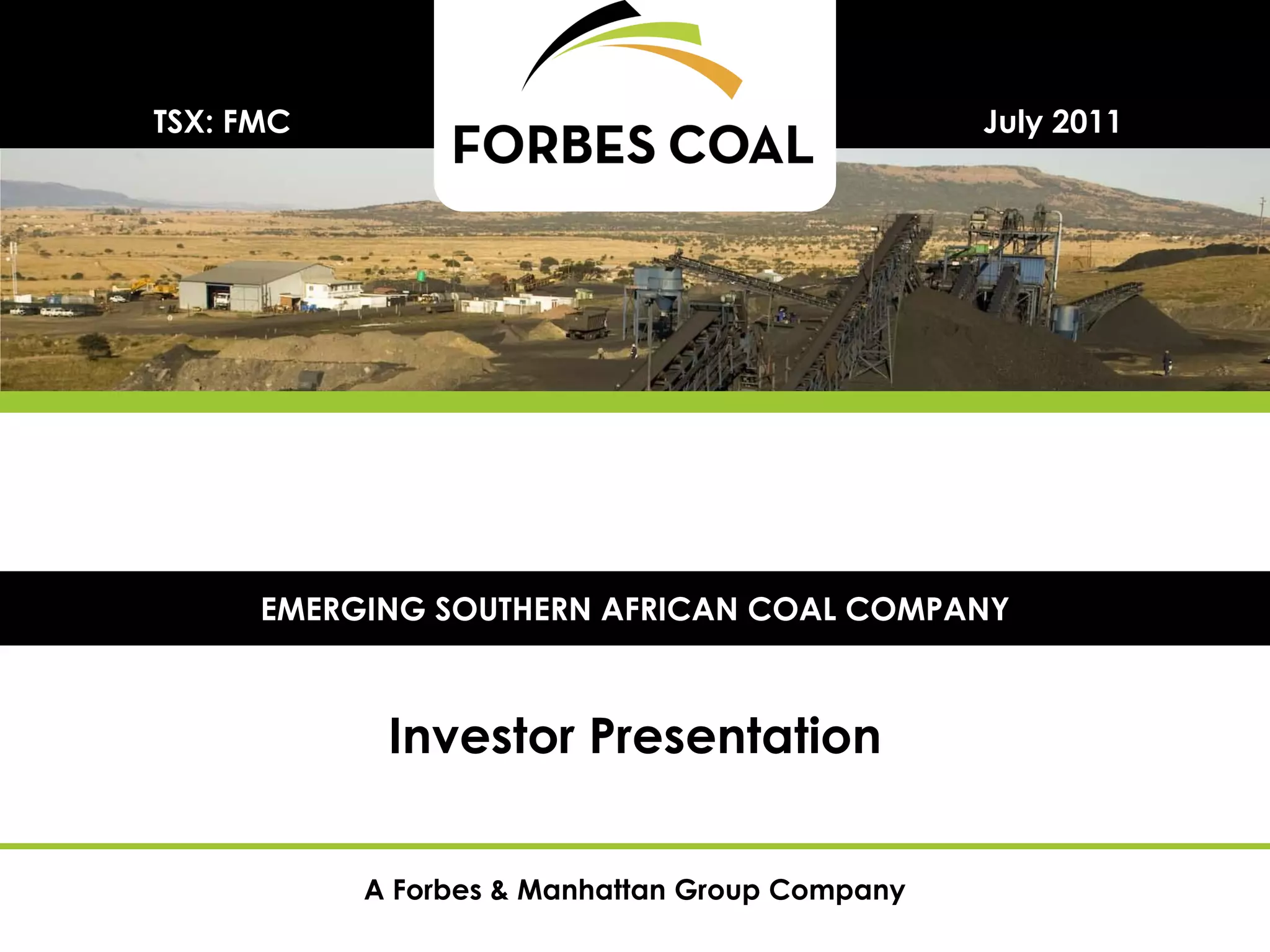
The presentation opens with a clear identification of the company as ForbesCoal, listed on the TSX under the symbol FMC. It is dated July 2011. The subtitle identifies it as an "Emerging Southern African Coal Company" and notes its affiliation as a "Forbes & Manhattan Group Company." The background image shows an active industrial mining site, establishing immediate visual context for the sector.
The Human Capital
Slide 5: Experienced Management Team
This slide lists six key executives, focusing heavily on their technical credentials and previous industry affiliations. Stephan Theron (CEO) is noted for project finance and equity analysis. Malcolm Campbell (COO) is highlighted as a "fourth generation coal miner" with 20 years at Anglo Coal. Other members, including Johan Louw and Kuda Muchenje, bring experience from KBR, Rio Tinto, and Weir PLC. The emphasis here is on operational longevity and specific expertise in the South African coal market, which is a common requirement for resource-sector investors looking for execution capability.
Geographic and Operational Footprint
Slide 9: Established Mining Region
This slide provides a comprehensive map of Southern African coalfields. It identifies 51 distinct coalfields across South Africa, Zimbabwe, Botswana, Namibia, Mozambique, and Zambia. ForbesCoal’s specific projects—Magdalena Bituminous Coal and Aviemore Anthracite—are located near Dundee in the KwaZulu-Natal province. The map also highlights the Richards Bay Coal Terminal, establishing the physical link between the mines and the export gateway. This slide serves to prove that the company is operating in a proven, resource-rich geography rather than a speculative frontier.
Strategic Growth and Logistics
Slide 13: Positioned for Multi-Year Export Growth
Logistics are often the failure point for mining companies. This slide addresses that risk directly. It cites a "milestone agreement" from December 7th that increases export capacity from 197,000 tonnes to a total of 1,157,000 tonnes by 2013. Furthermore, it mentions a three-year offtake agreement with a "global energy trading company" for 1.75 million tonnes of thermal coal. This is a critical slide because it demonstrates both the ability to move the product and a guaranteed buyer, which stabilizes future cash flows.
Asset Deep Dives
Slide 17: Magdalena Bituminous Coal Operations
This is a technical data sheet for the company’s primary asset. It lists the location (Dundee, KwaZulu-Natal), resource size (51.7 million tonnes), and technical coal specs (12,250 BTU/lb, 15% ash, 16.7% volatility). It projects a production increase from 556,000 tonnes in FY2011 to 900,000 tonnes in FY2012. The inclusion of "Mine Life: Approximately +20 years" and the presence of an existing wash plant suggests a long-term, stable production environment.
Slide 21: Aviemore Anthracite Coal Production Profile
This slide uses a bar chart to show historical and projected saleable production for the Aviemore project. It shows relatively flat production from 2006 to 2011 (ranging from 20k to 102k tonnes) but forecasts a massive spike to 161k tonnes in 2012E and 420k tonnes in 2013E. The slide explicitly states an expectation to hit 500,000 tonnes per annum by FY2014. This represents the "growth" narrative of the deck, showing where the incremental value will be created.
Market Context and Macro Trends
Slide 25: Appendix
A simple transition slide marking the beginning of the supplemental data section.
Slide 29: Thermal Coal Global Overview
This slide provides the macro justification for the business. A world map illustrates trade flows, showing South Africa as a key exporter (66mt) primarily feeding India and North Asia. It notes that India and China are the major global importers. By showing that South Africa exported 23 million tonnes to India in 2010, the company aligns its growth strategy with the largest demand centers in the world.
Slide 33: Metallurgical Coal Global Overview
This slide focuses on the coking coal market, which is used for steel production. It includes a detailed table of "Global Thermal Demand and Supply Forecast" from 2009 to 2015F. The table shows a "Notional Balance" that is negative from 2010 through 2014, indicating a market deficit. The text argues that lack of geographical diversity in supply and high geopolitical risks in other regions will keep prices elevated. This justifies the company's focus on South Africa as a stable alternative to other riskier jurisdictions.
Conclusion and Contact
Slide 37: Contact Information
The deck concludes with direct contact details for the CEO, Stephan Theron, and the Investor Relations Manager, Sabina Srubiski. The company’s headquarters is listed in Toronto, Ontario, Canada, which is consistent with its TSX listing.
What Works in This Deck
Operational Specificity: The deck avoids vague promises. By providing BTU values, ash percentages, and specific tonnage targets (Slide 17), the company speaks the language of institutional mining investors. They treat the mine as a factory with measurable inputs and outputs.
Logistical Clarity: Many resource decks fail to explain how they will get the product to market. ForbesCoal dedicates a full slide (Slide 13) to their export capacity at Richards Bay, which is the single most important infrastructure point for a South African coal exporter.
Management Pedigree: The management slide (Slide 5) is exceptionally strong. Listing specific roles at Anglo Coal and Rio Tinto provides immediate credibility that the team understands the local regulatory and geological landscape.
What Is Missing
Financial Statements: While the deck mentions offtake agreements and production targets, it lacks a summary of the company’s balance sheet, current cash position, or historical revenue. For a company already listed on the TSX, investors would expect a snapshot of their financial health.
Cost of Production: The deck discusses sale prices and market demand but does not explicitly state the cash cost per tonne to mine the coal. Without unit economics, it is difficult for an investor to calculate the potential margin, especially in a fluctuating commodity market.
Risk Factors: There is no mention of the specific risks associated with South African mining, such as labor relations, power supply issues (Eskom), or regulatory changes regarding Black Economic Empowerment (BEE) requirements, which were significant factors in 2011.
Founder Takeaways
Quantify Your Bottlenecks: If your business relies on a specific piece of infrastructure (like a port or a server farm), show exactly how much capacity you have secured and how it scales. ForbesCoal’s Slide 13 is a masterclass in addressing a primary investor concern head-on.
Use Macro Data to Validate Micro Strategy: The global trade flow map on Slide 29 makes the company’s focus on India and China feel inevitable rather than speculative. If you are entering a market, show the flow of money and goods that makes your entry logical.
Technical Credibility is King: In industrial or resource sectors, your team slide shouldn't just list titles; it should list specific, relevant achievements. Mentioning "fourth generation coal miner" (Slide 5) is a powerful way to signal deep-rooted expertise that goes beyond a resume.
Frequently asked questions
- What is the primary business model of ForbesCoal as presented?
- ForbesCoal operates as an emerging Southern African coal producer focused on the extraction and export of bituminous and anthracite coal. The model relies on owning high-quality assets (Magdalena and Aviemore) and securing the necessary rail and port infrastructure to move product from the KwaZulu-Natal region to global markets via the Richards Bay Coal Terminal.
- How does the company address logistical risks?
- Logistics are addressed through a 'milestone agreement' mentioned on Slide 13, which details an incremental increase in export capacity. By moving from 197,000 tonnes to a total capacity of over 1.1 million tonnes by 2013, the company demonstrates it has solved the primary bottleneck for South African inland miners: getting product to the coast.
- What are the specific technical specifications of their main asset?
- The Magdalena project is the flagship, featuring 51.7 million tonnes of measured and indicated resources. It produces bituminous coal with an average heat value of 12,250 BTU/lb and 15% ash content. The slide notes a 20-year mine life and an existing wash plant and processing infrastructure, indicating a 'de-risked' operational status.
- Who is the target audience for this coal production?
- The deck explicitly targets the Asian market. Slide 29 shows global trade flows, highlighting that India and China are the major importers. It notes that South Africa is already a major supplier to India, and the company's three-year offtake agreement for 1.75 million tonnes of thermal coal provides the necessary cash flow to fund production ramping.
- What is the significance of the management team's background?
- The team is positioned as 'experienced,' with leaders like Malcolm Campbell (COO) being a fourth-generation coal miner with 20 years at Anglo Coal. This is intended to reassure investors that the technical challenges of mining in South Africa—such as geology, labor, and local regulations—are being handled by veterans rather than generalist administrators.