FOEVR presents a vision for 'Fundamental Online Education' delivered via Virtual Reality (VR), targeting a perceived failure in how mathematics and natural sciences are taught globally. The deck, dated 2017, identifies a massive potential market of 350 million K-12 students, narrowing its focus to 10 million students from higher-income families. While the problem statement is comprehensive, the deck lacks a functional product demonstration, relying instead on definitions of VR and interdisciplinary learning. The team consists of a CEO with a teaching background and a CMO with marketing experi…
Key takeaways
- The company defines FOEVR as 'Fundamental Online Education' through 'Virtual Reality' (Slide 4).
- FOEVR identifies a total market of 350 million K-12 students, with a Serviceable Obtainable Market (SAM) of 10 million kids from higher-income families (Slide 5).
- The deck claims that 45% of students (160 million) underperform in math and natural sciences (Slide 5).
- The funding ask is exactly €250,000, intended to fund milestones 3 and 4, including prototype development (Slide 7).
- The CTO position is currently vacant, described as a 'question mark' requiring a software engineer or 3D app developer (Slide 6).
- CEO Miroslav Konstantinovic cites 30 years of watching ICT technology and being a primary school teacher as core qualifications (Slide 6).
- The deck omits a clear business model, pricing strategy, or competitive landscape analysis.
- The solution relies on an 'interdisciplinary approach' to solve complex problems like prosthesis design using multiple sciences simultaneously (Slide 4).
FOEVR Pitch Deck Analysis
The FOEVR pitch deck, dated 2017, represents an early-stage attempt to capitalize on the intersection of Virtual Reality and K-12 education. The deck is primarily conceptual, focusing on the pedagogical failures of the current system and proposing a VR-based solution. It lacks the typical traction metrics found in later-stage decks, functioning instead as a seed-level proposal for a company that has yet to build its core technology.
Slide 1: Title Slide
The cover slide introduces the company name, FOEVR, accompanied by the tagline "A Dawn Of A New Age In Education." The logo features an infinity symbol, and the slide includes a 2017 copyright notice. The design is minimalist, using a light grid background that persists throughout the deck.
Slide 2: The Underlying Causes
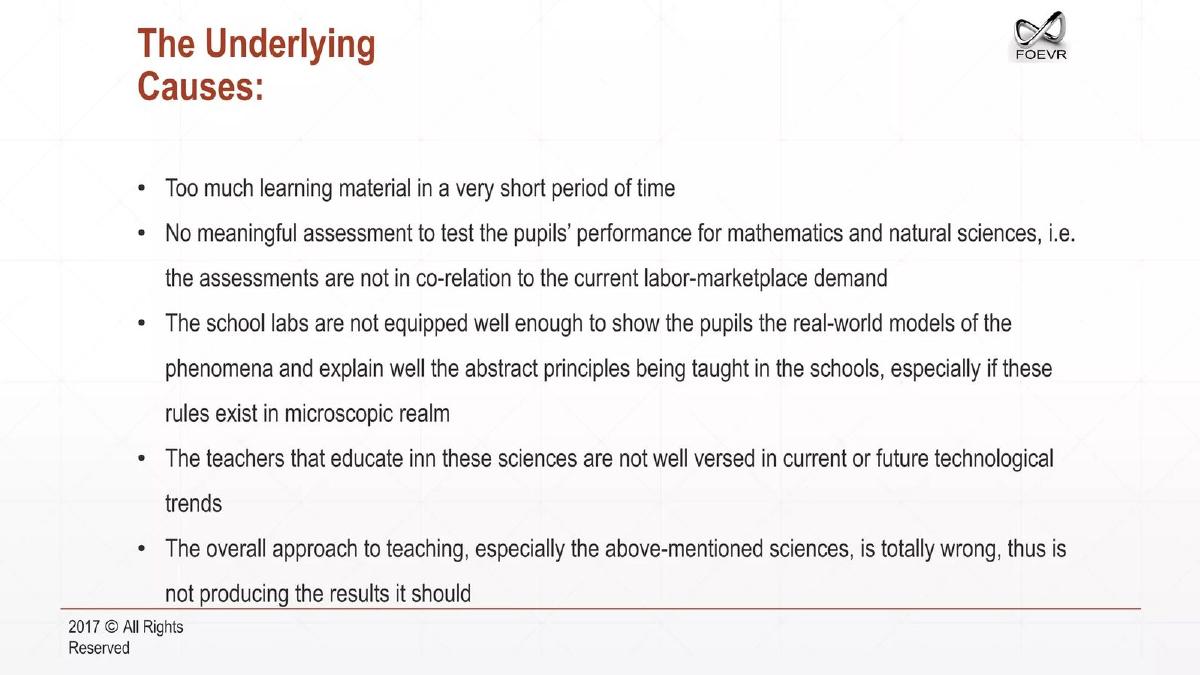
This slide serves as the problem statement. It lists five bullet points identifying why current science education is failing. Key points include:
Too much material in too little time. · Assessments that do not correlate with labor-market demand. · School labs that lack the equipment to show real-world models or microscopic phenomena. · Teachers who are not well-versed in technological trends. · An overall approach to teaching sciences that is "totally wrong."
The slide establishes a broad, systemic problem but does not provide external data or citations to support these specific claims, relying instead on the founder's observations of the educational landscape.
Slide 3: F.O.E. VR
This is a transition slide that introduces the acronym for the company. It stands for "Fundamental Online Education" combined with "VR" (Virtual Reality). The slide is visually sparse, containing only the large text and the company logo.
Slide 4: What Exactly Does These Mean?
This slide defines the company's core pillars. It explains that "Fundamental Online Education" focuses on mathematics, physics, chemistry, and biology. It introduces the "Interdisciplinary (multidisciplinary) approach," using the example of designing a prosthesis, which requires engineering, physics, chemistry, biology, and medicine. Finally, it provides a dictionary-style definition of Virtual Reality, describing it as a "computer generated three-dimensional environment" requiring "special electronic equipment, such as a helmet or goggles." The inclusion of a basic definition of VR suggests the deck was intended for an audience that might not be familiar with the technology in 2017.
Slide 5: Overall Market Potential
FOEVR uses a nested circle diagram to illustrate their market sizing. The figures quoted are as follows:
Total Market: 350 million enrolled K-12 kids globally. · Underperforming Segment: 160 million kids (45% of the total) who underperform in math and natural sciences. · TAM: 100 million kids between 5th and 12th/13th grade. · SAM: 10 million kids from higher-income families.
The slide notes that the target geography includes the US, Canada, Australia, UK, Ex-Yugoslavian, and EU countries. It specifically targets parents from "Generation X through mid-millennials" who are "too busy earning money" to help their children with science studies.
Slide 6: Team
The team slide features two confirmed members and one vacancy:
Miroslav Konstantinovic (CEO): A Professor of Mathematics and Physics in primary school. His bio mentions he has been "watching and learning about ICT technology for 30 years" and is self-taught in business management. · Manjunath Patil (CMO/CSO): Holds a Bachelor in Communication and Electronics Engineering. He worked at Oracle India Pvt Ltd for 3 years as a Marketing Analyst and has experience in other IT sales departments. · CTO (Question Mark): This position is listed as a vacancy. The deck specifies they are looking for a Software Engineer with VR knowledge or a 3D app developer experienced in Unreal or Unity engines.
The lack of a technical co-founder in a VR-focused startup is a significant detail revealed on this slide.
Slide 7: The Ask
The final slide in this set outlines the funding requirement. FOEVR is seeking €250,000 to meet their "3rd and 4th milestone." The funds are allocated for:
Developing a prototype of the educational design. · Conducting a pilot program to find "solution-market fit." · Organizing education events to engage VR influencers. · Hiring external education professionals to act as "evangelists and ambassadors." · Lead generation through conferences and education fairs. · Navigating "long sales cycles."
The ask confirms that the company is currently in the pre-product stage, as the primary use of funds is the creation of a prototype.
What Works in This Deck
The deck clearly identifies a specific niche: the failure of traditional science education and the potential for VR to bridge the gap between abstract principles and real-world application. The market sizing on Slide 5 is logical, moving from a massive global figure to a more realistic target of 10 million high-income families. By focusing on "fundamental sciences" (Slide 4), the company avoids the trap of trying to teach everything at once, instead focusing on subjects where 3D visualization is most beneficial.
What is Missing
The most glaring omission is a functional prototype or even mockups of the software. For a VR company, visual proof of the "interdisciplinary approach" is essential. Furthermore, the deck lacks a business model. There is no mention of how much the service will cost, whether it is a subscription or a one-time purchase, or if they are selling to schools (B2B) or directly to parents (B2C), although Slide 5 hints at the latter. The competitive landscape is also entirely absent; there is no mention of other VR education platforms or traditional digital learning tools like Khan Academy. Finally, the absence of a CTO is a major risk factor for a technology-heavy pitch.
Founder Takeaways
Founders can learn from FOEVR's attempt to quantify a qualitative problem. The breakdown of why science education fails (Slide 2) is a strong way to build a narrative. However, this deck serves as a cautionary tale regarding technical readiness. If your product relies on high-end software like VR, you must have a technical lead on the team slide, not a question mark. Additionally, when asking for a specific sum like €250,000, it is helpful to provide a more detailed breakdown of the "milestones" mentioned on Slide 7 so investors know exactly what their capital is buying.
Frequently asked questions
- What is the primary problem FOEVR is trying to solve?
- According to Slide 2, FOEVR addresses 'The Underlying Causes' of poor educational outcomes: excessive learning material in short timeframes, lack of meaningful assessment, poorly equipped labs, and teachers who are not well-versed in technological trends. They argue the current approach to teaching fundamental sciences is 'totally wrong' and fails to produce necessary results for the modern labor market.
- How does the company define its target market?
- Slide 5 breaks down the market starting with 350 million K-12 students globally. They narrow this to 160 million who underperform in science, then to a Total Addressable Market (TAM) of 100 million students in grades 5 through 13. Their Serviceable Addressable Market (SAM) is 10 million children from higher-income families with parents from Gen X or mid-millennial cohorts.
- What is the current state of the FOEVR product?
- Based on Slide 7, the product is in the pre-prototype stage. The funding ask of €250,000 is specifically designated to 'Develop a prototype of the educational design' and 'Conduct a pilot program.' The deck defines what VR is on Slide 4, suggesting that the technology has not yet been integrated into a functional tool.
- Who are the key people behind FOEVR?
- Slide 6 lists Miroslav Konstantinovic as CEO, a former teacher who has been 'learning by myself about running a business.' Manjunath Patil is the CMO/CSO, bringing three years of experience as a Marketing Analyst at Oracle India. The technical leadership (CTO) is currently an unfilled role, with the deck listing requirements for Unreal or Unity engine experience.
- What are the specific goals for the €250,000 investment?
- As stated on Slide 7, the funds are for prototype development, pilot programs, and organizing education events to attract VR influencers. Additionally, the capital will be used to hire external education professionals, generate leads through conferences and media, and navigate 'long sales cycles' within the education sector.