Folia Water’s 2016 Seed deck is an exercise in restraint, using just nine slides to secure $1.5 million in funding. The company, led by PhDs from Columbia and Cornell, targets the 1.8 billion people lacking safe drinking water with a nano-silver coated paper filter. Rather than getting bogged down in the chemistry of their 'super material,' the deck focuses on the unit economics: manufacturing at 7 cents, distributing at 25 cents, and retailing at 50 cents. By positioning their product as '10X cheaper' than bottled water and highlighting a $20 billion market opportunity among those earning $2…
Key takeaways
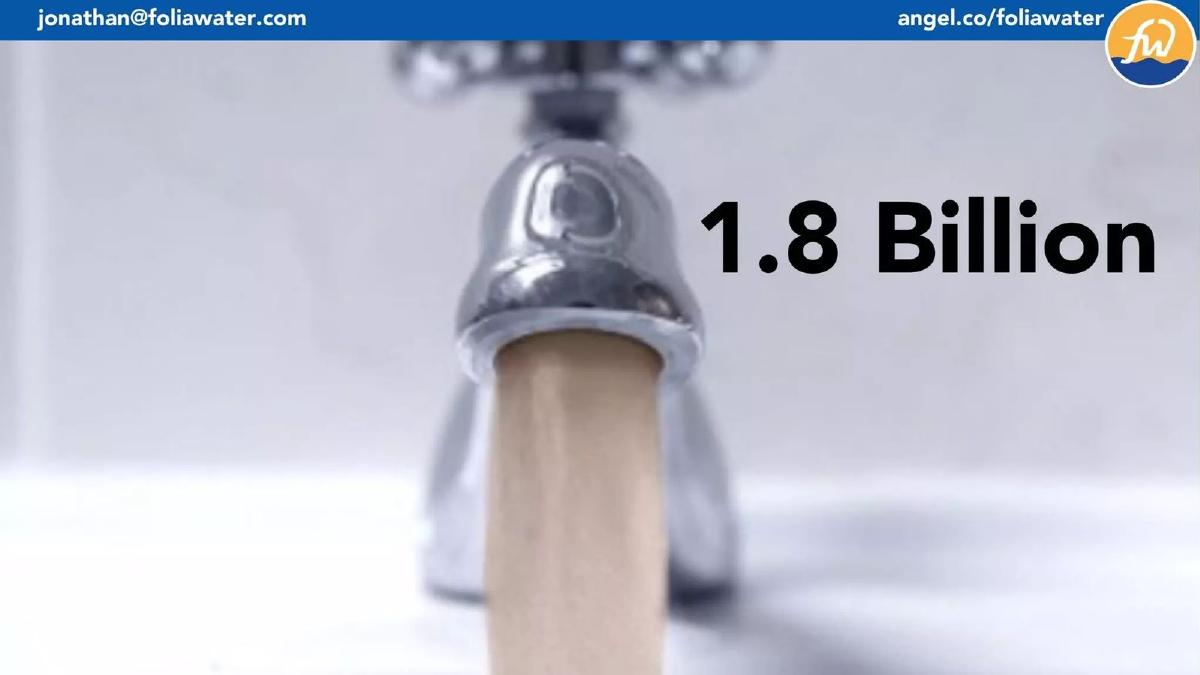
- The deck identifies a massive total addressable market of 1.8 billion people lacking safe water on slide 2.
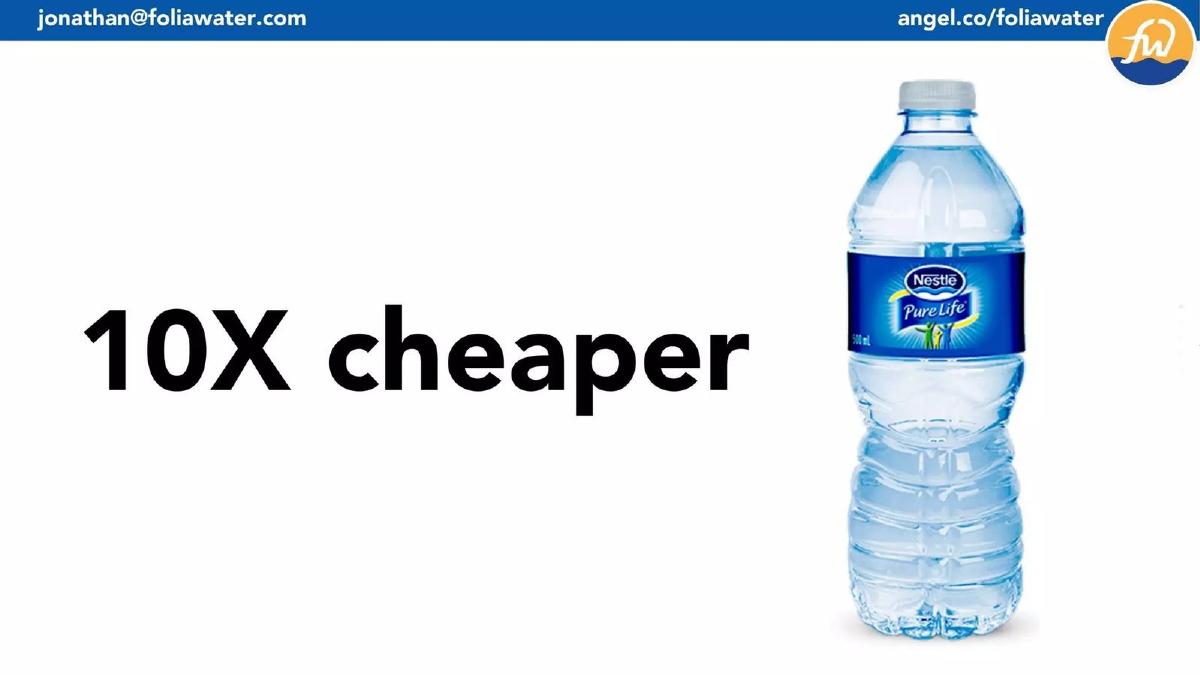
- The core value proposition is framed as a 10X cost reduction compared to existing bottled water solutions on slide 4.
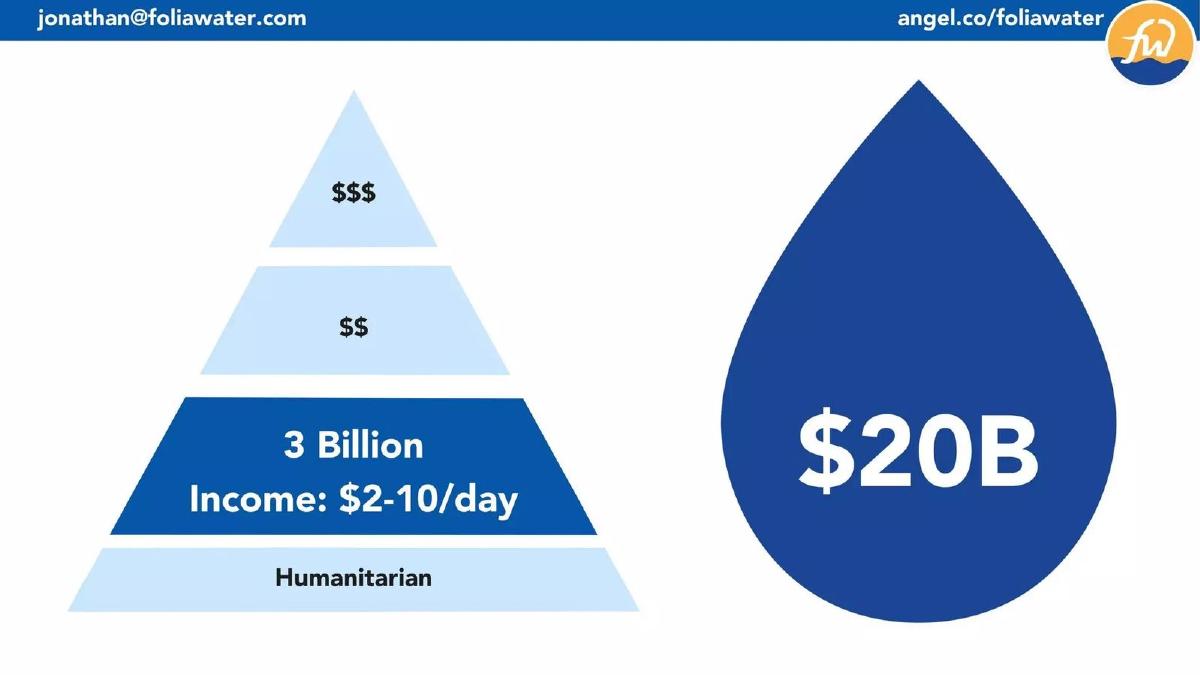
- Folia Water targets a specific economic demographic of 3 billion people earning $2-10 per day on slide 5.
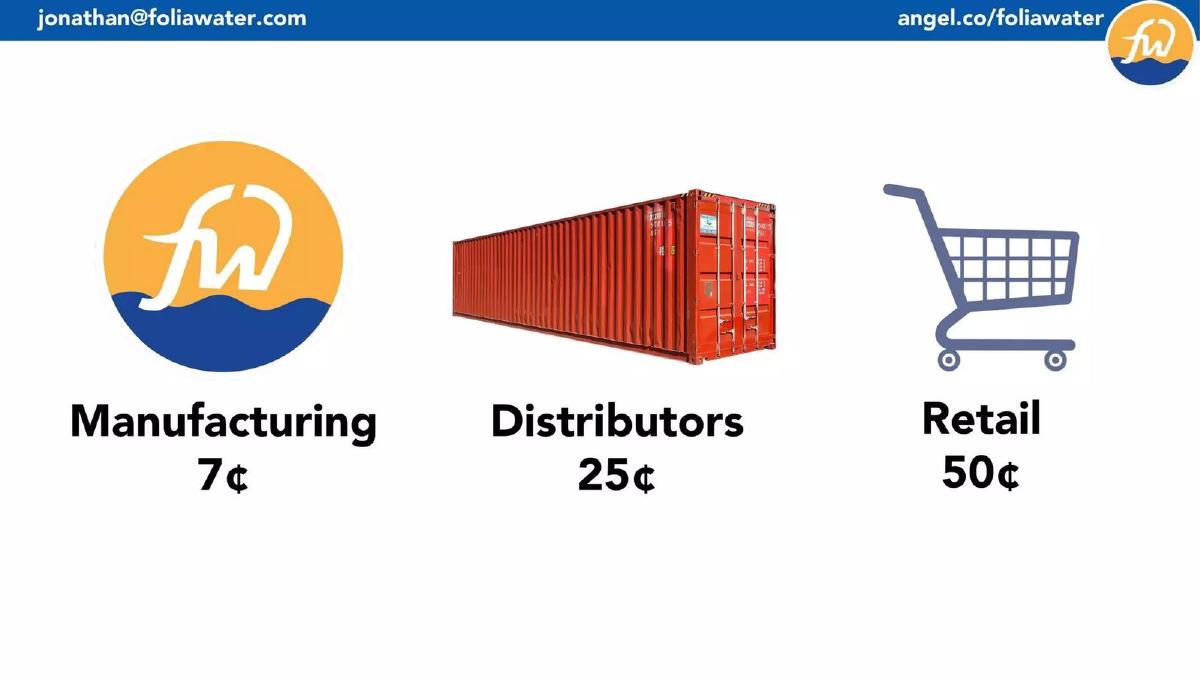
- The unit economics are clearly defined with a 7-cent manufacturing cost and a 50-cent retail price on slide 6.
- Traction is demonstrated through a 'Sold Out' MVP and $100k in initial results on slide 7.
- The founders project a significant revenue jump to $2-5M in 2018 through 8 distributors on slide 7.
- The technical credibility is established by a founding team of two PhDs from top-tier research universities on slide 8.
- The deck omits a formal 'Ask' slide, leaving the specific funding requirements and use of proceeds to the catalogue listing.
The Power of Radical Simplicity in Material Science
Folia Water’s 2016 pitch deck is a masterclass in how to present a complex, science-heavy business without losing the investor in technical jargon. At its core, Folia Materials (the parent company) is a nano-chemistry business. They have figured out how to coat ordinary paper with silver nanoparticles to kill bacteria and viruses. However, if you look at their nine-slide deck, you won't find a single chemical equation or a diagram of a silver ion. Instead, you find a relentless focus on the number 10X and the word pennies .
This teardown examines how a company with deep academic roots—led by two PhDs—stripped away the 'how' to focus entirely on the 'how much' and 'for whom.' By doing so, they successfully raised $1.5 million in a Seed round, proving that for early-stage investors, the economic viability of a breakthrough is often more compelling than the breakthrough itself.
Slides 1-3: The Problem and the 'Penny' Solution
The deck opens with a high-contrast title slide featuring the tagline: "Paper for pennies. Water for billions." This immediately sets the scale and the cost-advantage theme that carries through the entire presentation. Slide 2 is a classic 'problem' slide, but it uses extreme visual economy. It shows a faucet pouring brown, contaminated water with the text "1.8 Billion" superimposed. There is no further explanation needed; the image and the number define the global crisis of unsafe drinking water.
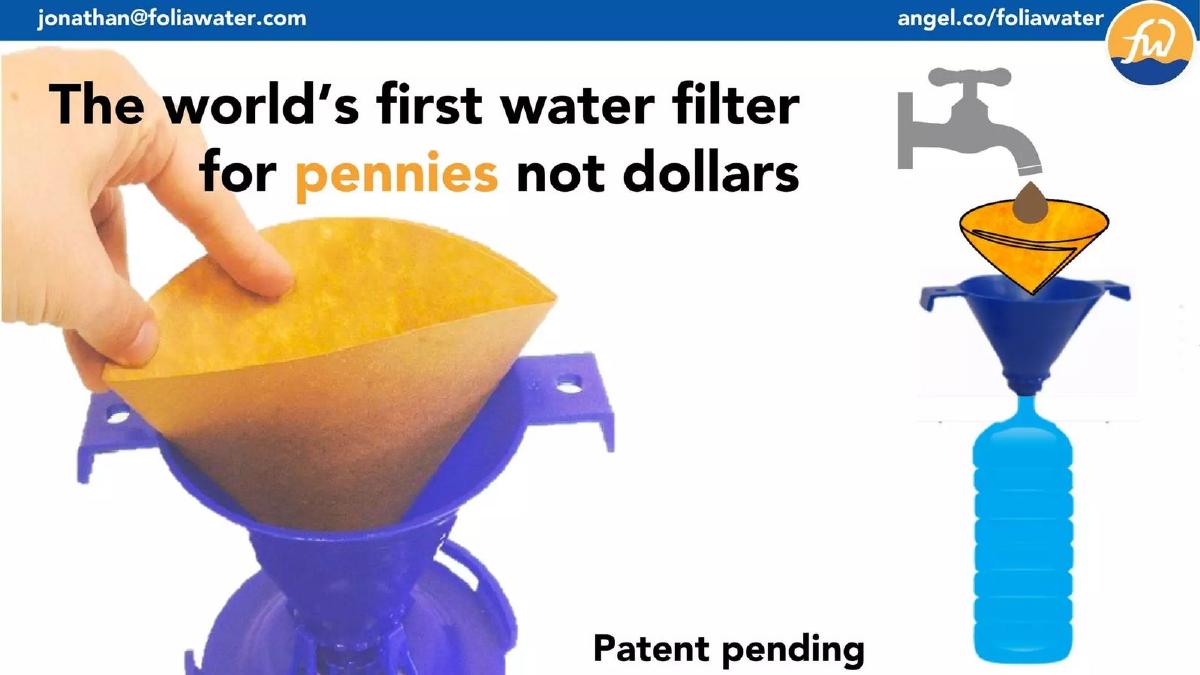
Slide 3 introduces the product. It is a simple photograph of a hand placing a brown paper cone into a blue plastic funnel. The text reads: "The world’s first water filter for pennies not dollars." Below the image, the words "Patent pending" provide the necessary defensive moat for a material science company. By showing the product in a familiar form factor—a coffee-style filter—Folia Water bypasses the need to explain the user experience. Investors immediately understand how it works: you pour water through the paper, and it comes out clean.
Slides 4-5: The 10X Advantage and Market Segmentation
Slide 4 is perhaps the most important slide in the deck. It features a bottle of Nestle Pure Life water and the text "10X cheaper." In the world of venture capital, a 10x improvement is often the benchmark for a viable startup. Folia isn't claiming to be 20% better; they are claiming a total disruption of the price floor for clean water. This slide reframes the company from a 'social enterprise' to a 'market disruptor.'
Slide 5 provides the market context. Using a pyramid diagram, the company identifies its target: 3 Billion people with an income of $2-10/day . This is a crucial distinction. They are not targeting the 'Humanitarian' base of the pyramid (which usually relies on NGOs and grants), but rather the 'working poor' who have discretionary income but limited access to infrastructure. The slide estimates this specific market at $20B . This tells the investor that Folia is a CPG (Consumer Packaged Goods) play, not a charity.
Slides 6-7: Unit Economics and Traction
Slide 6 breaks down the 'pennies' promise into hard figures. It shows a three-step value chain: Manufacturing (7¢) , Distributors (25¢) , and Retail (50¢) . This transparency is rare in seed decks but highly effective. It demonstrates that even at a very low retail price, there is enough margin to incentivize a distribution network. The use of a shipping container icon for distributors and a shopping cart for retail reinforces the idea of a physical, scalable supply chain.
Slide 7 addresses the 'Why Now?' and 'Is it working?' questions. It states that the MVP is "Sold Out" and has generated $100k in revenue. More importantly, it looks forward, claiming 8 Distributors are already in place with a projected revenue of $2-5M in 2018 . For a 2016 seed round, these projections are aggressive but grounded in the fact that the product is already moving through the channel. The visual of a pallet of boxes suggests that the company has moved past the lab phase and into the logistics phase.
Slides 8-9: The Team and the Vision
Slide 8 introduces the Founding Team: Scientists . The slide features a photo of CEO Jonathan Levine, PhD, and CTO Teri Dankovich, PhD. The logos of Columbia University, Cornell University, McGill, and Carnegie Mellon are displayed prominently. This slide serves as the 'trust' anchor. Because the previous slides were so simple, the investor might wonder if the technology is real. This slide answers that by showing the founders' elite academic credentials. They are not just entrepreneurs; they are the inventors of the material.
The final slide (Slide 9) acts as a summary and a closing 'big idea.' It repeats the 10X cheaper claim and the $20B market size, but adds a new headline: "Folia Filters: The Next $1B Staple." It positions the product alongside salt, soap, and flour—essential goods that every household buys. This is the ultimate goal of the pitch: to convince the investor that this paper filter will become a ubiquitous household item across the developing world.
What Works in This Deck
Extreme Brevity: At only 9 slides, the deck respects the investor's time. It doesn't over-explain the science, which can often be a trap for PhD founders. · The 10X Hook: The repeated emphasis on being 10X cheaper than the alternative (bottled water) is a powerful economic argument that overrides almost any other concern. · Clear Unit Economics: By showing the 7¢/25¢/50¢ breakdown, the founders prove they understand the realities of selling in emerging markets, where margin for middle-men is the only way to achieve scale. · Visual Proof: Using photos of the actual product and the founders holding a large sheet of the material makes the technology feel tangible and ready for market.
What Is Missing
The Ask: The deck does not state how much money they are raising or what they will do with it. While this information was in the catalogue listing ($1.5M), its absence from the slides is a missed opportunity to set the terms of the round. · Competitive Landscape: There is no mention of other low-cost water solutions like LifeStraw, chlorine tablets, or ceramic filters. Investors will inevitably ask how Folia compares to these incumbents. · Technical Validation: While the PhDs provide 'social proof' of expertise, the deck lacks data on the filter's efficacy. How many liters can one filter clean? What specific pathogens does it remove? These are critical questions for a water tech company. · Risk Factors: Selling into emerging markets with $2-10/day incomes involves massive logistical and currency risks. The deck ignores these challenges entirely.
What a Founder Should Copy
The 'Price Floor' Strategy: If your product is significantly cheaper than the status quo, make that the centerpiece of your deck. Don't hide it behind features. · Targeting the 'Missing Middle': Folia’s focus on the $2-10/day demographic is brilliant. It identifies a market that is large enough for VC returns but underserved by traditional premium brands. · Academic Credibility as a Moat: If you have a PhD or a patent, use it as a shorthand for 'this works' so you can spend your slides talking about 'this sells.' · Consistent Branding: The blue and orange color palette and the 'fw' logo are used consistently across all slides, giving the deck a professional, 'retail-ready' feel that belies its status as a seed-stage startup.
Frequently asked questions
- What is the primary technical innovation behind Folia Water?
- According to the catalogue listing, the company uses a patented process to bond nanosilver to ordinary industrial paper at the fiber level. This creates a 'super material' that acts as a highly effective, low-cost water filter. The deck itself focuses less on the chemistry and more on the physical application—a paper cone that fits into a standard funnel to purify water.
- How does Folia Water plan to reach its target market?
- The deck outlines a traditional retail distribution model on slide 6. They break down the price points from a 7-cent manufacturing cost to a 25-cent distribution cost, resulting in a 50-cent retail price. Slide 7 further notes they already have 8 distributors in place to facilitate a projected $2-5M in revenue for 2018.
- Who is the specific target consumer for this product?
- Slide 5 identifies a target segment of 3 billion people with a daily income of $2-10. This 'bottom of the pyramid' strategy focuses on consumers who are above the 'humanitarian' aid level but cannot afford premium water solutions, representing a $20 billion market opportunity.
- What evidence of market validation does the deck provide?
- Slide 7 highlights that their Minimum Viable Product (MVP) was 'Sold Out' and generated $100k. The catalogue listing adds that they piloted the product with Unilever in South Asian grocery stores, leveraging the distribution power of $1B soap brands to reach rural and low-income urban consumers.
- Does the deck explain how the $1.5M seed round will be used?
- No. The 9-slide deck completely omits a 'Use of Funds' or 'The Ask' slide. While the catalogue listing confirms they raised $1.5M in 2016, the deck focuses entirely on the problem, the product's cost advantage, and the team's credentials rather than the specific financial requirements of the round.