Forage Hyperfoods presents a compelling case for the 'functional food' movement, specifically leveraging the scarcity of wild-harvested Canadian Chaga. The deck highlights a significant pivot from 4 SKUs in 2020 to over 30 in 2021, supported by the strategic acquisition of Chaga.ca. While the company maintains a strong B2B wholesale base with over 50 recurring customers, the deck also reveals a diversification strategy into the ready-to-drink (RTD) market via a 25% equity stake in Backpack Co. The financial comparison slide suggests the company is seeking a valuation rerating, comparing its $…
Key takeaways
- The company claims a leadership position in the wild Canadian Chaga market, citing proprietary extraction methods as a barrier to entry on slide 5.
- Forage Hyperfoods has diversified its revenue stream with 50+ recurring wholesale customers, reducing reliance on direct-to-consumer lines according to slide 4.
- Product velocity is high, with the brand expanding from 4 SKUs in 2020 to over 30 SKUs by the end of 2021 as shown on slide 5.
- The company holds a 25% equity stake in Backpack Co., a pre-launch functional beverage brand, in exchange for advisory and supply services per slide 6.
- The team possesses significant sector experience, including a CFO with 30 years of experience who has assisted in raising over $120 million for early-stage companies (slide 7).
- Forage Hyperfoods reports $350,000 in pre-acquisition revenue and a $25 million market cap as of June 2021 on slide 8.
- The Use of Proceeds includes expansion into 'federally legal markets' like Bahamas and Jamaica for microdose products, as detailed on slide 9.
- The deck omits a specific total funding goal or 'the ask' in terms of a dollar amount, focusing instead on categorical allocations on slide 9.
Executive Summary: The Wild Chaga Play
Forage Hyperfoods Inc. presents a deck that leans heavily on the 'functional food' trend, specifically targeting the medicinal mushroom niche. The deck, dated June 2021, positions the company as a vertically integrated player that controls its supply chain—a rarity in a market often flooded with synthetic or low-quality cultivated alternatives. By highlighting their 50+ wholesale customers alongside a rapidly expanding consumer SKU list, the founders attempt to prove both market demand and operational scalability.
Slide 1: Title and Visual Identity
The cover slide features a high-resolution image of a Chaga mushroom growing on a birch tree. This immediately establishes the 'wild-harvested' narrative. The branding is minimalist, using a serif font and a simple 'f' monogram logo, signaling a premium, wellness-oriented market position.
Slide 2: The Future of Food is Functional
This slide serves as the 'Problem/Opportunity' statement. It argues that the wellness economy is shifting consumer buying decisions toward products with 'positive after-effects.' The text defines functional foods as those addressing mental health, energy levels, and moods. It is a high-level market thesis that sets the stage for why mushrooms are relevant now.
Slide 3: Market Positioning
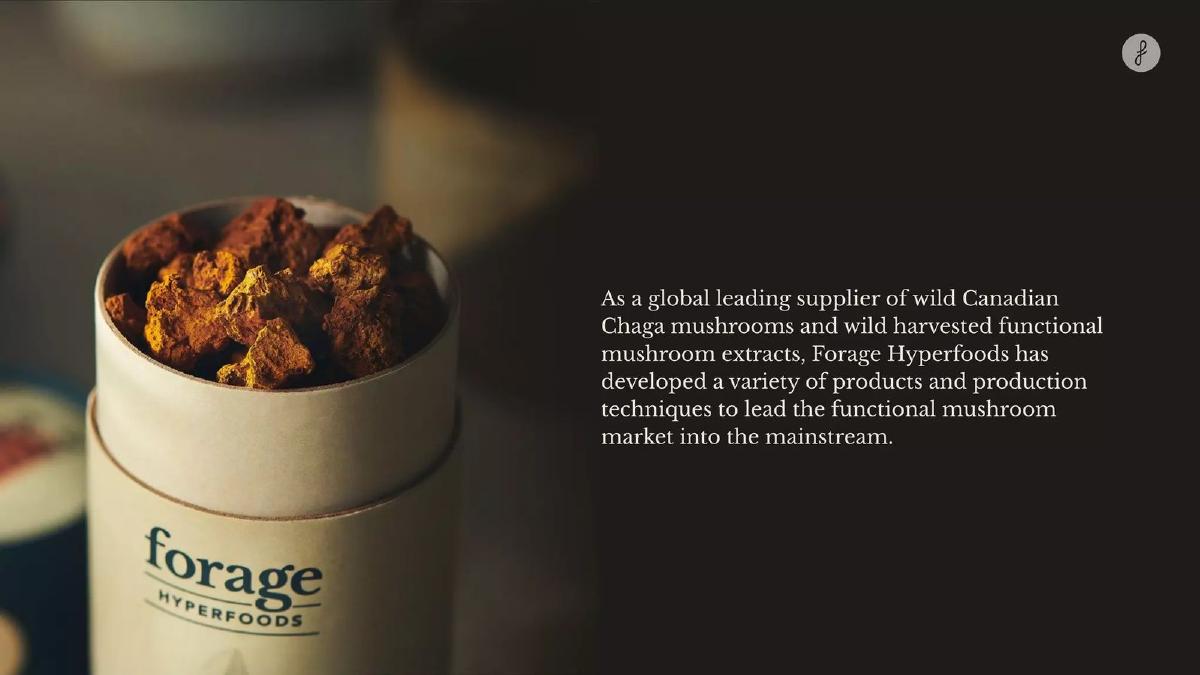
Slide 3 introduces Forage Hyperfoods as a 'global leading supplier of wild Canadian Chaga mushrooms.' This is a bold claim that shifts the company from a mere brand to a critical infrastructure provider for the broader industry. The visual of raw Chaga chunks in a branded tube reinforces the 'raw and authentic' product nature.
Slide 4: Wholesale Traction
The headline 'market growth = our growth' underscores their B2B strategy. The slide states that Forage has 50+ recurring wholesale customers for raw and extracted mushrooms. Crucially, it mentions that competitors' inability to mass-produce cultivated Chaga creates a supply constraint that Forage is positioned to exploit. This slide is the strongest evidence of product-market fit in the deck, showing they are 'non-reliant' on their direct-to-consumer (DTC) lines.
Slide 5: Brand Evolution and SKUs
This slide provides a timeline of product development. In 2020, the company had 4 SKUs under the 'Chaga.ca' brand. By Q1 2021, they rebranded to Forage Hyperfoods and expanded to 15 SKUs. By Q3 2021, the deck projects over 30 SKUs , including tinctures, coffee pods ('Out of the Woods'), and capsules. The slide credits the acquisition of Chaga.ca and investments in extraction technology for this rapid expansion.
Slide 6: Strategic Partnerships (Backpack Co.)
Forage reveals a diversification play here. They hold 25% equity in Backpack Co., a pre-launch functional beverage brand. Forage provides advisory services and the mushroom supply. This is a classic 'picks and shovels' strategy, where Forage benefits from the growth of the RTD (ready-to-drink) market without taking on the full operational risk of a beverage launch.
Slide 7: The Leadership Team
The team slide is comprehensive. Jonathan Murray (President) has a background in MedTech sales. David Ewart (CFO) is a standout, with 30 years of experience and a history of raising $120 million for early-stage companies. Christopher Murray brings cannabis industry experience from Canopy Growth, and Shane Currey adds a finance/investment perspective. This team appears well-balanced between sales, finance, and industry-specific operations.
Slide 8: Comparable Companies
This table compares Forage to peers like Laird Superfood, Four Sigmatic, and Red Light Holland. It lists Forage's 2020 reported revenues as $350,000 (pre-acquisition) and its market cap as $25,000,000 as of June 15, 2021. The table is designed to show that Forage is the only player checking every box: Food & Bev, Supplement, Psych (Psychedelics), and Proprietary Supply Chain. It suggests that Forage is undervalued relative to peers like Four Sigmatic, which it estimates is valued between $400m and $1b.
Slide 9: Use of Proceeds
The final slide in this set breaks down how the capital will be spent. Categories include Staffing & Sales, Inventory & Product Expansion, Marketing & Ad Spend (citing a 'positive ROAS'), and the establishment of Ticket Microdose Co. in the Bahamas and Jamaica. This last point is a significant pivot into the legal psychedelic space, which was a major investor trend in 2021.
What Works in This Deck
The deck excels at demonstrating vertical integration . By controlling the supply of a scarce resource (wild Canadian Chaga), Forage creates a moat that pure-play consumer brands lack. The transition from a raw material supplier (Chaga.ca) to a sophisticated consumer brand (Forage Hyperfoods) is clearly mapped out. The inclusion of a 25% equity stake in a beverage company shows strategic thinking about how to capture value in high-growth adjacent markets without overextending their own operations. The team slide is also strong, particularly the CFO's credentials, which adds significant institutional credibility to an early-stage venture.
What Is Missing
The most glaring omission is the specific 'Ask.' While the Use of Proceeds slide exists, it does not state the total dollar amount being raised or the terms of the offering. Additionally, the deck lacks unit economics . While they mention a 'positive ROAS' (Return on Ad Spend), they do not provide specific numbers for Customer Acquisition Cost (CAC) or Lifetime Value (LTV). For a company with 30+ SKUs, understanding the margins on tinctures versus wholesale raw materials is critical for an investor to assess the quality of the revenue. Finally, the revenue figure provided ($350,000) is pre-acquisition and dated; a more current post-acquisition run rate would have been more persuasive.
Founder's Guide: What to Copy
Founders should emulate the 'Comparable Companies' table (Slide 8). Instead of just listing names, Forage uses a checklist to show exactly where they have a competitive edge (Proprietary Supply Chain) that others lack. This forces the investor to view the company through the founder's preferred lens. The 'Brand Evolution' timeline (Slide 5) is also a great way to show momentum; it visually demonstrates that the team can execute and launch products quickly. Finally, if you have a B2B component to your business, follow their lead on Slide 4 by highlighting 'recurring wholesale customers' to prove that your business isn't entirely dependent on the whims of the DTC market.
Frequently asked questions
- What is Forage Hyperfoods' primary competitive advantage?
- According to slide 4 and 5, their advantage lies in their supply chain for wild-harvested Canadian Chaga. They note that competitors struggle to mass-produce cultivated Chaga, and Forage has secured a 'head start' through the acquisition of Chaga.ca and the development of proprietary extraction technology. This allows them to serve as both a raw material supplier and a consumer brand.
- How does the company generate revenue?
- The company utilizes a hybrid model. Slide 4 highlights a B2B wholesale business with 50+ recurring customers, including international brands and co-packers. Slide 5 shows a growing B2C consumer brand with over 30 SKUs across tinctures, powders, and capsules. Additionally, slide 6 mentions a 25% equity stake in a beverage partner, suggesting a long-term value-play in the RTD sector.
- Who are the key members of the leadership team?
- The team is led by President Jonathan Murray (formerly VP at a digital marketing agency) and CFO David Ewart, a Chartered Accountant with 30 years of experience. Other co-founders include Christopher Murray, an early Canopy Growth employee, and Shane Currey, a finance professional. Chanel Murray serves as VP and Co-Founder, bringing retail operations experience from Inditex (Zara).
- What are the company's plans for the 'microdosing' market?
- Slide 9 indicates that a portion of the proceeds will be used to establish a 'premium microdose product' under the name Ticket Microdose Co. The strategy involves launching in federally legal markets such as the Bahamas and Jamaica, while exploring licensing agreements in US jurisdictions where state-level legalization has occurred.
- What is missing from this pitch deck?
- The deck lacks a specific funding amount (the 'Ask'). While slide 9 outlines the 'Use of Proceeds,' it does not state how much capital is being raised. Furthermore, there are no detailed unit economics, customer acquisition cost (CAC) data, or specific revenue projections beyond the historical $350,000 pre-acquisition figure mentioned on slide 8.