Footprint raised $13M in 2024 for its fintech onboarding and fraud mitigation platform. The fundraising materials are notable for their bifurcated structure: a minimalist 9-slide visual deck followed by a detailed 5-page narrative memo. The core value proposition centers on 'portable identity' bound to biometrics, moving away from traditional database-centric identity verification. The deck emphasizes a 'land and expand' model, citing specific instances where customers like Grid and Flexcar replaced legacy providers (Persona, Onfido, VGS) with Footprint's integrated suite. By positioning them…
Key takeaways
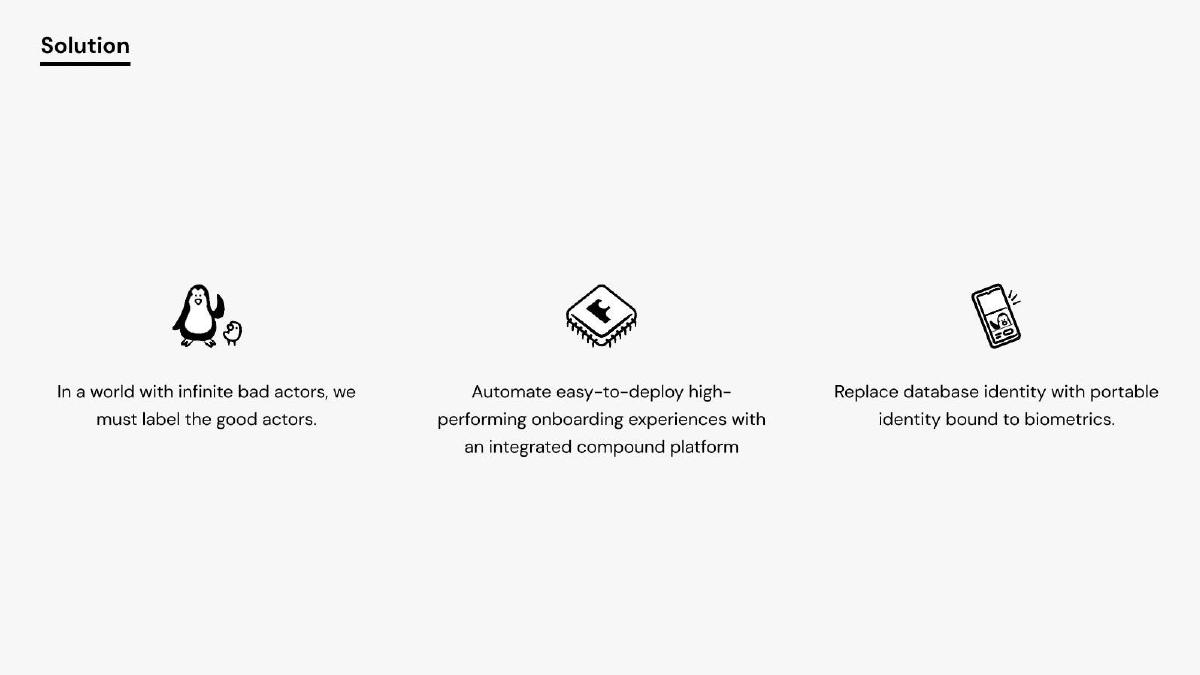
- The deck uses a minimalist visual style for the first 9 slides, relying on three-point summaries and simple icons to convey the solution and market timing (Slides 2-3).
- Footprint explicitly names competitors they have displaced, including Persona, Onfido, and VGS, to prove market fit and product superiority (Slide 10).
- The business model is a dual-revenue stream consisting of a per-onboard fee and a recurring charge per active user for data security (Slide 4).
- The team slide highlights deep domain expertise, featuring a CTO who built a company acquired by Akamai and a lead from Stripe's risk engineering team (Slide 5).
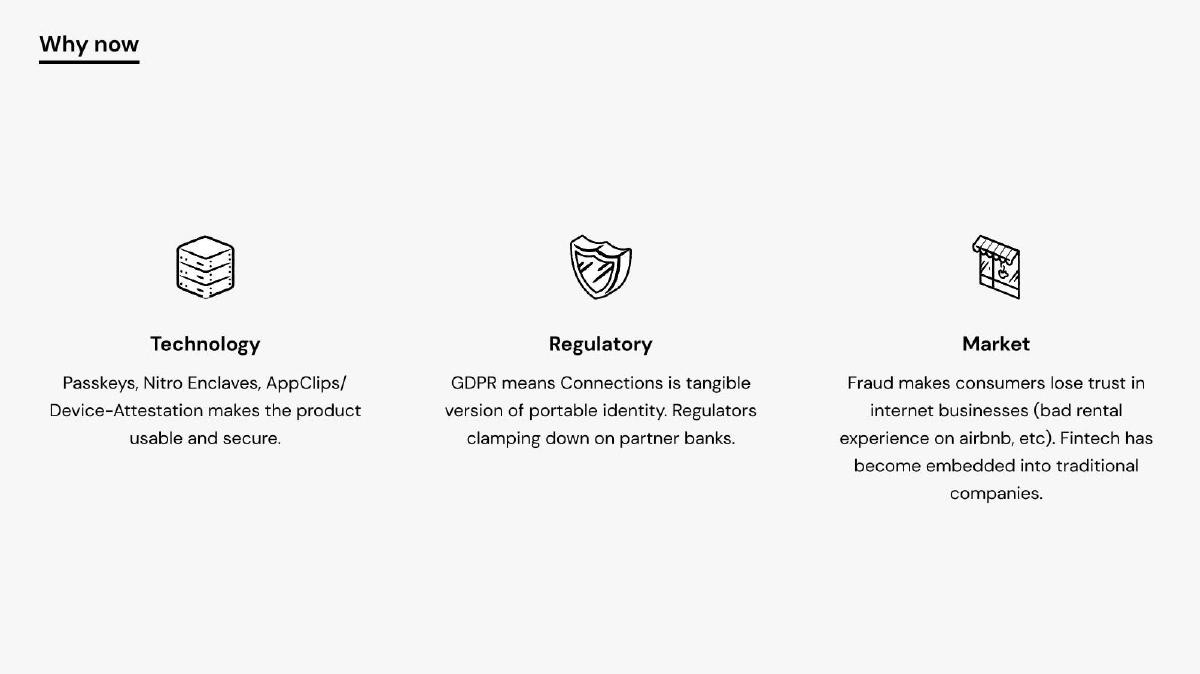
- The 'Why Now' slide identifies three specific tailwinds: Passkeys/Nitro Enclaves (Tech), GDPR/Regulator pressure (Regulatory), and consumer trust erosion due to fraud (Market) (Slide 3).
- The narrative memo argues that Generative AI makes it impossible to find every 'bad actor,' shifting the strategy to labeling 'good actors' in a closed-loop ecosystem (Slide 11).
- Footprint reports significant performance metrics from clients, such as a 30+% boost to pass-rates for Bloom and Composer after replacing internal KYC (Slide 10).
- The company aims to build a verified network of 100M+ de-duped authentic identities in the US to streamline consumer onboarding across the internet (Slide 11).
The Hybrid Pitch: Visuals for Impact, Memos for Depth
Footprint’s Series A materials represent a growing trend in high-stakes fundraising: the combination of a minimalist visual deck and a dense narrative memo. Reported by Business Insider as a $13M raise in 2024, the materials focus on the technical evolution of identity. The deck does not waste time on fluff; it moves directly from the vision of 'portable identity' to the specific competitors it is currently displacing in the market.
Slide 1-2: The Vision and The Solution
The deck opens with a clear mission statement: 'User onboarding to increase trust and lower friction and fraud on the internet.' Slide 2 breaks the solution into three pillars. First, the philosophical shift: in a world of infinite bad actors, the goal is to label the 'good actors.' Second, the automation of onboarding through an 'integrated compound platform.' Third, the technical differentiator: replacing database-stored identity with 'portable identity bound to biometrics.' This slide sets the stage for a product that isn't just a better KYC tool, but a fundamental change in how identity is managed.
Slide 3: The 'Why Now' Framework
Slide 3 is a textbook example of a 'Why Now' slide, categorizing the urgency into Technology, Regulatory, and Market factors. Under Technology, it lists Passkeys, Nitro Enclaves, and AppClips as the enablers of secure, usable products. The Regulatory section notes that GDPR makes portable identity a 'tangible version' of compliance and highlights increased pressure on partner banks. The Market section addresses the erosion of consumer trust due to fraud, citing specific examples like bad rental experiences on Airbnb, and notes that fintech is now embedded in traditional companies, expanding the total addressable market.
Slide 4: Business Model and Financials
Slide 4 is remarkably simple. It outlines a two-pronged revenue model: a 'Charge per-onboard' (transactional) and a 'recurring charge per/active user for data security and auth' (SaaS). This suggests a 'land and expand' financial strategy where the initial onboarding fee gets Footprint in the door, while the recurring security fee provides long-term, predictable revenue. No specific pricing tiers or dollar amounts are listed on this slide.
Slide 5: The Team Slide
The team slide (Slide 5) emphasizes technical pedigree and domain experience. Co-founder and CEO Eli Wachs is credited with building Decdis and HSHX, with a background in Security & Identity at GA and Stanford. Co-founder and CTO Alex Grinman brings significant credibility as the founder of KryptCo (acquired by Akamai) and a cryptography expert from MIT. The supporting team includes Elliott Forde (Robinhood backend lead), Dave Argoff (Stripe and Sardine risk engineering), Rafael Motta (Kyte/Fast frontend lead), and Pedro Marques (Kyte/Fast design lead). This lineup signals to investors that the company has the engineering muscle to handle complex fintech infrastructure.
Slides 6-9: The Visual Transition
Slides 6 through 9 are not explicitly detailed in the provided text but serve as the transition into the 'Series A Memo' portion of the presentation. In a typical 14-slide deck, these would likely contain product screenshots, architectural diagrams, or high-level market sizing data to bridge the gap between the vision and the granular customer data found in the memo.
Slide 10: The Displacement Memo (Customer Traction)
Slide 10 shifts to a text-heavy memo format, which is where the real 'meat' of the Series A case is made. This slide is a list of 'wins' against established competitors. It notes that Findigs replaced Persona, Flexcar replaced Onfido, and Bloom/Composer replaced Alpaca’s internal KYC. The results are specific: Bloom and Composer saw a '30+% boost to pass-rates.' In the security category, Grid chose Footprint over VGS to vault over 1M identities and 500k credit cards, while Yieldstreet uses them for 500k members and $9B in AUM. This slide is designed to prove that Footprint is winning head-to-head battles against the current market leaders.
Slide 11: The 'Segment for Fraud' Philosophy
Slide 11 delves into the company's long-term strategy. It argues that friction is the 'first place to remediate' because it represents billions in lost revenue, but the larger problem is fraud. The memo makes a bold claim: 'you can’t solve fraud with backend tools that don’t interact with real people.' It positions Footprint as a 'closed-loop ecosystem' that uses app clips and passkeys to limit one identity to each device. The goal is to become a 'Segment for Fraud,' acting as the front-end orchestration layer for all onboarding and compliance data. The slide concludes with the 'massive prize': a verified network of 100M+ de-duped authentic identities in the US.
What Works in This Deck
Specific Competitive Intelligence: Most decks shy away from naming competitors. Footprint leans into it, listing exactly who they replaced (Persona, Onfido, VGS, Auth0) and what the outcome was. This gives investors a clear sense of where the company sits in the ecosystem and why it is winning.
The 'Good Actor' Narrative: By framing the problem as 'labeling the good actors' rather than 'catching the bad actors,' Footprint differentiates itself from the hundreds of existing fraud detection tools. This narrative shift is particularly effective in the context of Generative AI, where 'bad actors' can scale infinitely.
Technical Credibility: The team slide and the mention of specific technologies like Nitro Enclaves and Passkeys signal that this is a product-led company. They aren't just selling a better UI; they are selling a fundamentally different technical architecture for identity.
What Is Missing
Financial Projections: There are no charts showing ARR growth, burn rate, or future revenue targets. While this information is certainly in the data room, its absence from the deck makes it harder to assess the business's current scale beyond the customer logos.
The Ask: The deck does not state how much they are raising or how the funds will be allocated. According to publisher reports, the round was $13M, but the deck itself remains silent on the terms of the deal.
Market Sizing (TAM): While the memo mentions a 'massive prize' of 100M identities, there is no traditional TAM/SAM/SOM slide. The deck assumes the investor already understands that the identity and fraud market is multi-billion dollar in scope.
Founder Takeaways
Use a Memo for Complexity: If your product is highly technical or operates in a crowded market, a visual deck might not be enough to explain your differentiator. Footprint’s use of a narrative memo allows them to explain the 'why' behind their technical choices in a way that bullet points cannot.
Focus on Displacement: If you are a Series A company, you are likely competing for budget with an incumbent. Showing exactly who you replaced and the percentage improvement (like the 30% pass-rate boost) is the most powerful form of traction you can show.
Leverage Pedigree: If your team has 'been there, done that' at major players like Stripe or Robinhood, make that the centerpiece of your team slide. In fintech, infrastructure experience is a major de-risking factor for investors.
Simplify the Business Model: Even for a complex product, the business model should be easy to understand. Footprint’s 'per-onboard + recurring security fee' is a clean way to explain how they capture value at different stages of the customer lifecycle.
Frequently asked questions
- What is the primary difference between Footprint and traditional KYC providers?
- According to Slide 2 and Slide 10, Footprint replaces 'database identity' with 'portable identity bound to biometrics.' Unlike legacy providers that treat KYC as a one-time checkbox, Footprint creates a cryptographic credential (passkey) during onboarding. This allows them to attest that the same user who verified their identity is the one signing in later, reducing friction and fraud in a way that heuristic-based tools cannot.
- How does Footprint justify its market timing in the 2024 landscape?
- Slide 3 points to the convergence of technology and regulation. It cites the availability of hardware-level security like Nitro Enclaves and Passkeys as the technological enabler. Regulators clamping down on partner banks and the rise of AI-generated fake identities provide the regulatory and market urgency for a more robust, biometric-linked identity solution.
- What is Footprint's 'Land and Expand' strategy?
- As detailed on Slide 10, Footprint often enters a customer through one of three surfaces: KYC/Onboarding, Security (Vaulting), or Auth. For example, Grid initially used Footprint for vaulting over 1M identities and 500k credit cards, then expanded into KYC and Auth. This allows Footprint to displace multiple point solutions like Auth0, AWS Cognito, and VGS over time.
- Who are the key members of the Footprint founding team?
- Slide 5 highlights a high-pedigree team. CEO Eli Wachs previously worked on security at GA and attended Stanford. CTO Alex Grinman founded KryptCo (acquired by Akamai) and studied cryptography at MIT. The team also includes former engineering leads from Robinhood (Elliott Forde) and Stripe/Sardine (Dave Argoff), providing deep experience in fintech infrastructure and risk.
- What specific metrics does the deck provide regarding product performance?
- Slide 10 provides concrete proof points: Bloom and Composer saw a 30+% boost to pass-rates after switching to Footprint. Grid used the platform to vault over 1M identities and 500k credit cards. Yieldstreet uses Footprint for vaulting for its 500k members and $9B of AUM. These figures serve as social proof of the platform's ability to handle enterprise-scale loads.