Prior Exits on a Pitch Deck Team Slide: What to Say About
'Acquired by Cisco' or 'sold for $500M' can be the strongest line on a team slide, or the vaguest.
Prior Exits on the Team Slide: Say What Was Sold, to Whom, When, and What You Did There
When a founder has sold a company before, that fact often becomes the headline of the team slide. Investors do pay attention: a past sale suggests the founder has built something a buyer wanted and has seen a company through to a result. But 'acquired by' covers everything from a large, profitable sale to a small team being hired by a bigger company, and a line on a slide rarely says which. It also rarely says what the person on this slide did at the company that was sold. This guide looks at four team slides that mention a founder's past company sale and shows which details make the line informative and which leave investors to fill gaps themselves, usually by searching.
TL;DR
Name the company that was sold, the buyer, the year, and your role there in words that match what you actually did: founder, co-founder, CTO, early employee. Give the price only if it is public or you are free to share it, and say whose figure it is. Put the exit next to the person it belongs to, not in a slide headline that seems to cover the whole team. EquityBee's CEO line reads 'Former co-founder & CTO at Tapingo (Acquired by Grubhub for $150M)' — role, company, buyer and price in one line, though no year. Harmony's headline says 'Successful Founders sold previous venture for $500M', while the line beneath gives a buyer and an amount raised but not the price. 40seas names the buyer for its COO, 'Co-Founder of ConvertMedia, acquired by Taboola', with no year or size. Footprint says its CTO 'Built KryptCo (acquired by Akamai)', where 'built' leaves his role unclear. Company, buyer, year and role are what investors check first.
Four team slides that mention a founder's past company sale
Each slide is read at full size. Quotes are exact; no exit, price or role was checked against outside sources.
EquityBee team slide — slide 11
Funding for startup employees' stock options. Founding team slide, three people.
EquityBee deck, slide 11. Exact stored slide matched to this analysis.
Our analysis: The most complete exit line of the four.
Evidence and limitation: Role, company, buyer and price in one bullet; no year or price source; second bullet under the CEO.
What a founder can adapt: Add the year and where the price comes from; put the strongest exit first.
Supporting analysis
What the deck claims: "Former co-founder & CTO at Tapingo (Acquired by Grubhub for $150M)".
Presentation choice: Shows how much one bullet can carry.
When it does not fit: Burying the exit below a company with no outcome.
What each slide tells an investor about a past exit
Company, buyer, year, price, role and placement.
Example
Buyer
Year
Price
Role stated
Placement
EquityBee
Grubhub
No
$150M (no source)
Co-founder & CTO
Second bullet, CEO card
Harmony
Cisco
No
$500M in title (no source)
Co-founder & CEO / CTO
Slide headline
40seas
Taboola
No
No
Co-founder
COO card
Footprint
Akamai
No
No
'Built' (unclear)
CTO card
Key Takeaways
Name the sold company, the buyer and the year on the same line.
State your role there exactly: founder, co-founder, CTO, early employee.
Give a price only if it is public or you may share it, and say where it comes from.
Attach each exit to the person it belongs to.
Don't let a headline imply the whole team shares one person's exit.
Put the most relevant exit first, even if it isn't the largest.
Write your exit line
Answer these for each past sale before it goes on the team slide.
Facts. Which company, which buyer, which year?
Role. What was your exact title and when did you hold it?
Price. Is the price public or yours to share? Where does the figure come from?
Relevance. In a few words, why does this exit matter to this company?
Copyable framework: "[Role], [Company], acquired by [Buyer] in [year] ([price, source / what the buyer did with it]); [relevance]."
Illustrative example 1 — written by us
Before: "Built KryptCo (acquired by Akamai)."
After: "Co-founded KryptCo, acquired by Akamai in [year]; [same security buyers]."
What improved: Our illustrative rewrite of Footprint's line. Bracketed details are not stated on the slide.
The question this guide answers
This guide answers one founder question: if someone on my team has sold a company before, how should the team slide say so, so that investors take it as evidence rather than as a name to check?
Our team slide guide covers what a team slide should show overall, including relevant experience. Our founder origin story draft covers why a founder is working on this problem. Our board and advisors guides cover people outside the founding team, some of whom have exits of their own. None makes a founder's past company sale its subject. The advice here is specific: which details of an exit investors look for, how precise to be about price and role, and where on the slide the exit should sit.
The question matters most at pre-seed and seed, where the team is a large part of what investors are judging and a past exit may be the most concrete evidence available.
How we chose and read the examples
We searched extracted slide text for phrases such as 'acquired by', 'exited to' and 'sold to' within reach of 'founder', 'co-founder' or 'CEO'. We excluded listed companies, SPAC and merger presentations, investment funds, and slides where the exit belonged to an advisor or investor rather than someone on the operating team. We kept four slides that each handle the exit differently: a full line with price, a headline claim, a buyer with no size or date, and an exit with an ambiguous role.
Each slide was rendered from the source deck and read at full size. Quotes are exact. We did not check any exit, price or role against outside sources; where a slide gives a figure, we report it as the company's claim. We also don't know how investors reacted to these slides.
What investors want to know about a past exit
What was sold and to whom. The company name and the buyer are the minimum. A buyer that is a leader in the same market says something about what the founder built; an unfamiliar buyer prompts a search.
When. An exit from last year and one from fifteen years ago say different things about how current the founder's experience is. The year also lets an investor find the deal and check it.
What you did there. 'Founder and CEO' through to the sale, 'co-founder and CTO', 'early employee' and 'built' are very different claims. Investors who later find a role was smaller than the slide implied tend to discount the rest of the deck, so the role should be the one you would put on a reference form.
How big. Price is the detail founders most want to show and most often cannot. Many sale prices are confidential. If you give one, it should be public or one you are free to share, and the slide should say whether it is the reported price, the headline value including earn-outs, or something else. If the sale was small, it can be better to leave the price out and state what the sale demonstrates, such as a product a buyer integrated, than to imply a larger result.
Why it is relevant. An exit in the same market, or one where the founder built the same kind of product or sold to the same customers, carries more weight than an exit in an unrelated field. The slide can make that link explicit in a few words.
Role, company, buyer and price in one line: EquityBee
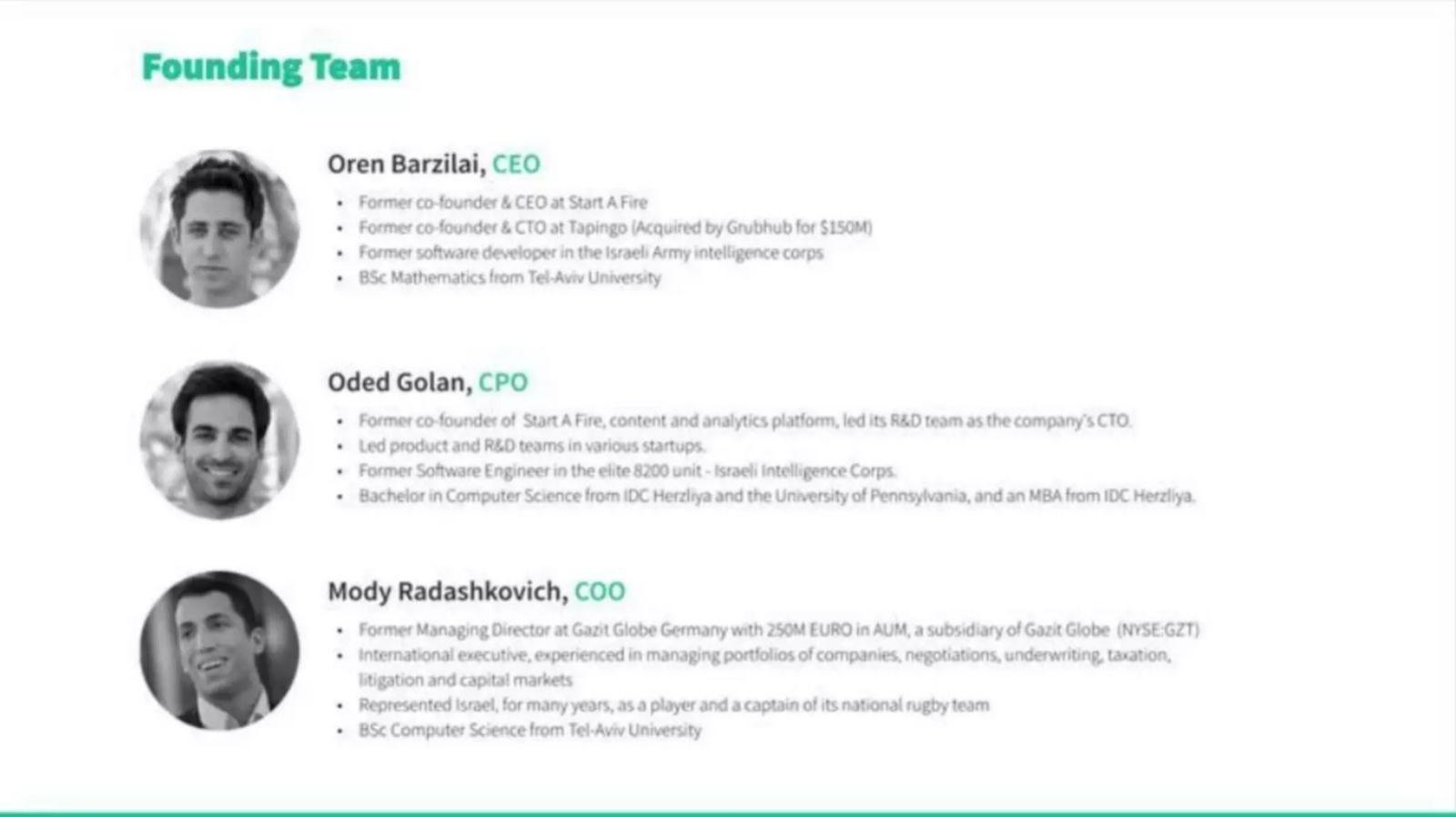
EquityBee, which helps startup employees fund their stock options, has a slide headed 'Founding Team' with three people. The CEO, Oren Barzilai, has four bullets: 'Former co-founder & CEO at Start A Fire', 'Former co-founder & CTO at Tapingo (Acquired by Grubhub for $150M)', 'Former software developer in the Israeli Army intelligence corps' and 'BSc Mathematics from Tel-Aviv University'.
The Tapingo line is the most complete of the four examples. It names the role ('co-founder & CTO'), the company, the buyer and a price, all inside one bullet attached to one person. A reader can tell exactly what is being claimed and could look it up.
Three details would make it stronger. There is no year, so the reader can't tell how recent the sale was. The price has no source; '$150M' may be the reported figure, but the slide doesn't say. And the exit is the second bullet, below Start A Fire, which has no outcome attached. If the Tapingo sale is the strongest evidence on the slide, it could come first. The CPO's bullets mention Start A Fire too, which tells the reader the two founders have worked together before — a useful point the slide could state directly.
A headline exit: Harmony
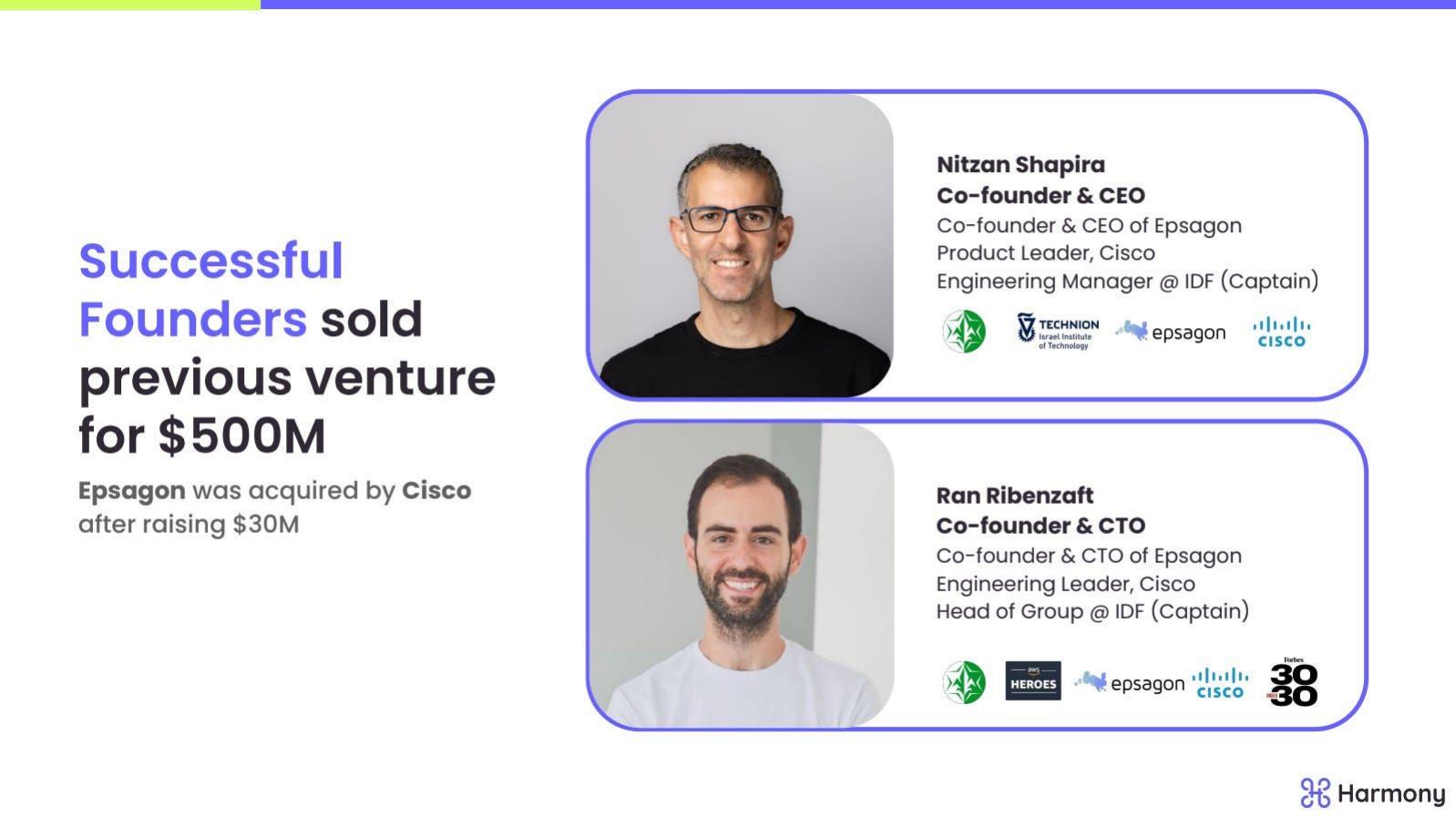
Harmony's team slide gives most of its space to a headline on the left: 'Successful Founders sold previous venture for $500M'. Beneath it, smaller: 'Epsagon was acquired by Cisco after raising $30M'. On the right are two cards. Nitzan Shapira, 'Co-founder & CEO', lists 'Co-founder & CEO of Epsagon', 'Product Leader, Cisco' and 'Engineering Manager @ IDF (Captain)'. Ran Ribenzaft, 'Co-founder & CTO', lists 'Co-founder & CTO of Epsagon', 'Engineering Leader, Cisco' and 'Head of Group @ IDF (Captain)'. Logos for Epsagon and Cisco sit on both cards.
Here the exit is the whole slide, and that fits: both founders co-founded the company that was sold, in the same roles they hold now, and both worked at the buyer afterwards. The cards make the shared history clear without extra words.
The gap is between the headline and the line beneath it. The headline gives '$500M' as the sale price; the second line gives a buyer and '$30M' raised, but doesn't repeat the price or give a year or source. A reader sees two numbers of very different size with no indication of where the larger one comes from. Putting buyer, year and price in one sentence, with a source if the price is public, would let the headline carry its full weight. 'After raising $30M' is useful context — it suggests a large return on capital — but the slide leaves the reader to make that comparison.
A buyer with no size or date: 40seas
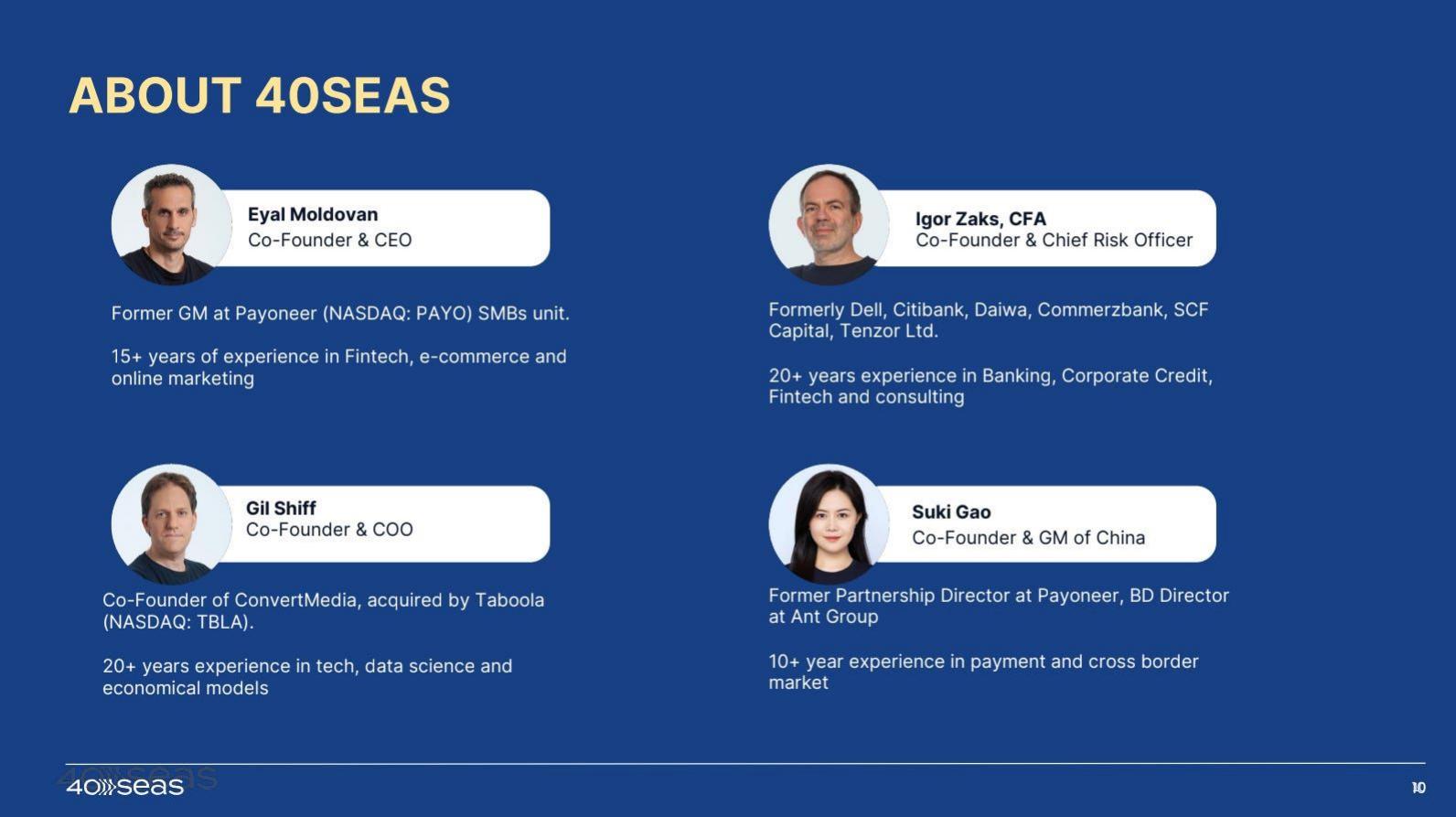
40seas, which offers trade finance for cross-border sellers, has a slide headed 'ABOUT 40SEAS' with four co-founders. Under Gil Shiff, 'Co-Founder & COO', the first line reads 'Co-Founder of ConvertMedia, acquired by Taboola (NASDAQ: TBLA).' The second reads '20+ years experience in tech, data science and economical models'. The other three founders list former employers such as Payoneer, Citibank and Ant Group.
The line does the basics well: it names the role, the company and the buyer, and it is attached to the right person. Adding the buyer's ticker tells the reader the buyer is a listed company, though it says nothing about the size of the sale.
What's missing is when and how large. Without a year, a reader can't tell whether the exit was recent. Without any sense of scale, a reader can't tell whether this was a significant sale or a small acquisition. If the price is confidential, the slide could still say what the sale shows — for example, how long Shiff ran the company or what the buyer did with it. The slide also doesn't connect ConvertMedia, an advertising technology company by its name and buyer, to 40seas' trade finance business; one phrase on what carries over would help.
An exit with an unclear role: Footprint
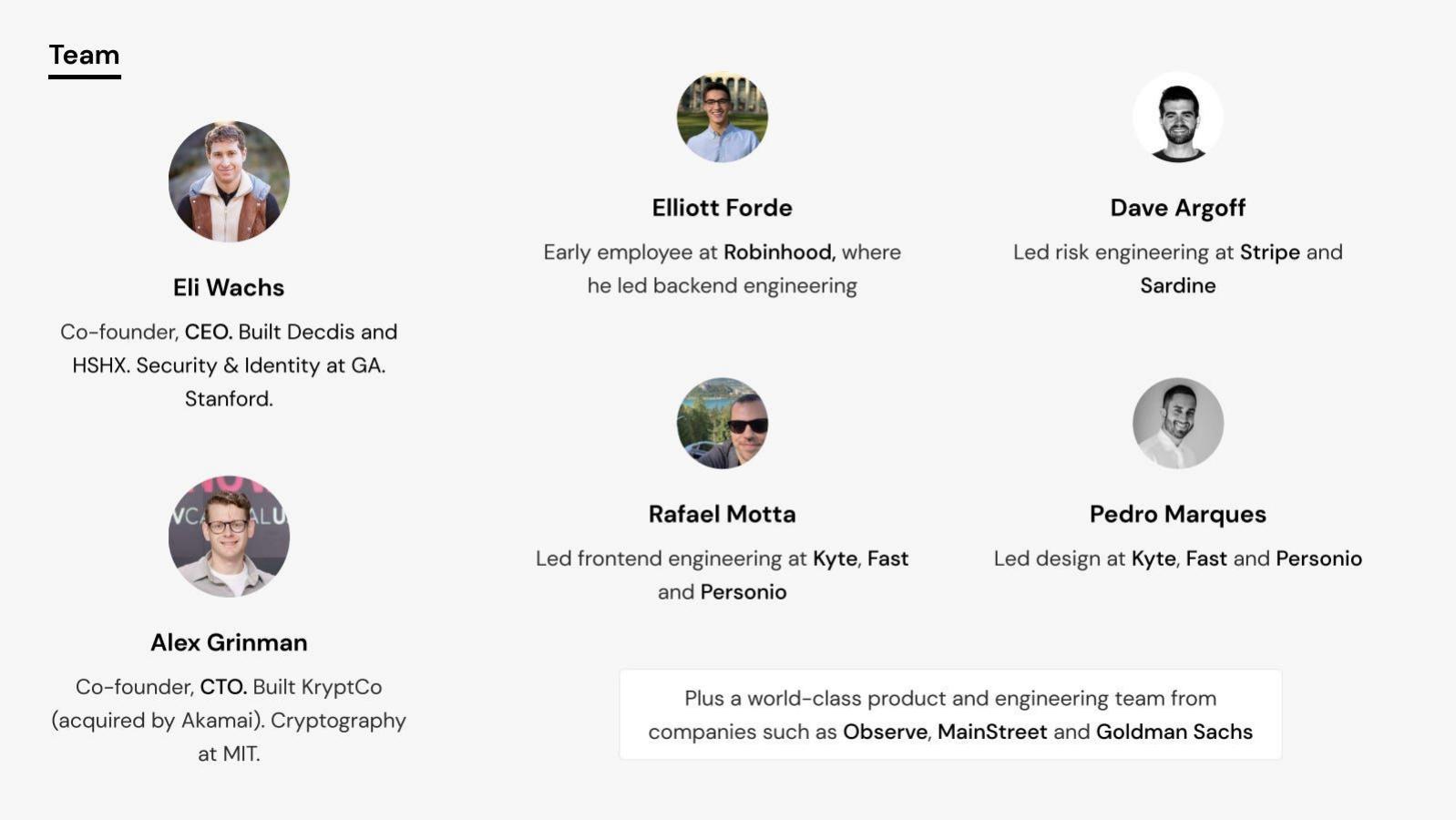
Footprint, which offers identity verification, has a slide headed 'Team' with six people. Alex Grinman's line reads 'Co-founder, CTO. Built KryptCo (acquired by Akamai). Cryptography at MIT.' The CEO, Eli Wachs, is described as 'Built Decdis and HSHX. Security & Identity at GA. Stanford.' The other four people list companies where they led engineering or design.
The exit sits in the right place and the buyer is named. The relevance is also clear without explanation: a cryptography company sold to a security and infrastructure buyer, from a CTO now building identity software.
The word 'built' is the problem. It could mean founded, co-founded, led engineering, or worked on. Investors will want to know which, and the slide uses the same verb for the CEO's two companies, which have no outcomes attached. 'Co-founded KryptCo (acquired by Akamai, [year])' would remove the ambiguity. There is no year or size, which matters less here because the slide's tone is brief throughout; a year alone would be enough.
How to write the exit line
Use one pattern for each person: role, company, buyer, year, and price only if you may share it. For example: 'Co-founder and CEO, [Company], acquired by [Buyer] in [year] ([reported price, source]).' Keep the verb exact. 'Founded', 'co-founded' and 'was CTO of' are claims an investor can check; 'built' and 'helped grow' are not.
If the price is confidential, don't hint at it with phrases such as 'significant exit'. State the facts you can share instead: how long you ran the company, its size at the sale, or what the buyer did with the product. Those are often more informative than a price anyway.
If the exit is the main thing you want investors to notice, it can go in the slide title, as Harmony does. In that case the title should only cover people who share the exit, and the supporting line should carry buyer, year and the source of any figure. If only one founder has an exit, keep it on that founder's card.
Add one phrase on relevance when it isn't obvious. 'Same buyers', 'same product category' or 'ran the sales team that we now need to build' tells the reader why the exit matters to this company.
Keep failures and small exits honest. A small acquisition is still evidence of having built something a buyer wanted. It should be described as what it was; investors will find the details, and an accurate description builds more trust than a vague one.
Templates
Full: '[Role], [Company], acquired by [Buyer] in [year] for [price] ([source]).'
Price confidential: '[Role], [Company] ([years]), acquired by [Buyer] in [year]; [what the buyer did with it].'
Shared exit as title: '[Founders] co-founded [Company], acquired by [Buyer] in [year].'
Relevance: '… [same customers / same product / same market] as [this company].'
What these examples can and cannot show
These four slides show how founders have presented a past company sale on a team slide. They can't show whether the exits happened as described, what the prices actually were, what role each person played, or how investors responded. We have not checked any of these claims against outside sources; prices are reported as the companies' claims.
Treat them as patterns of presentation. EquityBee's one-line format is the easiest to copy. Harmony shows how a headline exit needs its supporting line to match. 40seas and Footprint show how a missing year or an inexact verb leaves the most important line on the slide only half-useful.
Common mistakes
No year. A reader can't tell whether the experience is recent.
Vague role. 'Built' or 'helped grow' instead of an exact title.
Unsourced price. A figure with no indication of where it comes from.
Mismatched figures. A headline price that the supporting line doesn't repeat.
Team-wide headline. One person's exit worded as if it covers everyone.
Diagnostic checklist
Company, buyer and year on one line.
Exact role at the sold company.
Price only if public or shareable, with source.
Exit attached to the right person.
Relevance stated when not obvious.
Frequently asked questions
Should I mention an exit if the price was small?
Yes, described accurately. A sale shows you built something a buyer wanted. Leave the price out if it's small or confidential and state what the sale shows instead.
Can I list an exit where I was an early employee, not a founder?
Yes, as long as the role says so. 'Early employee, led backend' is useful experience; describing it as founding is not something investors forgive when they find out.
How we chose these examples
Corpus: published pitch deck teardowns on StartupFundraising.com. Founder-uploaded private decks are excluded.
Selection (2026-10-01): we searched extracted slide text for acquisition phrases near founder titles, excluded listed companies, SPAC and merger presentations, funds and advisor-only exits, and kept four slides each presenting a team member's past sale differently.
Review: the four slides were rendered from the source decks on 2026-10-01 and read in full at full size against company, deck and page number (editorial model review, with AI assistance in drafting; not human-reviewed). No exit, price or role was checked against outside sources.