Harmony’s 15-slide deck is a masterclass in leveraging founder reputation to secure high-valuation early-stage capital. Raising $34M at the Seed stage is an anomaly that requires immense trust, which the founders establish on Slide 3 by highlighting a previous $500M exit to Cisco. The narrative shifts from a broken employee experience to a 'horizontal solution' that automates IT, HR, and Procurement via Slack and Microsoft Teams. While the deck lacks specific financial projections or a detailed 'Ask' slide, it compensates with social proof, showcasing 16 customer logos and a suite of security…
Key takeaways
- The founders lead with their track record, noting on Slide 3 that their previous venture, Epsagon, was acquired by Cisco for $500M after raising only $30M.
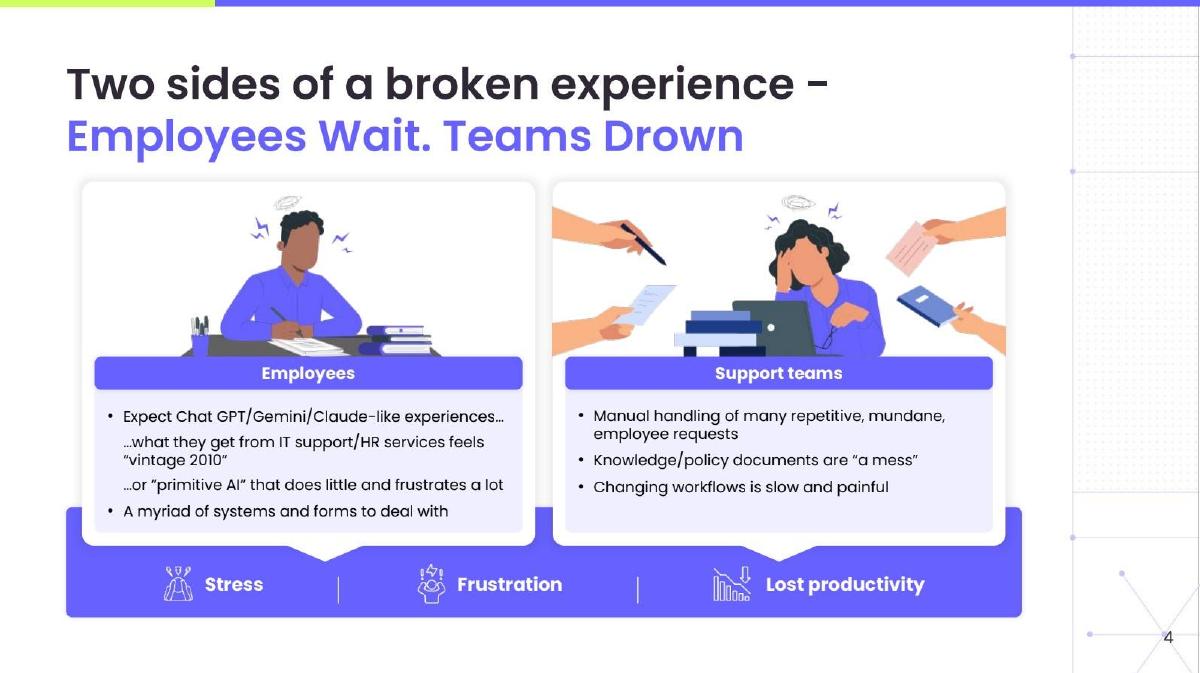
- Harmony defines the problem on Slide 4 as a 'broken experience' where employees wait and support teams drown in requests.
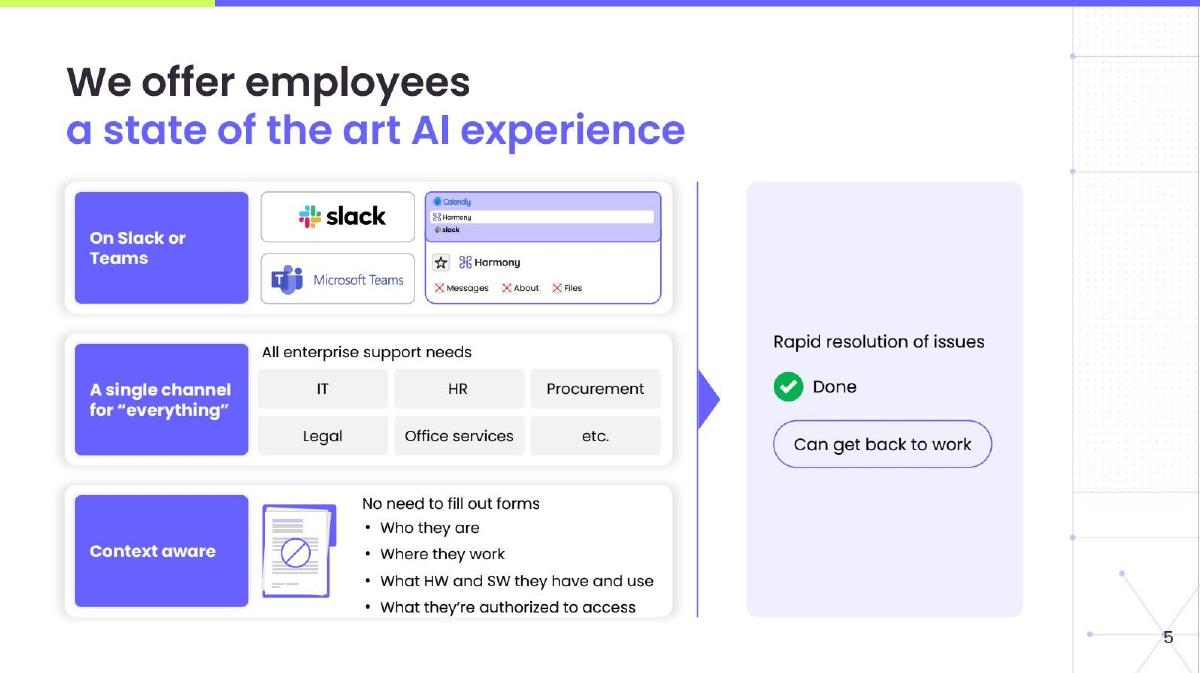
- The product is positioned as 'context aware,' claiming on Slide 5 to know who employees are and what hardware/software they are authorized to access without forms.
- Efficiency metrics are central to the pitch, with Slide 7 claiming a 50-70% 'no-touch resolution' rate that grows to 90%+ at full rollout.
- The deck emphasizes speed to value, stating on Slide 14 that customers are 'Production-Ready in 48 Hours.'
- Market expansion is a core strategy; Slide 10 explains that customers start with IT and then expand to all other support functions.
- The company positions itself against 'DIY' AI builds on Slide 11, arguing that building internal tools with Copilot or Claude takes months and lacks maintenance.
- Early market traction is demonstrated on Slide 13 with 16 logos including eToro, Fireblocks, and Kith, despite only selling for 'a few months.'
The Pedigree Play: Analyzing Harmony's $34M Seed Deck
Harmony’s pitch deck is a concise 15-slide presentation that successfully secured $34M in Seed funding in 2024. For a Seed round, the capital raised is exceptionally high, which is explained by the founders' previous exit. The deck focuses on the transformation of Enterprise Service Management (ESM) from a manual, ticket-heavy process into an automated, AI-first experience. By leveraging existing communication tools like Slack and Microsoft Teams, Harmony positions itself as a friction-less utility for the modern enterprise.
Slide 1: The Vision Statement
The deck opens with a clear, bold value proposition: "Enterprise service management that runs itself." This immediately identifies the sector (ESM) and the primary benefit (automation). The branding is clean and professional, setting a tone of enterprise readiness from the first second.
Slide 2: The User Experience
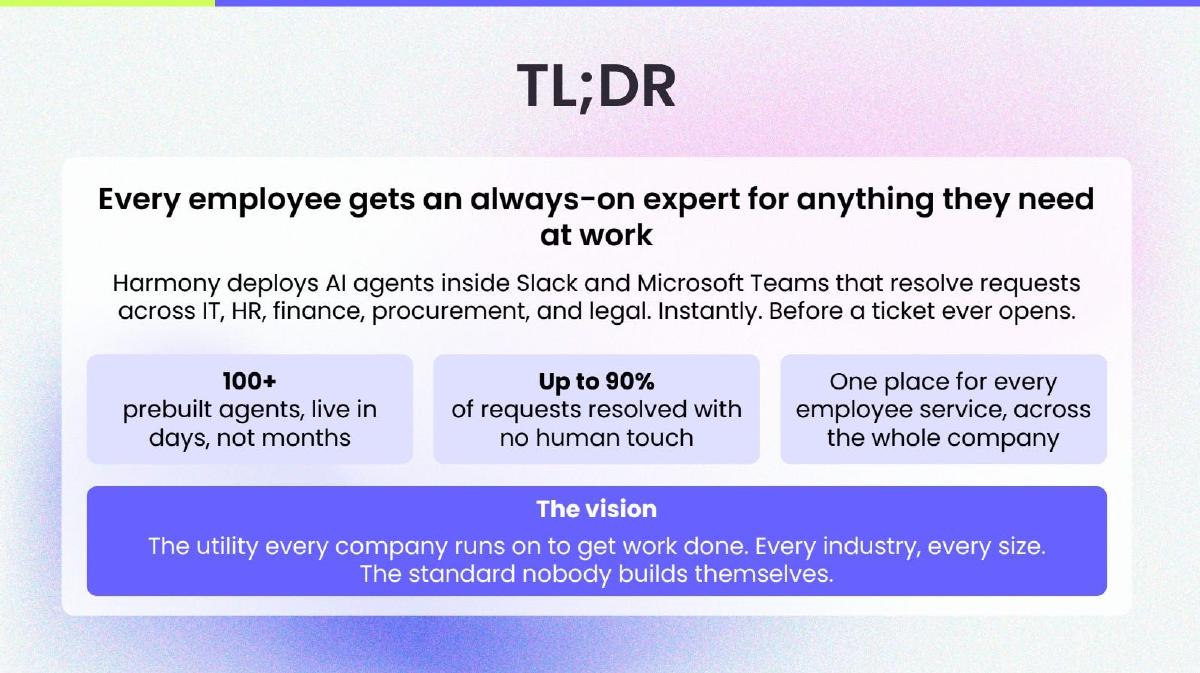
Slide 2 expands on the vision, stating that "Every employee gets an always-on expert for anything they need at work." This slide focuses on the end-user rather than the administrator, framing the product as a benefit for the entire workforce, not just a cost-saving tool for the IT department.
Slide 3: The Founder Pedigree
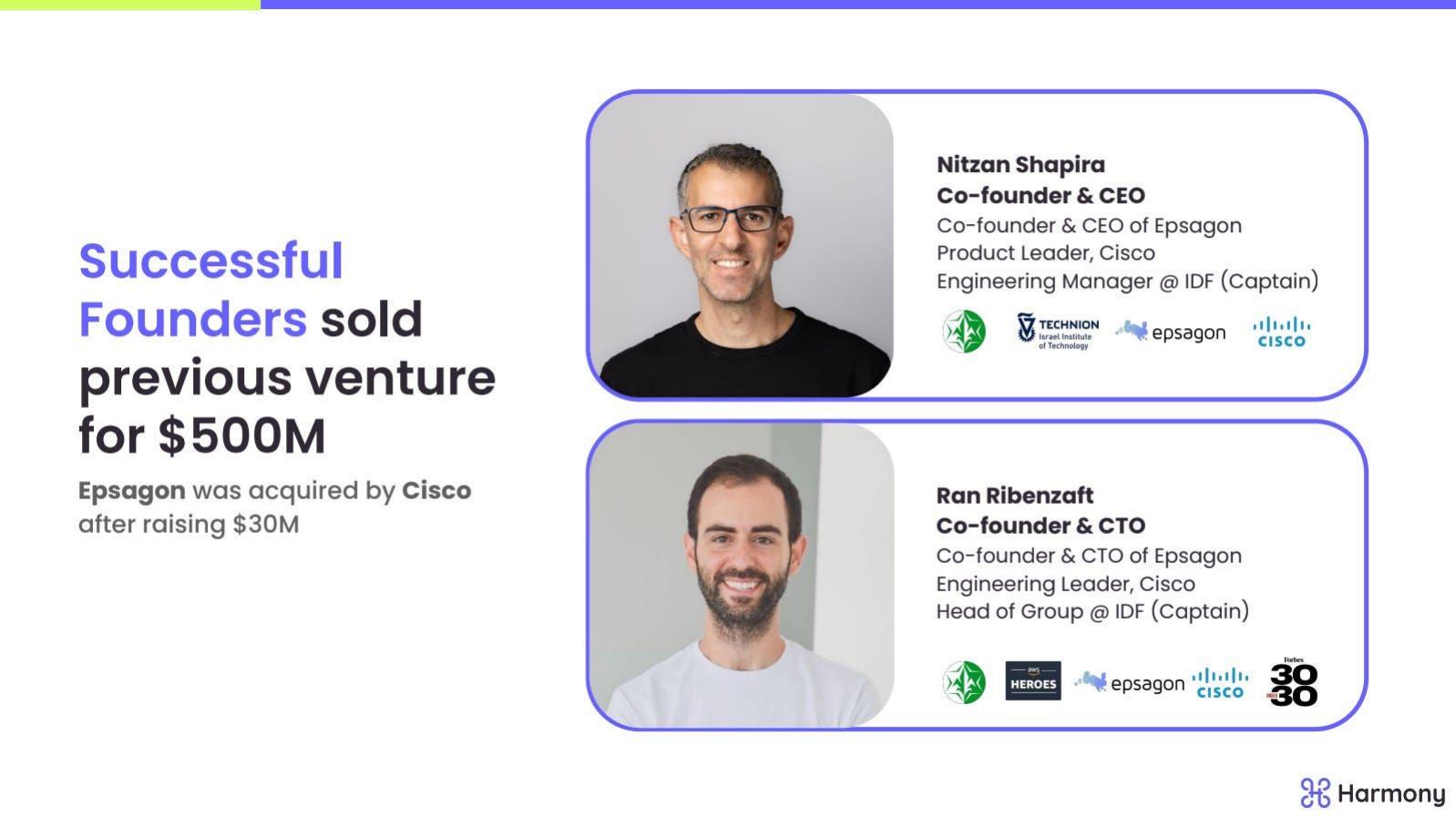
This is arguably the most important slide in the deck for a $34M Seed round. It features Nitzan Shapira (CEO) and Ran Ribenzaft (CTO). The headline reads: "Successful Founders sold previous venture for $500M." It specifies that their previous company, Epsagon, was acquired by Cisco after raising $30M. This slide establishes immediate credibility, reducing the perceived risk for investors and justifying a premium valuation.
Slide 4: The Problem Statement
Harmony identifies "Two sides of a broken experience." On one side, "Employees Wait," and on the other, "Teams Drown." This slide uses simple language to describe the inefficiency of traditional ticketing systems, where the volume of requests overwhelms support staff and leads to productivity losses for employees.
Slide 5: The Solution Architecture
Slide 5 details the "state of the art AI experience." It highlights three pillars: integration with Slack/Teams, a single channel for all needs (IT, HR, Procurement, Legal), and context awareness. The slide claims the AI knows "Who they are," "Where they work," and "What HW and SW they have," eliminating the need for employees to fill out repetitive forms.
Slide 6 & 7: Productivity and Resolution Metrics
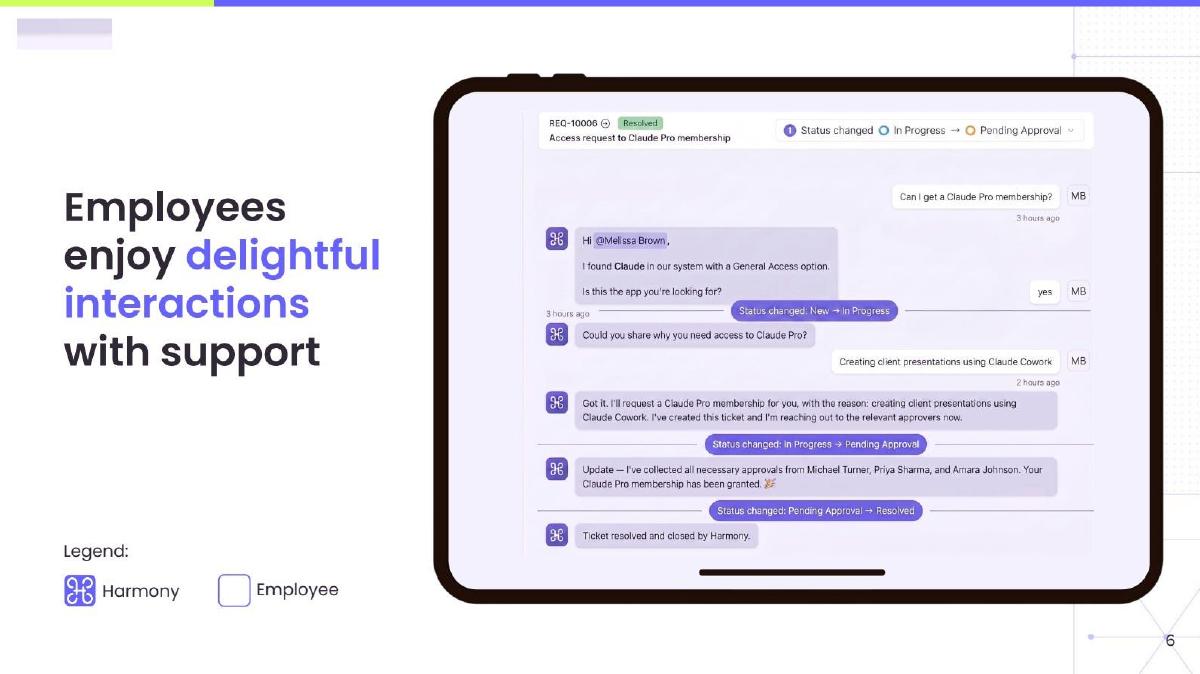
Slide 6 focuses on user delight, while Slide 7 provides the hard data for the support teams. Harmony claims a "50-70% No-touch resolution following onboarding," with the potential to grow to "90%+" at full rollout. It also mentions an "AI-based workflow builder" and "Knowledge base generation through request analysis," showing how the system improves over time.
Slide 8, 9 & 10: The Land and Expand Strategy
These slides outline the go-to-market strategy. Slide 8 notes that "Customers start with IT," and Slide 9 shows a screenshot of the "state-of-the-art asset management" interface, proving the product exists and is functional. Slide 10 describes the expansion into "all other employee-facing support functions," suggesting a high potential for Net Revenue Retention (NRR) as the software spreads through an organization.
Slide 11: Market Positioning
Harmony positions itself as a "horizontal solution across a vast addressable market." It uses a bold analogy: "Think of us as the Zoom for enterprise service management (ESM)." Crucially, it addresses the 'Build vs. Buy' debate, arguing that DIY solutions using Microsoft Copilot or Claude are inefficient because "DIY takes months, not days" and requires constant maintenance.
Slide 12: Technical Scalability
To prove it can handle enterprise complexity, Slide 12 highlights "100+ agents 'out of the box'" and integrations with "all the common back-end systems." This addresses the technical hurdle of how an AI actually performs tasks like password resets or procurement approvals.
Slide 13: Early Traction
Despite only selling for "a few months," Slide 13 displays 16 customer logos. The diversity of these logos—ranging from eToro and Fireblocks to Kith and Honeybook —validates the claim that Harmony is a horizontal solution applicable to various industries.
Slide 14 & 15: Speed and Security
Slide 14 claims customers are "Production-Ready in 48 Hours," a key selling point for enterprise software which often takes months to deploy. Slide 15 concludes with a heavy emphasis on security, displaying logos for SOC 2, ISO 27001, GDPR, HIPAA, and PCI DSS . For an AI company handling sensitive employee data, this 'Secure by design' slide is a mandatory requirement for closing enterprise deals.
What Works in the Harmony Deck
The deck is highly effective because it balances founder authority with tangible product proof . Many AI decks at the Seed stage are purely theoretical, but Harmony includes screenshots (Slide 9), specific resolution metrics (Slide 7), and a large list of active customers (Slide 13). The 'Land and Expand' narrative is also very clear, showing investors a path from a single-department tool to an all-encompassing enterprise utility. The focus on 'no-touch resolution' is the ultimate 'North Star' metric for any automation company, and Harmony puts it front and center.
What is Missing from the Harmony Deck
The most glaring omission is the Financials and the Ask . There is no slide detailing how much they are raising (though we know from publisher reports it was $34M) or how they plan to spend the capital. There is also no Roadmap slide to show where the product goes after ESM. Furthermore, the Competitive Landscape is largely ignored. While they mention why companies shouldn't build their own tools, they do not address established giants like ServiceNow or emerging AI-native competitors in the support space. Finally, there is no mention of Unit Economics or pricing models, which would be helpful to understand the long-term viability of the business model.
What Founders Should Copy
Founders should emulate Harmony’s clarity of problem-solving . They don't use overly technical jargon about LLMs; instead, they focus on the outcome: "Employees Wait. Teams Drown." This is a relatable pain point for any executive. Additionally, the Security and Compliance slide (Slide 15) is a gold standard for enterprise startups. Showing that you are already SOC 2 and HIPAA compliant at the Seed stage signals that you are ready to sell to the Fortune 500 immediately. Lastly, if you have a successful track record, put it on Slide 3 . Harmony knows that their $500M exit is their strongest asset, and they don't bury it at the end of the deck.
Frequently asked questions
- How did Harmony raise $34M at the Seed stage?
- The high funding amount is primarily driven by founder pedigree. Slide 3 highlights that Nitzan Shapira and Ran Ribenzaft previously sold Epsagon to Cisco for $500M. In venture capital, a successful 'exit' of this magnitude often allows founders to skip traditional valuation caps and raise significantly larger rounds based on the assumption of execution excellence and market knowledge.
- What is the core product functionality described in the deck?
- Harmony is an AI-driven Enterprise Service Management (ESM) platform. According to Slide 5 and Slide 12, it integrates with Slack and Microsoft Teams to provide 100+ 'out of the box' agents. These agents handle requests for IT, HR, Legal, and Procurement by accessing back-end systems to resolve issues like password resets or software access without human intervention.
- What specific metrics does Harmony use to prove its value?
- The deck relies on two primary efficiency metrics. Slide 7 cites a '50-70% no-touch resolution' rate immediately following onboarding, which the company claims scales to over 90% at full rollout. Additionally, Slide 14 emphasizes deployment speed, claiming that enterprise customers can be 'Production-Ready in 48 Hours,' a significant contrast to traditional ESM implementations.
- Who are Harmony's target customers?
- Slide 13 shows a diverse range of 16 logos across industries, including fintech (eToro, Fireblocks), retail (Kith), and tech infrastructure (Coralogix, n8n). Slide 11 further clarifies that they are a 'horizontal solution' intended for every industry and every company, positioning themselves as the 'Zoom for enterprise service management.'
- What is missing from the Harmony pitch deck?
- The deck is notably missing a detailed 'Ask' slide (specifying the amount raised and use of funds), a roadmap for future product development, and any financial projections or unit economics. It also lacks a competitive landscape slide, choosing instead to briefly dismiss 'DIY' AI solutions on Slide 11 rather than addressing direct competitors in the ESM space.