Happy Tom’s 2015 business deck presents a company at a critical geographic pivot. Having established a small footprint of 600 customers in Ukraine, the startup sought $500,000 in seed funding to relocate and scale in the United States. The core value proposition is a 'complex approach' to pet health, bundling organic, tailored food with treats, toys, and a proprietary vet appointment system. While the deck provides clear historical milestones and specific use-of-funds for their monthly burn, it relies heavily on aggressive three-year projections—forecasting a jump from $1.6M to $60M in gross…
Key takeaways
- The company successfully raised a $43k pre-seed round and participated in the Happy Farm acceleration program before seeking US expansion (Slide 7).
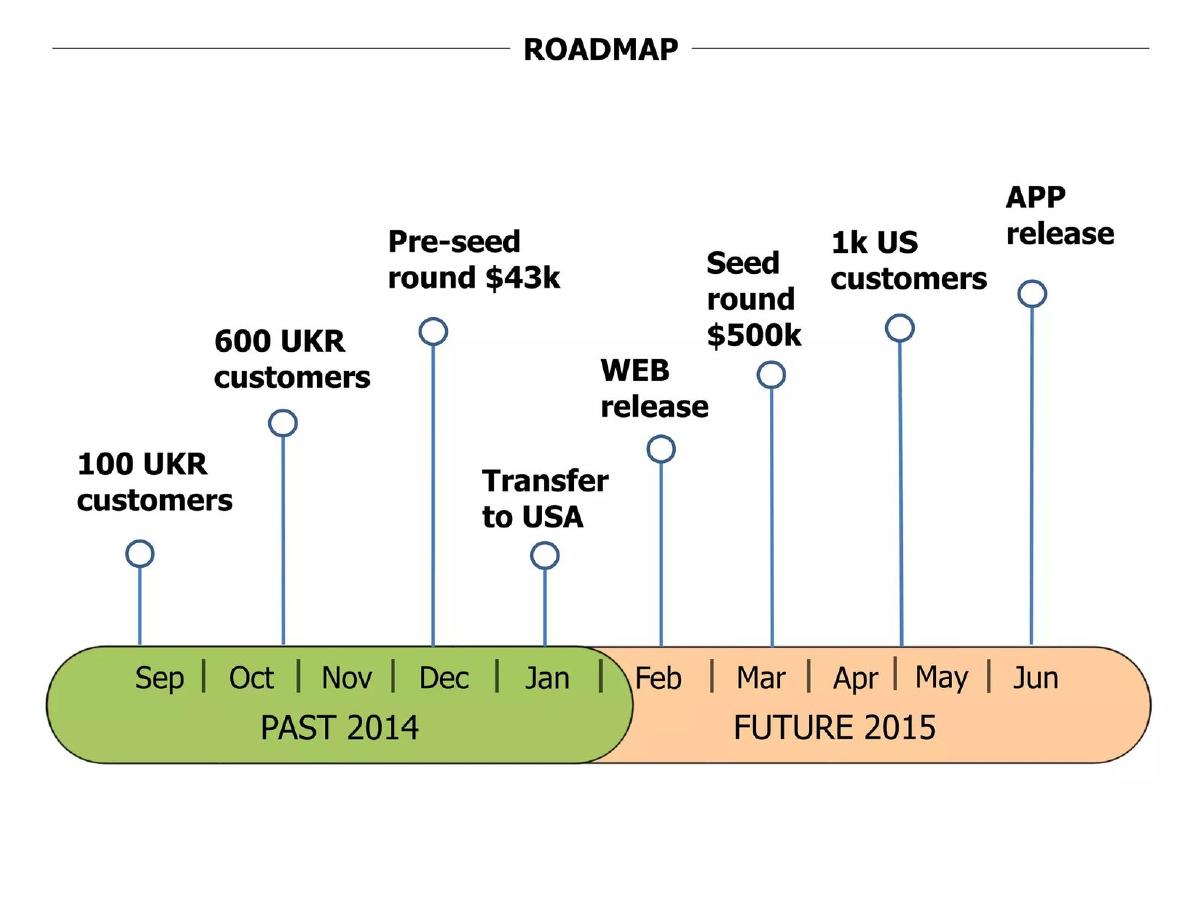
- Traction in Ukraine peaked at 600 customers in October 2014 before the 'Transfer to USA' began in January 2015 (Slide 2).
- The seed round ask is $500k for 10% equity, implying a $5M post-money valuation (Slide 7).
- The business model is a monthly subscription that claims to achieve an LTV > 2x, though the benchmark for this multiplier is not defined (Slide 5).
- Operational costs are transparently broken down into a $39k monthly burn: $18k for product development, $12k for business development, and $9k for marketing (Slide 7).
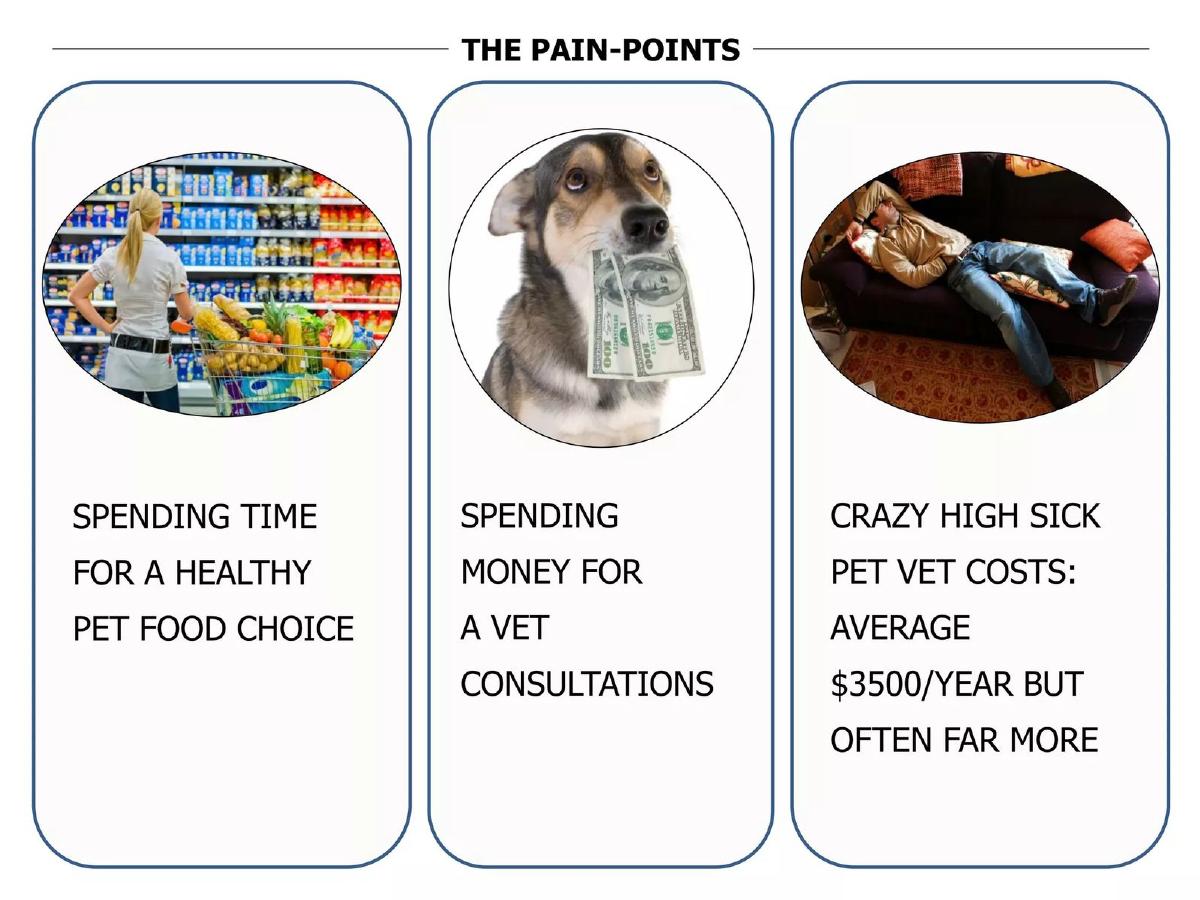
- The solution attempts to solve high veterinary costs, citing an average of $3,500/year for sick pets (Slide 3).
- Marketing strategy includes a 'Viral Sexy Video' alongside traditional channels like context advertising and affiliate partnerships (Slide 6).
- The exit strategy explicitly targets M&A within 3-5 years, naming Amazon, eBay, and Mars as potential suitors (Slide 7).
Executive Summary: The Pivot to the American Pet Market
The Happy Tom Feb 2015 deck is a document of a startup in transition. It captures the moment a Ukrainian-born pet food subscription service decided to leave its home market—where it had proven basic product-market fit with 600 customers—to pursue the venture capital and consumer scale of the United States. The deck is structured to show momentum, moving quickly from past achievements to a future that relies on a $500,000 seed investment. While the visual design is dated, the clarity of the roadmap and the specific breakdown of the 'Investing' slide provide a level of transparency often missing in early-stage decks.
Slide 1: Title and Tagline
The cover slide features the Happy Tom logo—a minimalist cat-head outline—and the tagline "FOOD TAILORED FOR YOUR PET." The background image shows a pug on a beanbag chair next to a laptop and a book, signaling a modern, tech-enabled lifestyle brand. The branding is friendly and approachable, though the logo suggests a focus on cats while the imagery features a dog, indicating a broad pet-sector reach.
Slide 2: The Roadmap
This is arguably the most important slide in the deck. It provides a clear timeline split between "PAST 2014" and "FUTURE 2015." Key data points include:
Sep 2014: 100 UKR customers. · Oct 2014: 600 UKR customers. · Dec 2014: Pre-seed round of $43k. · Jan 2015: Transfer to USA. · Feb 2015: Web release. · Mar 2015: Seed round of $500k. · Apr 2015: 1k US customers. · Jun 2015: App release.
This slide establishes that the founders have experience acquiring customers and raising capital, even if the scale was small. The 6x growth in one month (Sep to Oct) is a strong signal of early traction.
Slide 3: The Pain-Points
Happy Tom identifies three primary friction points for pet owners: Spending time for healthy food choices, spending money for vet consultations, and "Crazy high sick pet vet costs." The slide cites a specific figure: "Average $3500/year but often far more." By framing the problem around the high cost of reactive veterinary care, Happy Tom positions its organic food as a preventative health investment rather than just a commodity purchase.
Slide 4: Our Solution
The solution is described as a "Subscription Based on Organic Food Tailored For Each Pet." The slide introduces the concept of "Secret Sauce," which includes features like "Free Vet Advice" and a "Vet-Alliance Based Pet Appointment system." This suggests the company is not just a logistics business but a platform that integrates professional services into the physical product delivery.
Slide 5: Our Advantages
This slide elaborates on the subscription bundle, which includes Healthy Food, Treats & Toys, and the Vet Advice/Appointment system. The founders claim this "complex approach" is the reason their "LTV > 2x." However, the slide fails to define what the LTV is greater than—presumably, it means Lifetime Value is more than double the Customer Acquisition Cost (CAC), but without the CAC figure, the metric is incomplete.
Slide 6: Marketing
The marketing strategy is visualized through an image of a dog growing from a puppy to an adult. The channels listed are:
Word of Mouth & Social Media · Affiliate: Vet Clinics, Insurance, Grooming, Shelters · Viral Sexy Video · Context Advertising
The mention of a "Viral Sexy Video" is a relic of 2015-era marketing tactics (likely referencing the success of brands like Dollar Shave Club), which may feel out of place in a modern professional context but shows an intent to use high-impact creative content.
Slide 7: Investing
The final slide in the provided set is dense with financial data and exit strategy. It is divided into four sections:
Past: Mentions the Happy Farm acceleration program and the $43k pre-seed round from Imperious Group. · Present: The ask is $500k for 10% Equity. It also lists a monthly burn of $39k , broken down into Prod Dev ($18k), Biz Dev ($12k), and Marketing ($9k). · 3 Years Scenarios: Aggressive growth targets. Year 1: $1.6M sales. Year 2: $20M sales. Year 3: $60M sales and $10M profit. · Exits: Lists M&A targets like Amazon, Petco, and Nestle. It cites the 2010 sale of Wag.com (Quidsi) to Amazon for $545M as a comparable success story.
What Works in This Deck
Transparency of Burn: Founders often hide their intended spending. Happy Tom explicitly states their $39k monthly burn and where it goes. This allows an investor to immediately judge if the allocation (e.g., spending more on product than marketing) aligns with their own investment thesis.
Historical Traction: By showing the 600-customer milestone in Ukraine, the founders prove they aren't just theorists. They have operated a supply chain and managed a customer base, which de-risks the execution of the US launch.
Bundled Value Proposition: The integration of vet services into a food subscription is a smart way to increase stickiness and justify a premium price point, addressing the 'pain point' of high vet costs directly.
What is Missing
The Team Slide: The provided slides do not include a team biography. In a seed-stage round, the pedigree and experience of the founders are often more important than the initial traction, especially when moving to a new country.
Competitive Landscape: The pet food subscription space was already becoming crowded in 2015 (with players like The Farmer's Dog and Ollie emerging). The deck does not explain how Happy Tom's "tailored" food differs from these competitors.
Unit Economics: While LTV is mentioned, there is no data on the cost of goods sold (COGS), shipping costs, or the actual dollar value of a customer. For a logistics-heavy business, these numbers are vital.
Founder Takeaways
Be Specific with the Ask: Happy Tom doesn't just ask for money; they state the equity they are willing to give (10%). While this can sometimes limit negotiation, it sets a clear valuation floor ($5M post-money) and shows the founders have a specific plan for the capital.
Use a Roadmap to Tell a Story: The roadmap slide effectively bridges the gap between a small overseas operation and a large US ambition. It makes the transition feel like a logical next step rather than a desperate move.
Connect Problem to Solution: The deck does a good job of linking the high cost of vet care (Problem) to the organic food and vet-advice system (Solution). It turns a luxury product (organic pet food) into a cost-saving tool for the consumer.
Frequently asked questions
- What is the specific product Happy Tom is selling?
- Happy Tom offers a subscription-based service providing organic pet food tailored to individual pets. According to Slide 5, the subscription is a 'complex approach' that includes healthy food, treats, toys, and access to a 'Vet-Alliance Based Pet Appointment system.' It positions itself as a preventative health solution to reduce high annual vet costs.
- How does the company justify its move to the United States?
- Slide 2 shows the company reached 600 customers in Ukraine by late 2014. The roadmap indicates a 'Transfer to USA' in January 2015, with a goal of reaching 1,000 US customers by April 2015. The move appears motivated by the larger market opportunity and the ability to raise a $500k seed round, which is significantly larger than their $43k Ukrainian pre-seed.
- What are the financial projections for the first three years in the US?
- The projections on Slide 7 are aggressive. Year 1 targets 30k customers and $1.6M in gross sales with $0 profit. Year 2 jumps to 150k customers and $20M in sales ($3M profit). By Year 3, they project 450k customers, $60M in gross sales, and $10M in profit. This represents a 37.5x increase in revenue between Year 1 and Year 3.
- What is the intended use of the $500,000 seed investment?
- The deck specifies a monthly burn of $39,000. This is allocated as $18,000 for Product Development, $12,000 for Business Development, and $9,000 for Marketing. At this rate, the $500k investment would provide approximately 12.8 months of runway, aligning with their '1Y' milestone goals on Slide 7.
- What marketing channels does Happy Tom plan to use?
- Slide 6 outlines a multi-stage marketing funnel. It includes 'Word of Mouth & Social Media' for early growth, followed by 'Affiliate' partnerships with vet clinics, insurance companies, and shelters. More aggressive tactics mentioned include a 'Viral Sexy Video' and 'Context Advertising' to reach scale.