Happy Health’s 13-slide deck is a highly polished example of a 'full-stack' healthcare pitch. Rather than just selling a wearable device, the company positions itself as a comprehensive care provider that handles everything from FDA-cleared diagnostics to long-term treatment and insurance billing. By highlighting a massive, 80% undiagnosed market and a 5-day turnaround for clinical results, the deck addresses the primary friction points of traditional sleep medicine. While it lacks a traditional team slide or detailed financial projections, the emphasis on national payor coverage and a 50-sta…
Key takeaways
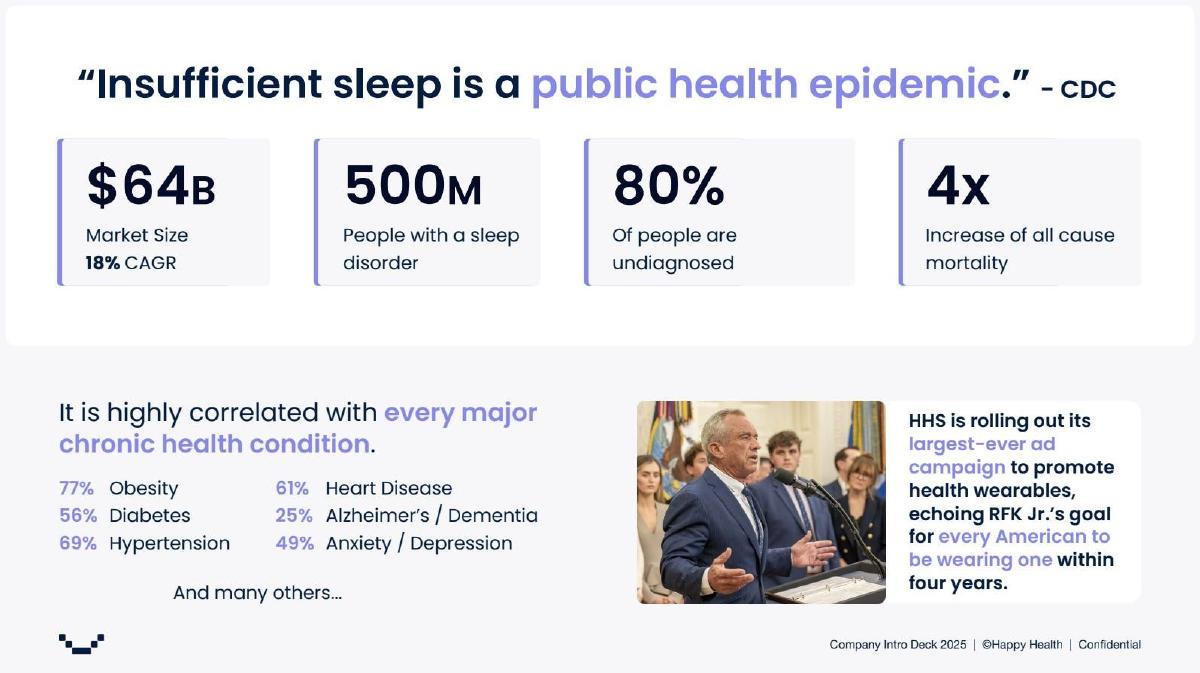
- The deck identifies a $64B market size with an 18% CAGR, noting that 80% of the 500M people with sleep disorders remain undiagnosed (Slide 3).
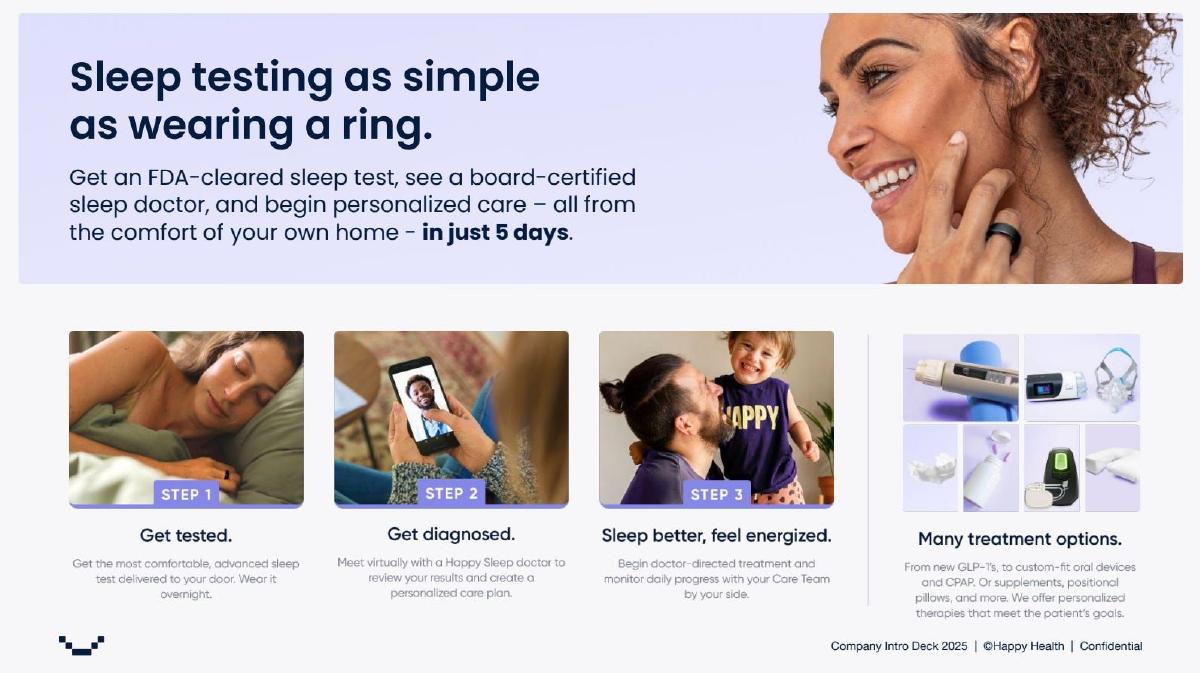
- Happy Health positions its solution as a 5-day end-to-end process: home testing, virtual doctor consultation, and personalized treatment (Slide 5).
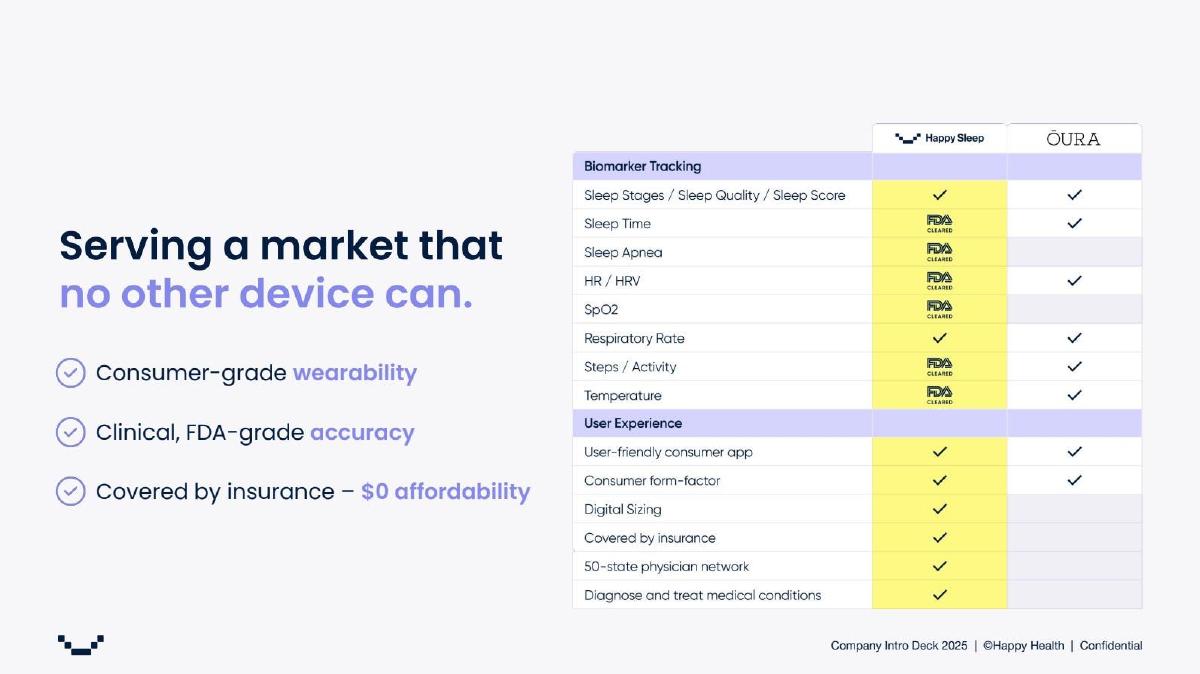
- The company claims to be the only device capable of serving its specific market segment, though the exact competitive differentiator is not explicitly detailed (Slide 6).
- A vertically integrated model is showcased, featuring a 50-state provider network and national payor coverage including Aetna, Cigna, and Humana (Slide 7).
- The product ecosystem includes AI-powered algorithms that monitor for 'subtle shifts' to spot illness months or years early (Slide 9).
- Treatment options are not limited to the ring; they include GLP-1s, custom oral devices, CPAP, and supplements (Slide 5).
- The deck omits a dedicated team slide, specific revenue figures, and a clear breakdown of the $75M use of funds.
- Marketing assets shown in Slide 12 suggest a heavy focus on consumer-facing messaging, targeting libido, mental clarity, and 'ditching the CPAP.'
The Vision: Whole-Body Healthcare
Slide 1: Title and Positioning
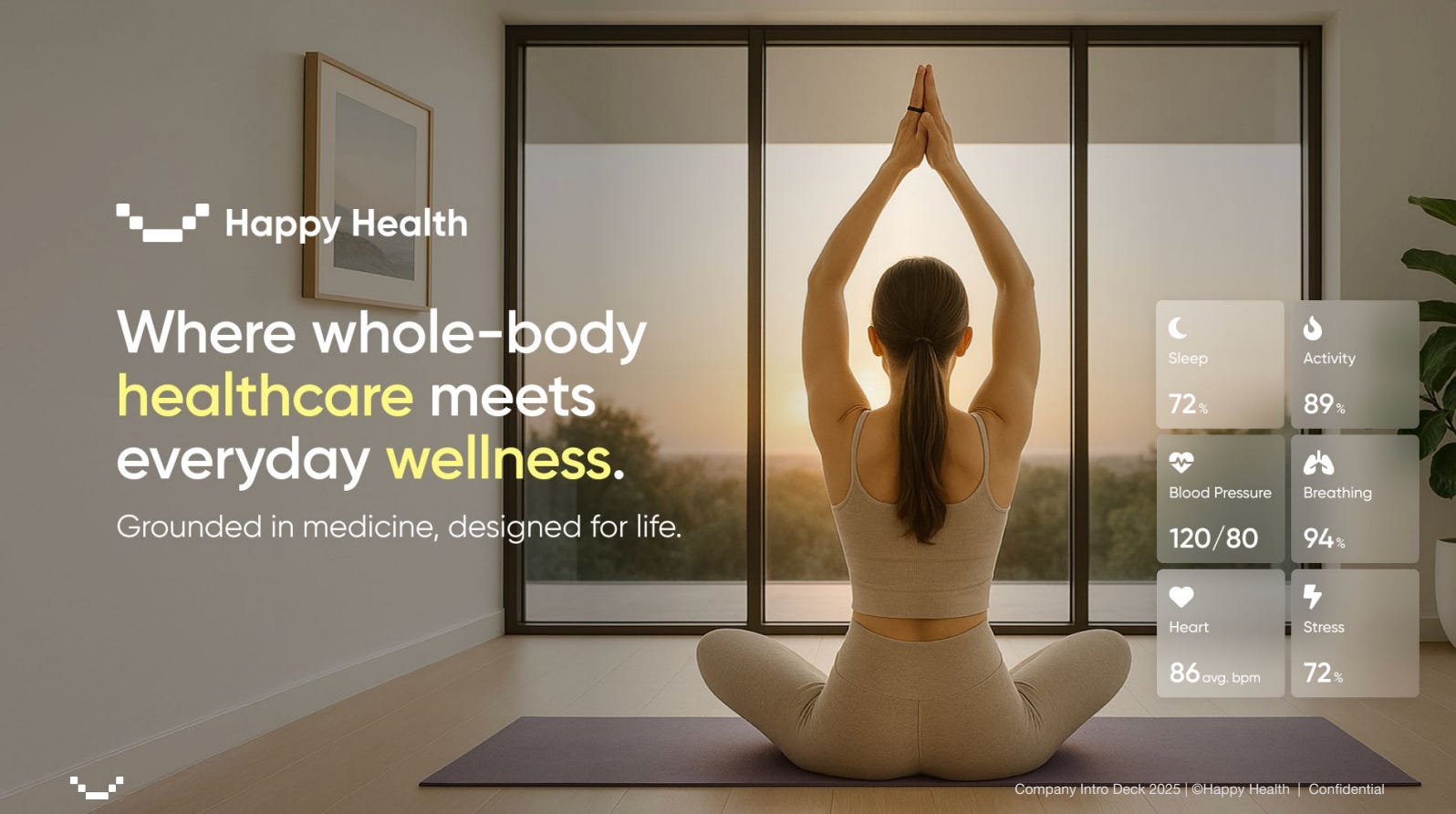
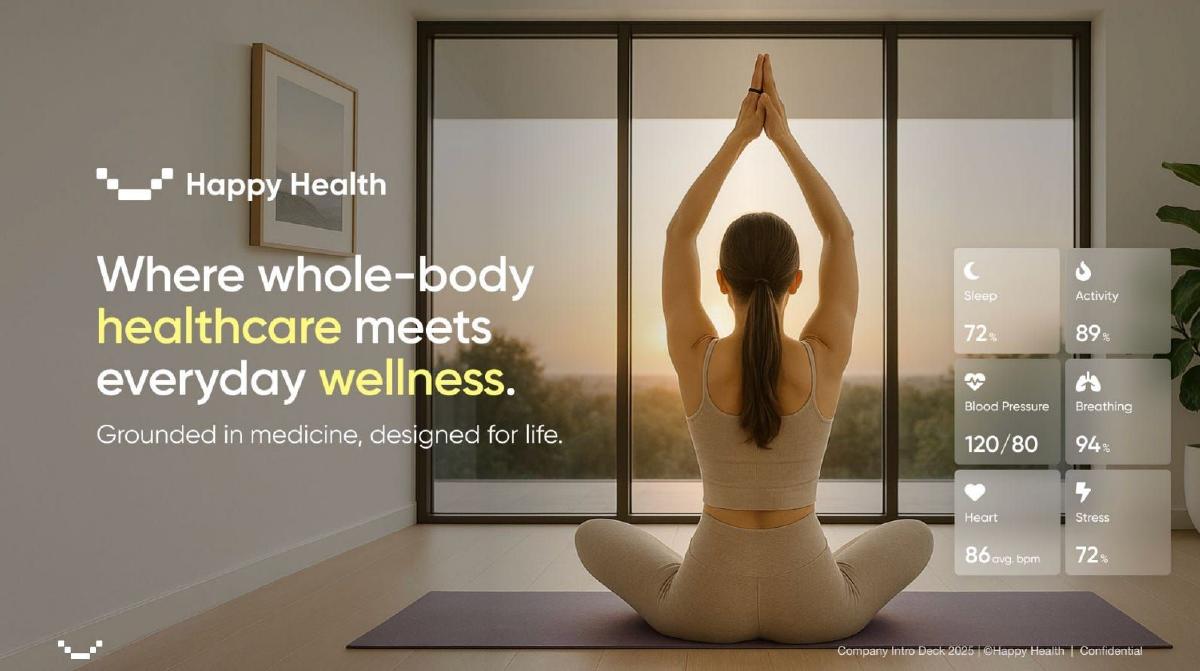
The deck opens with a high-fidelity lifestyle image of a woman practicing yoga, immediately signaling a 'wellness' aesthetic. However, the copy, 'Where whole-body healthcare meets everyday wellness,' attempts to bridge the gap between consumer tech and clinical medicine. The sub-headline, 'Grounded in medicine, designed for life,' reinforces this dual positioning. A UI overlay shows metrics for Sleep (72%), Activity (89%), Blood Pressure (120/80), Heart (86 bpm), Breathing (94%), and Stress (72%), suggesting a multi-sensor capability beyond simple sleep tracking.
Slide 2: The Vision Statement
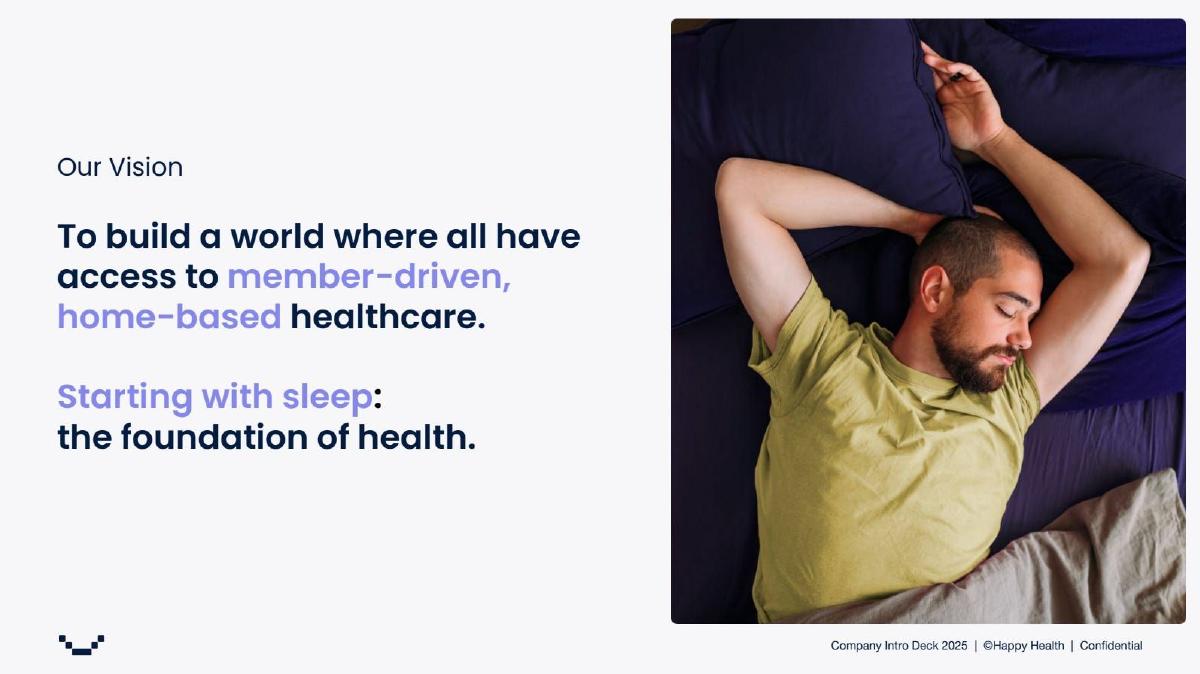
The vision is stated as building a world with 'access to member-driven, home-based healthcare.' Crucially, they identify sleep as the 'foundation of health' and their starting point. This tells investors that while the current focus is sleep apnea, the long-term play is a broader home-health platform.
The Problem: A Public Health Epidemic
Slide 3: Market Opportunity and Statistics
Happy Health leans on authority by quoting the CDC: 'Insufficient sleep is a public health epidemic.' The slide provides four key pillars of the market opportunity: a '$64B Market Size' with an '18% CAGR,' '500M people with a sleep disorder,' and the staggering fact that '80% of people are undiagnosed.' They also link sleep to a '4x increase of all-cause mortality.' The bottom of the slide connects sleep to chronic conditions like Obesity (77% correlation), Hypertension (69%), and Diabetes (56%). Interestingly, they include a photo of a political figure and a note about an HHS ad campaign to promote wearables, signaling a favorable regulatory and macro environment.
Slide 4: The Friction Point
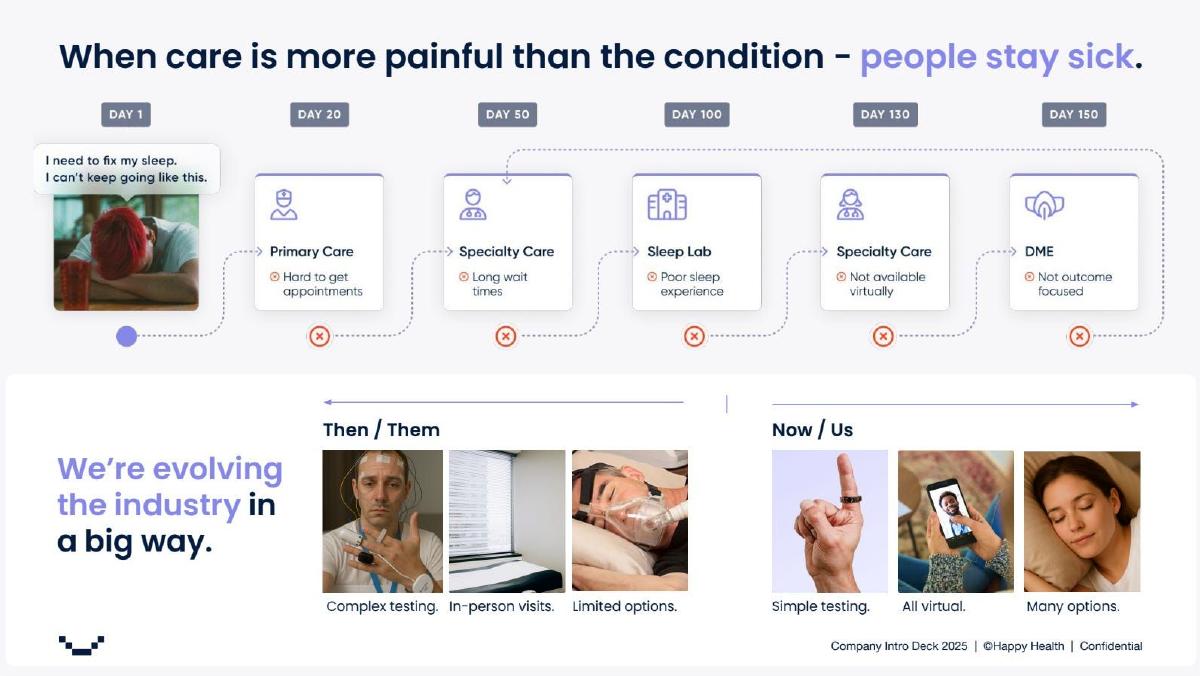
This slide addresses the 'Why Now' and the specific barrier to entry in the current market. 'When care is more painful than the condition - people stay sick.' This refers to the traditional, cumbersome process of in-lab sleep studies (polysomnography) which often involve sleeping in a clinic hooked up to dozens of wires.
The Solution: Clinical Care in a Ring
Slide 5: The 5-Day Workflow
This is the core value proposition slide. It promises an 'FDA-cleared sleep test' and a 'board-certified sleep doctor' all from home in 'just 5 days.' The three-step process is clearly mapped: 1. Get tested (wear the ring overnight), 2. Get diagnosed (virtual doctor visit), 3. Sleep better (monitor progress). A fourth panel shows 'Many treatment options,' including GLP-1s, oral devices, CPAP, and supplements. This is a critical slide because it proves Happy Health isn't just a hardware company; they are a pharmacy and a medical practice.
Slide 6: Market Differentiation
The slide simply states they are 'Serving a market that no other device can.' While it lacks specific technical details, the implication is that their FDA clearance for diagnosis separates them from consumer-grade rings like Oura or Evie, which are generally for wellness tracking rather than clinical diagnosis.
The Infrastructure: Vertical Integration
Slide 7: The Continuum of Care
This slide is designed to satisfy institutional investors concerned with scalability and moat. Happy Health describes itself as 'vertically integrated' with a '50-state provider network.' The most important element here is the 'national payor coverage' section, featuring logos for Blue Cross Blue Shield, United Healthcare, Aetna, Cigna, Anthem, Humana, and Medica. By being 'in-network,' Happy Health removes the price barrier for the average consumer, a massive advantage in the US healthcare market.
Slide 8 & 9: Product and AI
Slide 8 focuses on 'Wellness insights,' while Slide 9 focuses on 'Medical testing.' Slide 9 highlights 'AI-powered algorithms' that monitor for 'subtle shifts' to spot illness 'months-years-early.' The UI mockups show a 'Sleep Physical' screen with a circular data visualization and specific metrics like 'Breathing & Oxygen (46/hr)' and 'Sleep Debt (2h 45m).'
Slide 10 & 11: The Future Roadmap
Slide 10 reiterates the 'AI-powered, at-home diagnostics' capability. Slide 11 presents a conceptual graph titled 'Swap late-stage heroics for early-stage detection.' It shows a white line (Happy Early Detection) staying low and stable, while a red line (Late-Stage Crisis Management) spikes toward a crisis point in December. This frames the company as a preventative health platform, which is a high-value category for insurance companies looking to reduce long-term costs.
Marketing and Traction
Slide 12: Customer Sentiment
Instead of traditional testimonials, this slide shows a grid of 18 different social media or digital ad creatives. The messaging varies from 'Sleep trackers suck. Get real answers' to 'Better sleep = higher libido' and 'Ditch the CPAP.' This demonstrates that the company has a sophisticated, multi-pronged customer acquisition strategy and has likely tested which messages resonate with different demographics.
Slide 13: Closing Imagery
The deck ends with a simple brand image, maintaining the clean, medical-yet-accessible aesthetic established on the first slide.
What Works in This Deck
The 'Full-Stack' Approach: By including doctors, insurance, and treatment, Happy Health isn't just selling a ring; they are selling a result (better sleep). This is much more attractive to investors than a pure hardware play. · Clarity of Process: The 5-day timeline (Slide 5) is a powerful 'Aha!' moment. It takes a process that usually takes months in the traditional healthcare system and compresses it into a single work week. · Regulatory and Payor Readiness: Highlighting FDA clearance and listing major insurance partners (Slide 7) de-risks the investment significantly. It shows the company has already cleared the hardest hurdles in healthcare. · Visual Storytelling: The deck uses high-quality photography and clean UI mockups to make a complex medical process feel simple and consumer-friendly.
What Is Missing
The Team: There is no slide introducing the founders or the medical advisory board. For a $75M raise, the pedigree of the leadership team is usually a primary selling point. · Financials and Traction: While they mention a $64B market, they don't disclose their own revenue, number of active users, or customer acquisition cost (CAC). · The Ask: The deck does not specify how much they are raising (though Business Insider reported $75M) or how they plan to allocate the capital. · Competition: There is no competitive matrix. While they claim to be unique, they don't explicitly compare their sensor accuracy or diagnostic capabilities against competitors like ResMed or consumer rings.
Founder Takeaways
Sell the System, Not the Gadget: If you are building a medical device, don't just pitch the hardware. Pitch the clinical outcomes and the ease of the patient journey. Happy Health succeeds because they focus on the '5-day' result. · Address the 'Who Pays?': In healthcare, the user is rarely the payer. By putting insurance logos front and center, Happy Health answers the most important question an investor will have about a medical startup. · Use 'Why Now' Macro Trends: Slide 3 uses a CDC quote and a mention of government health initiatives to create a sense of urgency. Founders should always link their specific product to a larger, unstoppable societal shift. · High-Fidelity Mockups Matter: The UI screens in Slides 9 and 10 look 'ready to ship.' This gives investors confidence that the product development is mature and the user experience has been deeply considered.
Frequently asked questions
- What is the primary product Happy Health is selling?
- Happy Health is selling a vertically integrated healthcare service centered around an FDA-cleared smart ring. While the ring is the diagnostic tool, the 'product' is the entire care continuum: home-based testing, virtual consultations with board-certified doctors, and a range of treatments including prescriptions (GLP-1s), medical devices (CPAP), and supplements.
- How does Happy Health plan to make money?
- Based on Slide 7, the company utilizes a traditional healthcare reimbursement model. They highlight 'national payor coverage' from major insurers like Blue Cross Blue Shield, United Healthcare, Aetna, Cigna, Humana, and Medica. This indicates they operate as a covered medical provider rather than just a direct-to-consumer hardware seller.
- What is the '5-day' promise mentioned in the deck?
- Slide 5 outlines a rapid clinical workflow where a patient can get an FDA-cleared sleep test delivered to their door, wear it overnight, meet virtually with a 'Happy Sleep doctor' to review results, and begin a personalized care plan—all within a 5-day window.
- Does the deck address competition like Oura or Whoop?
- Slide 6 explicitly claims they are 'serving a market that no other device can,' and Slide 12 includes marketing copy stating 'Sleep trackers suck. Get real answers.' This implies a positioning strategy where consumer wearables are framed as 'wellness' toys, while Happy Health is a 'medical' tool capable of clinical diagnosis.
- What is missing from this pitch deck?
- The deck is notably missing a Team slide, which is unusual for a $75M raise. It also lacks a 'The Ask' slide detailing how the funds will be spent, a Competition matrix, and any hard financial data or unit economics beyond general market size figures.