Coinrule raised a $2M Seed round in 2021 with a 13-slide deck that emphasizes accessibility in the complex world of crypto trading. By framing the problem through the lens of 'retail army' growth and the 'amateurization' of finance, the founders successfully argued for a middle-ground solution between manual trading and high-frequency institutional bots. The deck is notable for its 'if-this-then-that' logic simplicity, which targets the 360 million millennials owning cryptocurrency. While it lacks a traditional competition matrix or detailed use-of-funds slide, it compensates with deep founde…
Key takeaways
- The deck identifies a massive market of 360M millennials owning crypto, with 82% wanting to react quickly to market changes (Slide 3).
- Coinrule positions itself as a 'no coding required' solution for automated trading instructions (Slide 5).
- User traction is demonstrated through a global footprint spanning over 130 countries, with the USA and UK as top markets (Slide 6).
- A KPI slide claims that 67% of users made profits despite a 'historical market collapse,' backed by a three-month data breakdown (Slide 7).
- The founding team brings institutional credibility from UBS, Citi, and Lloyds Banking Group (Slide 8).
- The business model is a clear four-tier SaaS structure ranging from a 'Starter' free tier to a $449.99/mo 'Pro' plan (Slide 11).
- The deck highlights 'Premium Partnerships' with major exchanges like Kraken and Bitpanda to establish infrastructure legitimacy (Slide 10).
- A notable omission is a specific 'Ask' slide detailing the exact valuation or breakdown of the $2M raise within the deck itself.
The Coinrule Seed Deck: A Masterclass in Simplifying Complexity
Fundraising for a technical product in the crypto space often leads founders down a rabbit hole of jargon. Coinrule’s 2021 Seed deck, which helped secure $2M, takes the opposite approach. It focuses on the 'democratization' of tools previously reserved for Wall Street elites. By using a clean, high-contrast design and focusing on user outcomes rather than backend architecture, the deck makes a compelling case for the 'retail army' thesis.
Slide 1: Title and Hook
The deck opens with a minimalist title slide: "Automated Trading Made Easy." The visual language is established immediately with a vibrant yellow-to-orange gradient and a simple line graph showing a positive trend. The logo, a friendly robot icon, reinforces the 'automated' theme without appearing overly industrial or intimidating.
Slide 2: The Vision
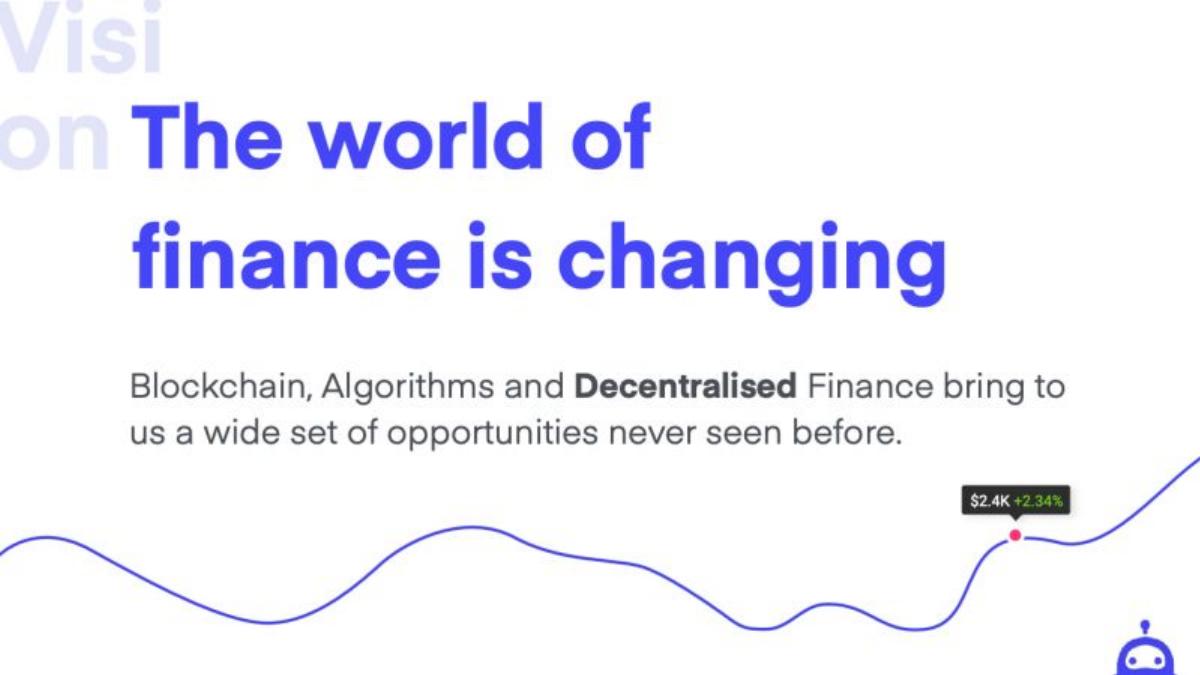
Slide 2 sets the macro stage. Under the heading "The world of finance is changing," the company identifies three pillars: Blockchain, Algorithms, and Decentralised Finance. It frames these not as technical hurdles, but as a "wide set of opportunities never seen before." This is a standard 'Why Now' setup, positioning the company at the intersection of major tailwinds.
Slide 3: Market Trends and Opportunity
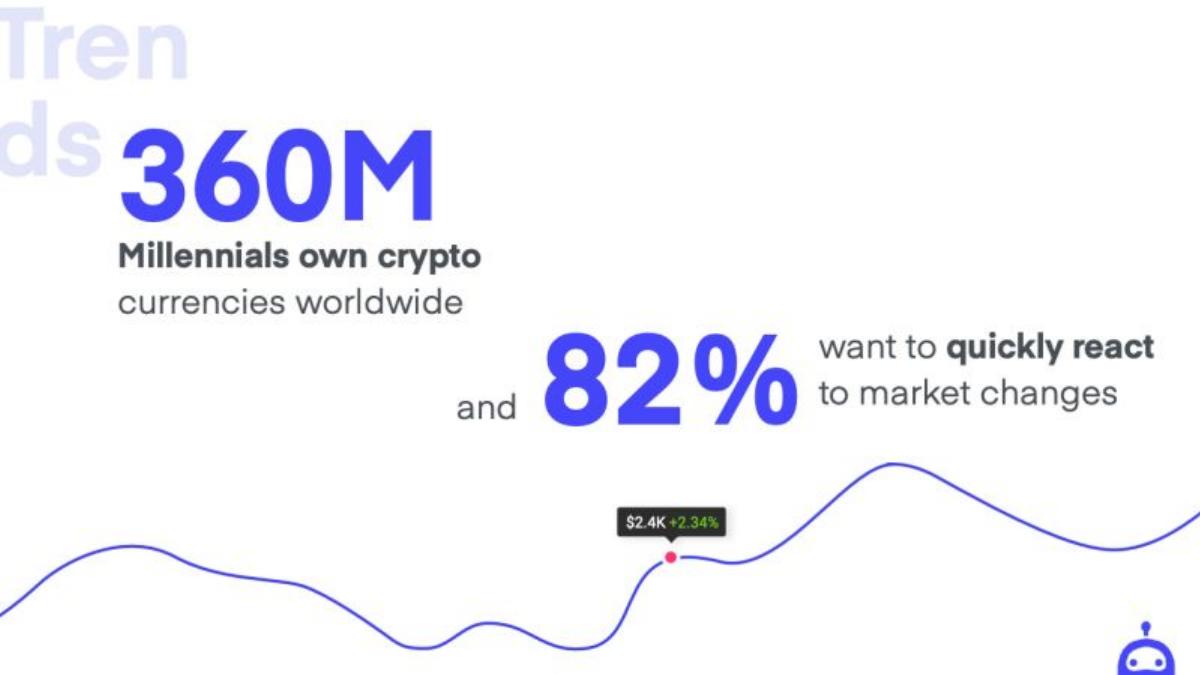
Coinrule quantifies the opportunity on Slide 3 with two aggressive stats: "360M Millennials own cryptocurrencies worldwide" and "82% want to quickly react to market changes." By focusing on millennials, they define a specific, tech-savvy demographic that is dissatisfied with static 'buy and hold' strategies but lacks the time or skill to day-trade manually.
Slide 4: The Contextual Narrative
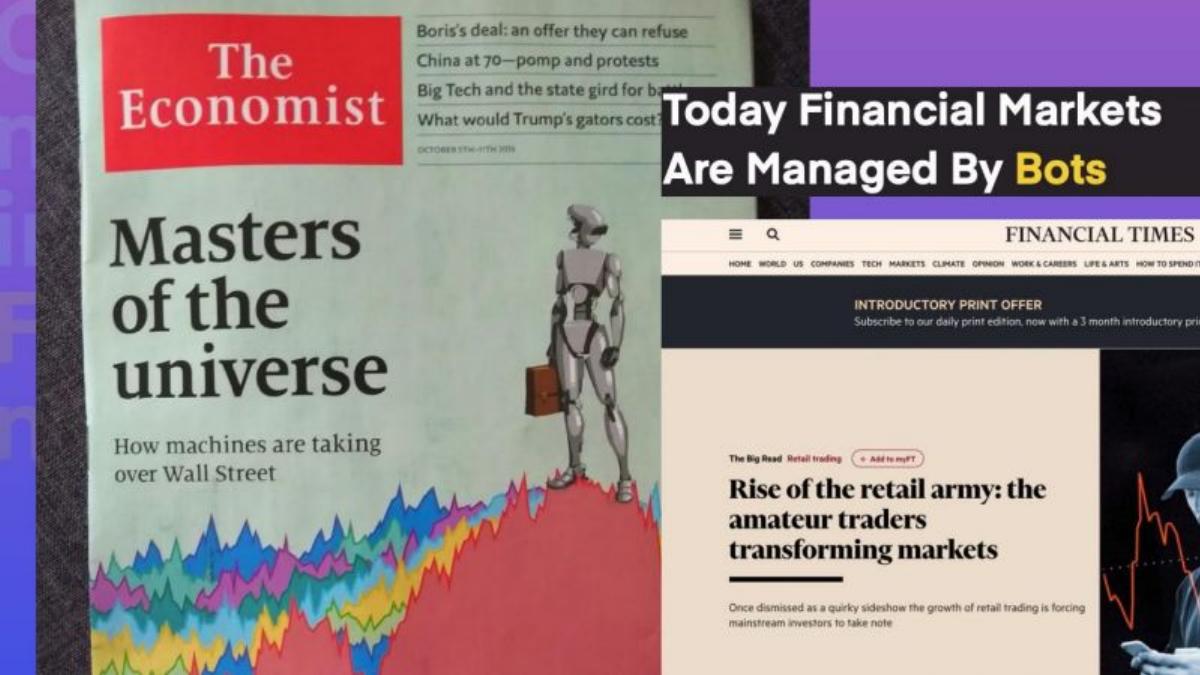
This is a 'clipping' slide. It features covers from The Economist ("Masters of the Universe: How machines are taking over Wall Street") and The Financial Times ("Rise of the retail army"). The text overlay, "Today Financial Markets Are Managed By Bots," creates a sense of urgency. It suggests that retail traders are at a disadvantage unless they have the same tools as the 'Masters of the Universe.'
Slide 5: The Solution
Slide 5 introduces the product with the tagline "Trade While You Sleep." It defines Coinrule as a "beginner-friendly platform to send automated trading instructions to your favourite exchanges." Crucially, it highlights "No coding required." The slide includes a mockup of the mobile and desktop interface, showing a clean UI that looks more like a consumer banking app than a terminal.
Slide 6: Social Proof and Testimonials
To counter the inherent skepticism in the crypto space, Slide 6 focuses on global reach. It claims "Happy Users From Over 130 Countries," with the Top 5 being the USA, UK, Brazil, Spain, and Germany. Two testimonials from users named Jordan and Damon emphasize that the platform is "intuitive," "simple to set up," and "extremely affordable." Jordan specifically mentions the "if this then that" logic, which is a key product differentiator.
Slide 7: Performance Metrics (KPIs)
This is arguably the most important slide for a trading tool. It features a pie chart titled "Coinrule User Profits Breakdown." The headline claim is "Investors Make 67% Profits Despite Historical Market Collapse." The chart shows that 23% of users made $40k to $50k in profit, and another 23% made $20k to $30k. While the source is listed as "Coinrule Data - Three-Month User profits," the slide successfully argues that the product delivers on its core promise: protecting and growing capital.
Slide 8: The Founders
The 'Founders' slide is heavy on institutional logos. Gabriele Musella (CEO) lists UBS, Lloyds, and MIT. Oleg Giberstein (COO) highlights Citi and Oxford. Zdenek Hofler (CTO) is positioned as the technical backbone with GDPR and cybersecurity expertise. For a Seed round, this level of professional pedigree in traditional finance (TradFi) is a significant de-risking factor for investors.
Slide 9: The Extended Team and Advisors
Slide 9 shows a grid of 12 additional team members and 5 advisors. The advisors include former executives from WPP, Twitter, and IG Index. This slide aims to show that the company is not just three guys in a room, but a structured organization with access to high-level strategic guidance.
Slide 10: Affiliations and Partnerships
This slide serves as a 'trust' wall. It lists MKB Fintechlab as the "Last Round Lead Investor" and names Kraken and Bitpanda as "Premium Partners." It also mentions the FCA Sandbox Alumni status, which is critical for regulatory credibility in the UK. Other logos include RBS, Web Summit, and The Alan Turing Institute.
Slide 11: Business Model and Pricing
Coinrule presents a very clear SaaS pricing table on Slide 11. The tiers are:
Starter (Free): 2 Live Rules, $5k Monthly Volume. · Hobbyist ($29.99/mo): 7 Live Rules, $50k Monthly Volume. · Trader ($59.99/mo): 15 Live Rules, $500k Monthly Volume. · Pro ($449.99/mo): 50 Live Rules, $3m Monthly Volume.
This transparency shows that the company has moved past the 'idea' stage and has a functional engine for revenue growth.
Slide 12: Closing and Contact
The deck concludes with the same visual theme as the opening: "Tools for a new world of trading." It provides a direct email for the CEO (gab@coinrule.io). It is a standard, professional close.
Slide 13: Source Attribution
The final slide is a promotional slide for the source library (bestpitchdeck.com) and is not part of the original Coinrule investor presentation.
What Coinrule Does Well
Clarity of Logic: By describing their product as "if-this-then-that" for trading, they use a mental model that investors already understand from tools like Zapier or IFTTT. This removes the 'black box' fear often associated with algorithmic trading.
Market Timing: The deck leans heavily into the 'retail army' narrative. In 2021, following the GameStop and AMC surges, the idea that retail traders were a force to be reckoned with was at its peak. Coinrule positioned itself as the armory for that army.
Credibility Transfer: The founders didn't just say they were good; they used the logos of UBS, Citi, and the FCA to transfer the trust of established institutions to their startup.
What Is Missing from the Deck
The Competitive Landscape: There is no mention of 3Commas, Cryptohopper, or HaasOnline. Investors would inevitably ask how Coinrule's 'if-this-then-that' logic holds up against these established competitors. Omitting this suggests they are trying to define a new category rather than fight in an existing one.
The 'Ask': While we know from catalogue facts that they raised $2M, the deck itself does not state the amount being raised, the valuation, or the specific milestones they intend to hit with the capital. This information was likely reserved for a follow-up document or a verbal pitch.
Unit Economics: While the pricing is clear, the deck doesn't show Customer Acquisition Cost (CAC) or Lifetime Value (LTV). For a Seed round, these metrics are often nascent, but some indication of how they acquire those "130 countries" of users would have been beneficial.
What Other Founders Should Copy
The 'KPI' Slide Strategy: If your product helps people make money, show exactly how much they made. Slide 7 is a powerful piece of evidence because it doesn't just show 'growth'—it shows 'utility.' It proves the product works during a market collapse, which is the ultimate stress test for a trading bot.
Tiered Pricing as Validation: Even if you are pre-revenue, showing a well-thought-out pricing page demonstrates that you understand your customer segments. Coinrule’s jump from $59 to $449 for the 'Pro' tier clearly identifies a 'Power User' or 'Semi-Pro' segment that they are targeting for high-margin growth.
Visual Consistency: The use of the robot mascot and the consistent color palette makes the deck feel like a finished product. It suggests a level of attention to detail that investors often correlate with the quality of the underlying code.
Frequently asked questions
- What is Coinrule's core value proposition?
- Coinrule provides a 'beginner-friendly' platform that allows retail investors to automate trading strategies across multiple exchanges without needing to write code. As stated on Slide 5, it uses an 'if-this-then-that' logic to help users 'trade while they sleep,' effectively bridging the gap between professional algorithmic traders and casual retail participants.
- How does Coinrule prove its product actually works for users?
- On Slide 7, the company presents a 'User Profits Breakdown' pie chart. It claims that 67% of its investors remained profitable during a market downturn. Specifically, 23% saw profits between $40k-$50k, and 21% saw profits up to $10k. This data is used to prove the efficacy of their automated 'rules' in volatile conditions.
- What does the competitive landscape look like according to the deck?
- The deck actually omits a traditional competitor grid. Instead, it uses Slide 4 to contrast the 'Masters of the Universe' (institutional bots) with the 'Rise of the retail army.' It positions Coinrule as the tool that empowers the latter to compete with the former, rather than listing specific direct competitors in the crypto-bot space.
- What is the background of the Coinrule founding team?
- The team has significant traditional finance and tech experience. CEO Gabriele Musella has ties to UBS and Lloyds; COO Oleg Giberstein worked in risk roles at Citi and holds an Oxford degree; CTO Zdenek Hofler is described as a cybersecurity entrepreneur with GDPR expertise. This mix of 'Old Finance' and 'New Tech' is a central pillar of their credibility (Slide 8).
- How does the company generate revenue?
- Coinrule utilizes a classic SaaS subscription model detailed on Slide 11. They offer four tiers: Starter (Free), Hobbyist ($29.99/mo), Trader ($59.99/mo), and Pro ($449.99/mo). Revenue scales based on the number of 'Live Rules,' connected exchanges, and monthly trade volume, which ranges from $5k on the free plan to $3m on the Pro plan.