CommandBar’s seed deck is an anomaly in the world of fundraising, consisting of only six slides that prioritize intellectual thesis over standard metrics. Rather than following the traditional problem-solution-market sequence, the deck opens with a product visual and immediately pivots into a dense, text-heavy 'thesis' slide that outlines the company’s entire strategic worldview. The deck successfully raised $4.8M from top-tier investors like Thrive Capital and Y Combinator by framing the product not just as a tool, but as a new standard for software interaction comparable to in-app chat. By…
Key takeaways
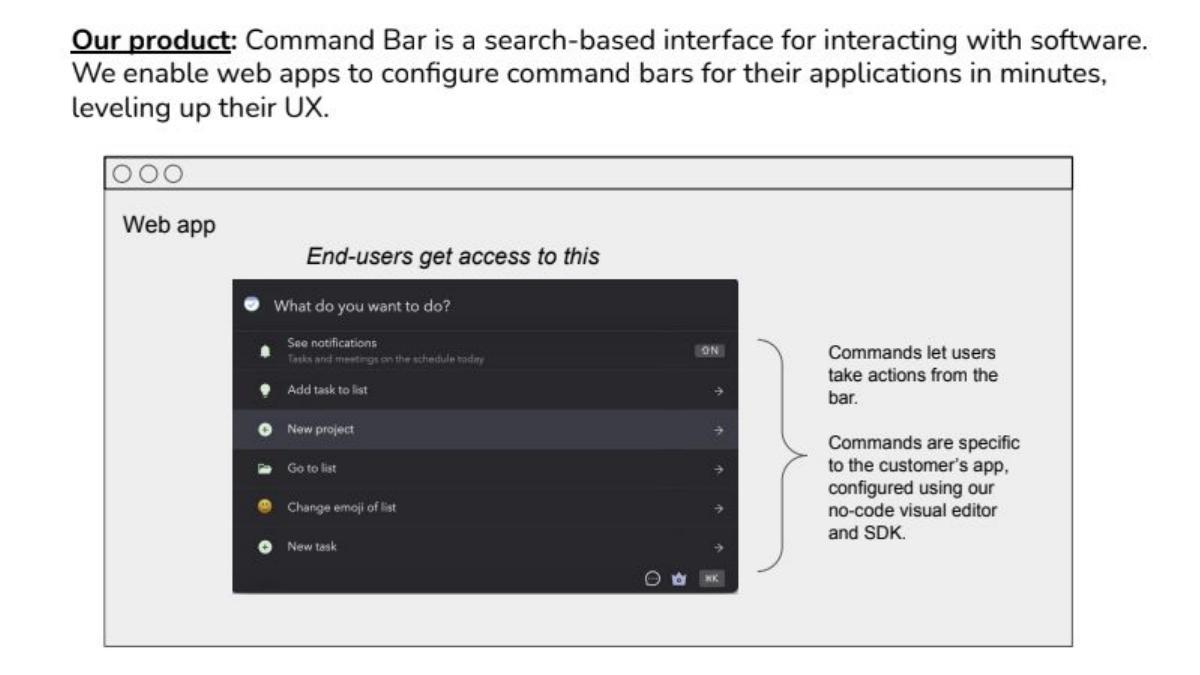
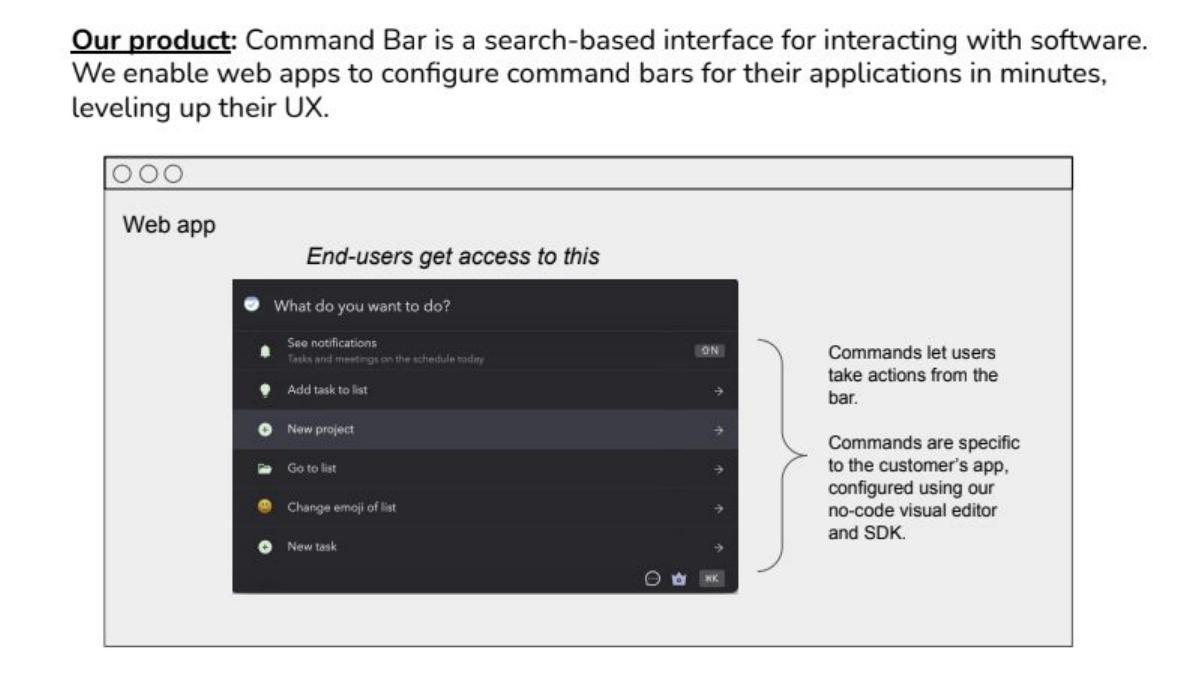
- The deck leads immediately with a product visualization on Slide 1, defining the tool as a search-based interface for interacting with software.
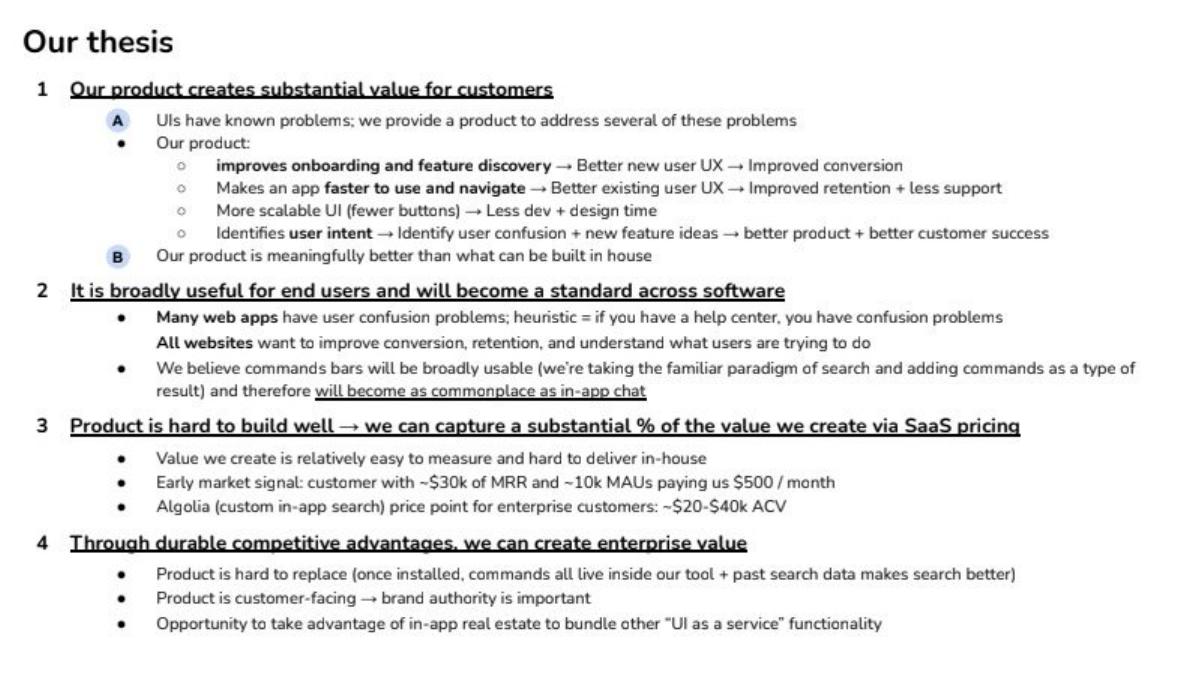
- Slide 2 presents a comprehensive four-point thesis covering customer value, market standardization, pricing capture, and durable competitive advantages.
- The founders provide specific early traction data on Slide 2, citing a customer with ~$30k MRR and ~10k MAUs paying $500 per month.
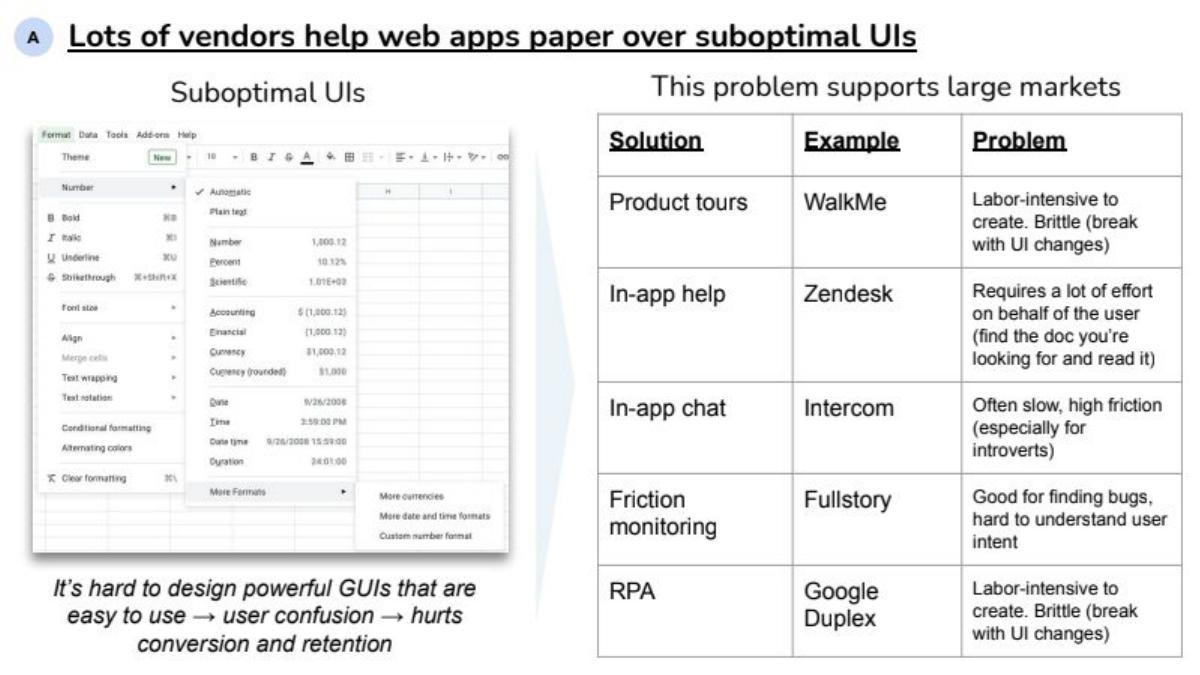
- Competitive positioning on Slide 3 identifies existing solutions like WalkMe, Zendesk, and Intercom as 'papering over suboptimal UIs.'
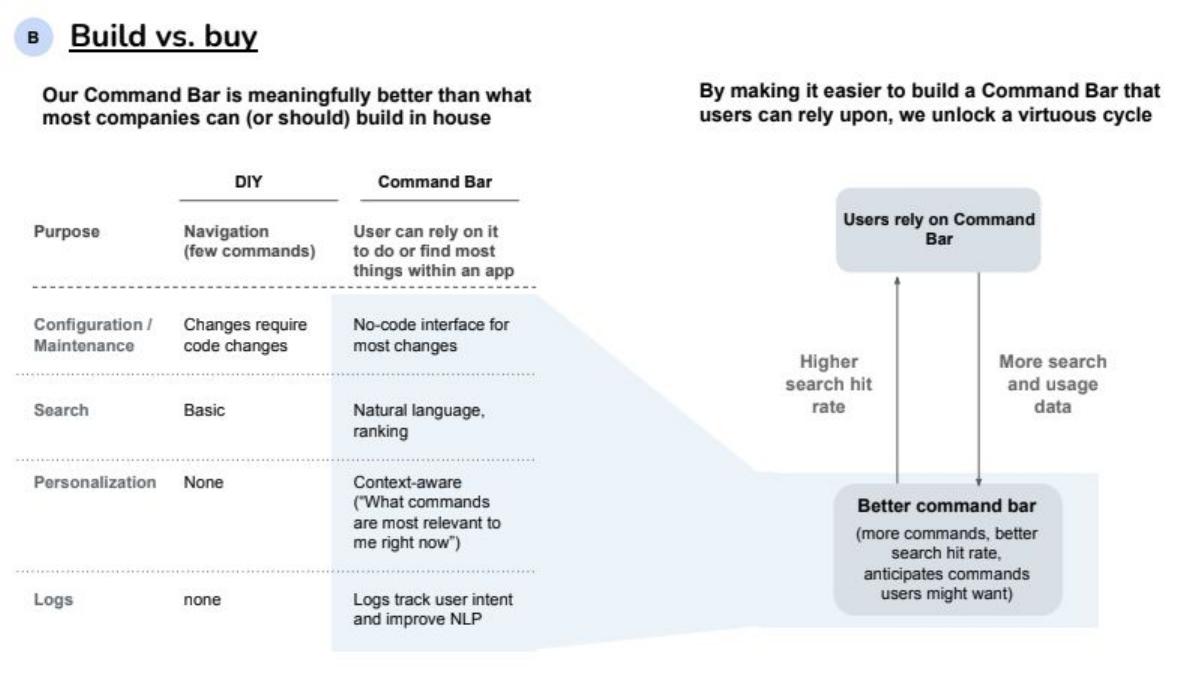
- The 'Build vs. Buy' argument on Slide 4 uses a virtuous cycle diagram to show how search data improves the product over time, creating a moat.
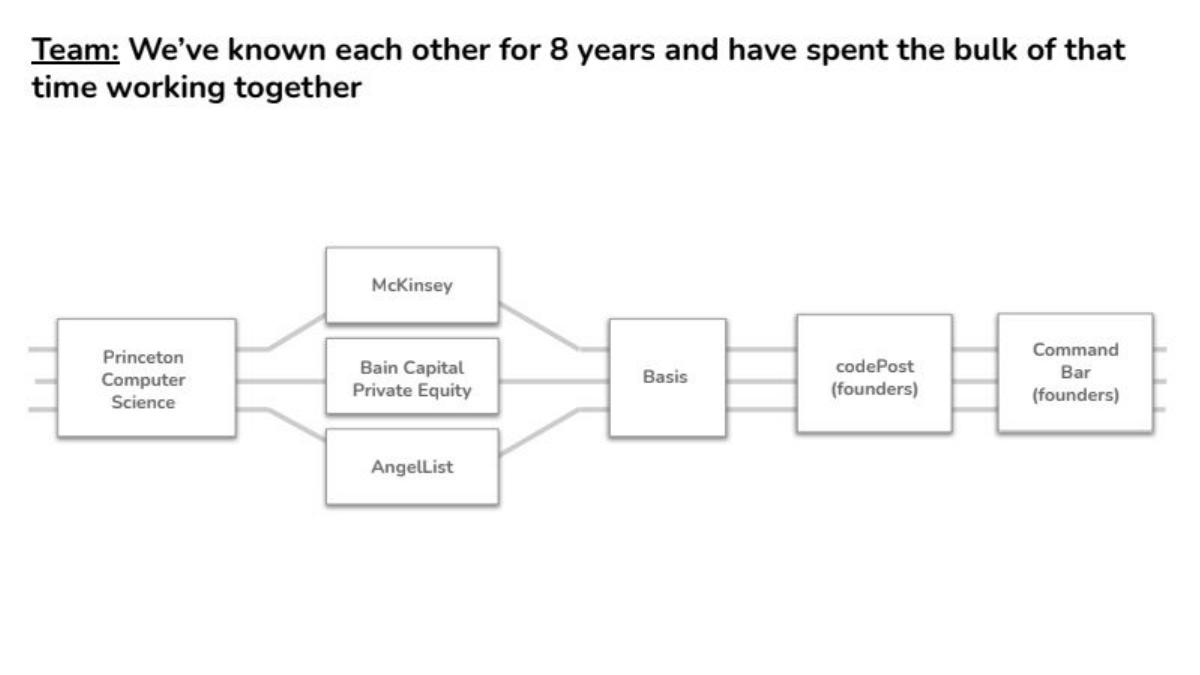
- The team slide (Slide 5) uses a flow chart to show the founders have worked together for 8 years across Princeton, McKinsey, and two previous startups.
- The deck completely omits a traditional 'Market Size' or 'TAM' slide, relying instead on the ubiquity of 'user confusion problems.'
- There is no 'Ask' slide in this version of the deck, leaving the specific round size and terms to the catalogue data ($4.8M raised).
The 6-Slide Thesis: How CommandBar Raised $4.8M
CommandBar’s pitch deck is a masterclass in brevity and logical density. At only six slides, it ignores the traditional 12-to-15 slide template in favor of a concentrated 'thesis' approach. The deck was used to raise a $4.8M seed round led by Thrive Capital, with participation from Y Combinator and a long list of prominent angels including Naval Ravikant and Jack Altman. The core of the presentation is not about what the product is today, but why the product's category is inevitable.
Slide 1: The Product Visualization
CommandBar opens immediately with a product definition and a visual mockup. Slide 1 states: "Command Bar is a search-based interface for interacting with software." The slide shows a dark-themed command interface overlaid on a generic web app, listing actions like "Add task to list" and "New project." The primary value proposition here is speed and ease of implementation, claiming to enable web apps to configure these bars "in minutes, leveling up their UX." By starting with the product rather than the problem, the founders immediately anchor the investor in the tangible reality of the tool before moving into abstract strategy.
Slide 2: The Four-Point Thesis
Slide 2 is the most information-dense part of the deck, titled "Our thesis." It breaks the company's potential into four logical pillars. First, it argues that the product creates value by improving onboarding and feature discovery, which leads to better conversion. Second, it claims the tool will become a "standard across software," comparing its future ubiquity to in-app chat. Third, it addresses monetization, noting that the product is "hard to build well" and citing an early market signal: a customer with "~$30k of MRR and ~10k MAUs paying us $500 / month." Finally, it outlines durable competitive advantages, specifically that the product is "hard to replace" once installed because it captures search data that makes the tool smarter over time.
Slide 3: The Competitive Landscape
Slide 3, titled "Lots of vendors help web apps paper over suboptimal UIs," takes a direct swipe at established categories. It uses a table to compare CommandBar's approach to existing solutions. It lists WalkMe (Product tours) as "brittle," Zendesk (In-app help) as requiring "a lot of effort on behalf of the user," and Intercom (In-app chat) as "often slow, high friction." By framing these multi-billion dollar companies as mere 'band-aids' for bad UI, CommandBar positions itself as the more elegant, intent-driven alternative. The slide concludes that "It’s hard to design powerful GUIs that are easy to use," which creates the market gap CommandBar intends to fill.
Slide 4: The Build vs. Buy Argument
Slide 4 focuses on why a company wouldn't just build a command bar themselves. The founders contrast a "DIY" approach (which is limited to basic navigation and requires code changes) with "Command Bar" (which offers a no-code interface, natural language ranking, and context-aware personalization). The right side of the slide illustrates a "virtuous cycle" : as users rely on the bar, the company gets more search and usage data, which leads to a better command bar (more commands, better hit rate), which in turn makes users rely on it more. This is a classic 'flywheel' argument designed to show investors how the business scales its defensibility.
Slide 5: The Founder Journey
The team slide (Slide 5) is remarkably effective because it focuses on collective history rather than individual accolades. The headline states: "We’ve known each other for 8 years and have spent the bulk of that time working together." A flow chart tracks the founders from Princeton Computer Science through stints at McKinsey, Bain Capital, and AngelList , and then through two previous startups, Basis and codePost . This visual proof of 'founder-founder fit' is a powerful de-risking mechanism for seed investors who often worry about team stability in the early stages.
Slide 6: The Conclusion
The final slide in this version of the deck is a promotional slide for the platform where the deck is hosted. In the original pitch context, this would typically be a 'Thank You' or 'Contact' slide. Notably, the deck does not include a formal 'Ask' slide detailing the amount of money being raised or the specific use of funds. According to the catalogue data, the round eventually closed at $4.8M , suggesting that the strength of the thesis and the team's pedigree were sufficient to drive the conversation without a prescriptive budget slide.
What CommandBar Does Well
The strength of this deck lies in its logical sequencing . It doesn't waste time on 'fluff' or generic market statistics about the growth of SaaS. Instead, it makes a specific, opinionated argument about how software should work. By benchmarking their early traction ($500/month from a $30k MRR customer) and comparing their potential ACV to Algolia ($20-$40k) , they provide a concrete financial framework that feels grounded in reality. The use of a virtuous cycle diagram on Slide 4 is also a high-leverage move, as it explains the 'moat' in a way that is easy for a generalist investor to grasp.
What is Missing from the Deck
The most glaring omission is a Total Addressable Market (TAM) slide. While the founders argue that their tool will become a 'standard,' they never quantify how many companies could use it or what the total revenue opportunity looks like in dollars. There is also no roadmap or 'Future Vision' slide. The deck focuses heavily on what the product is now and why it works, but it doesn't explicitly show where the product goes next—for example, moving into AI-driven automation or broader analytics. Finally, the unit economics are only hinted at through one customer example; a more detailed breakdown of customer acquisition costs (CAC) or sales cycles is absent, though this is common for a seed-stage deck where such data is often nascent.
Founder Takeaways: Why This Worked
Focus on the Thesis: If you are building a new category, don't just show the product; explain your worldview. CommandBar succeeded by convincing investors that the current way of helping users is broken. · Visual Team History: If you have a long history with your co-founders, show it visually. A timeline of shared projects is much more convincing than a list of logos. · Specific Benchmarks: Don't just say you are 'SaaS.' Compare your pricing and value to a known entity (like Algolia) to help investors bucket your potential. · Minimalism as Authority: The lack of design polish in this deck actually works in its favor. It suggests that the founders are focused on product and logic rather than marketing, which can appeal to technical investors.
Frequently asked questions
- How does CommandBar justify its market potential without a TAM slide?
- CommandBar uses a heuristic argument on Slide 2: 'if you have a help center, you have confusion problems.' By positioning their command bar as a future standard 'as commonplace as in-app chat,' they imply a market size equal to the entire SaaS ecosystem. They also benchmark potential ACV against Algolia, noting enterprise price points of $20k-$40k, which provides a concrete revenue framework without needing a billion-dollar total addressable market graphic.
- What is the core competitive advantage claimed in the deck?
- The deck highlights two primary advantages on Slide 4. First, a 'no-code interface' that allows for rapid changes without engineering resources. Second, a data moat: as users search, the system logs intent and improves its natural language processing (NLP). This creates a virtuous cycle where more usage leads to a better command bar, making it 'hard to replace' once installed.
- How does the team slide establish credibility?
- Slide 5 is a visual timeline rather than a list of bullet points. It shows the founders' shared history starting at Princeton Computer Science, moving through prestigious firms like McKinsey and Bain Capital, and culminating in two previous joint ventures (Basis and codePost). This '8 years working together' narrative reduces the perceived risk of founder conflict, a major concern for seed-stage investors.
- What specific problem does CommandBar aim to solve?
- According to Slide 3, the problem is 'suboptimal UIs' that are hard to use, which hurts conversion and retention. The deck argues that current solutions like product tours (WalkMe) are brittle and break with UI changes, while in-app help (Zendesk) requires too much user effort. CommandBar positions itself as a way to identify and act on user intent directly through a search interface.
- Is the pricing model explained in the deck?
- Yes, Slide 2 explicitly mentions a SaaS pricing model. It provides a real-world example of an early customer paying $500 per month. The slide also suggests that the value created is 'relatively easy to measure,' which supports their ability to capture a percentage of that value through recurring fees, eventually scaling to enterprise-level contracts.