Compass Pathways raised $80M in 2021 for its Series B round, following the 2019 deck analyzed here. The presentation is a masterclass in life sciences fundraising, shifting the narrative from 'alternative medicine' to rigorous clinical development. By highlighting 'Breakthrough Therapy' potential and citing specific academic trials from institutions like Johns Hopkins and Imperial College London, the company de-risked a controversial asset class. The deck focuses heavily on Treatment-Resistant Depression (TRD), mapping out a clear regulatory path toward a 2022 marketing authorization. It bala…
Key takeaways
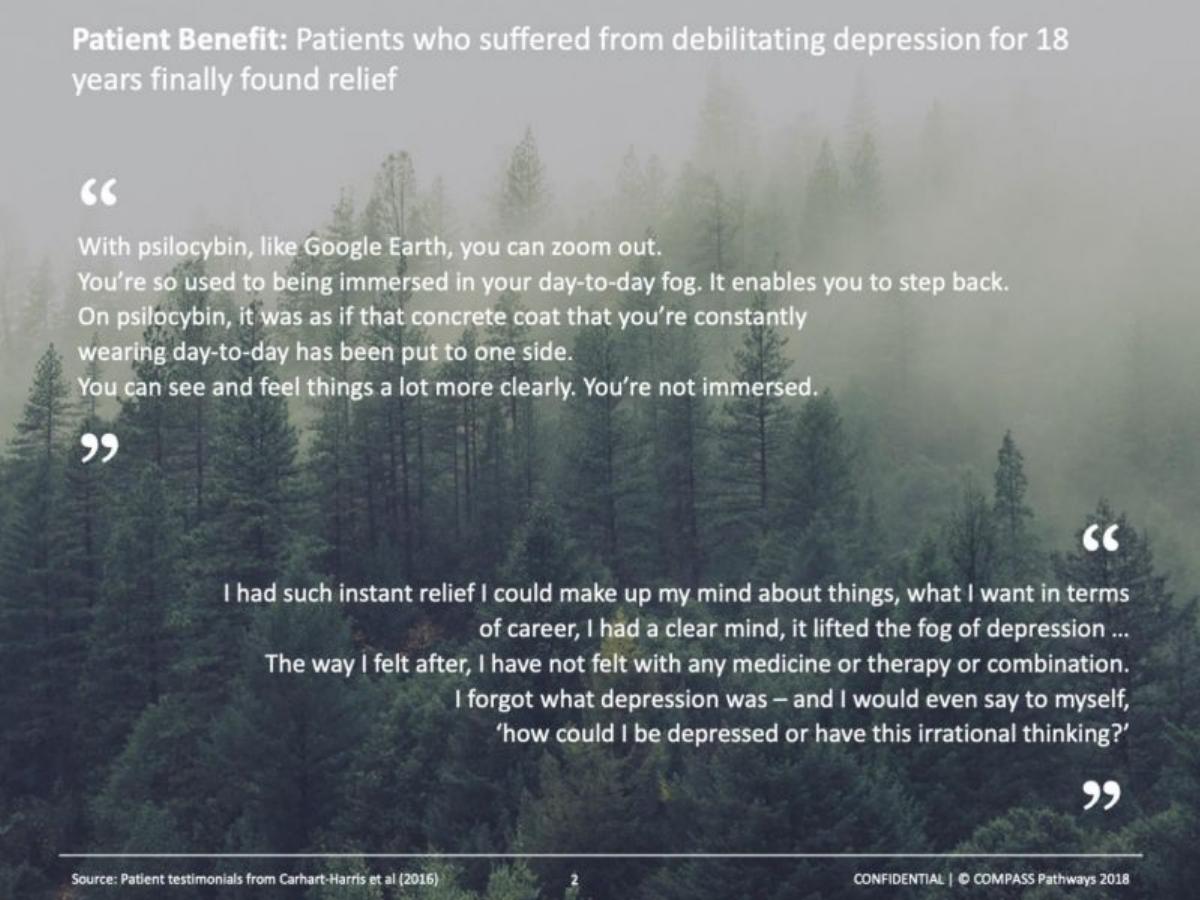
- The deck leads with emotional patient testimonials to establish the 'relief' provided by psilocybin after 18 years of debilitating depression (Slide 2).
- A global mental health crisis is quantified with a projected $16 trillion economic cost by 2030 (Slide 6).
- The value proposition is split into three distinct pillars: Patient Benefit, Therapeutic Benefit, and Economic Benefit (Slide 8).
- Clinical signals are backed by specific trial data from UCLA, NYU, Johns Hopkins, and Imperial College London (Slide 10).
- A detailed regulatory timeline targets Marketing Authorisation by 2022 across the EU, US, and Canada (Slide 12).
- The Total Addressable Market (TAM) for psilocybin therapy in TRD is estimated at £140-200 billion yearly (Slide 16).
- Competitive analysis focuses on Janssen’s Esketamine, highlighting its 'mixed results' and 'uncertain efficacy' as a market gap (Slide 18).
- The Scientific Advisory Board features heavyweights from Harvard Medical School, Stanford, and the former President of the American Psychiatric Association (Slide 22).
The Clinical Narrative: Transforming Psilocybin into a Pharmaceutical Asset
The Compass Pathways deck is a 29-slide document (15 of which are analyzed here) that serves as a blueprint for biotech and life sciences fundraising. In 2019, when this deck was circulated, psilocybin was still largely viewed through a counter-culture lens. This presentation successfully pivots the conversation toward rigorous clinical development, regulatory milestones, and massive economic impact. The deck does not sell a 'drug'; it sells a 'care pathway' that combines a psychoactive compound with a structured therapeutic protocol.
Slides 1-4: Mission and Patient Impact
The deck opens with a serene, fog-covered forest and the tagline: "Transforming mental health through psychoactive care pathways." This immediately sets a professional, clinical tone. Slide 2 is a strategic choice to lead with the 'Why.' It features two lengthy patient testimonials. One patient describes the experience as being like "Google Earth," allowing them to "zoom out" from the fog of depression. These quotes are sourced from a 2016 Carhart-Harris et al. study, grounding the emotional appeal in academic literature.
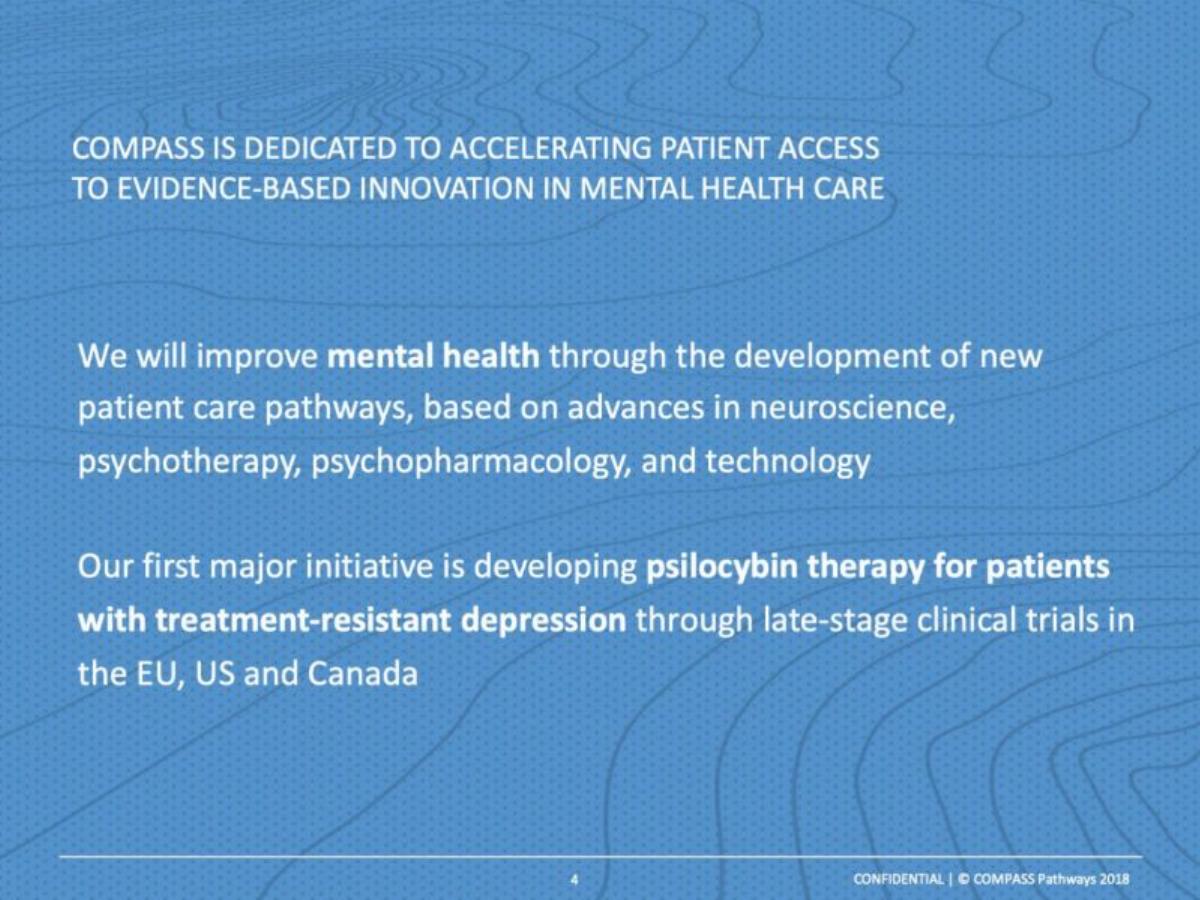
Slide 4 delivers the mission statement: "COMPASS is dedicated to accelerating patient access to evidence-based innovation in mental health care." It explicitly mentions that their first major initiative is developing psilocybin therapy for treatment-resistant depression (TRD) through late-stage clinical trials in the EU, US, and Canada. This slide is critical because it defines the company as a platform for 'innovation' rather than a single-molecule play.
Slides 6-8: The Global Crisis and Value Proposition
Slide 6 quantifies the problem. It lists global yearly prevalence for various disorders, with Generalised Anxiety Disorder at 275 million and Chronic Pain at 130 million. The 'hook' for investors is a quote from The Lancet Commission stating that the rising cost of mental health will hit $16 trillion by 2030 . This frames the investment not just as a medical necessity, but as a global economic imperative.
Slide 8 breaks down the value proposition into three categories: Patient Benefit (faster, longer-lasting relief), Therapeutic Benefit (superior efficacy and safety), and Economic Benefit . The economic section is particularly sharp, citing lower hospitalization rates and fewer outpatient visits to GPs and psychiatrists. This is the language of payers and insurance companies, which is vital for a Series B biotech company.
Slides 10-12: Clinical Signals and Regulatory Roadmap
Slide 10 is perhaps the most important slide for de-risking the investment. It summarizes 'Clinical Signals' from four major institutions: UCLA, NYU, Johns Hopkins, and Imperial College London. By citing response rates as high as 92% (Johns Hopkins, 2016), Compass leverages the prestige of these universities to validate their own commercial path. The slide concludes that these signals present a "commercial opportunity for treatment-resistant depression.".
Slide 12 provides the Psilocybin TRD Development Programme timeline. It shows a clear progression from 2016 (EMA Scientific Advice) to a projected 2022 Marketing Authorisation. It highlights that they are currently in Phase IIB: Dose Finding with 216 patients across EU, US, and Canada sites. This timeline gives investors a clear 'exit' or 'liquidity' horizon based on regulatory success.
Slides 14-16: The Patient Experience and Market Size
Slide 14 details the Clinical Trial Patient Experience . This is not a pill you take at home. It involves a 5-6 hour treatment session where the patient is "supported by therapist and assistant therapist." This slide is crucial for explaining the business model; it’s a service-heavy medical intervention, which justifies the high price point suggested in later slides.
Slide 16 calculates the Total Addressable Market (TAM) . The math is transparent: 78 million depressed patients x 18-26% TRD rate x £10-15k direct medical cost = £140-200 billion yearly . To provide context, they list peak sales of other treatments like Abilify (£5.2b) and Zoloft (£1.8b). This comparison suggests that if Compass captures even a small fraction of the TRD market, the returns will be venture-scale.
Slides 18-22: Competition and The Team
Slide 18 is a direct attack on Janssen (Johnson & Johnson) . It analyzes their Esketamine product, noting that while it is a competitor for the TRD indication, it has "uncertain efficacy" and "restrictive co-morbidities." By pointing out that one of Janssen's short-term studies "failed to meet primary endpoint," Compass positions its own psilocybin therapy as a potentially superior alternative.
Slide 20 and 22 cover the team. While the operational team (Slide 20) is impressive, featuring alumni from BCG, Goldman Sachs, and various NHS trusts, the Scientific Advisory Board (Slide 22) is the real star. It includes Prof. David Nutt (Imperial College London) and Prof. Alan Schatzberg (Stanford). In biotech, the quality of the advisors is often a proxy for the quality of the science, and this list is top-tier.
Slides 24-26: The Investor Base
The final slides (24 and 26) list the investors. This is a "who's who" of contrarian and institutional capital. Notable names include Peter Thiel (Thiel Capital) , Christian Angermayer (ATAI Life Sciences) , and Thomas Insel (Former Director of the US National Institute of Mental Health). Seeing Peter Thiel as a 'Seed, Series A' investor provides a massive signal of confidence to new Series B investors.
What Compass Pathways Does Well
The deck excels at institutionalizing a stigmatized asset . By using the same visual language, data structures, and regulatory milestones as a traditional pharmaceutical company, they remove the 'psychedelic' stigma. The use of academic citations on almost every slide (WHO, Lancet, PubMed, etc.) creates a sense of inevitability. They also do a great job of explaining the 'Economic Benefit,' which is often overlooked in healthcare decks but is essential for insurance reimbursement discussions.
What is Missing from the Deck
The most notable omission is a detailed breakdown of the manufacturing and supply chain . Psilocybin is a controlled substance, and the logistics of manufacturing medical-grade synthetic psilocybin at scale are complex. While Slide 12 mentions "manufacturing practices (GMP) production batch," there is no detail on the cost of goods sold (COGS) or the scalability of the therapist-led model. Additionally, there is no explicit 'Ask' slide in this 15-slide selection, though the catalogue facts indicate an $80M raise.
What a Founder Should Copy
Founders in highly regulated or 'fringe' industries should copy the De-Risking Through Association strategy used here. Compass didn't just say their drug worked; they showed that Johns Hopkins and NYU said it worked. They didn't just say they had a good idea; they showed that the former head of the NIMH was on their board. If you are building something controversial, your deck must be the most 'boring' and 'professional' document in the room to compensate for the perceived risk of the asset class.
Final Verdict: This is a high-conviction, data-driven deck that successfully bridges the gap between breakthrough science and institutional investment. It treats the regulatory process as a series of logical steps rather than hurdles, which is exactly what Series B investors want to see.
Frequently asked questions
- How does Compass Pathways define its primary market opportunity?
- The company focuses specifically on Treatment-Resistant Depression (TRD). According to slide 16, they target a population of 78 million depressed patients in the US, EU28, and Japan. By narrowing the focus to the 18-26% who are treatment-resistant and applying a direct medical cost of £10-15k per patient, they arrive at a yearly TAM of £140-200 billion.
- What clinical evidence is presented to support the use of psilocybin?
- Slide 10 lists four key academic trials. These include a 2011 UCLA study showing a 30% mood improvement at 6 months and a 2016 Johns Hopkins study reporting a 92% anti-depressant response rate at 5 weeks. These 'positive signals' are used to justify the commercial opportunity for TRD.
- What does the patient experience look like in their clinical trials?
- Slide 14 outlines a three-stage process: Screening and Preparation (3+ visits), a 5-6 hour Treatment Session where the patient wears eye shades and listens to a music soundtrack, and Integration and Follow-Up (5 visits). This emphasizes that the product is a 'therapy' rather than just a drug.
- Who are the key members of the Compass Pathways team and advisory board?
- The deck highlights a massive Scientific Advisory Board (Slide 22) including Prof. David Nutt and former leaders of the Italian Medicines Agency and the American Psychiatric Association. The operational team (Slide 20) includes specialists in clinical trials, business development from BCG/Goldman Sachs, and PhD research analysts.
- How does the company compare itself to existing pharmaceutical competitors?
- Slide 18 provides a 'teardown' of Janssen’s Esketamine. Compass notes that while Janssen received Breakthrough Therapy Designation, their Phase III results were 'mixed' with some trials failing to meet primary endpoints. This positions Compass's psilocybin therapy as a potentially more reliable alternative.