Compliable’s 2021 Seed deck is an exercise in brevity, relying on high-signal traction and market timing rather than exhaustive explanations. By focusing on the legalization of sports betting across US states, the company positioned itself as the essential infrastructure for operators like FanDuel. The deck highlights a 'Current Opportunity' driven by state-level regulatory changes and showcases a team with deep technical and industry-specific expertise, including the former Head of Licensing at DraftKings. While the deck lacks traditional slides for problem, solution, and market size, it com…
Key takeaways
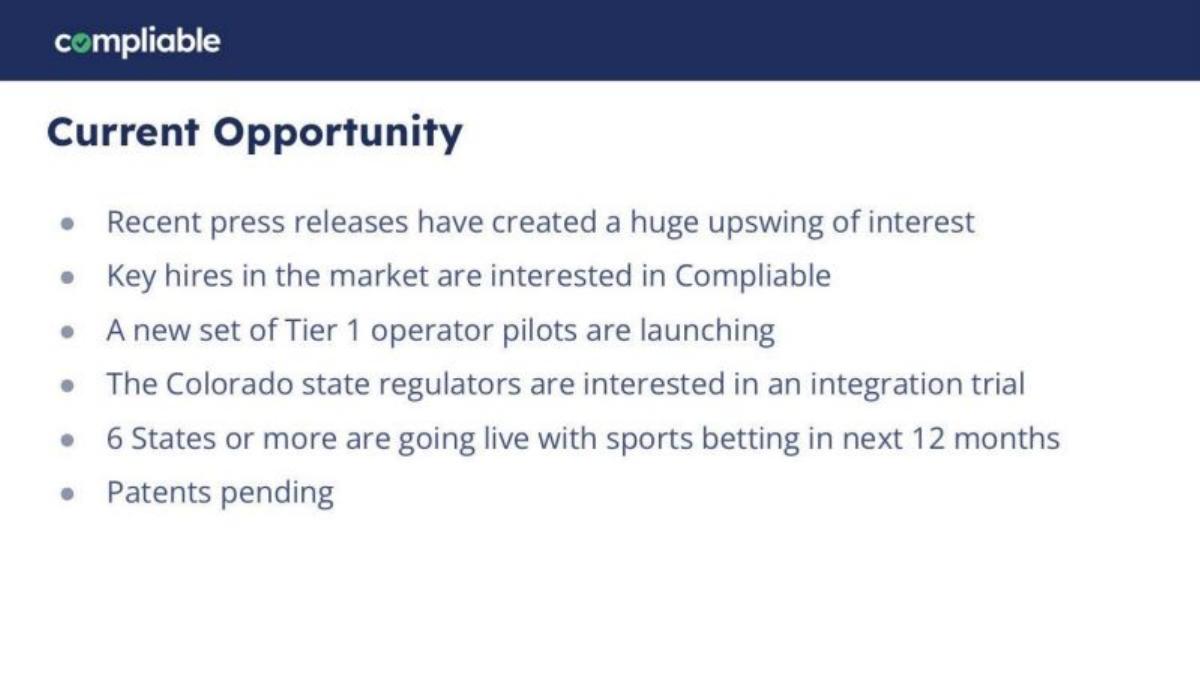
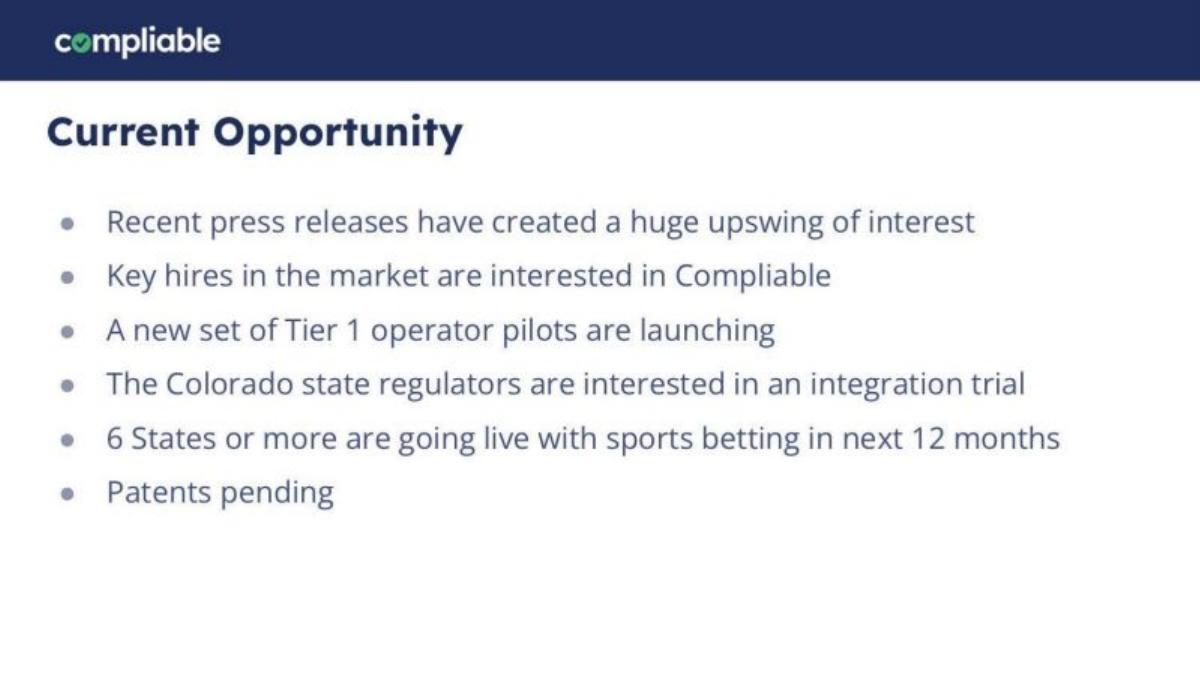
- The deck identifies a specific regulatory window where 6 or more states were going live with sports betting within 12 months (Slide 1).
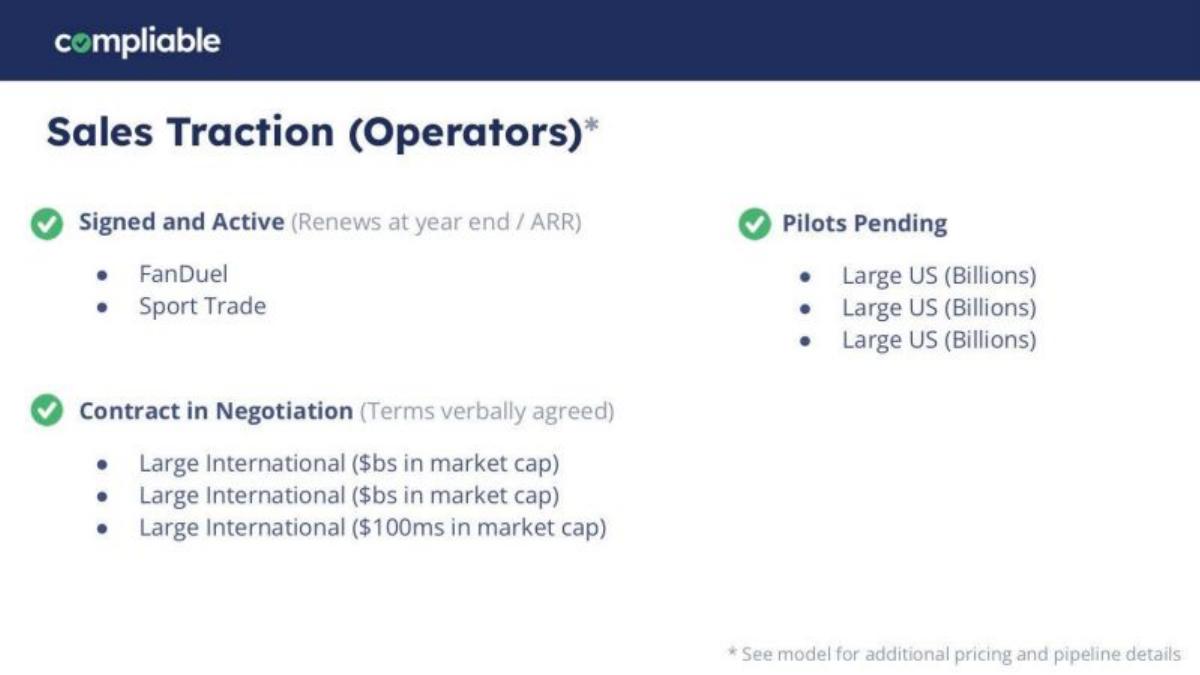
- Traction is validated by naming FanDuel and Sport Trade as signed and active customers (Slide 2).
- The company uses 'Large US (Billions)' and 'Large International ($bs in market cap)' as placeholders for a high-value pipeline in negotiation (Slide 2).
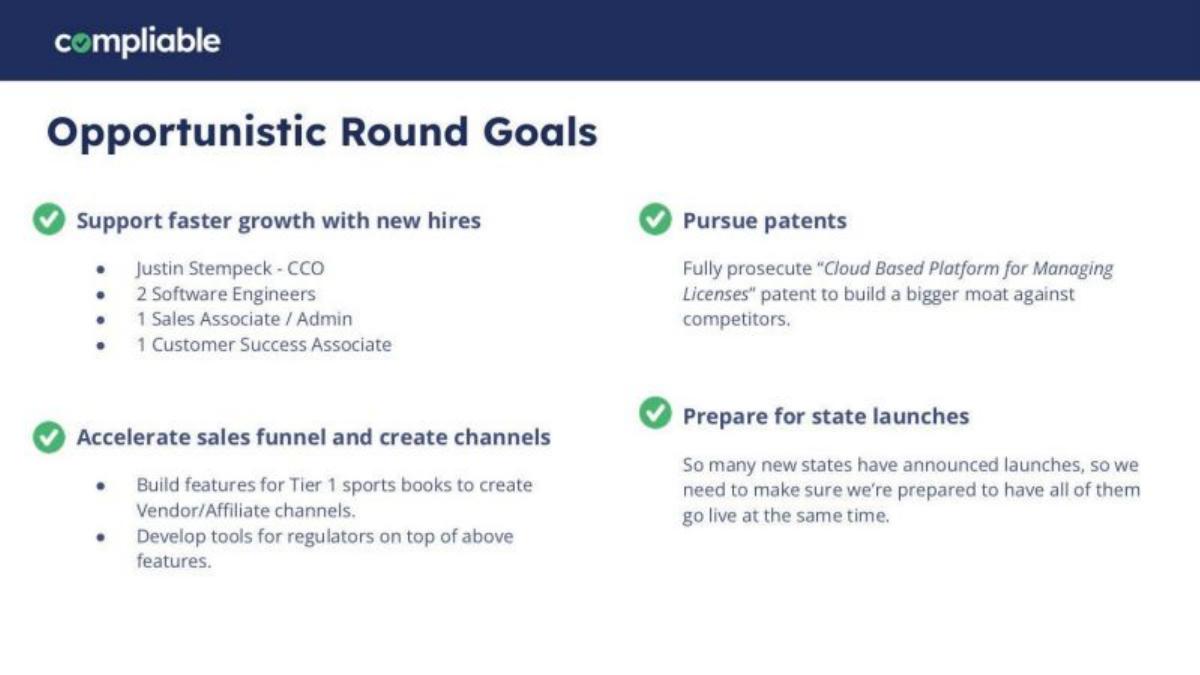
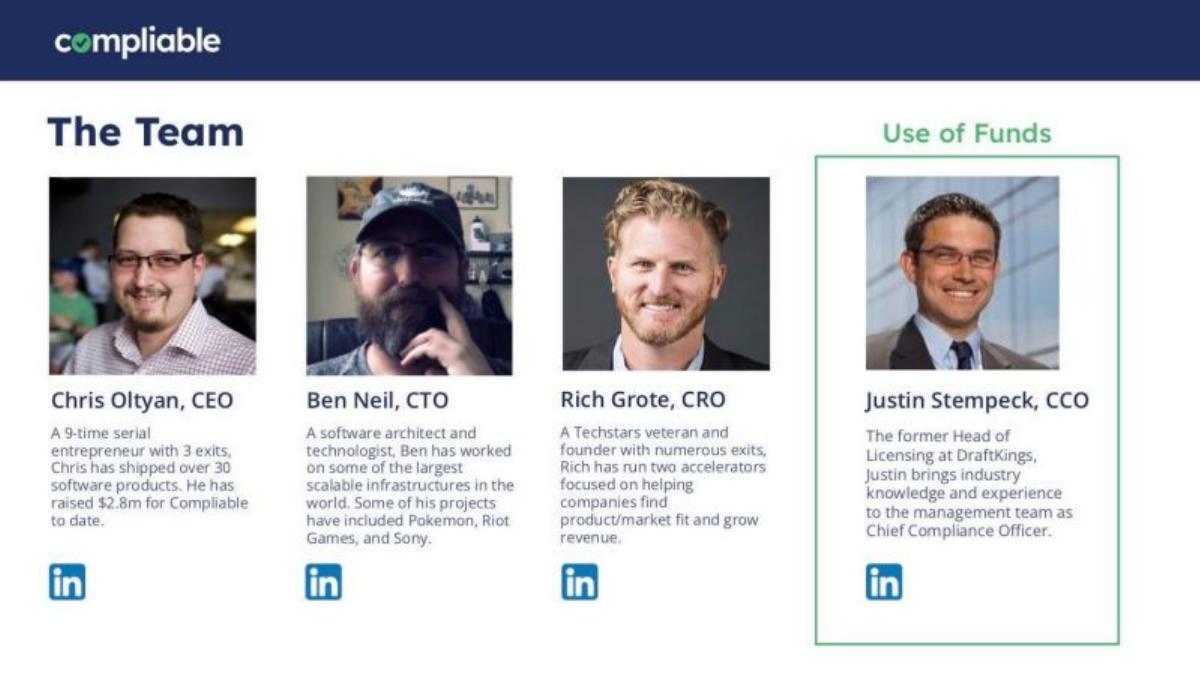
- A key strategic move was hiring Justin Stempeck, the former Head of Licensing at DraftKings, to serve as CCO (Slide 4).
- The deck mentions a pending patent for a 'Cloud Based Platform for Managing Licenses' to establish a competitive moat (Slide 3).
- The 'Use of Funds' is uniquely integrated into the team slide, highlighting Justin Stempeck as a primary investment target (Slide 4).
- The CEO, Chris Oltyan, is presented as a 9-time serial entrepreneur with 3 exits, having already raised $2.8M for the company prior to this round (Slide 4).
- The deck omits standard slides for Problem, Solution, and TAM, assuming the investor is already familiar with the sports betting compliance landscape.
The Power of a High-Signal Lean Deck
Compliable’s 5-slide deck is a departure from the standard 12-15 slide venture narrative. It operates on the assumption that the audience understands the macro environment—specifically the rapid legalization of sports betting in the United States following the 2018 Supreme Court ruling. By skipping the 'Why Now' and 'Problem' slides, the deck focuses entirely on 'Why Us' and 'Why Today.'
Slide 1: Current Opportunity
The deck opens with a list of catalysts. Rather than a vision statement, Slide 1 acts as a momentum report. It cites 'Recent press releases' and 'Key hires' as drivers of interest. The most critical data points here are the regulatory ones: 'The Colorado state regulators are interested in an integration trial' and '6 States or more are going live with sports betting in next 12 months.' This creates a sense of unavoidable urgency. If an investor doesn't act, they miss the window of these state launches. The mention of 'Patents pending' adds a layer of intellectual property protection to what might otherwise be seen as a pure service play.
Slide 2: Sales Traction (Operators)
Slide 2 is the strongest slide in the deck. It categorizes the pipeline into three clear buckets: Signed and Active, Contract in Negotiation, and Pilots Pending. Naming FanDuel is a significant 'anchor tenant' win. For a Seed stage company, having one of the two largest players in the US market validates the product-market fit instantly. The use of 'Large US (Billions)' and 'Large International ($bs in market cap)' for the remaining pipeline items suggests that Compliable is targeting the enterprise level of the market, where contract values are highest and barriers to entry (compliance) are steepest. A footnote directs the reader to a 'model' for pricing, indicating this deck is meant to be viewed alongside a detailed financial spreadsheet.
Slide 3: Opportunistic Round Goals
This slide serves as the 'Ask' and 'Strategy' combined. It outlines four pillars: hiring, sales funnel acceleration, patent prosecution, and state launch preparation. The hiring section is specific, naming Justin Stempeck as the CCO (Chief Compliance Officer). The deck also mentions building features for 'Tier 1 sports books' to create vendor and affiliate channels. This is a strategic pivot from just being a tool for operators to becoming a platform for the entire ecosystem. The goal to 'fully prosecute' the 'Cloud Based Platform for Managing Licenses' patent is explicitly linked to building a 'bigger moat against competitors.'
Slide 4: The Team and Use of Funds
The team slide is dense with credibility. Chris Oltyan (CEO) is described as a 9-time serial entrepreneur with 3 exits and $2.8M already raised for Compliable. Ben Neil (CTO) brings high-scale infrastructure experience from companies like Pokemon, Riot Games, and Sony. Rich Grote (CRO) is noted as a Techstars veteran. However, the standout is the visual emphasis on Justin Stempeck (CCO) . His photo is boxed in green and labeled 'Use of Funds.' By highlighting the former Head of Licensing at DraftKings , Compliable is telling investors that they haven't just built software; they have hired the person who knows the regulatory hurdles better than anyone else in the industry. This is a brilliant way to show that the capital is being used to acquire 'unfair advantages.'
Slide 5: Supplemental Information
The final slide in the provided set is a promotional slide for the source library and does not contain company-specific data. Therefore, the core narrative of the Compliable pitch is contained entirely within the first four slides.
What Works in the Compliable Deck
1. Extreme Focus on Traction: By naming FanDuel on Slide 2, the founders bypass the need to explain why their software is good. If the market leader uses it, the software is presumed to be functional and necessary.
2. Regulatory Tailwinds: The deck identifies a specific 12-month window (Slide 1) where the market will expand by at least 6 states. This gives investors a clear timeline for when they can expect to see growth and ROI.
3. The 'Strategic Hire' as a Milestone: Most decks list 'Hiring' as a generic use of funds. Compliable names the specific person (Justin Stempeck) and his pedigree (DraftKings) on Slide 4, turning a line item into a major value-add.
4. De-risking via Regulators: Mentioning interest from Colorado state regulators (Slide 1) is a rare and powerful signal. In the world of RegTech, having the regulator's blessing is the ultimate competitive advantage.
What is Missing from the Compliable Deck
1. No Problem/Solution Framework: The deck never explicitly states what is wrong with the current licensing process. While industry insiders know it is manual, slow, and paper-heavy, a generalist investor might not grasp the pain point without a dedicated slide.
2. No Financials or Unit Economics: Aside from a footnote mentioning a 'model,' there are no details on how Compliable makes money. Is it a SaaS fee per state? A per-user license? A percentage of the application fee? This information is vital for understanding scalability.
3. No Competitive Landscape: The deck mentions building a 'moat' (Slide 3) but doesn't identify who they are building it against. Investors usually want to see a 'Magic Quadrant' or a feature comparison list to understand where Compliable sits relative to incumbents or other startups.
4. No Clear 'Ask' Amount: While the catalogue facts state they raised $3.6M, the slides themselves do not list a specific dollar amount being sought. It is labeled as an 'Opportunistic Round,' which can sometimes be interpreted as 'we will take what we can get at the right valuation.'
Founder's Playbook: What to Copy
1. The 'Use of Funds' Team Integration: If you are hiring a 'heavy hitter' from a major competitor, don't just put them on the team slide. Highlight them as a primary reason for the capital raise. It shows that the money is buying talent that directly translates to market share.
2. Use 'Billion Dollar' Proxies: If you are under NDA and cannot name your pipeline, do what Compliable did on Slide 2. Use market cap or revenue tiers (e.g., 'Large US - Billions') to indicate the caliber of customers you are talking to.
3. Lead with Momentum: If your industry is undergoing a massive shift (like a change in law), make that the first thing the investor sees. Compliable’s Slide 1 is a 'Why Now' slide without the fluff.
4. Keep it Lean for Insiders: If you are pitching to sector-specific VCs who already know the space, don't waste time explaining the basics. Compliable’s 5-slide approach is perfect for a second-round meeting or a follow-up to a successful intro call.
Frequently asked questions
- Why is the deck only 5 slides long?
- Compliable likely used this as a 'teaser' or a follow-up deck for investors already briefed on the industry. It skips foundational explanations (Problem/Solution) to focus entirely on momentum, traction, and the specific 'Opportunistic Round' goals. In a hot market like US sports betting in 2021, brevity can signal confidence and urgency.
- How does Compliable prove market demand without a TAM slide?
- Instead of theoretical market sizing, they use 'Sales Traction' (Slide 2) to show real-world demand. By listing FanDuel as a client and mentioning three pending pilots with billion-dollar US entities, they demonstrate that the largest players in the industry are already engaging with their product, which validates the market size by proxy.
- What is the significance of the Colorado state regulator mention?
- On Slide 1, they note that Colorado regulators are interested in an integration trial. This is a massive 'de-risking' signal. If a government regulator uses or integrates with a compliance platform, it creates a powerful network effect and makes the software a de facto standard for operators in that jurisdiction.
- Is the lack of a 'Problem' slide a mistake?
- For a general pitch, yes. However, for a sector-specific raise during a regulatory gold rush, the 'Problem' (the difficulty of multi-state licensing) is often self-evident to the target investors. Compliable chose to spend their limited slide real estate on their 'Moat' and 'Traction' instead.
- What does 'Opportunistic Round' imply?
- It suggests the company wasn't necessarily desperate for cash but saw a specific window (the 6+ state launches mentioned on Slide 1) where extra capital could drastically accelerate their market share. It frames the investment as a way to capture a time-sensitive upside rather than just keeping the lights on.