Comprehensive’s 10-slide deck is a textbook example of a Seed round narrative built on founder-market fit. Rather than leading with complex product features, the deck establishes a clear thesis: compensation is the last major HR workflow still trapped in spreadsheets. By highlighting founder Roger Lee’s success with Human Interest (a $1B valuation company), the deck builds immediate credibility. It uses a visceral 'Problem' slide—a messy, error-prone spreadsheet—to contrast against a clean, automated solution. While the deck lacks traditional metrics like revenue, CAC, or a specific 'Ask,' it…
Key takeaways
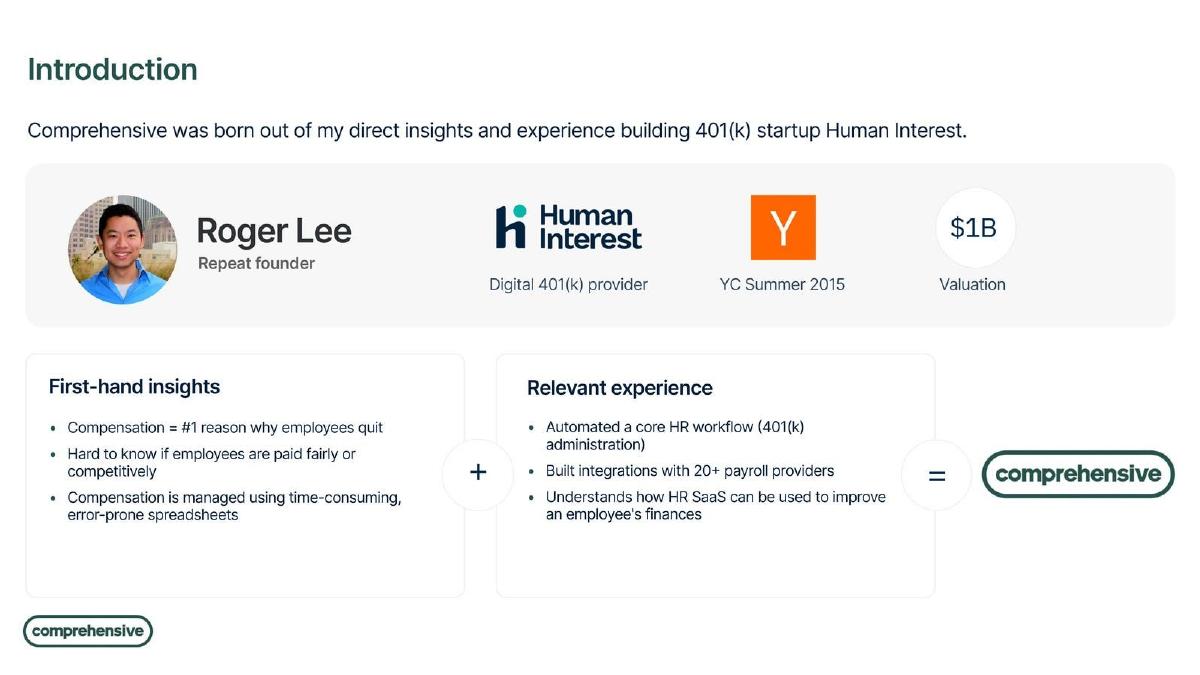
- The deck leads with founder pedigree, highlighting Roger Lee's previous success building Human Interest to a $1B valuation (Slide 2).
- A clear 'Thesis' slide defines the company's mission as migrating compensation management from spreadsheets to the cloud (Slide 3).
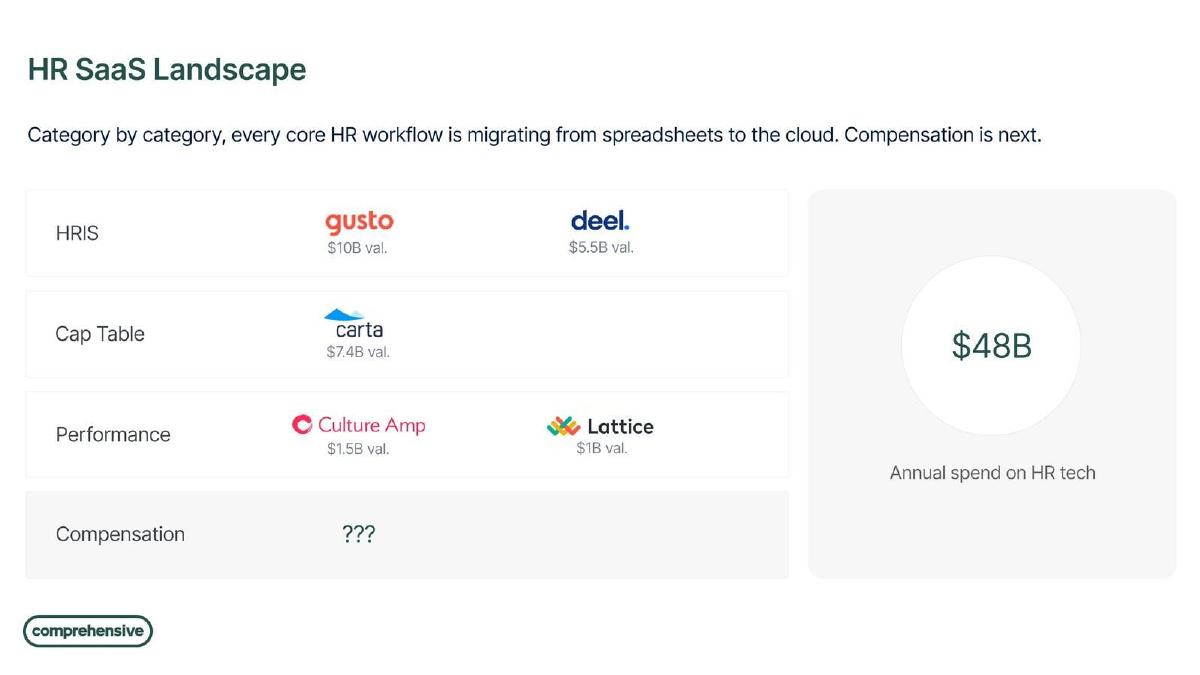
- The market landscape slide positions compensation as the missing piece in a $48B HR tech spend, alongside giants like Gusto and Carta (Slide 4).
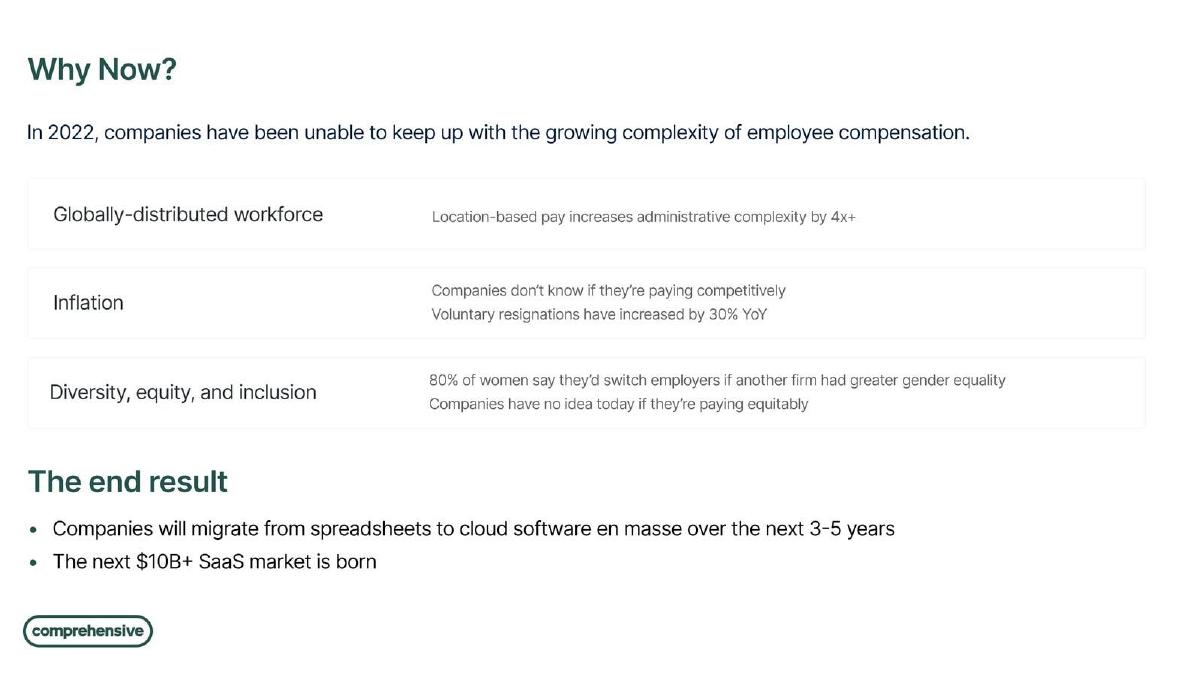
- The 'Why Now' slide identifies three specific tailwinds: globally distributed workforces, inflation-driven turnover, and DEI transparency (Slide 5).
- A detailed 'Example' slide uses a real-world spreadsheet screenshot to visualize pain points like broken VLOOKUPs and manual data pulls (Slide 7).
- The solution is framed as a unified SaaS platform with real-time integrations and churn prediction capabilities (Slide 8).
- The team slide emphasizes deep domain expertise, including a VP of Customer Success with 7+ years in compensation management (Slide 9).
- The deck completely omits financial projections, current traction metrics, and a specific funding ask (Slides 1-10).
The Narrative Strategy: Selling the 'Missing Piece' of HR Tech
Comprehensive’s pitch deck is a masterclass in category positioning. Instead of competing for a slice of an existing pie, the founders argue that the pie itself is incomplete. By framing compensation management as the last great HR workflow to be digitized, they move the conversation away from 'features' and toward 'inevitability.' The deck is lean, at only 10 slides, and relies heavily on the credibility of the founding team to bridge the gap between a vision and a $6M Seed round.
Slide 1-2: The Power of Founder-Market Fit
The deck opens with a minimalist title slide before immediately diving into the 'Introduction' on Slide 2. This is a strategic move. For a Seed round, the 'Who' is often more important than the 'What.' The slide highlights Roger Lee as a 'Repeat founder' and prominently displays the logo of Human Interest, his previous venture, alongside a '$1B Valuation' tag. By connecting his past experience—building integrations with 20+ payroll providers—to the new problem of compensation, the deck establishes immediate trust. It frames Comprehensive not as a random idea, but as a logical evolution of Lee's career in HR SaaS and consumer finance.
Slide 3-4: Defining the Category
Slide 3 presents a single, bold 'Thesis': Compensation management is the next big HR workflow to migrate from spreadsheets to the cloud. This sets the stage for Slide 4, 'HR SaaS Landscape.' This slide is a classic '2x2' alternative. It lists established categories like HRIS (Gusto, Deel), Cap Table (Carta), and Performance (Culture Amp, Lattice) with their respective multi-billion dollar valuations. By placing a '???' in the Compensation row, Comprehensive visually suggests that there is a massive, empty slot in the enterprise stack waiting to be filled. The inclusion of a '$48B' figure for annual HR tech spend provides the scale necessary to excite venture investors.
Slide 5: The 'Why Now' Catalyst
Timing is everything in fundraising. Slide 5 addresses this by citing three 2022-specific pressures: globally distributed workforces (which increase administrative complexity by 4x+), inflation (leading to a 30% YoY increase in voluntary resignations), and DEI (80% of women citing gender equality as a reason to switch employers). These aren't just 'problems'; they are external catalysts that make the status quo (spreadsheets) untenable. The slide concludes with a bold prediction: the birth of a new '$10B+ SaaS market.'
Slide 6-7: The Spreadsheet 'Villain'
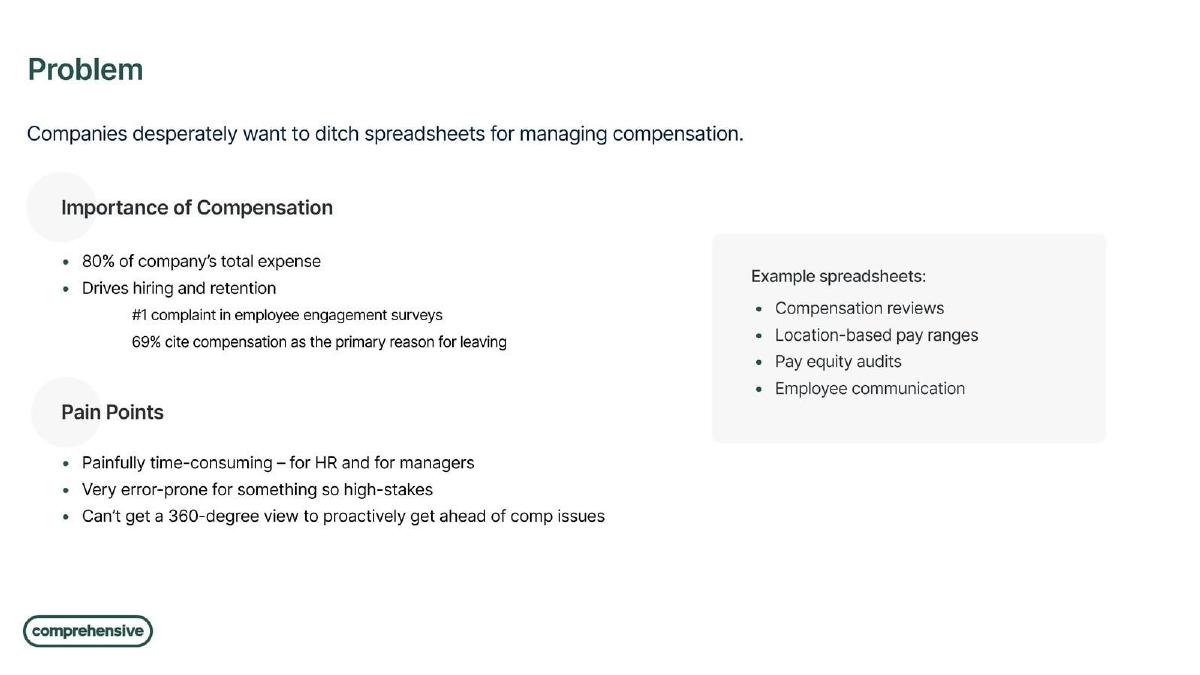
Every good story needs a villain. In this deck, the villain is the spreadsheet. Slide 6 lists the stakes: compensation is 80% of a company's total expense and the primary reason 69% of employees leave. Slide 7 is perhaps the most effective slide in the deck. It shows a blurred-out screenshot of a 'Q4 Compensation Planner' spreadsheet, annotated with common failures: 'Separate custom spreadsheet needed for each manager,' '55 columns total,' and 'Broken VLOOKUP formula.' This slide resonates because every HR professional or manager has experienced this specific frustration. It turns an abstract problem into a visceral one.
Slide 8: The Clean Solution
After the chaos of Slide 7, Slide 8 offers the 'Solution.' The visual is a clean, modern dashboard. The text emphasizes 'Real-time integrations,' 'Roles and permissions,' and 'Data on external competitiveness.' It positions Comprehensive as the 'unified' alternative to the manual data pulls mentioned in the previous slide. While it doesn't go deep into technical architecture, it promises the one thing the spreadsheet cannot: a '360-degree view' of compensation data.
Slide 9-10: The Team and the Vision
Slide 9 reinforces the team's strength. Beyond the CEO, it introduces CTO Teddy Sherrill (former CTO of Burger King) and Katelyn Lopez (VP Customer Success). The inclusion of Lopez is notable; her 7+ years of experience at Option Impact (a compensation data provider) signals to investors that the company has deep domain expertise, not just general engineering talent. The deck ends on Slide 10 with a vision statement about 'pay transparency' and 'employee prosperity,' tying the product back to the macro DEI trends mentioned earlier.
What Works in This Deck
Strong Pedigree: Leading with a $1B valuation exit from a previous company immediately lowers the perceived risk for Seed investors. · Visual Contrast: The 'messy spreadsheet' vs. 'clean dashboard' comparison (Slides 7 and 8) is a highly effective way to demonstrate product value without a live demo. · Market Gap Strategy: By showing the valuations of companies in adjacent HR categories, the deck creates a 'fear of missing out' (FOMO) regarding the next big category leader. · Macro Alignment: Tying the product to inflation and remote work makes the solution feel urgent rather than 'nice to have.'
What Is Missing
Traction Metrics: There is no mention of current customers, pilot programs, or revenue. For a 2024 Seed round, some indication of early market validation is usually expected, though the founder's history may have superseded this need. · Unit Economics: The deck does not explain how the company plans to make money. Is it a per-employee-per-month (PEPM) model? Is there a data play? The business model is entirely absent. · The Ask: The deck does not state how much capital is being sought or what the milestones for the next 18 months are. This suggests the deck was used as a teaser or in a high-trust environment where the 'ask' was handled in person. · Competitive Analysis: While Slide 4 shows adjacent players, it ignores direct competitors in the compensation space (e.g., Pave, Barley). Investors would likely ask how Comprehensive differentiates from these specific rivals.
Founder's Playbook: Lessons to Copy
The 'Missing Piece' Slide: If you are entering a crowded market, use a slide like Slide 4 to show how your specific niche is the only one that hasn't been 'SaaS-ified' yet. · Annotated Pain Points: Don't just say your product is better than the current tool. Show a screenshot of the current tool (like the spreadsheet on Slide 7) and point out exactly where it breaks. · Leverage Relevant Experience: If you have built something similar before, don't just list your title. List the specific technical challenges you solved (e.g., 'Built integrations with 20+ payroll providers') that apply to the new venture. · Keep it Lean: 10 slides is the sweet spot for a Seed deck. It forces you to focus on the 'Why Now' and the 'Who' rather than getting bogged down in unproven financial projections.
Frequently asked questions
- What is the primary value proposition of Comprehensive?
- Comprehensive positions itself as an all-in-one compensation management platform. According to Slide 8, it unifies disparate HR data through real-time integrations, provides workflows for compensation reviews, and offers insights into pay equity and employee churn. The goal is to replace manual, error-prone spreadsheets with a centralized cloud-based system.
- How does the deck justify the market opportunity?
- Slide 4 cites a $48B annual spend on HR tech. It argues that while HRIS, Cap Table, and Performance management have already migrated to the cloud (citing companies like Gusto and Carta), compensation remains underserved. Slide 5 further predicts that this shift will create a new $10B+ SaaS market over the next 3-5 years.
- What specific 'pain points' does the deck address?
- Slide 6 and 7 detail the 'messy' reality of current compensation management. Key issues include compensation being the #1 reason for employee turnover (69% citation), the fact that pay accounts for 80% of company expenses, and the technical failures of spreadsheets, such as broken formulas and data being manually pulled from four different systems.
- Who are the key team members mentioned in the deck?
- The team includes CEO Roger Lee (founder of Human Interest), CTO Teddy Sherrill (former CTO of Burger King and Flocabulary), and Katelyn Lopez (VP Customer Success, formerly at Option Impact). This combination provides a mix of unicorn-building experience, engineering scale, and deep compensation domain expertise.
- Is there a clear funding ask or roadmap in the deck?
- No. The 10-slide deck provided does not include a slide detailing how much money is being raised, the valuation, or a roadmap for how the funds will be used. It functions more as a vision and 'why now' deck rather than a detailed operational plan.