Pennylane’s 2022 Series B deck is a highly structured, product-centric presentation that secured $57M in funding. The narrative centers on the fragmentation of financial data, illustrating how current software operates in silos. The deck excels by segmenting its value proposition into three distinct personas: Startups, Agencies, and SMEs. Each segment is supported by real-world testimonials and specific time-saving metrics, such as saving startups 3 days per month. Technically, the deck emphasizes automation through 200+ bank connections and deep integrations with platforms like Shopify and S…
Key takeaways
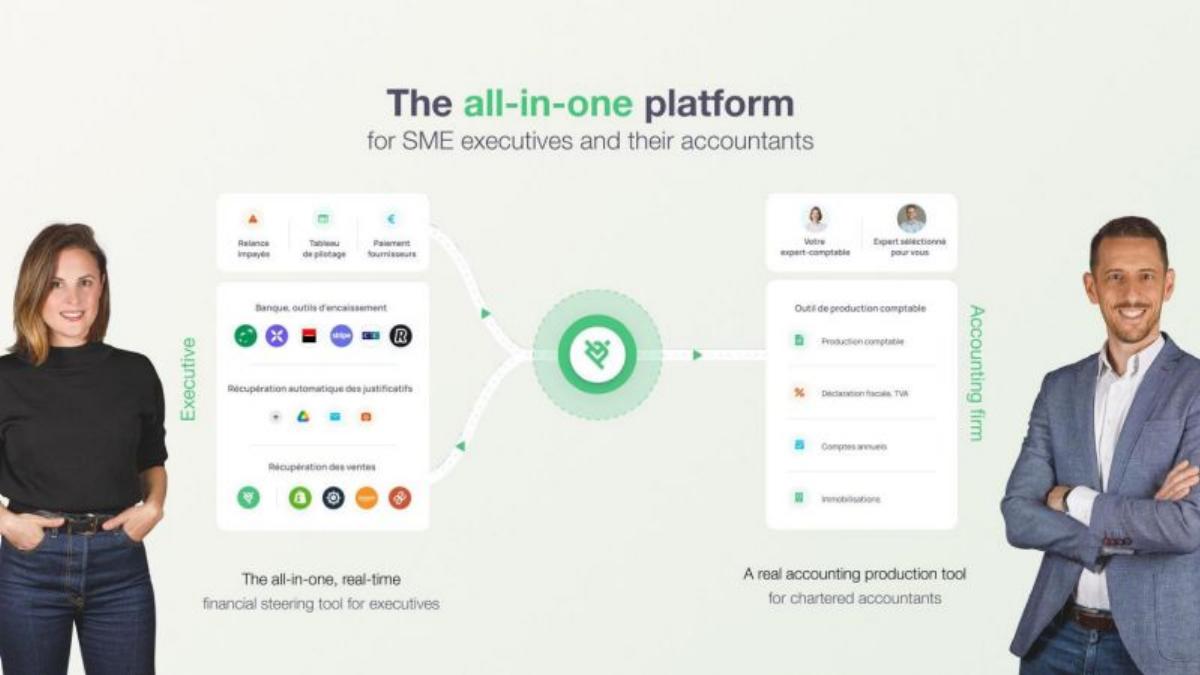
- The deck positions Pennylane as a dual-sided platform: a production tool for accountants and a steering tool for clients (Slide 1).
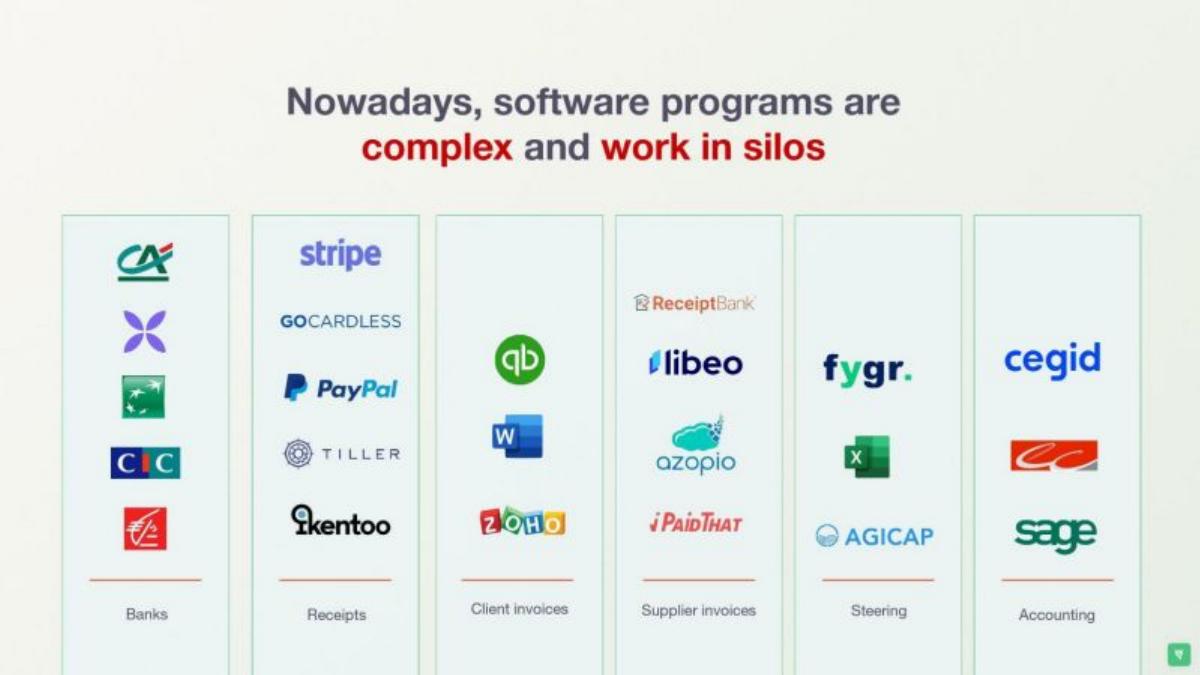
- It identifies the core problem as financial software programs working in 'complex silos' across banks, receipts, and accounting (Slide 2).
- Specific time-saving claims are used for different segments, such as saving startups 3 days per month (Slide 4) and agencies 20 hours per month (Slide 9).
- The platform features deep e-commerce integration, specifically highlighting a three-click connection for Shopify sites (Slide 7).
- Automation is a central theme, with the deck boasting 200+ bank and PSP connections including Stripe, GoCardless, and PayPal (Slide 14).
- The 'Entry' slide details advanced technical capabilities like OCR for lettering and automated recovery of purchase/sales invoices (Slide 15).
- Pennylane offers a hybrid service model, providing an 'Accounting lab' for in-house handling or matching clients with a network of partner firms (Slide 17).
- The deck utilizes social proof through founder testimonials from companies like Luko and By Charlot to validate the SME and startup market fit (Slides 4, 11).
The Series B Narrative: From Tool to Ecosystem
Pennylane's Series B deck, used to raise $57M in 2022, is a clinical study in product-market fit. Rather than relying on abstract visions, the deck focuses on the tangible friction of financial management. It moves systematically through user personas, proving that the platform isn't just a utility but a central nervous system for business finance.
Slide 1: The Dual-Sided Value Proposition
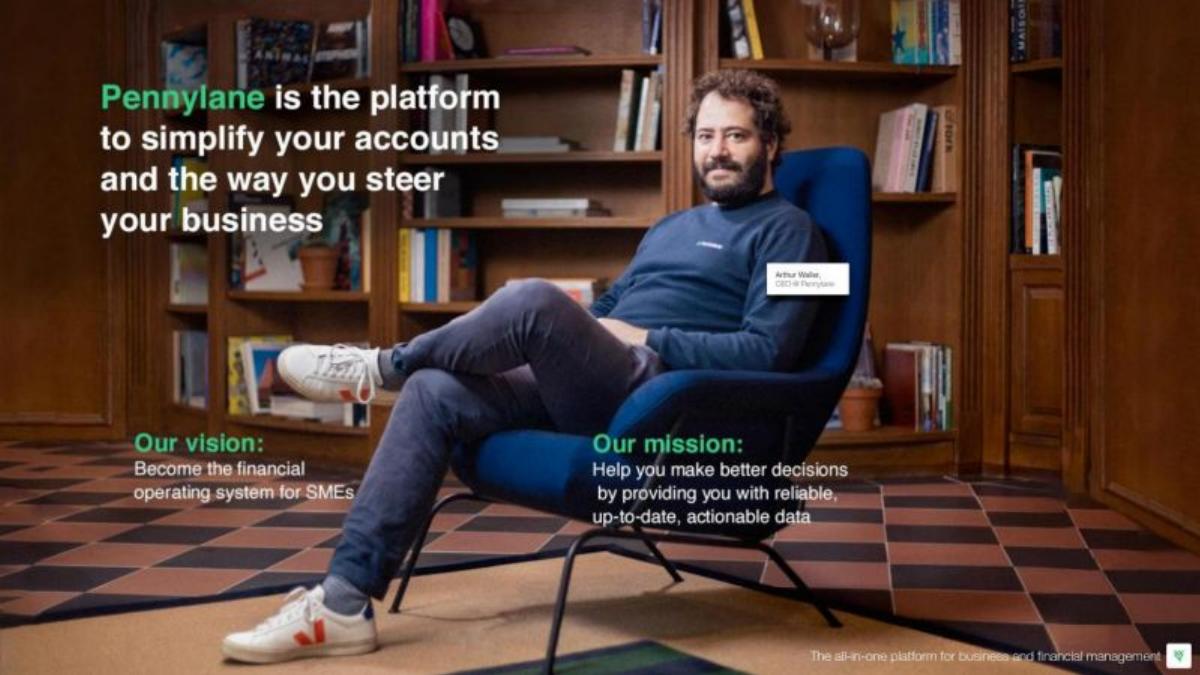
The cover slide immediately establishes the company's unique positioning. It defines Pennylane as 'The first platform to be a production software program for accountants AND a steering tool for their clients.' By showing two diverse professionals, the visual reinforces the bridge between the back-office (accounting) and the front-office (management).
Slides 2-3: The Problem of Fragmented Silos
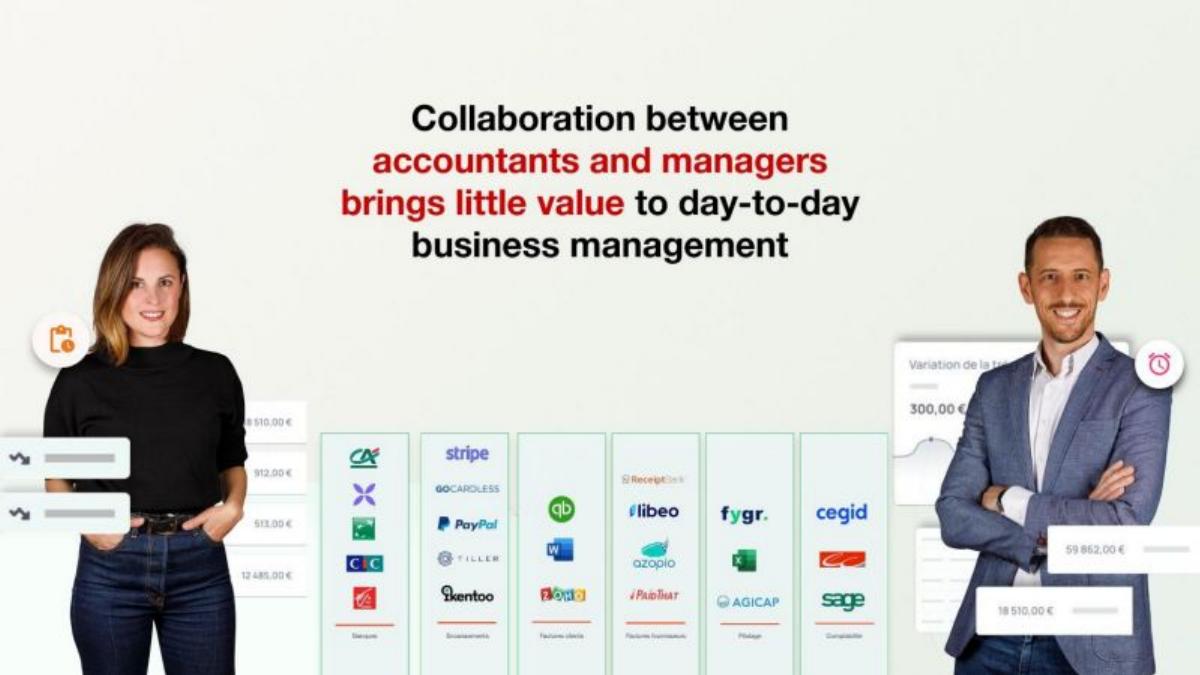
Slide 2 is a classic 'landscape of pain' slide. It lists dozens of logos—including Stripe, QuickBooks, Sage, and various banks—categorized into silos like 'Receipts,' 'Steering,' and 'Accounting.' The message is clear: the current stack is complex and disconnected. Slide 3 takes this further, stating that current collaboration 'brings little value to day-to-day business management' because the accountant and the manager are looking at different data sets.
Slides 4-5: The Startup Persona
Pennylane begins its segment-specific deep dive with Startups. Slide 4 features Raphaël Vullierme, founder of Luko, and claims the platform saves startups '3 days every month.' Slide 5 details how this is achieved: real-time steering of cash burn and runway, and more efficient collaboration using the same tool as the accountant. This moves the product from a 'nice-to-have' to a critical time-saving asset.
Slides 6-8: Automation and E-commerce Features
These slides focus on specific pain points for modern digital businesses. Slide 6 highlights the automatic retrieval of ad invoices from Facebook, Google, and LinkedIn. Slide 7 addresses the complexity of international commerce with automated VAT calculation for multiple countries and a 'three-click' Shopify integration. Slide 8 introduces 'one-click' supplier payments and batch processing, showing the platform's evolution into a payment execution tool, not just a recording tool.
Slides 9-10: The Agency Persona and Workflow Automation
Slide 9 targets Agencies, claiming a saving of '20 hours every month.' This segment often struggles with high-volume invoicing, which Pennylane addresses in Slide 10 through its Zapier connector. This allows users to automate the entire invoicing process—from drafting estimates to sending reminders—without writing code.
Slides 11-13: The SME Persona and Cash Flow Management
Slide 11 uses 'By Charlot' as a case study for SMEs, positioning Pennylane as an 'all-in-one solution.' Slide 12 focuses on sales management and real-time cash flow steering, allowing owners to view supplier debts and client receivables at a glance. Slide 13, titled 'Purchase management,' introduces the 'Dedicated Wallet' feature, which supports up to 200 payments per action and dedicated IBANs for suppliers.
Slides 14-16: Technical Depth and Compliance
The deck shifts to the 'how' in the final section. Slide 14, 'Cashflow steering,' boasts 200+ connections to banks and PSPs. Slide 15, 'Entry,' is the most technical, detailing API & EBICS flows, OCR for lettering, and automated analytical breakdown rules. Slide 16, 'Filing,' addresses the accounting side of the house, showing remote VAT filing and automated tax return forms (TVA, IS, CVAE), proving the tool is robust enough for professional accountants.
Slide 17: The Tailor-Made Service Model
The final content slide explains how Pennylane scales its service. They offer an 'Accounting lab' for direct handling, a 'network of partner firms' for matching, or the ability to 'work with your accountant.' This flexibility removes the friction of a company having to fire their current accountant to use the software.
What Works in This Deck
Persona-Based Messaging: By breaking the deck into Startup, Agency, and SME sections, Pennylane ensures that every potential investor understands the product's utility across the entire market spectrum.
Quantifiable ROI: The deck doesn't just say it saves time; it specifies '3 days' or '20 hours.' These figures are bolded and highlighted in green, making the value proposition impossible to miss.
Integration Breadth: The constant mention of 200+ connections and specific logos (Shopify, Stripe, Zapier) builds technical credibility. It positions Pennylane as the aggregator in a fragmented market.
What Is Missing
Financial Performance: As a Series B deck, the absence of MRR (Monthly Recurring Revenue), churn rates, or CAC/LTV (Customer Acquisition Cost / Lifetime Value) in these slides is notable. While likely present in the full 35-slide version, their absence here leaves the 'growth' story untold.
Competitive Analysis: The deck identifies the problem of silos but does not explicitly name or compare itself against other neo-accounting platforms or legacy players like Xero or QuickBooks beyond the 'silo' slide.
The 'Ask': There is no slide in this selection detailing the $57M raise, the valuation, or the intended use of funds. This information is only available through the catalogue facts.
What a Founder Should Copy
The 'Problem' Visualization: Slide 2 is a perfect template for any founder building a 'horizontal' platform. Grouping competitors into functional silos and then positioning your product as the layer that connects them is a highly effective narrative device.
Customer Testimonials as Anchors: Instead of a single 'Wall of Love' slide, Pennylane uses specific founders to anchor each customer segment. This makes the use cases feel grounded in reality rather than theoretical marketing.
Feature-Benefit Pairing: Every feature mentioned (like the Zapier connector) is immediately followed by a benefit (getting paid quicker). Never list a technical feature without explaining the business outcome it drives.
Frequently asked questions
- What is Pennylane's primary value proposition?
- Pennylane positions itself as the first platform to combine a production software for accountants with a financial steering tool for business owners. This dual-sided approach aims to eliminate the silos between banking, invoicing, and accounting, allowing for real-time collaboration and data-driven decision-making.
- Which customer segments does Pennylane target?
- The deck specifically highlights three core segments: Startups, Agencies, and SMEs. For each, it provides a tailored value proposition, such as automated ad invoice retrieval for agencies and real-time cash flow monitoring for SMEs and startups.
- How does Pennylane handle accounting services?
- Pennylane offers a flexible model described as a 'tailor-made accounting solution.' They operate an internal 'Accounting lab,' maintain a network of partner accounting firms to match with clients, or allow clients to bring their own external accountants onto the platform.
- What technical integrations are featured in the deck?
- The platform emphasizes its connectivity, featuring 200+ integrations with banks and payment service providers (PSPs) like Stripe and PayPal. It also highlights specific connectors for Shopify and a Zapier integration to automate invoicing workflows without code.
- What specific problems does the deck address?
- The deck identifies that collaboration between accountants and managers currently 'brings little value' because data is fragmented. It promises to solve this by automating VAT calculations, supplier payments, and the retrieval of invoices from platforms like Facebook and Google Ads.