The Peloton Series F pitch deck from 2018 is a unique artifact in the fundraising world. Spanning 23 slides, it eschews traditional metrics like CAC, LTV, or revenue growth in favor of a deep dive into brand positioning. The deck meticulously defines its 'Serious About Fitness' target consumer, noting an average age of 43 and a household income of $100-150K+. It utilizes a 'Brand Wheel' to articulate how the product makes users feel and look, positioning the bike as a 'badge' of good judgment. While the lack of financial data is striking for a late-stage round, the deck successfully argues th…
Key takeaways
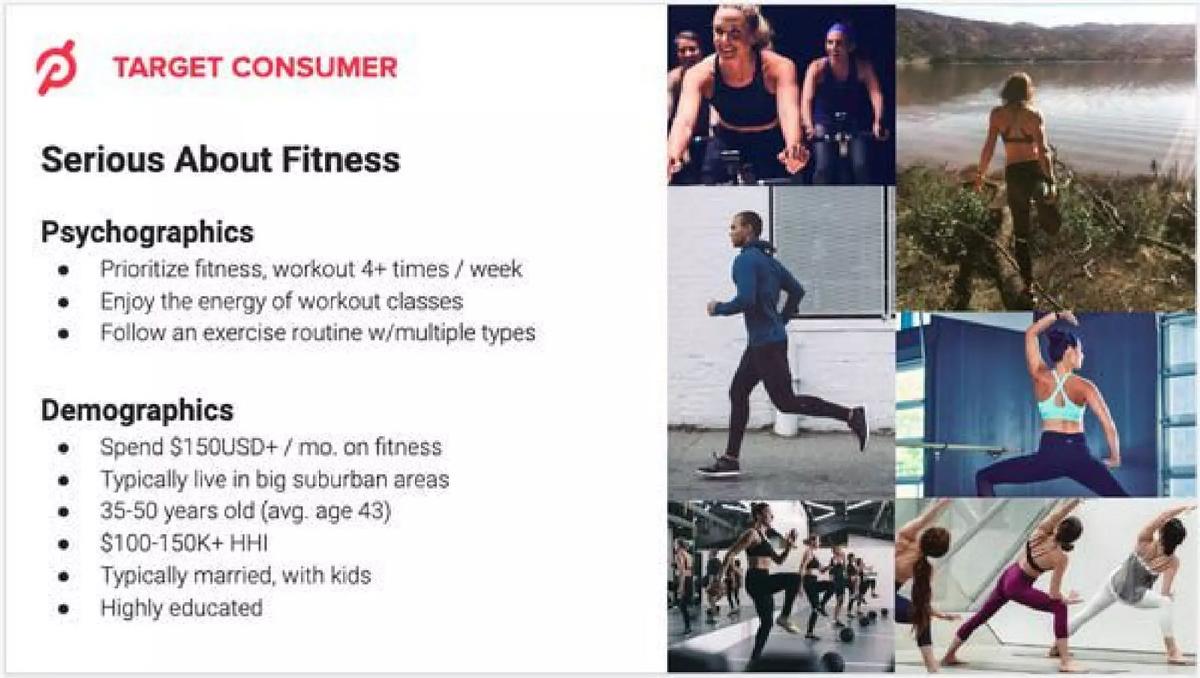
- The deck identifies a very specific demographic: 35-50 year olds with $100-150K+ HHI who live in big suburban areas (Slide 3).
- Peloton explicitly distances itself from 'gimmicky' fitness trends, banning 'before and after' photos and 'cheesy ads' from its brand identity (Slide 7).
- The 'Brand Wheel' serves as the deck's central framework, mapping functional truths to emotional outcomes (Slide 8).
- The company positions its instructors as 'celebrity status' assets that are as important as the hardware itself (Slide 23).
- Marketing shifted from 'Product-Led' in 2014 to 'Emotional-Led' by 2018, as shown in their campaign timeline (Slide 10).
- The deck defines the Peloton experience as a 'badge' that makes the consumer look 'tech-savvy' and 'discerning' (Slides 15-17).
- There is a total absence of financial statements, churn rates, or hardware margins in this specific 23-slide deck.
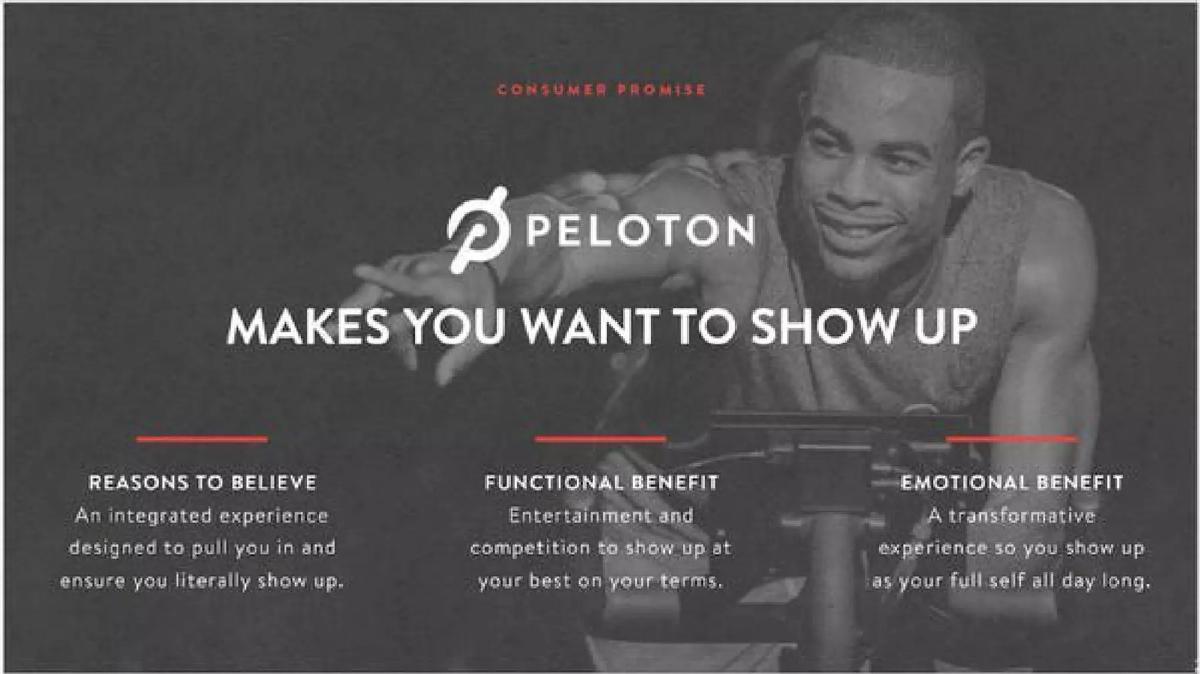
- The 'Consumer Promise' is distilled into a single, actionable phrase: 'Makes you want to show up' (Slide 4).
The Brand-First Raise: Analyzing Peloton's Series F Deck
Peloton’s 2018 Series F pitch deck is a fascinating example of late-stage fundraising. At this point in a company's lifecycle, the 'product-market fit' question has been answered. The goal of a $550M raise is typically global scale and brand entrenchment. Consequently, this deck reads more like a brand manifesto than a traditional startup pitch. It is a masterclass in psychographic targeting and emotional storytelling.
Section 1: Defining the Consumer and the Promise
Slide 1: Title Slide The deck opens with a high-production-value image of a woman on a Peloton bike. The text 'Brand Positioning' immediately signals that this presentation will focus on identity rather than spreadsheets.
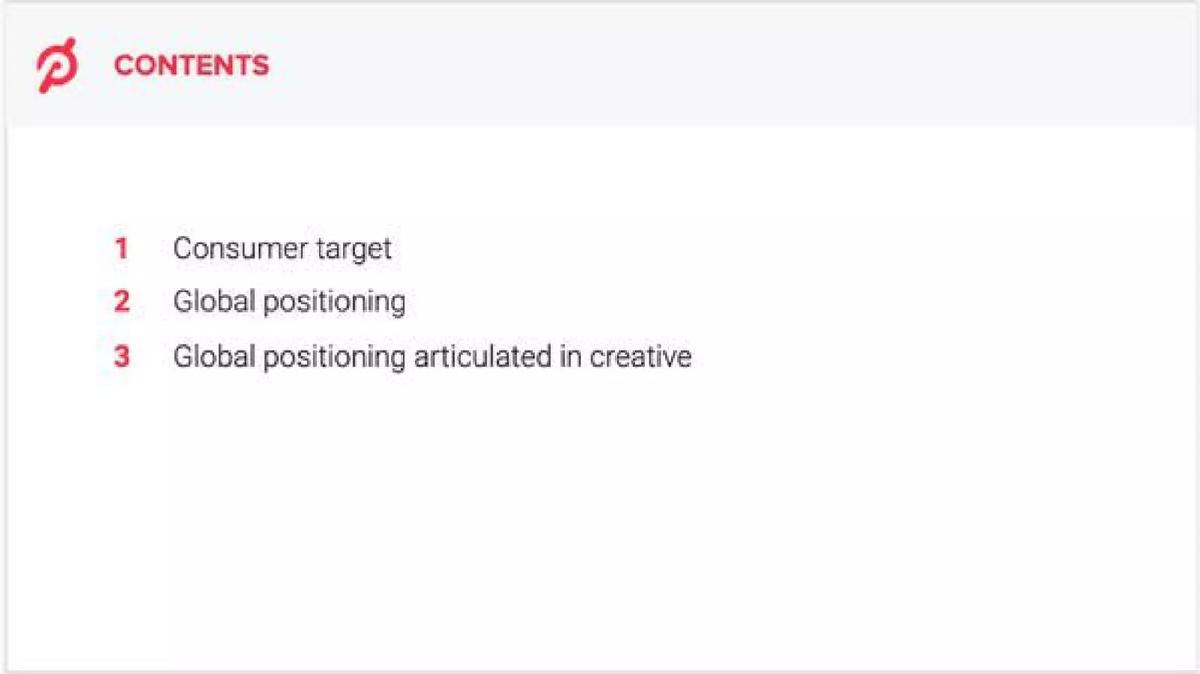
Slide 2: Contents The agenda is simple: (1) Consumer target, (2) Global positioning, and (3) Global positioning articulated in creative. This confirms the deck's narrow focus on marketing and brand perception.
Slide 3: Target Consumer This is one of the most data-rich slides in the deck. Peloton defines its user as 'Serious About Fitness.' Psychographically, they workout 4+ times a week and 'enjoy the energy of workout classes.' Demographically, the average age is 43, with a household income (HHI) of $100-150K+. They are 'highly educated' and 'typically married, with kids.' This level of specificity tells investors exactly whose wallet Peloton is capturing.
Slide 4: Consumer Promise The core value proposition is distilled into: 'Peloton Makes You Want To Show Up.' It breaks this down into 'Reasons to Believe' (integrated experience), 'Functional Benefit' (entertainment/competition), and 'Emotional Benefit' (transformative experience). It’s a classic marketing framework applied to a pitch deck.
Section 2: Brand Identity and Values
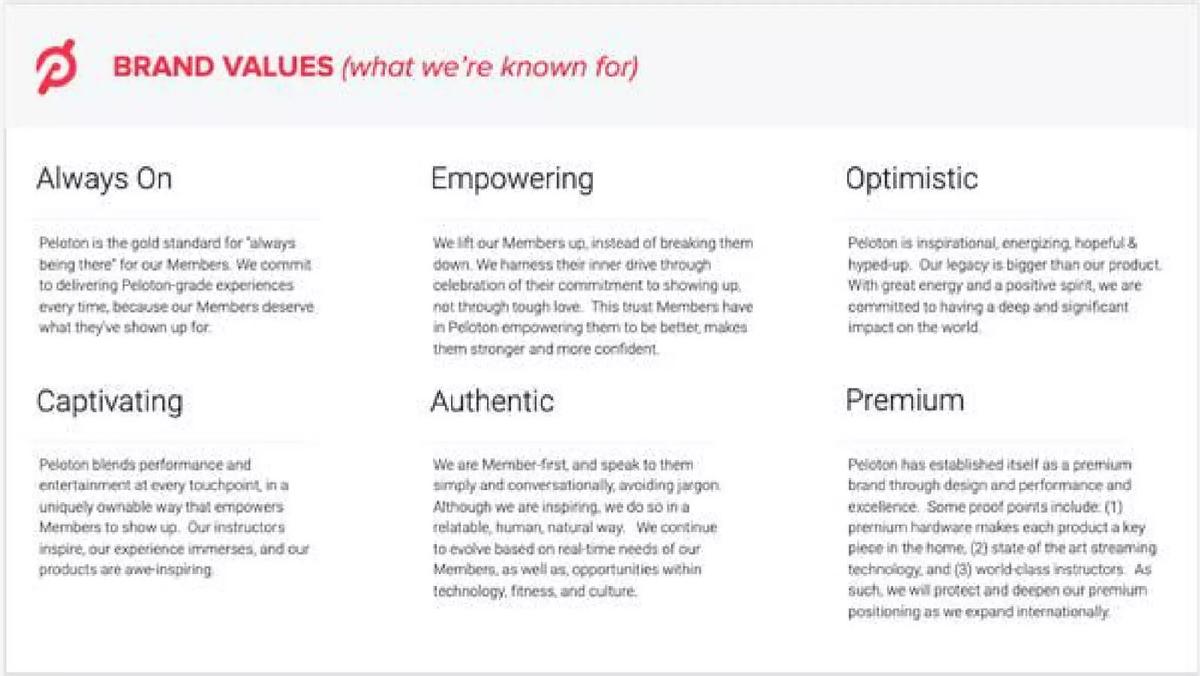
Slide 5: Brand Values Peloton lists six core values: Always On, Empowering, Optimistic, Captivating, Authentic, and Premium. Notably, under 'Premium,' they cite their hardware as a 'key piece in the home,' emphasizing the aesthetic value of the bike itself.
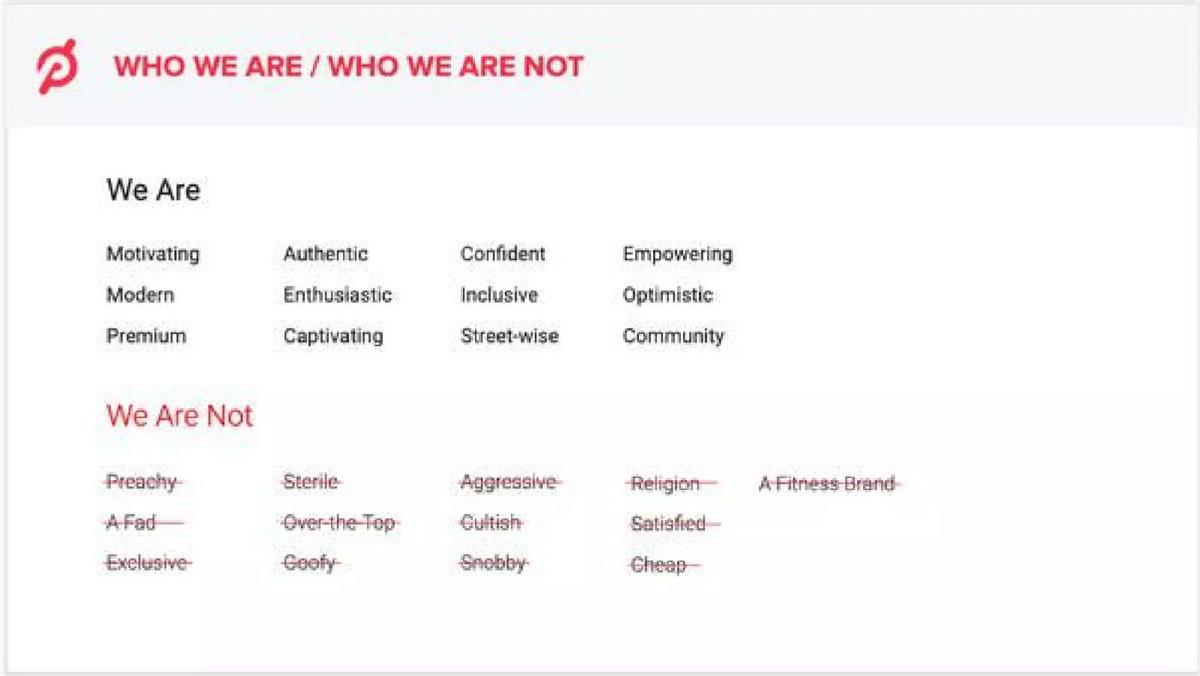
Slide 6: Who We Are / Who We Are Not This slide is a bold exercise in brand boundary-setting. They claim to be 'Modern,' 'Street-wise,' and 'Community.' More interestingly, they explicitly state they are NOT 'A Fitness Brand,' 'A Fad,' 'Cultish,' or 'Cheap.' By crossing out 'A Fitness Brand,' Peloton is signaling to investors that they should be valued as a tech/media platform, not a gym equipment manufacturer.
Slide 7: We Are Not A Gimmicky Fitness Brand To reinforce the previous slide, Peloton shows examples of what they avoid: 'No Before & Afters,' 'No Cheesy Ads,' and 'Don’t talk Down.' They use images of competitors (blurred) to show the 'gimmicks' they are rising above. This is a play for the 'sophisticated' investor and consumer.
Section 3: The Brand Wheel and Marketing Strategy
Slide 8: Brand Wheel The Brand Wheel is the strategic heart of the deck. It maps 'Product Truths' (Leaderboard, Metrics, Top-tier talent) to 'Brand Values' (Always On, Encouraging) and finally to consumer perceptions. It answers four questions: What does the product do for me? How would I describe the product? How does the brand make me feel? How does the brand make me look?
Slide 9: Marketing Entry Points This slide highlights specific nodes on the Brand Wheel—like 'Innovative Design' and 'Tech-Savvy'—as the primary ways they attract new customers. It shows a tactical understanding of their own funnel.
Slide 10: Storytelling Evolution A timeline shows the shift from 'Product-Led' advertising in 2014-2016 (focused on the bike) to 'Emotional-Led' advertising in 2018 (focused on the feeling of the workout). This transition is typical for brands that have achieved baseline awareness and are now seeking cultural relevance.
Section 4: Creative Articulation of the Brand
Slides 11-14: Functional and Emotional Proof These slides use high-quality stills from Peloton's marketing campaigns to illustrate the Brand Wheel in action. Slide 11 ('Makes Hard Work Fun') shows the instructor as the hero. Slide 12 ('Pushes Me to Excel') focuses on the leaderboard. Slide 13 ('Innovative Design') shows the bike 'in situ' in a high-end home, reinforcing the premium nature of the hardware. Slide 14 ('Wholly Immersive') focuses on the user's intense focus.
Slides 15-17: The 'Outward' Brand These slides address how the brand makes the user look. Slide 16 uses press clippings from Wired, TechCrunch, and Fast Company to prove that Peloton makes users feel 'Tech Savvy.' Slide 17 uses customer reviews to show that owning a Peloton is a 'badge' of being 'Discerning.' One review highlighted states: 'Peloton changed my life!'
Slides 18-22: The 'Inward' Brand These slides focus on the internal emotional state of the user. Phrases like 'Committed,' 'Like Nothing Is In My Way,' and 'Like I Belong To Something' are paired with imagery of sweat, post-workout 'afterglow,' and the digital community. Slide 21 specifically mentions that while they don't 'overtly talk about community,' they use copy like 'never ride alone' to reinforce it.
Section 5: The Recap
Slide 23: Recap The final slide summarizes the six pillars of Peloton's success: (1) Convenience & efficiency, (2) The bike itself, (3) Variety of class, (4) The instructors, (5) Live performance metrics, and (6) Community. It describes the instructors as having 'celebrity status' and the bike as having 'state-of-the-art tech.' This is the closest the deck gets to a traditional 'Why Us' slide.
What Works in This Deck
1. Unapologetic Premium Positioning: Peloton knows exactly who its customer is. By defining the target as a 43-year-old with a $150K income, they justify their high price point and luxury branding. They aren't trying to be for everyone, which is a position of strength in a pitch.
2. The 'Anti-Category' Strategy: By explicitly stating they are not a 'fitness brand,' Peloton reframes the conversation. They are selling a '2-minute commute' to a 'transformative experience.' This helps them avoid the low multiples typically associated with hardware or gym companies.
3. Visual Consistency: The deck is beautiful. Every slide feels like it was pulled from a high-end magazine. For a company selling 'Innovative Design' and 'Premium' experiences, the deck itself must be a proof of concept. It succeeds here.
What is Missing
1. Financials and Unit Economics: For a Series F deck, the total absence of revenue, EBITDA, CAC, or LTV is jarring. While this was likely in a separate data room, a teardown of this specific 23-slide deck reveals a complete lack of hard numbers.
2. Competitive Landscape: The deck operates in a vacuum. It doesn't mention SoulCycle, Equinox, or emerging digital competitors. It assumes Peloton is the category leader and focuses entirely on its own brand equity.
3. The 'Ask' and Use of Funds: There is no slide detailing how much they are raising or what the $550M will be used for (e.g., R&D for the Tread, international expansion, etc.). This is common in late-stage decks where the terms are often negotiated before the formal presentation.
What a Founder Should Copy
1. The 'Who We Are Not' Slide: Every founder should be able to define their brand by what it refuses to be. It creates clarity and prevents 'feature creep' in the brand's identity.
2. Mapping Features to Emotions: The Brand Wheel is a fantastic tool. Don't just tell investors what your product does; tell them how it makes the customer feel and, more importantly, how it makes them look to their peers.
3. Psychographic Depth: Move beyond basic demographics. Peloton’s insight that their users 'enjoy the energy of workout classes' but have 'no time' is the core problem they solved. Understanding the 'why' behind the 'who' is investor gold.
Frequently asked questions
- Why are there no financial metrics in this deck?
- At the Series F stage, investors are often already intimately familiar with the company's P&L through data rooms. This deck likely served as a supplemental presentation to align investors on the 'Brand Vision' and global expansion strategy. It focuses on the 'why' and 'who' rather than the 'how much,' assuming the financial performance is already a known quantity.
- How does Peloton define its target audience?
- According to Slide 3, the target is 'Serious About Fitness,' meaning they workout 4+ times per week. Demographically, they are highly educated, married with kids, and spend over $150 per month on fitness. This specificity allowed Peloton to justify its premium pricing and high-end brand positioning during its growth phase.
- What is the purpose of the 'Brand Wheel' in the deck?
- The Brand Wheel (Slide 8) is a strategic tool used to bridge the gap between product features and consumer emotions. It categorizes 'Product Truths' (like leaderboards) and translates them into 'Brand Values' (like being competitive) and finally into 'Emotional Outward' perceptions (looking tech-savvy). It shows investors that the product's success is rooted in psychology.
- What does Peloton mean by 'not a fitness brand'?
- On Slide 6, Peloton lists 'A Fitness Brand' under the 'Who We Are Not' section. This suggests they view themselves as a technology and media company first. By avoiding the 'fitness' label, they escape the boom-and-bust cycles of fitness fads and position themselves as a permanent lifestyle fixture, similar to Apple or Netflix.
- How does the deck handle competition?
- The deck does not name specific competitors like SoulCycle or Flywheel. Instead, it defines competition through 'Brand Values' and 'Psychographics.' By stating they are 'not a fad' and 'not gimmicky' (Slide 7), they indirectly critique the rest of the fitness industry while positioning Peloton as the only 'premium' and 'authentic' alternative.