Pendo’s Series B deck is a study in demonstrating product-market fit through rigorous data visualization. By framing the problem as a gap between consumer-grade UX and clunky enterprise tools, Pendo positions itself as the essential bridge for product managers. The deck excels at showing, rather than just telling, its growth trajectory; the cohort analysis on slide 17 provides a transparent look at how revenue stacks over time, a critical metric for Series B investors. While the external version redacts specific financial forecasts and TAM figures, the structure remains a gold standard for B2…
Key takeaways
- The deck frames the core problem on slide 4 as a consumerization of IT, noting that users demand work software behave like home software.
- Pendo defines its value proposition through four key strengths on slide 7: integration, targeted messaging, segmentation, and retroactive data capture.
- A detailed case study on slide 10 shows Infor using Pendo to monitor end-user performance across their HCM suite while negotiating an enterprise-wide deal.
- The Go-To-Market strategy on slide 14 is highly specific, targeting B2B web-based businesses and the Product Management persona.
- Pricing is transparently tied to a value metric on slide 14: monthly active end users per product.
- Slide 17 features a sophisticated cohort analysis showing consistent ARR expansion and layer-cake growth from 2016 through late 2017.
- The deck concludes with a specific funding ask on slide 23: $15M for a Series B round in Q1 FY18.
- Market sizing and financial forecasts (slides 20 and 23) are included in the structure but were redacted for the public version of the deck.
The Narrative: Consumerizing the Enterprise
Pendo’s Series B deck starts with a powerful psychological hook. It doesn't lead with features; it leads with a shift in human behavior. By the time a company reaches Series B, investors are looking for more than just a product—they are looking for a market inevitability. Pendo argues that the 'Consumerization of IT' is that inevitability. The deck sets the stage by showing that the gap between beautiful consumer apps and clunky enterprise software is no longer acceptable to the modern worker.
Slide 1: Title and Branding
The deck opens with a clean, high-contrast title slide. It identifies the presentation as the 'Series B Investor Presentation.' The branding is consistent with Pendo’s signature pink/magenta color palette, signaling a professional and established brand identity. There are no distracting taglines here; the focus is entirely on the company name and the stage of the raise.
Slide 4: The Problem Statement
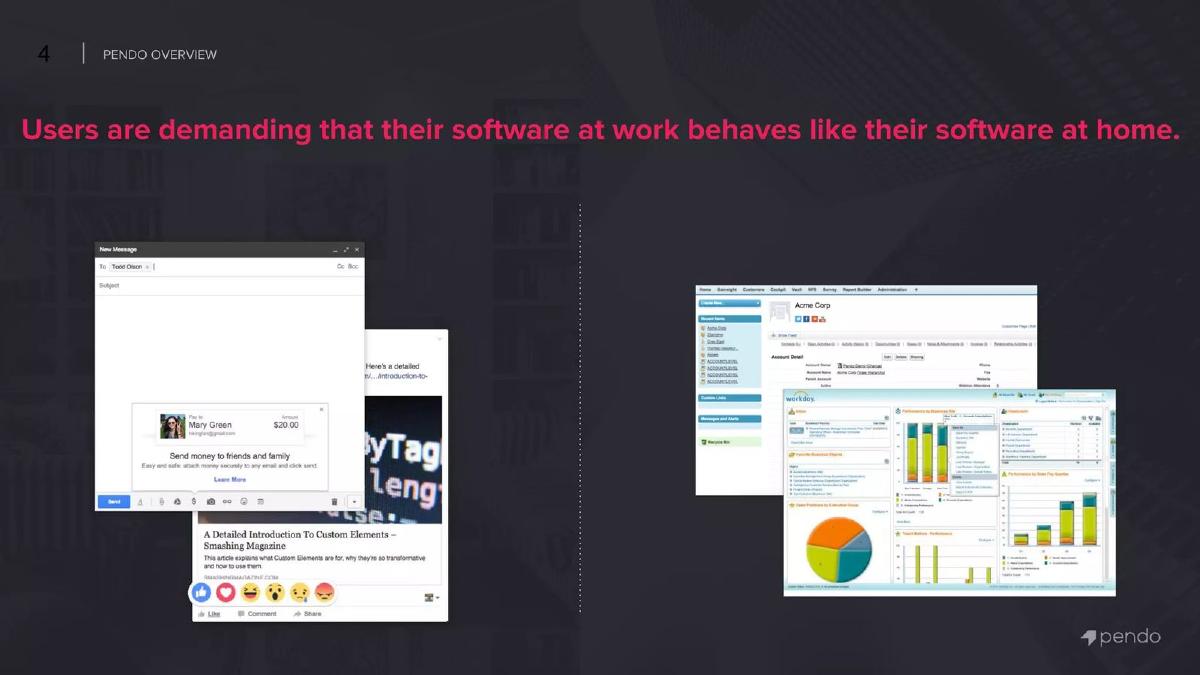
Slide 4 is the emotional core of the pitch. It features a bold headline: 'Users are demanding that their software at work behaves like their software at home.' To illustrate this, the slide uses a split-screen visual. On the left, we see clean, intuitive interfaces from consumer-facing apps like Venmo and Facebook. On the right, we see dense, data-heavy, and arguably confusing dashboards from enterprise tools like Gainsight and Workday. This visual juxtaposition immediately identifies the 'enemy' (bad UX) and the 'opportunity' (bringing consumer-grade UX to the enterprise).
Slide 7: Key Strengths and Product Differentiation
On slide 7, Pendo moves from the 'why' to the 'what.' They list four key strengths that define their competitive advantage. First is the 'Fully Integrated Solution,' which they claim replaces three to four disparate tools. This is a classic 'platform vs. point solution' argument that appeals to enterprise buyers looking to consolidate their tech stack. Second is 'Targeted Messaging,' allowing for real-time personalization. Third is 'Rich User/Customer Segmentation,' specifically mentioning an integration with Salesforce.com. Finally, they highlight 'Capture Everything,' noting that their data insights are retroactive to the install date—a major technical selling point that removes the friction of manual event tracking.
Slide 10: Social Proof and Case Study
Slide 10 provides a concrete example of the product in action through a case study with Infor. The slide features a testimonial-style layout with a headshot and the headline: 'Monitor end user performance to delight customers.' Key bullet points reveal the depth of the relationship: Pendo is 'Standard across HCM Suite,' works across 'On-Premise, Single-tenant, and Multi-tenant products,' and, most importantly for investors, they are 'Negotiating Enterprise-wide Deal.' This demonstrates that Pendo can scale within massive organizations and move from departmental usage to enterprise-wide contracts.
Slide 14: The Go-To-Market (GTM) Engine
Slide 14 is a model of clarity for a Series B deck. It breaks down the GTM strategy into four clear components. The 'Type' is direct, utilizing an inside sales team. The 'Current Target Customer' is B2B web-based businesses. The 'Target Persona' is narrowed down specifically to Product Management. Finally, the 'Pricing' is explained as 'Monthly active end users per product.' By defining these four pillars, Pendo shows investors that they have a repeatable sales motion and a clear understanding of who buys their product and why.
Slide 17: Cohort Trending and Revenue Health
For a Series B investor, slide 17 is likely the most important slide in the deck. It features two charts: a 'Cohort Analysis' and an 'ARR Cohort Build.' The ARR Cohort Build is a classic 'layer cake' chart. It shows that revenue from older cohorts (starting in Q1-2016) is not just staying flat, but is actually expanding over time. This indicates a high Net Revenue Retention (NRR). When each new quarter's cohort is stacked on top of a growing base of existing revenue, the result is the exponential growth curve seen on the right side of the chart. This is the definitive proof of product-market fit and a healthy SaaS business model.
Slide 20: Total Addressable Market (TAM)
Slide 20 addresses the scale of the opportunity. While the specific figures are 'Redacted' in this external version, the structure shows three growing circles representing different market segments, along with a large bar at the bottom representing the 'Current Pipeline' and 'Sample Customers.' Even without the numbers, the slide tells a story of expansion—starting from a niche and moving into a massive, multi-layered market opportunity.
Slide 23: Forecast and The Ask
The deck concludes on slide 23 with a 'Forecast Summary & Fundraising' overview. The financial table, covering FY2015 through FY2019, is 'Redacted,' but the 'Funding Plan' is clearly stated: '$15M Series B, Q1 FY18.' By placing the ask directly next to the (redacted) financial forecast, Pendo creates a direct link between the capital they are requesting and the growth they expect to achieve. It frames the $15M not as a lifeline, but as fuel for a fire that is already burning.
What Works Well
The most impressive aspect of this deck is its specificity . Many founders at the Series B stage still use vague language about 'changing the world.' Pendo, instead, identifies a specific persona (Product Managers) and a specific technical advantage (retroactive data). The use of the ARR Cohort Build is a masterstroke; it is the most honest way to show a SaaS company's health, as it exposes churn and expansion simultaneously. Furthermore, the problem-solution framing on slide 4 is visceral. It doesn't just describe a problem; it shows it, making the need for Pendo feel urgent and obvious.
What is Missing
Because this is an 'External' version of the deck, the most glaring omissions are the actual financial figures . We see the labels for TAM and Forecasts, but the data is redacted. Additionally, this 8-slide selection omits the Team slide . At Series B, the pedigree and execution capability of the leadership team are paramount. We also see no mention of Unit Economics (CAC, LTV, Payback Period) in this selection, though these were likely present in the full 24-slide version. Finally, there is no Competitive Landscape slide in this set, which is usually necessary to explain how Pendo wins against established analytics players or newer in-app guidance tools.
What a Founder Should Copy
The Layer Cake Chart: If you are a SaaS founder, use the ARR Cohort Build format from slide 17. It is the gold standard for proving retention and expansion. · Visual Problem Statements: Don't just list pain points. Use side-by-side comparisons like slide 4 to show the 'Before' and 'After' or the 'Bad' vs. 'Good' user experience. · Persona Targeting: Be as specific as slide 14. Don't just say your target is 'Enterprises.' Say it is 'Product Management at B2B web-based businesses.' · Value-Based Pricing: Clearly state your pricing lever. Investors want to see that your revenue grows automatically as your customers' usage grows. · Retroactive Value: If your product has a technical 'unfair advantage' (like Pendo's retroactive data capture), highlight it as a 'Key Strength' to show why you are hard to displace.
Frequently asked questions
- What is Pendo's primary value proposition according to the deck?
- Pendo positions itself as a 'Fully Integrated Solution' that replaces three to four disparate tools. As stated on slide 7, its primary strengths are providing a single platform for user insights, targeted in-app messaging, and rich customer segmentation. A key technical differentiator mentioned is that their data capture is 'retroactive to our install date,' allowing teams to visualize insights into any aspect of their product without pre-tagging.
- Who is Pendo's target customer and how do they charge?
- According to the Go-To-Market slide (slide 14), Pendo targets B2B web-based businesses, specifically focusing on the Product Management persona. Their sales motion is primarily driven by a direct, inside sales team. Their pricing model is usage-based, calculated by the number of monthly active end users per product, which aligns their revenue growth with the customer's product adoption.
- How does Pendo demonstrate traction to Series B investors?
- Pendo uses a 'Cohort Trending' slide (slide 17) to show the health of their revenue. The ARR Cohort Build chart displays a 'layer cake' effect where each quarterly cohort of customers continues to contribute and expand over time. This visualization is crucial for Series B rounds as it proves low churn and high net revenue retention, suggesting that new capital will be used to acquire similarly high-value, long-term customers.
- What specific problem does Pendo claim to solve for the enterprise?
- Slide 4 identifies a psychological shift in the workforce: 'Users are demanding that their software at work behaves like their software at home.' The deck contrasts clean consumer interfaces (like Venmo or Facebook) against cluttered, complex enterprise dashboards (like Workday or Gainsight). Pendo provides the tools to bridge this gap, helping enterprise companies deliver the modern experience their employees and customers now expect.
- What was the outcome of this specific fundraising deck?
- Slide 23 explicitly states the goal: a $15M Series B in Q1 FY18. While the deck itself is an 'External' version with redacted financials, it outlines the exact roadmap used to secure that capital. The presence of a detailed 'Forecast Summary' slide (even if redacted) indicates that the company was prepared to discuss multi-year projections from FY2015 through FY2019.