Pelago’s 16-slide Series C deck, which secured $58M in 2024, is built on the foundation of clinical credibility and fiscal responsibility. Operating in the high-stakes healthcare sector, Pelago avoids vague promises of 'wellness' and instead targets the specific financial pain points of large employers. The deck utilizes a Milliman-validated claims study to prove a $9,367 annual medical claims reduction per member, representing a 3x ROI. By positioning itself as the 'world’s first digital clinic' for substance use management, Pelago differentiates itself from generic mental health apps. The n…
Key takeaways
- Substance use disorder is framed as a top 5 driver for healthcare costs, with 1 in 5 Americans affected (Slide 3).
- The 'Why Now' slide highlights a 500% YoY increase in Substance Use Management RFP activity in 2023 (Slide 5).
- Pelago defines its product as a 'digital clinic' rather than an app, covering Opioids, Alcohol, Tobacco, and Vaping (Slide 7).
- A Milliman-validated study of 2,670 members is the centerpiece of the deck's ROI argument (Slide 13).
- The program demonstrates a $9,367 medical claims reduction per member per year (Slide 13).
- Pelago claims a 3x ROI for its Substance Use Management (SUM) program in Year 1 (Slide 13).
- The leadership team is heavily weighted toward clinical and industry veterans from companies like Livongo and Teladoc (Slide 15).
- The deck identifies that 85% of employers are looking to expand virtual SUD and mental health access in 2024/25 (Slide 5).
The Strategic Framing of Healthcare Costs
Pelago’s Series C deck is a masterclass in enterprise healthcare sales. In a market saturated with 'wellness' apps that struggle to prove clinical utility, Pelago positions itself as a 'Digital Clinic.' This distinction is vital. By using clinical terminology and focusing on Substance Use Disorder (SUD)—a high-cost, high-stigma area—they move away from discretionary spending and into the 'must-have' category for HR benefits leaders.
Slide 1-2: The Narrative Hook
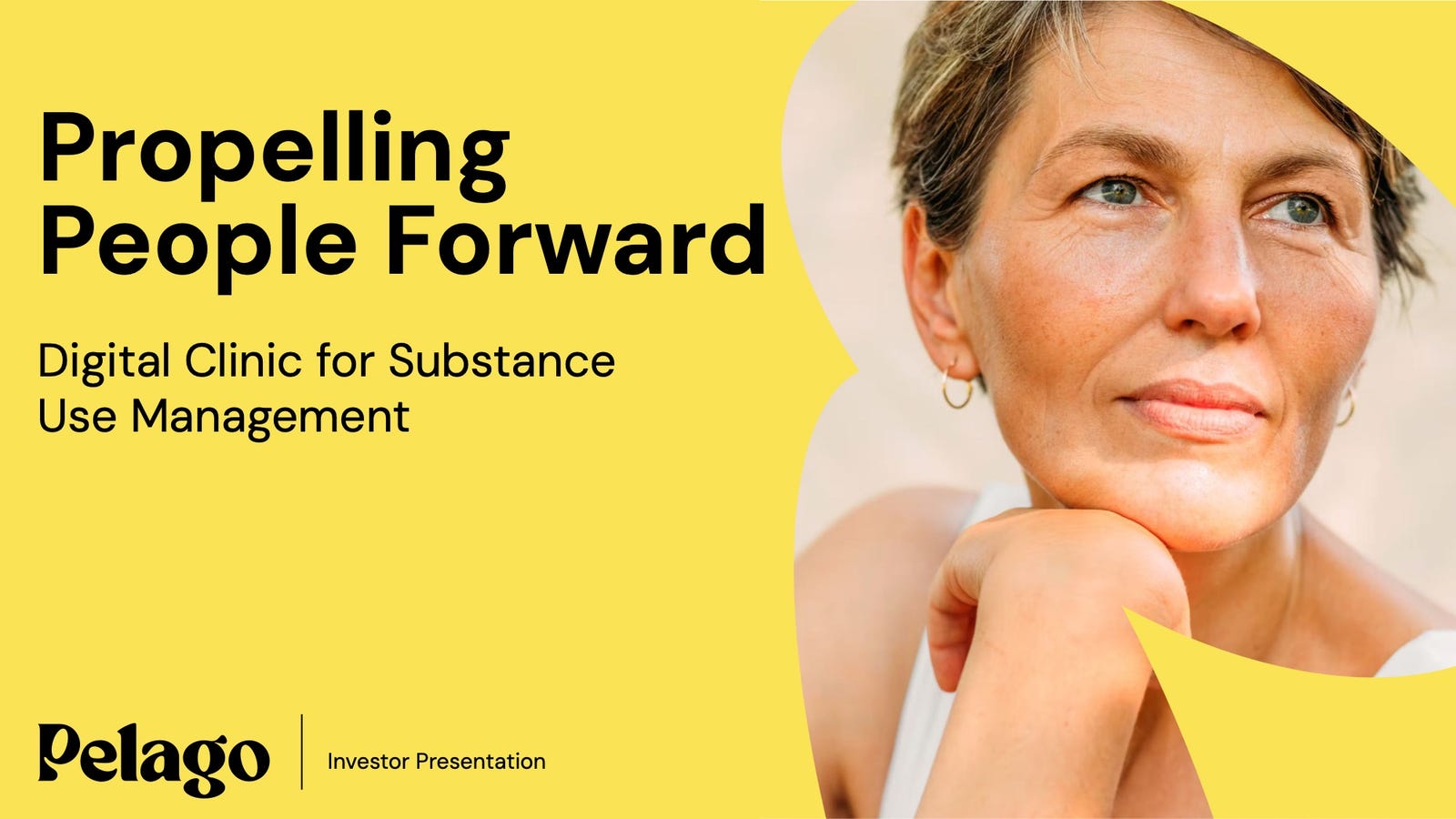
The deck opens with a human-centric cover slide titled 'Propelling People Forward' (Slide 1). It immediately establishes the brand as a 'Digital Clinic for Substance Use Management.' Slide 2 introduces the problem, but it is Slide 3 that provides the heavy lifting for the investment thesis.
Slide 3: The Economic Burden
Slide 3, titled 'Substance misuse is a top 5 driver for healthcare costs,' uses CDC research on 162 million employees to quantify the pain. It shows that the average annual healthcare cost per person is $10,330, but for those with SUD, that cost jumps to $25,970. The slide identifies a '$15,640 Addressable Excess Healthcare Cost' per person. This is the 'size of the prize' for an employer: if you can reduce that excess cost, the platform pays for itself.
Slide 4-5: The 'Why Now' and Market Failure
Slide 4 argues that current treatment models are 'broken and ineffective.' Slide 5 provides the urgency. It notes that prevalence has spiked 32% in two years and that '85% of employers are looking to expand access' in 2024/25. The most striking metric here is the '500% YoY increase in Substance Use Management RFP activity in 2023.' This tells investors that the market is not just large, but actively seeking solutions right now.
Slide 6-8: The Digital Clinic Solution
Pelago defines its program in Slide 6 and 7. It positions itself as the 'world’s first digital clinic for substance use management for adults and teens.' The inclusion of 'teens' is a strategic expansion of the Total Addressable Market (TAM), as adolescent SUD is a major concern for parents in the workforce. Slide 7 lists the specific disorders treated, including Opioids, Alcohol, and Tobacco. Slide 8 outlines the 'four pillars' of the clinic, though the specific details of these pillars are kept high-level in the summary text.
Slide 9-10: Enterprise Traction
After a transition slide (Slide 9), Slide 10 highlights that they 'work with some of the most well-known employers.' While the specific logos are not listed in the provided text, the slide serves to validate that Pelago has moved past the pilot phase and into enterprise-grade deployments.
Slide 11-13: The ROI Proof Point
This is the core of the Series C argument. Slide 11 and 12 focus on outcomes and validation. Slide 13, 'Demonstrated ROI validated by claims data,' is the most important slide in the deck. It references a '2,670 member claims-based matched control study by Milliman.' The graph shows a clear divergence: employees in the matched control group (without Pelago) maintain high costs, while those enrolled in Pelago see a '$9,367 medical claims reduction per member per year.' The slide explicitly states a '3x ROI' in Year 1. For a Series C investor, this data mitigates the risk of the business model.
Slide 14-15: The Team and Backers
Slide 15 presents a formidable team. It emphasizes that the company was 'Founded by medical doctors' and is supported by veterans from Teladoc, Livongo, Quartet, and Virgin Pulse. These are the 'blue chips' of digital health. The slide also lists top-tier investors: Atomico, Octopus Ventures, Y Combinator, and Kinnevik. This combination of clinical expertise, successful digital health exits, and Tier-1 VC backing completes the credibility loop.
What Works in the Pelago Deck
Hard Data Over Soft Promises: In healthcare, 'engagement' is a vanity metric. Pelago focuses on 'Claims Reduction.' By using a third-party validator like Milliman, they remove the 'founder bias' from their performance metrics. This is essential for a Series C round where the focus shifts from vision to unit economics.
Specific Problem Targeting: Instead of being a general 'mental health' platform (a crowded space), they own 'Substance Use.' This allows them to target a specific, high-cost line item in an employer's budget, making the sales cycle more efficient.
The RFP Metric: Citing a 500% increase in RFP activity is a brilliant way to demonstrate market pull. It proves that the 'Why Now' isn't just a theoretical trend, but a documented change in buyer behavior.
What is Missing from the Pelago Deck
The Financial Ask: The provided slides do not include a specific 'Ask' or 'Use of Funds' slide. While the publisher reports a $58M raise, the deck itself (in this version) does not state how much they are seeking or how that capital will be allocated between R&D, sales, and marketing.
Competitive Landscape: There is no slide addressing competitors like Quit Genius (now Pelago) or other virtual SUD providers. A Series C deck usually includes a 'Why We Win' slide that maps the competitive landscape.
Unit Economics: While the ROI for the customer is clear, the deck doesn't explicitly detail the company's unit economics—such as Customer Acquisition Cost (CAC), Lifetime Value (LTV), or gross margins. These are typically expected in late-stage fundraising materials.
What Founders Should Copy
The 'Matched Control' Visual: If you are in B2B or Healthcare, Slide 13 is the gold standard for proving value. Showing your users' costs vs. a control group's costs on a single timeline is the most persuasive way to justify a high contract value.
The 'Executive Pedigree' Layout: Slide 15 does an excellent job of balancing the founders' clinical roots with the executive team's operational experience. Using logos of former employers (Teladoc, Livongo) next to team photos provides immediate context for their ability to scale.
Clear Categorization: Slide 7’s checklist of treated conditions is a simple, effective way to communicate the breadth of a complex clinical product without overwhelming the viewer with medical jargon.
Frequently asked questions
- How does Pelago prove its financial value to employers?
- Pelago uses a matched control study by Milliman involving 2,670 members. Slide 13 shows that while a control group’s costs remain high, Pelago members see a significant drop in excess healthcare costs, resulting in a $9,367 reduction per member per year and a 3x ROI in the first year.
- What specific conditions does Pelago treat?
- According to Slide 7, Pelago treats Opioid Use Disorder, Alcohol Use Disorder, Smoking, Smokeless Tobacco, Vaping, Binge Drinking, and Pain Medication Misuse. It also addresses co-occurring anxiety and depression and provides post-residential care.
- Why is the timing right for a Series C in this sector?
- Slide 5 points to a 'perfect storm': SUD costs for employers rose 34% last year, exceeding $135B annually. Furthermore, there was a 500% increase in RFP activity for these services in 2023, indicating massive enterprise demand.
- Who are the key investors and leaders behind Pelago?
- Slide 15 lists Atomico, Octopus Ventures, Y Combinator, and Kinnevik as backers. The leadership team includes co-founders Yusuf Sherwani, Maroof Ahmed, and Sarim Siddiqui, supported by executives with experience at Teladoc, Livongo, and Virgin Pulse.
- What is missing from the Pelago pitch deck?
- The deck is missing a specific 'Ask' slide detailing how the $58M will be spent. It also lacks a detailed competitor matrix and a multi-year financial projection, though these may have been provided in a separate data room for the Series C round.