Penda Health’s 2011 summary deck is a masterclass in capital efficiency for emerging markets. Seeking a $250,000 seed round via convertible debt, the company aims to disrupt a $620 million healthcare market in East Africa by providing non-judgmental, low-cost reproductive services for women. The deck highlights a lean operational model where a single clinic requires only $10,000 in working capital and reaches profitability within 11 months. With a clear focus on factory partnerships to drive volume and a team that has already built six successful Kenyan organizations, the pitch balances socia…
Key takeaways
- The team emphasizes local expertise, noting all members are fluent in Kiswahili and have built 6 successful Kenyan organizations (Slide 2).
- The total addressable market for healthcare for middle/low-income women in East Africa is valued at $620M and growing at 10% annually (Slide 3).
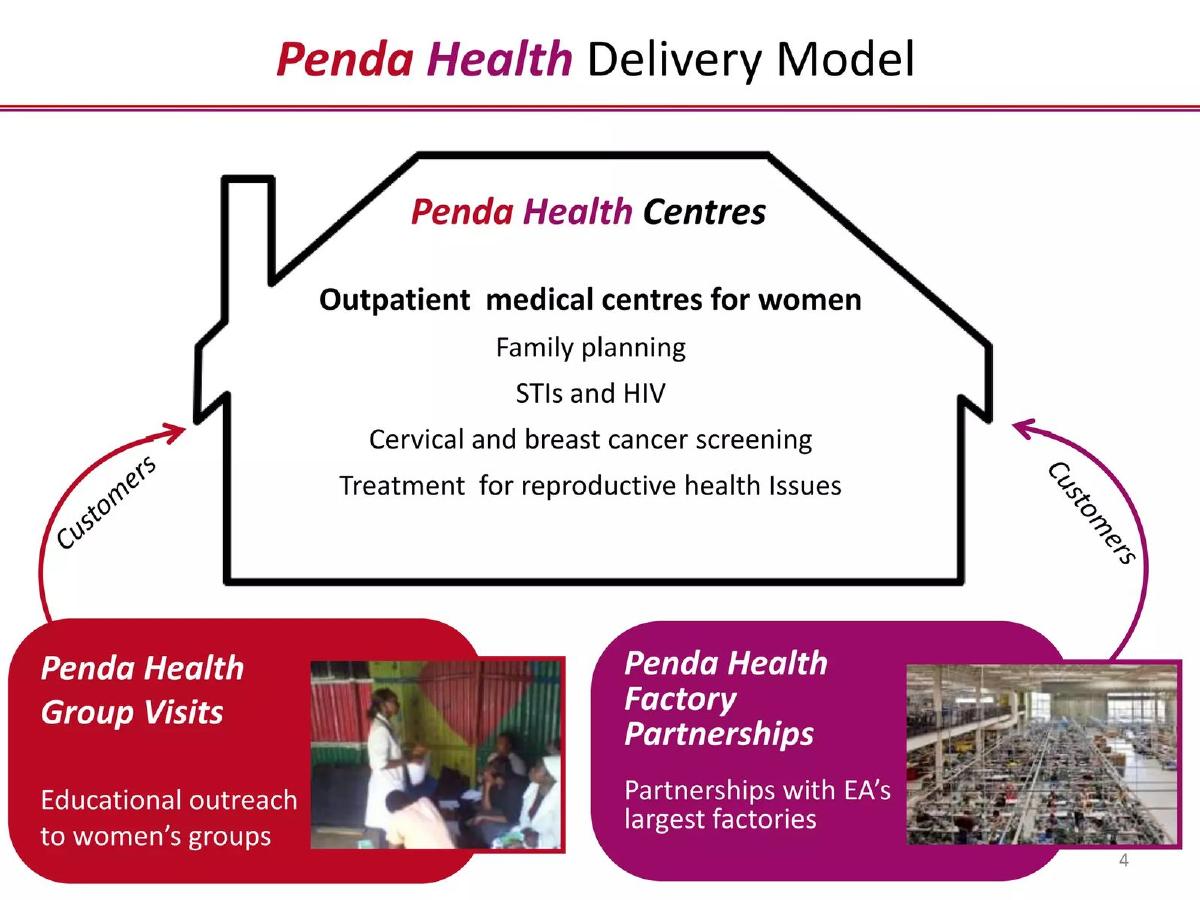
- Penda Health utilizes a three-pronged delivery model: outpatient centers, group visits for outreach, and factory partnerships (Slide 4).
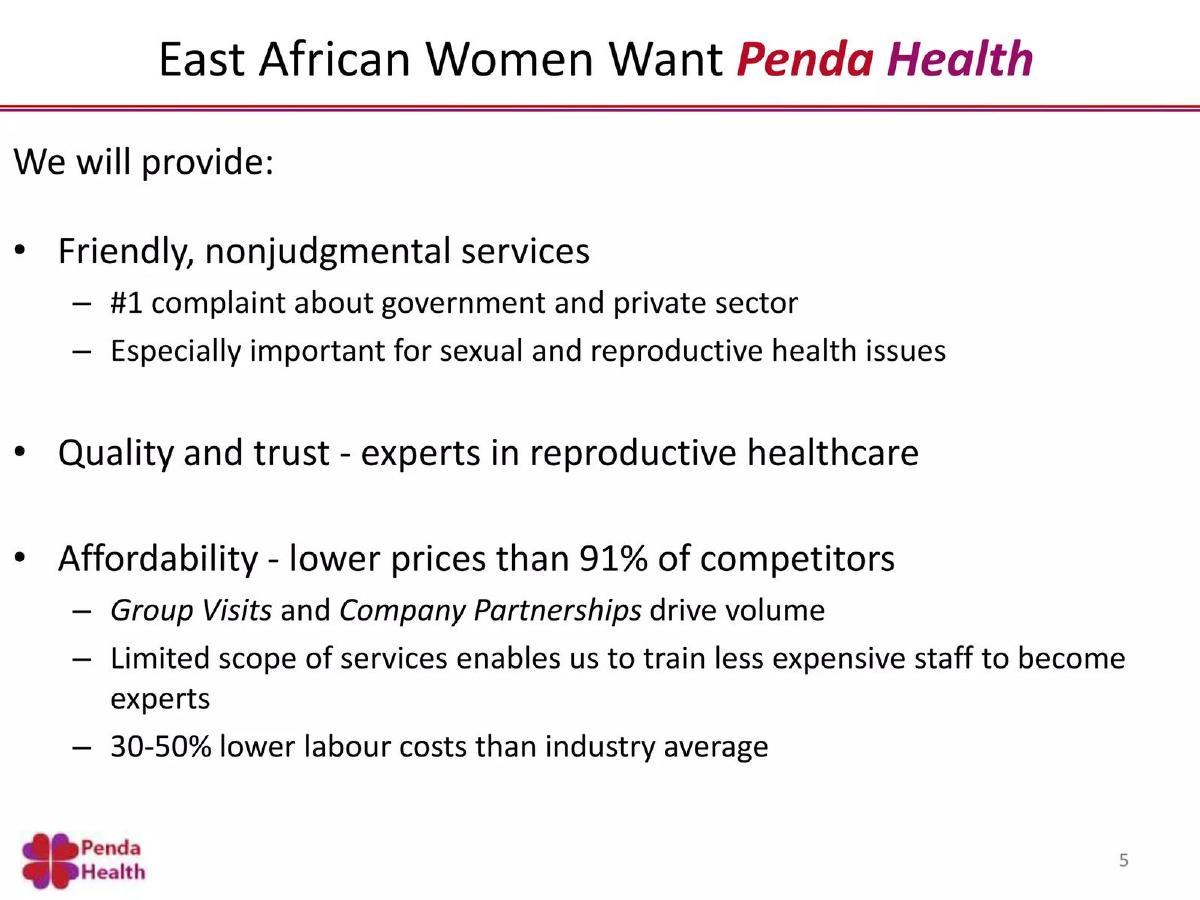
- The company claims a significant cost advantage, offering prices lower than 91% of competitors and labor costs 30-50% below the industry average (Slide 5).
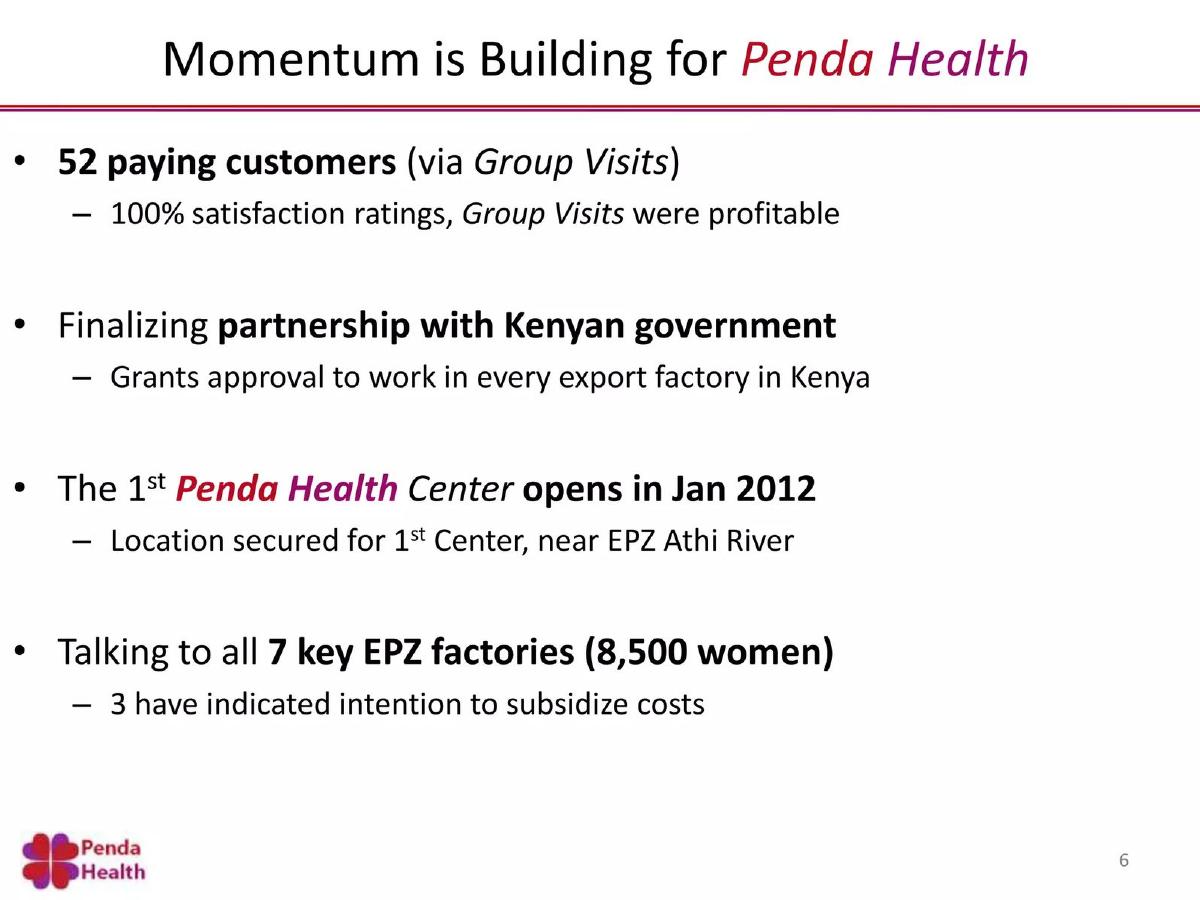
- Early traction includes 52 paying customers through profitable group visits and a secured location for the first center opening in Jan 2012 (Slide 6).
- Unit economics are highly efficient, with a single center requiring only $10,000 in working capital to break even in 11 months (Slide 7).
- The financial goal is to reach a 36% net profit margin and generate ~$50,000 in profits per center by Year 3 (Slide 7).
- The $250k seed round is structured as convertible debt with a discount and no cap, with $40k already committed by a US angel (Slide 8).
Penda Health: A Summary Deck Analysis
The Penda Health summary deck from November 2011 is a concise, 9-slide presentation designed to secure seed funding for a specialized healthcare provider in Kenya. It focuses on sexual and reproductive health, targeting a demographic that is often underserved by both the public and private sectors in East Africa. The deck is notable for its focus on lean operations and clear unit economics.
Slide 1: Title Slide
The cover slide introduces Penda Health with the tagline "Sexual and Reproductive Healthcare Designed for Africa." It is dated November 2011. The branding is simple, featuring a four-petal flower logo in red and purple. The slide establishes the company's niche immediately: a regional focus on a specific medical vertical.
Slide 2: The Team
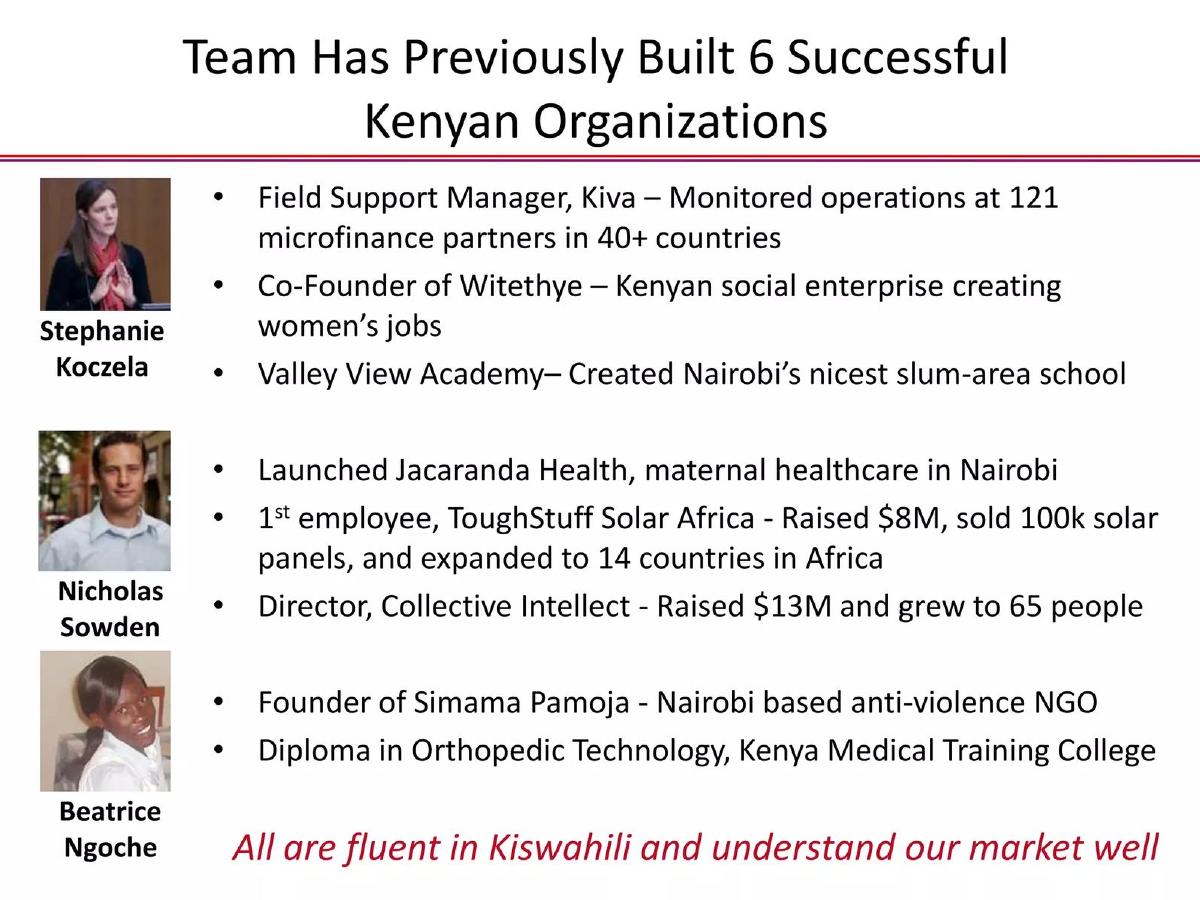
The team slide is exceptionally strong for an early-stage venture. Instead of focusing solely on academic credentials, it highlights that the "Team Has Previously Built 6 Successful Kenyan Organizations."
Stephanie Koczela: Highlights experience as a Field Support Manager at Kiva, monitoring 121 partners in 40+ countries, and co-founding Witethye, a Kenyan social enterprise. · Nicholas Sowden: Credited with launching Jacaranda Health and being the first employee at ToughStuff Solar Africa, which raised $8M and expanded to 14 countries. · Beatrice Ngoche: Founder of Simama Pamoja, a Nairobi-based anti-violence NGO, with a diploma in Orthopedic Technology.
The slide concludes with a critical cultural and operational note: "All are fluent in Kiswahili and understand our market well." This addresses a common investor concern regarding the ability of founders to navigate local market nuances in emerging economies.
Slide 3: Market Opportunity
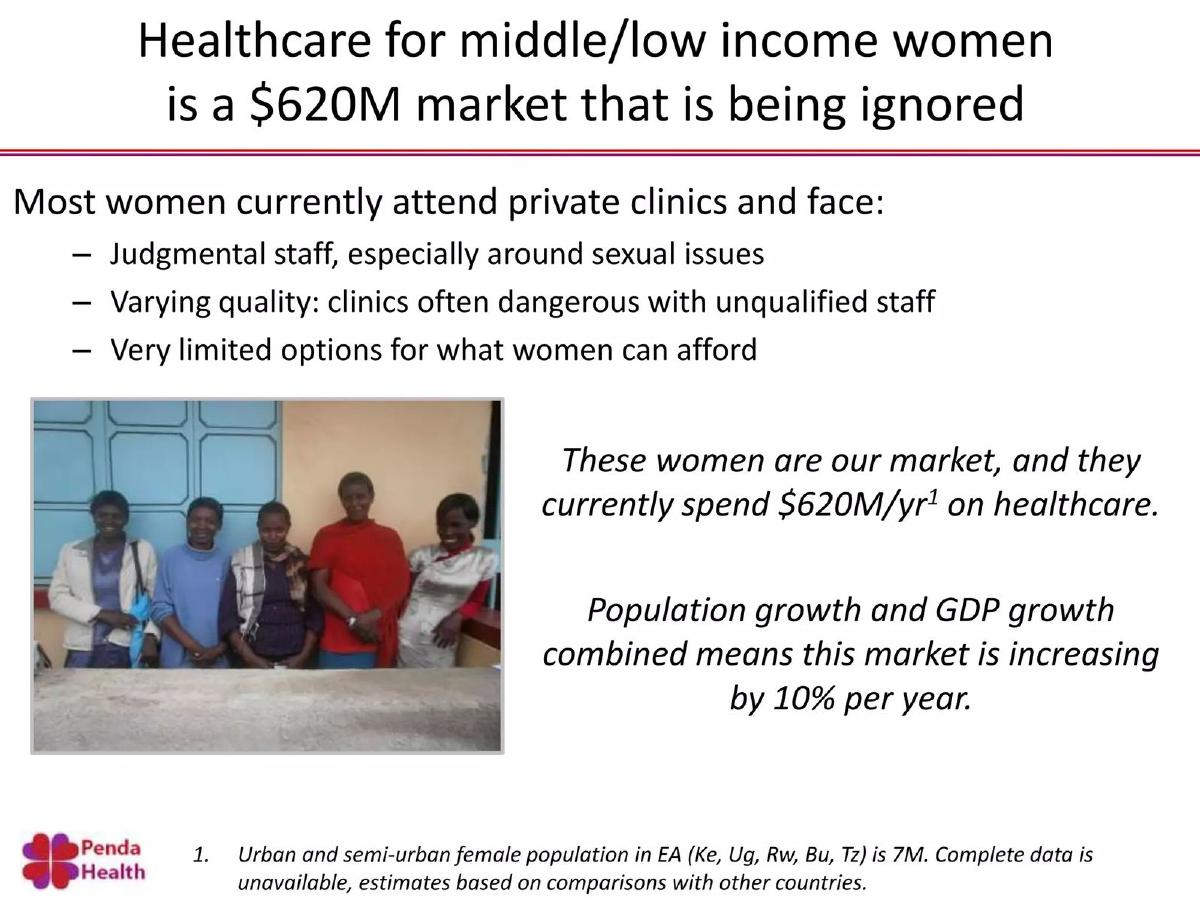
Slide 3 quantifies the opportunity, stating that healthcare for middle/low-income women is a "$620M market that is being ignored." The slide identifies three pain points in the current market: judgmental staff, varying/dangerous quality, and limited affordability. A footnote clarifies that the $620M figure is based on an urban and semi-urban female population of 7 million across Kenya, Uganda, Rwanda, Burundi, and Tanzania. The slide also claims the market is growing by 10% per year due to population and GDP growth.
Slide 4: Delivery Model
The delivery model is visualized as a house, representing the Penda Health Centres . These are outpatient medical centers providing family planning, STI/HIV testing, cancer screening, and reproductive health treatments. The model is supported by two customer acquisition channels: Penda Health Group Visits (educational outreach) and Penda Health Factory Partnerships (partnerships with East Africa's largest factories). This suggests a B2B2C approach to ensure high patient volume.
Slide 5: Value Proposition
This slide details why "East African Women Want Penda Health." The three pillars are friendliness, quality, and affordability. The most compelling data point here is that Penda offers "lower prices than 91% of competitors." They achieve this through 30-50% lower labor costs compared to the industry average, enabled by a limited scope of services that allows for the training of specialized, less expensive staff.
Slide 6: Traction and Momentum
Slide 6 provides evidence of early validation. The company reports 52 paying customers via Group Visits, which were reportedly profitable with 100% satisfaction ratings. Key milestones include:
Finalizing a partnership with the Kenyan government for factory access. · Securing a location for the first center near EPZ Athi River, set to open in January 2012. · Active discussions with 7 EPZ factories representing 8,500 women.
Slide 7: Unit Economics
This is arguably the most important slide for a seed-stage investor. It breaks down the economics of a single health center:
$10,000 in working capital required per center. · 11-month break-even period based on 25 women per day and 13 group visits per month. · $50,000 in annual profit by Year 3, representing a 36% net profit margin.
The slide also sets a long-term goal of opening 72 health centers in five years, tapping into a total regional demand for 350 centers.
Slide 8: The Ask
The company is seeking a $250k Seed Round . The funds are earmarked for renting and renovating two centers, purchasing equipment and drugs, and covering salaries through December 2012. The terms are specified as "Convertible debt with a discount and no cap." The slide also mentions that $40k has already been committed by a US-based angel investor, providing a signal of external validation.
Slide 9: Social Value and Contact
The final slide emphasizes the social impact, including improving maternal death rates and empowering women through family planning. It features a photo of a real customer, Purity Gathwera, to humanize the data. The call to action directs potential investors to contact Stephanie Koczela for a full business plan and financials.
What Works in This Deck
Hyper-Specific Unit Economics: The breakdown on Slide 7 is excellent. By showing that a center costs only $10k to start and breaks even in under a year, the founders demonstrate a highly scalable, low-risk capital deployment strategy. This is exactly what seed investors look for in brick-and-mortar or service-based startups.
Local Execution Credibility: Slide 2 does a great job of proving the team isn't just "well-meaning outsiders." By listing specific Kenyan organizations they have built and highlighting their fluency in Kiswahili, they mitigate the perceived risk of operating in a complex emerging market.
Clear Customer Acquisition Strategy: The focus on factory partnerships (Slide 4 and 6) is a smart way to solve the "empty waiting room" problem. By going where the target demographic already spends their day, Penda shows a sophisticated understanding of distribution.
What Is Missing
Competitive Landscape: While the deck mentions that prices are lower than 91% of competitors, it does not name those competitors or explain how they will defend their market share if a larger player decides to lower prices or improve service quality.
Regulatory Hurdles: Healthcare is a heavily regulated industry. While they mention a government partnership for factory access, the deck lacks a slide addressing the licensing requirements for clinics and medical staff in Kenya, which could be a significant barrier to the rapid 72-center expansion plan.
Detailed Financial Projections: The deck provides a snapshot of one center's profitability, but it does not show a consolidated pro-forma for the entire company over the five-year expansion period. Investors would likely want to see how corporate overhead scales as the number of centers grows.
What a Founder Should Copy
The "Ask" Clarity: Slide 8 is a model for how to present a seed round. It tells the investor exactly how much is needed, exactly what it will be spent on, how long the runway will last, and what the specific investment terms are. The mention of the $40k already committed is a perfect use of social proof to create urgency.
The Problem/Solution Alignment: The deck does not waste time on generic global health statistics. It identifies three specific complaints (judgmental staff, quality, price) and maps their solution directly to those three points. This tight narrative makes the business case feel logical and inevitable.
Focus on Efficiency: In a world where many startups pitch high-burn models, Penda’s focus on 30-50% lower labor costs and low-CAPEX centers stands out. Founders building in capital-constrained environments should emulate this focus on reaching profitability quickly at the unit level.
Frequently asked questions
- What is the primary problem Penda Health is solving?
- According to Slide 3, middle and low-income women in East Africa face judgmental staff, varying and sometimes dangerous clinical quality, and limited affordable options for sexual and reproductive health. Penda Health aims to provide a non-judgmental, high-quality, and affordable alternative to the existing private and government sectors.
- How does Penda Health achieve such low operating costs?
- Slide 5 explains that their limited scope of services allows them to train less expensive staff to become experts, resulting in labor costs 30-50% lower than the industry average. Additionally, Slide 7 notes that their centers require low equipment costs because they do not include an on-site lab, and they benefit from low rent.
- What is the specific go-to-market strategy mentioned in the deck?
- The strategy relies heavily on 'Factory Partnerships.' Slide 4 and Slide 6 highlight partnerships with East Africa’s largest export factories. By the time of the deck, they were in talks with 7 key EPZ factories representing 8,500 women, with three factories indicating an intention to subsidize costs for their workers.
- What are the terms of the investment being sought?
- Slide 8 states the company is raising a $250,000 seed round. The investment vehicle is convertible debt with a discount and no cap. At the time of the deck's publication, $40,000 of the round had already been committed by a US-based angel investor.
- What is the long-term scaling vision for the company?
- Slide 7 identifies a demand for 350 centers in East Africa alone. Penda Health’s specific five-year target is to open 72 health centers. The seed round is intended to prove assumptions across two centers before raising a subsequent $2M round for broader regional expansion.