Pepper Bio’s Seed deck is a masterclass in translating complex biological concepts into a clear investment thesis. By identifying the 'static, biased, and correlative' nature of current drug discovery (Slide 5), they position their 'transomic' stack as the necessary evolution for precision medicine. The deck effectively balances deep scientific credibility—anchored by a team with MIT and Harvard pedigrees (Slide 4)—with pragmatic business milestones. Notably, they demonstrate early commercial validation with '<$1M in revenue' from top-tier pharma partners (Slide 16) while simultaneously build…
Key takeaways
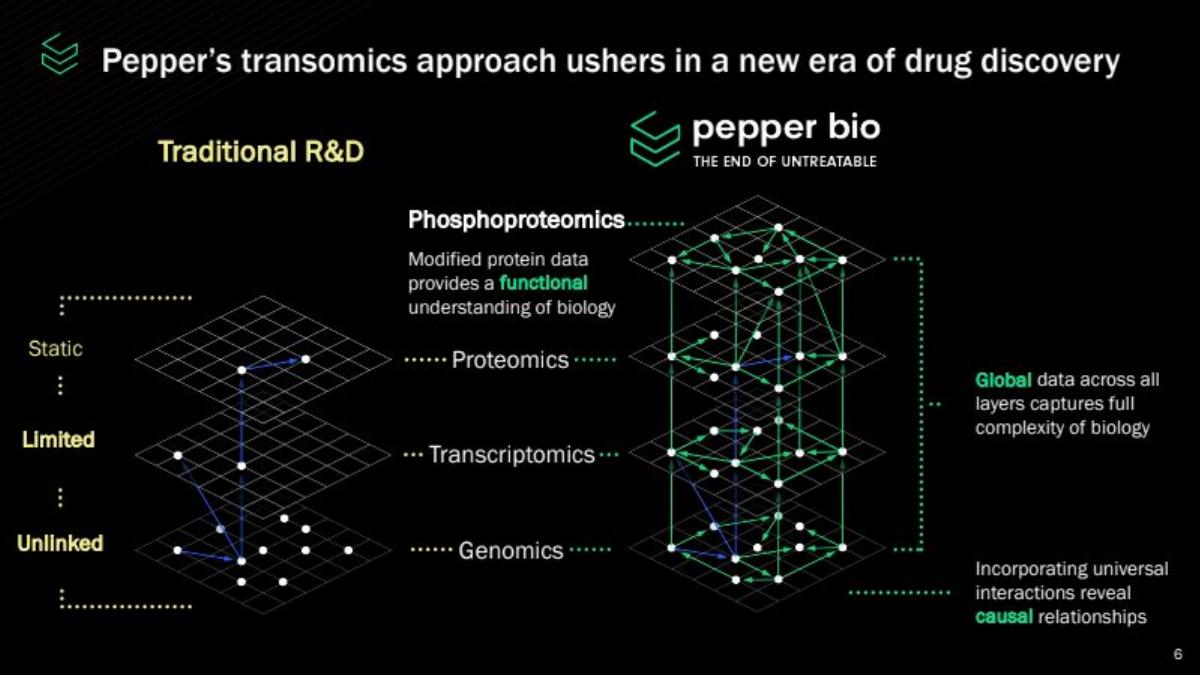
- The platform integrates four layers of biological data: genomics, transcriptomics, proteomics, and phosphoproteomics (Slide 6).
- Pepper Bio claims its platform is 12x better than leading NLP and 4x better than traditional multiomic analyses (Slide 7).
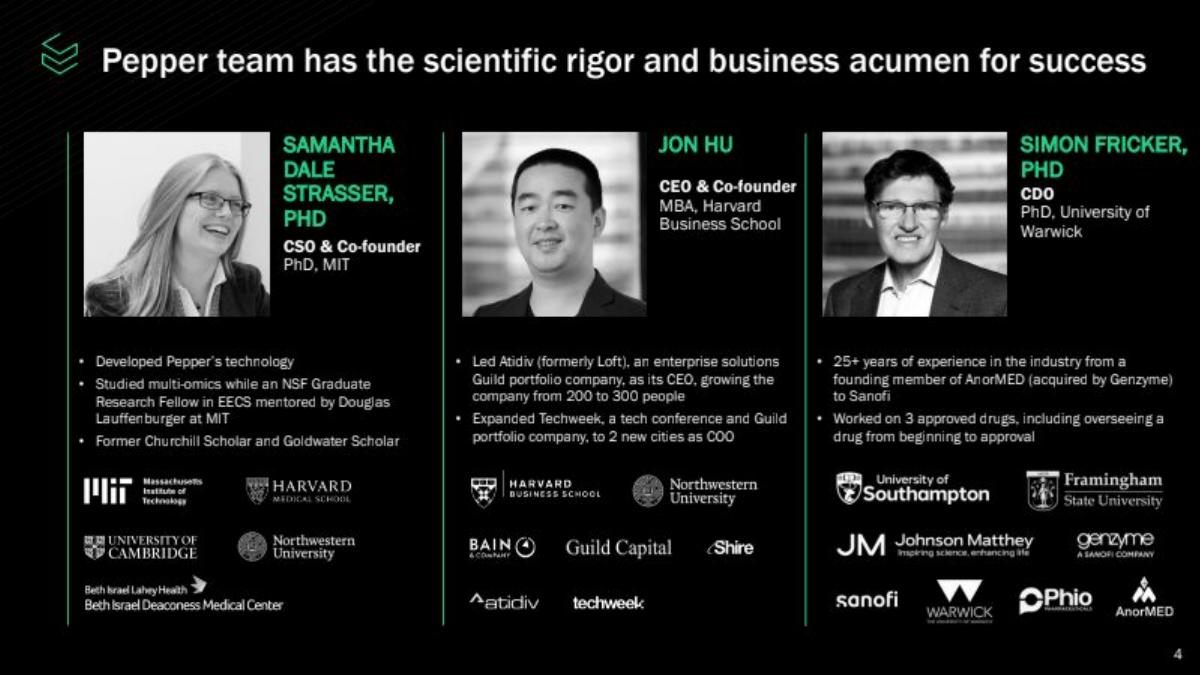
- The team includes a CSO from MIT, a CEO from HBS, and a CDO with experience on 3 approved drugs (Slide 4).
- The company employs a dual business model: internal drug development and pharma partnerships for early revenue (Slide 12).
- Initial internal pipeline focus is on Lymphoma, Liver cancer, and NSCLC, representing a $5.3B addressable market (Slide 13).
- The startup has already secured three partnerships with revenue ranging from $100K to $400K each (Slide 16).
- Projected deal values are expected to jump from $100K+ to over $100M once drugs reach the clinic in late 2024 (Slide 17).
- The deck lacks a specific 'Ask' slide detailing the exact use of the $6.5M raised in this round.
The Narrative Arc: From Personal Loss to Platform Revolution
Pepper Bio’s pitch deck is structured as a logical progression from a human problem to a technical solution, ending with a commercial roadmap. It avoids the common pitfall of being too academic, despite the heavy scientific subject matter. By starting with the patient experience and moving quickly into the 'why now' of transomics, the founders build a compelling case for a paradigm shift in drug discovery.
Slides 1-3: The Problem and Personal Motivation
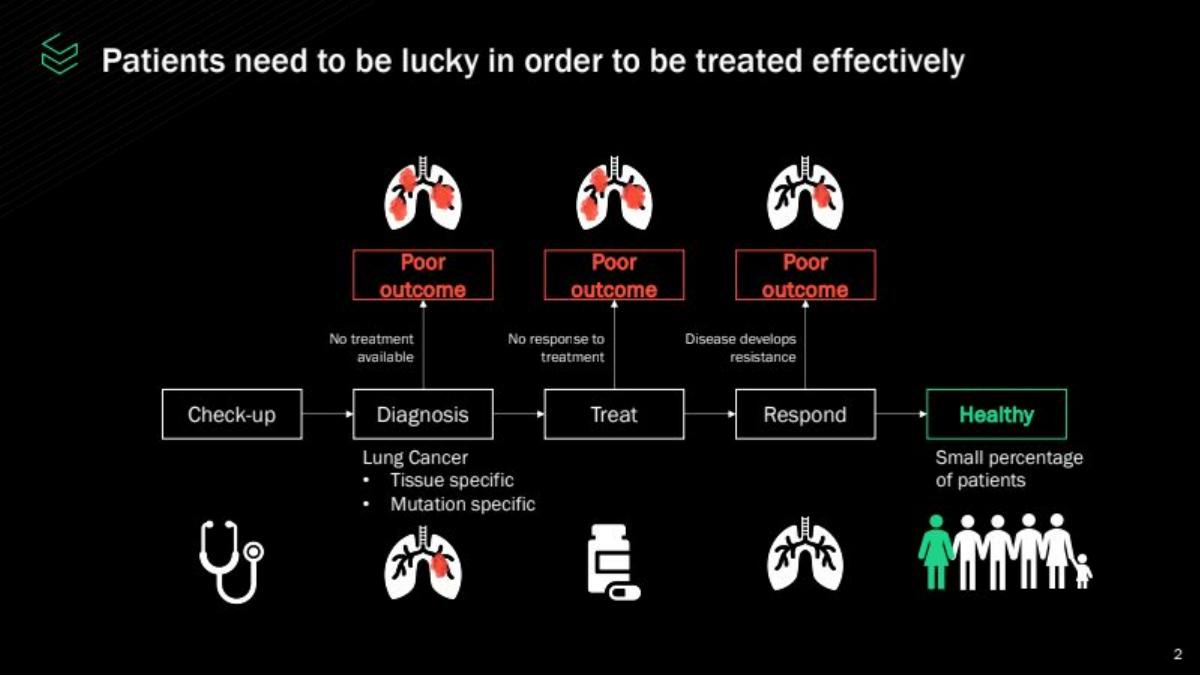
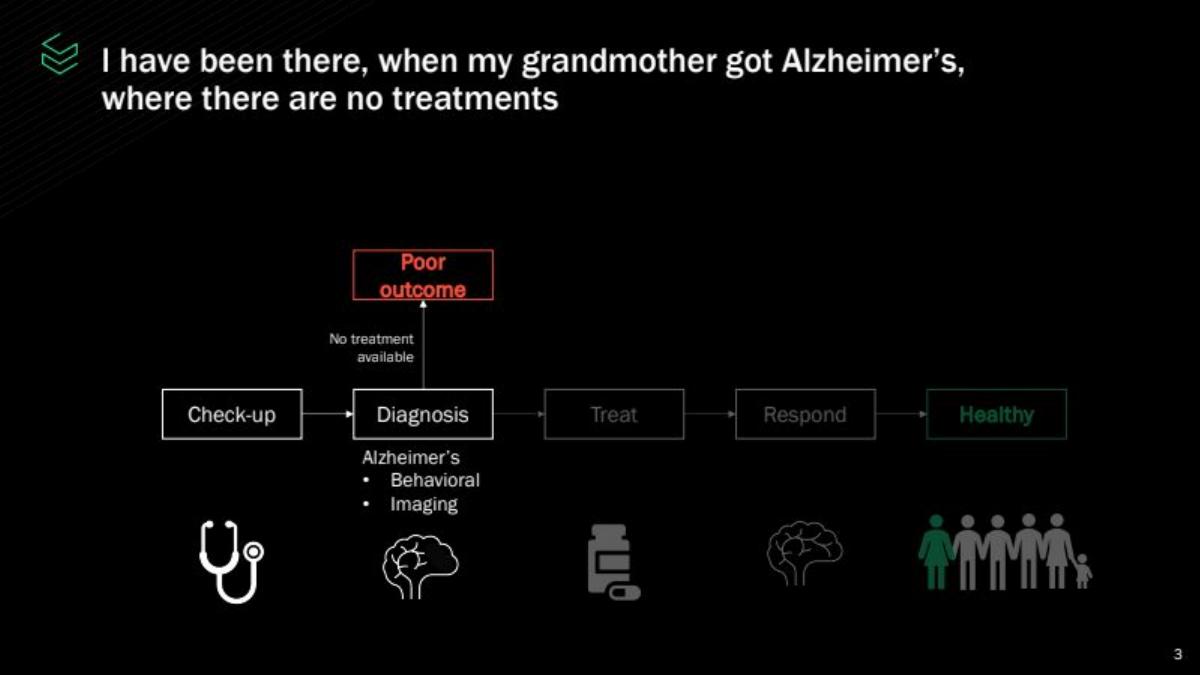
The deck opens with the tagline "The End of Untreatable." Slide 2 establishes the grim reality of current medicine: "Patients need to be lucky in order to be treated effectively." It uses a flowchart showing how most patients fall off the path to health due to lack of treatment, no response, or developed resistance. Slide 3 adds a layer of founder empathy, mentioning the CEO's grandmother’s struggle with Alzheimer’s, which serves to anchor the company’s mission in a real-world unmet need.
Slide 4: The Team
This is a high-signal team slide. It balances three distinct pillars: Scientific Rigor (Dr. Strasser, MIT PhD), Business Acumen (Jon Hu, HBS MBA and former CEO of Atidiv), and Industry Experience (Dr. Fricker, 25+ years in pharma, 3 approved drugs). The inclusion of logos like MIT, Harvard, Bain & Company, and Sanofi provides immediate institutional credibility to investors.
Slides 5-7: The 'Transomics' Solution
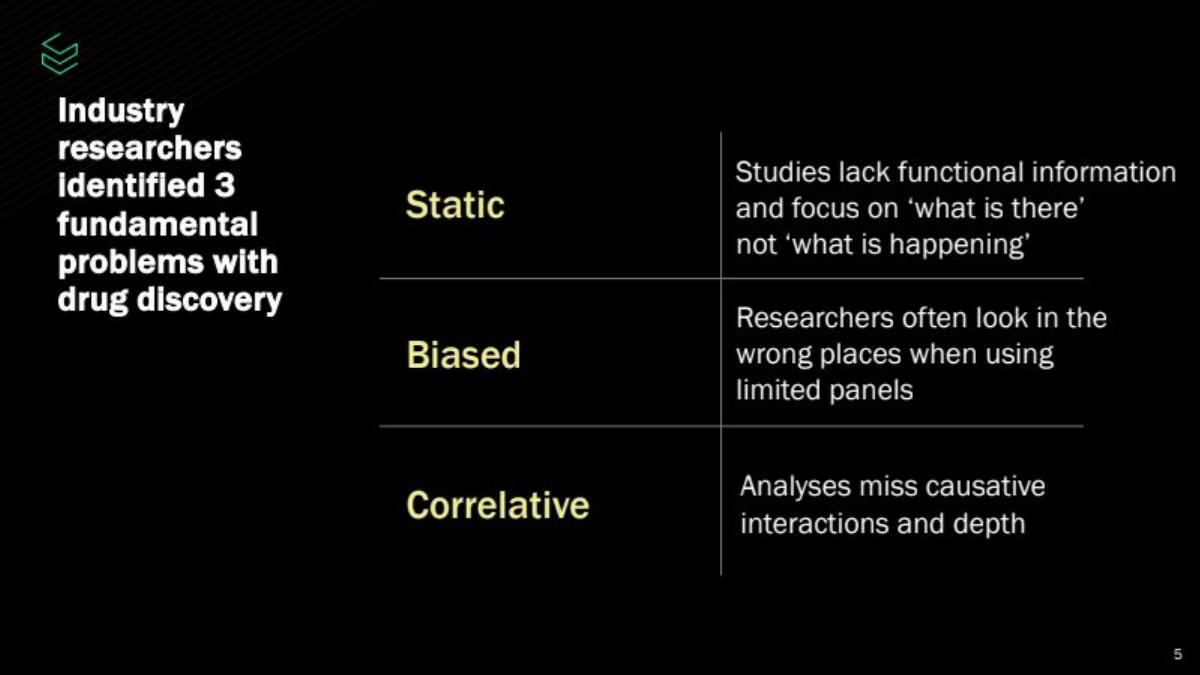
Slide 5 identifies three fundamental flaws in current drug discovery: it is Static (focuses on 'what is there' rather than 'what is happening'), Biased (limited panels), and Correlative (misses causative interactions). Slide 6 introduces Pepper Bio’s solution: a four-stack 'transomic' approach. By adding Phosphoproteomics to the standard genomics/transcriptomics/proteomics stack, they claim to capture the functional and causal layers of biology. Slide 7 quantifies this advantage, claiming the platform is 12x better than leading NLP and 4x better than traditional multiomic analyses in cancer target identification.
Slides 8-11: Market Application and Strategy
Slides 8 and 9 simplify the value proposition into two questions: "Right target?" and "Right drug?" Pepper Bio claims their tech addresses both by understanding what drives disease and the full impact of a drug on a patient. Slide 10 shows how this integrates into the existing pharma R&D lifecycle, from target discovery to clinical trials. Slide 11 defines the massive Total Addressable Markets (TAM) they are pursuing: Oncology ($201B), Inflammatory diseases ($98B), and Neurodegenerative diseases ($34B).
Slides 12-14: The Internal Pipeline
Slide 12 introduces the dual-track business model: internal drug development and external partnerships. Slide 13 gets specific about their internal oncology pipeline, targeting Lymphoma, Liver cancer, and NSCLC with a combined TAM of $5.3B. Slide 14 provides the 'proof in the pudding' with a graph showing their target's performance in animal models for Hepatocellular Carcinoma (HCC), demonstrating significant tumor volume suppression compared to the standard of care.
Slides 15-17: Commercial Traction and Projections
Slide 15 and 16 focus on revenue. They disclose <$1M in revenue from three partnerships, including a "Top 5 pharma" company. This is crucial for a Seed stage biotech, as it proves that the platform has immediate market value. Slide 17 projections are aggressive, showing a path from $100K deals to $1B+ 'jumbo-sized' platform deals as their assets move toward clinical stages in late 2024.
Slides 18-20: The Future Vision
Slide 18 places Pepper Bio at the end of a historical timeline of biological discovery, moving from DNA (2000s) to Transomics (the present). Slide 19 visualizes the shift from defining disease by tissue of origin to defining it by 'transomic signature,' which allows for more precise patient stratification and better response rates. Slide 20 concludes with a simple call to action and contact information.
What Works in This Deck
Clarity of the 'Transomic' Stack: The visualization on Slide 6 is excellent. It takes a complex biological concept and turns it into a clear architectural diagram that an investor can understand. · Commercial Validation: Many biotech decks stay purely theoretical at the Seed stage. Pepper Bio’s inclusion of actual revenue figures and partnership durations (Slide 16) significantly de-risks the investment. · The Dual-Track Model: By showing both an internal pipeline and a partnership model, they demonstrate two ways for investors to win: through a massive drug exit or through consistent platform licensing revenue. · Quantified Benchmarks: Using "12x" and "4x" on Slide 7 provides a 'hook' for the platform’s superiority that is easy to remember and repeat.
What Is Missing
The Ask: The deck completely omits a slide detailing how much they are raising (though the catalogue confirms $6.5M) and how they intend to spend it. There is no breakdown of 'Runway' or 'Milestones to Series A.' · Competition: There is no competitive landscape slide. While they mention 'traditional R&D,' they do not name other multi-omic or AI-drug discovery startups (like Recursion or Insitro) to explain their specific edge over modern peers. · IP Status: For a company built on a proprietary 'stack,' there is no mention of patent filings or the defensibility of their transomic algorithms. · Unit Economics: While they show deal values, they don't discuss the cost of running the platform or the margins on their partnership revenue.
What a Founder Should Copy
The 'Problem' Framework: Slide 5’s use of 'Static, Biased, Correlative' is a perfect way to categorize the failings of an entire industry and set up your solution as the logical antidote. · The Team Layout: Grouping the team by 'Scientific Rigor' and 'Business Acumen' is a smart way to show that the company isn't just a lab project, but a commercial entity. · The Traction Table: Slide 16 is a model of transparency. Listing the goal, revenue range, and duration for early pilots is exactly what sophisticated investors want to see to gauge product-market fit. · The 'Evolution' Slide: Slide 18 (The journey towards transomics) is a classic 'inevitability' slide. It makes the company’s success feel like a natural progression of history rather than a speculative bet.
Frequently asked questions
- What is 'transomics' as defined in this deck?
- According to Slide 6, transomics is the integration of multiple 'omic' layers—genomics, transcriptomics, proteomics, and phosphoproteomics—to reveal causal relationships in biology. Pepper Bio argues that while traditional R&D is static and unlinked, their approach captures the full complexity of biological interactions, specifically using phosphoproteomics to provide a functional understanding of what is actually happening in a cell.
- How does Pepper Bio generate revenue?
- The company uses a hybrid model detailed on Slide 12. They develop drugs internally to capture high value and maintain control, while simultaneously forming partnerships with pharmaceutical companies. Slide 16 shows they have already generated less than $1M in revenue from three distinct partnerships with 'Top 5 pharma' and public biopharma companies, with deal durations ranging from 3 to 8 months.
- What are the specific medical targets for their internal pipeline?
- Slide 13 outlines three primary oncology targets: Myc-driven Lymphoma ($1.5B TAM), Myc-driven Liver cancer ($1.5B TAM), and EGFRm Non-Small Cell Lung Cancer (NSCLC) ($2.3B TAM). They specifically target atypical mutations and standard-of-care resistant cases. Slide 14 shows animal data for their Hepatocellular Carcinoma (HCC) target, indicating plans to reach the clinic by 2024.
- Who are the key members of the leadership team?
- The team (Slide 4) consists of Dr. Samantha Dale Strasser (CSO & Co-founder, PhD from MIT), Jon Hu (CEO & Co-founder, MBA from Harvard), and Dr. Simon Fricker (CDO, PhD from University of Warwick). Dr. Fricker brings significant industry experience, having worked at Genzyme and Sanofi and contributed to three approved drugs.
- What is the projected growth for their partnership deals?
- Slide 17 illustrates a significant planned escalation in deal value. Current partnerships are valued at $100K+ upfront. They projected that by Q3 2023, deal values would reach $10M–$100M, and by late 2024, as drugs enter the clinic, total deal values could reach $100M–$1B+ per program, including tiered royalties of less than 10%.