How biotech and drug-discovery startups present the solution in a pitch deck: explain the science in one picture, compare it with today's approach.
Biotech Solution Slide: Real Pitch Deck Examples
Eight solution slides from biotech, drug-discovery and diagnostics startups, shown in full, compare whether each slide explains the science plainly, contrasts it with today's approach, and backs the gain with a figure.
TL;DR
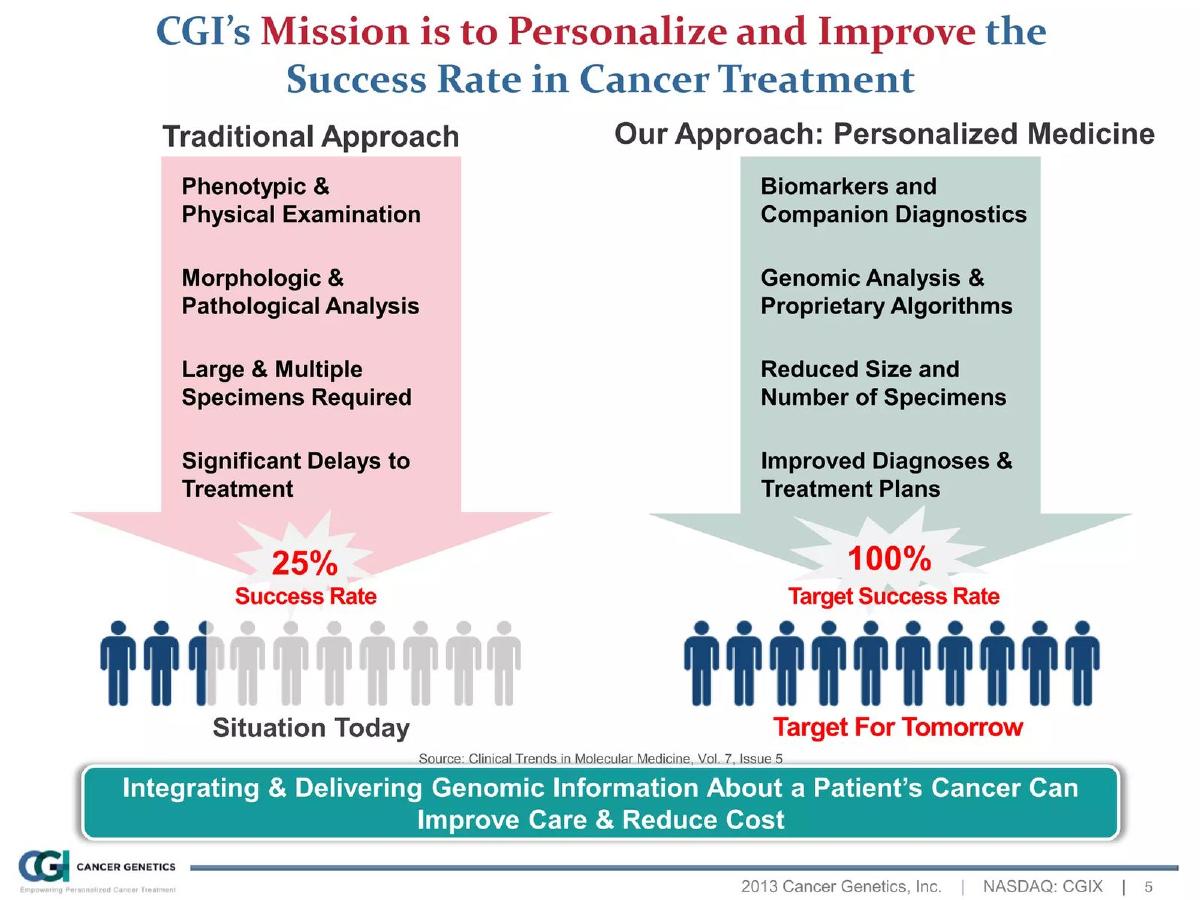
A biotech solution slide should explain the science in plain words, set it against today's method, and give a measured gain. Lantern Pharma does all three: its AI platform can "compress the timeline of early-stage drug development by 70% and reduce the cost by 80%", can "increase the odds of clinical trial success by 12X" (with a citation), and has "launched 10 new programs in 2 years". Cancer Genetics puts "Traditional Approach" beside "Our Approach: Personalized Medicine", with a "25% Success Rate" today against a "100% Target Success Rate", sourced to a journal. Ourotech's single line over a photo, "Take the guess work out of cancer treatment", explains nothing and is the weaker pattern.
Biotech solution slides from real pitch decks
Each example shows the exact stored slide above its analysis and links to the full teardown. Claims are as shown on the slides; we have not verified them.
Lantern Pharma solution slide — slide 5
AI-guided cancer drug development. Four claims round the platform logo, and a three-step model underneath.
Lantern Pharma deck, slide 5. Exact stored slide matched to this analysis.
Our analysis: The strongest example here: each claim answers a number on its problem slide (cost, risk, time) with a number of its own.
Evidence and limitation: Five figures; the 12X figure carries a citation.
What a founder can adapt: Answer each problem figure with a solution figure.
Supporting analysis
What the deck claims: "Lantern is Transforming Drug Discovery Timelines & Costs with AI." "AI insights and biomarkers can increase the odds of clinical trial success by 12X*." "Lantern can compress the timeline of early-stage drug development by 70% and reduce the cost by 80%." "RADR® can predict and stratify real-world patients for clinical trials with 88% accuracy." "Lantern has launched 10 new programs in 2 years, and has active ongoing ph.1 and ph.2 clinical trials." Model: "Large Scale/Multi-omics Oncology Data" → "Proprietary AI platform RADR®" → "Accelerated timelines; reduced costs and risks".
Presentation choice: "10 new programs in 2 years" is a result the company can point to, not only a promise.
When it does not fit: Say whether 70% and 80% are measured or projected, and cite them like the 12X.
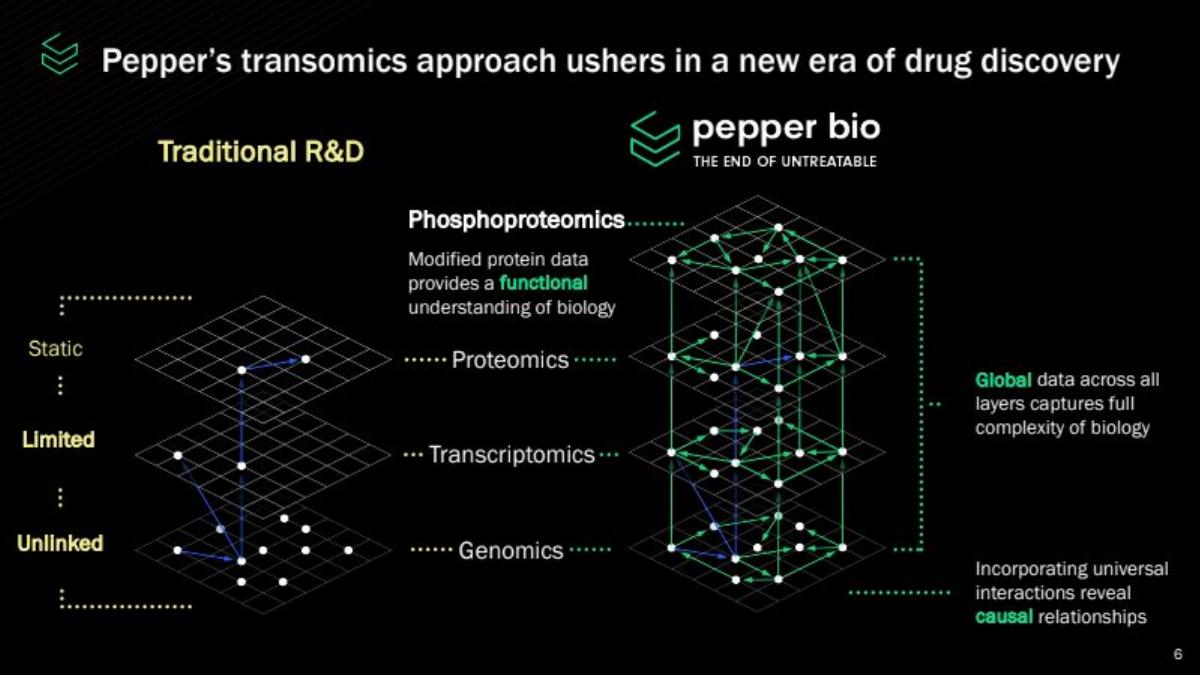
Drug-discovery data platform. Two layered diagrams side by side.
Pepper Bio deck, slide 6. Exact stored slide matched to this analysis.
Our analysis: It answers its problem slide word for word: "Static" becomes "functional", "Correlative" becomes "causal".
Evidence and limitation: Diagram; no figures.
What a founder can adapt: Reuse your problem slide's words and show each one fixed.
Supporting analysis
What the deck claims: "Pepper's transomics approach ushers in a new era of drug discovery." "Traditional R&D": layers labelled "Static", "Limited", "Unlinked" (genomics, transcriptomics, proteomics). "pepper bio": adds "Phosphoproteomics: Modified protein data provides a functional understanding of biology"; "Global data across all layers captures full complexity of biology"; "Incorporating universal interactions reveal causal relationships."
Presentation choice: The old and new diagrams share a shape, so the difference stands out.
When it does not fit: Add one result, such as a target found that other methods missed.
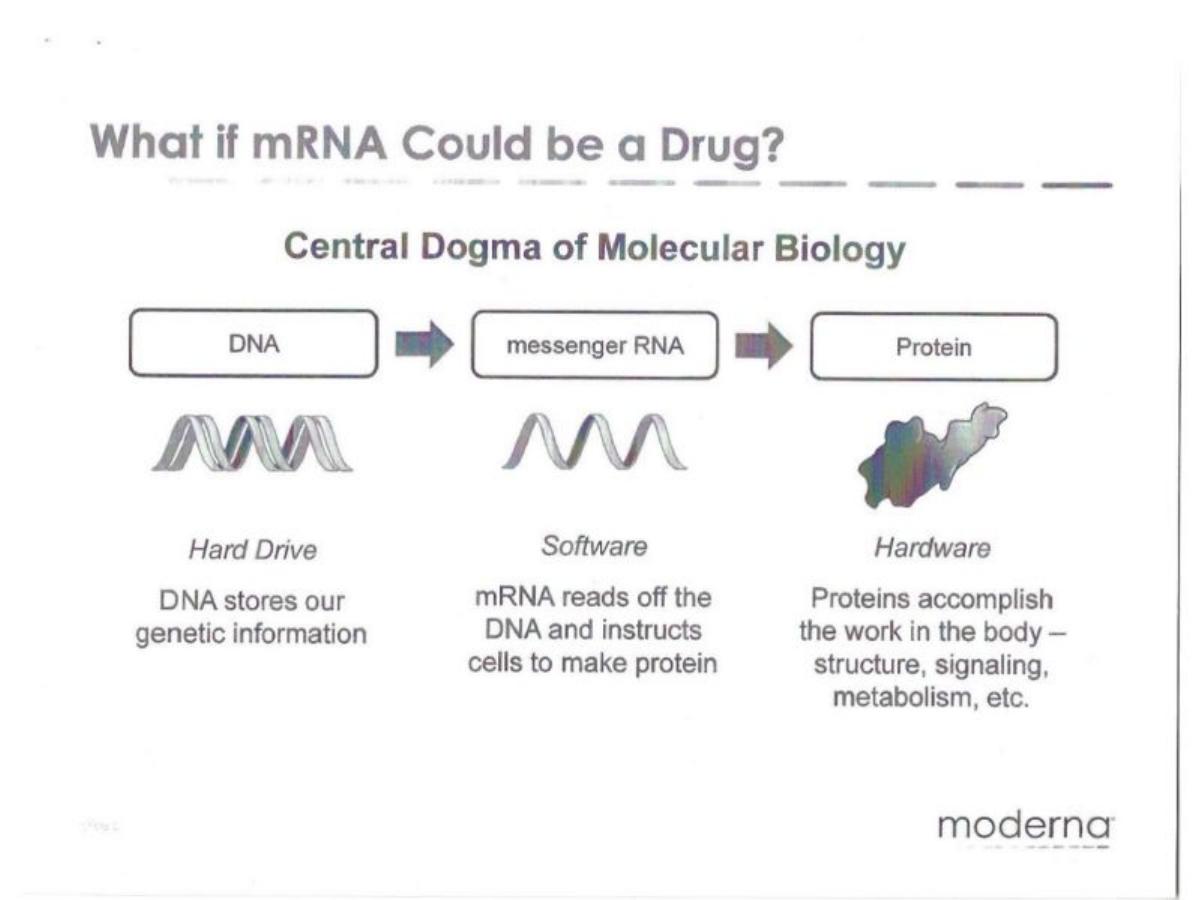
mRNA medicines (early private deck). Three boxes and an analogy.
Moderna deck, slide 5. Exact stored slide matched to this analysis.
Our analysis: It explains the science with a computer analogy anyone can follow, as a question.
Evidence and limitation: Concept only; no data.
What a founder can adapt: Find one everyday comparison for your science.
Supporting analysis
What the deck claims: "What if mRNA Could be a Drug?" "Central Dogma of Molecular Biology": "DNA — Hard Drive: DNA stores our genetic information" → "messenger RNA — Software: mRNA reads off the DNA and instructs cells to make protein" → "Protein — Hardware: Proteins accomplish the work in the body – structure, signaling, metabolism, etc."
Presentation choice: "Software" sets up the platform idea: change the instructions, get a new medicine.
When it does not fit: Pair the concept with the evidence slide that follows.
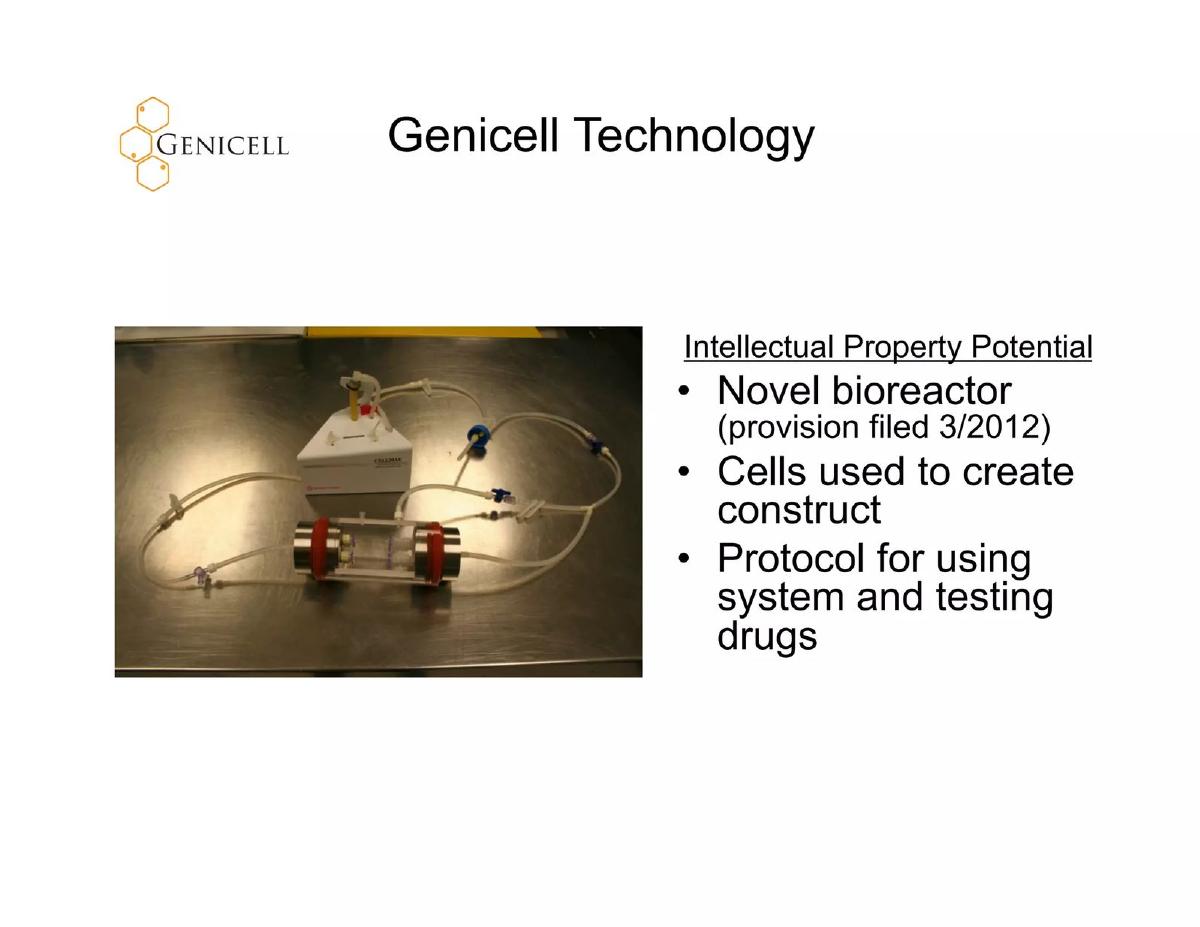
Cell-based compound screening. A photo of the device and three bullets.
Genicell deck, slide 5. Exact stored slide matched to this analysis.
Our analysis: It shows the physical product, but lists what could be protected rather than what it does.
Evidence and limitation: Device photo and filing date; no results.
What a founder can adapt: Show the device and say what it measures and how fast.
Supporting analysis
What the deck claims: "Genicell Technology." Photo of the bioreactor. "Intellectual Property Potential: Novel bioreactor (provision filed 3/2012); Cells used to create construct; Protocol for using system and testing drugs."
Presentation choice: A real photo makes an early science company tangible.
When it does not fit: Leading with patents instead of what the product does.
Fluorine chemistry for carbohydrate drugs. Two sentences.
Sirona Biochem deck, slide 6. Exact stored slide matched to this analysis.
Our analysis: Two plain sentences explain the chemistry and link it to the problem (instability) on the slide before.
Evidence and limitation: No figures.
What a founder can adapt: Add a before/after figure, such as how long the molecule stays stable.
Supporting analysis
What the deck claims: "How we do it." "Sirona's Fluorination Chemistry Technology is the solution to unstable carbohydrate molecules." "We strengthen the bond of a carbohydrate molecule by strategically placing fluorine atoms within the molecule."
Presentation choice: Short enough for a non-chemist to repeat.
When it does not fit: Text only; a molecule diagram would help.
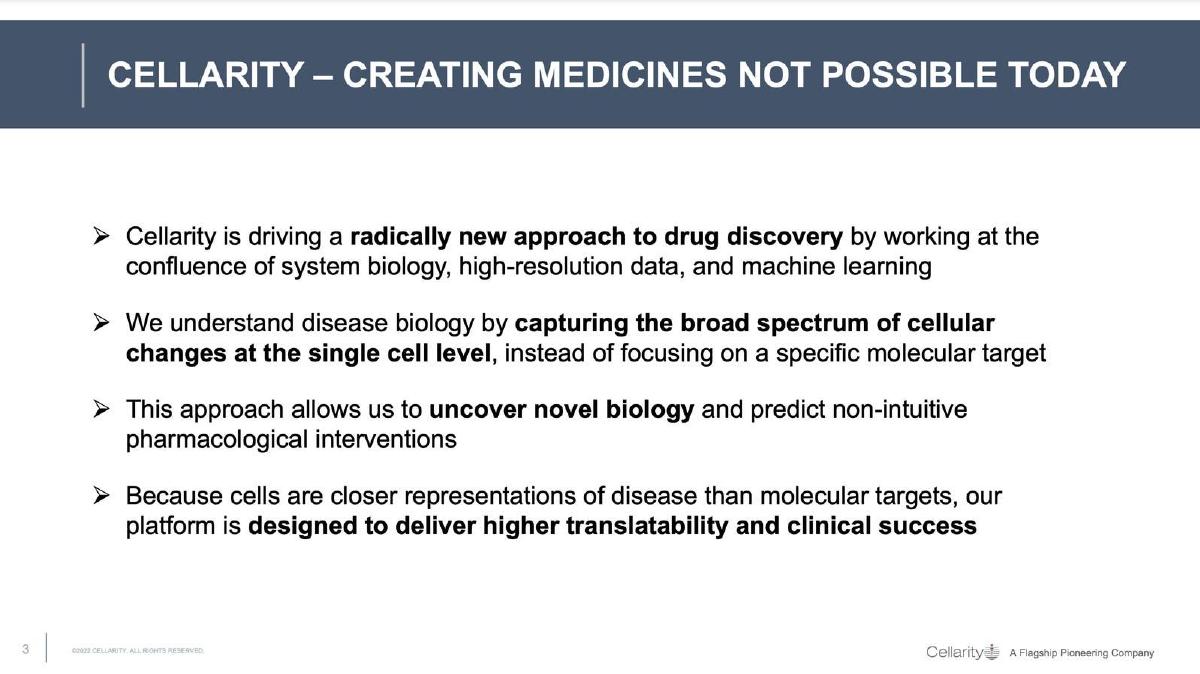
Cellarity deck, slide 3. Exact stored slide matched to this analysis.
Our analysis: Partial: it says clearly how it differs (cells, not single targets) but gives no picture and no evidence; "designed to" is a hope.
Evidence and limitation: No figures.
What a founder can adapt: Add one result: a drug candidate found this way, or a prediction later confirmed.
Supporting analysis
What the deck claims: "Cellarity – Creating Medicines Not Possible Today." "Cellarity is driving a radically new approach to drug discovery by working at the confluence of system biology, high-resolution data, and machine learning." "We understand disease biology by capturing the broad spectrum of cellular changes at the single cell level, instead of focusing on a specific molecular target." "Because cells are closer representations of disease than molecular targets, our platform is designed to deliver higher translatability and clinical success."
Presentation choice: Kept to show a clear contrast that still needs proof.
When it does not fit: "Radically new" and "designed to deliver" without evidence.
Whether each slide explains the science, contrasts it with today, and gives a measured gain.
Example
Science explained
Contrast with today
Measured gain
Lantern Pharma
Partly (three-step model)
Partly
Yes (one cited)
Cancer Genetics
Yes
Yes (side by side)
Yes (sourced; target labelled)
Pepper Bio
Yes (diagram)
Yes (side by side)
No
Moderna
Yes (analogy)
No
No
Genicell
Partly (photo)
No
No
Sirona Biochem
Yes (two sentences)
Partly
No
Cellarity
Yes
Yes (cells vs targets)
No
Ourotech
No
No
No
Key Takeaways
Explain the science in one plain sentence or picture.
Put your approach next to today's method.
Give a measured gain (time, cost, success rate) with a source.
Label targets as targets and results as results.
A tagline over a photo is not a solution slide.
Build your biotech solution slide
Plain science, today versus you, one measured gain.
Plain words. Explain the science in one sentence a non-scientist can repeat.
Today. What is the standard method? Put it beside yours.
Gain. Time, cost or success rate, measured, with a source.
Status. Result, early data or target? Label it.
Copyable framework: Instead of [today's method], we [plain-words science]. [Gain] ([source; result or target]).
Illustrative example 1 — written by us
Before: Take the guess work out of cancer treatment.
After: Instead of trying drugs one by one on the patient, we test them on a copy of the patient's tumour in the lab. In our first 40 samples, the test matched the patient's actual response in 3 out of 4 cases (early data).
What improved: Our illustrative rewrite; the figures are invented for the example. It names today's method, the science and a labelled result.
What this guide adds
This is the companion to the biotech problem guide. Five of its eight decks appear there too (Lantern Pharma, Moderna, Genicell, Pepper Bio, Ourotech), so you can read each company's problem and solution side by side. Cancer Genetics, Sirona Biochem and Cellarity are new to the library. The healthcare solution guide covers care delivery and digital health and doesn't repeat these slides.
Three things a biotech solution slide proves
It is understandable: "DNA... Hard Drive", "mRNA... Software", "Proteins... Hardware" (Moderna); "strategically placing fluorine atoms within the molecule" (Sirona).
It differs from today: "Traditional R&D" against "pepper bio" (Pepper Bio); "Traditional Approach" against "Personalized Medicine" (Cancer Genetics).
It works, or is expected to: "70%", "80%", "12X", "88% accuracy" (Lantern); "25%" today, "100%" target (Cancer Genetics).
Common mistakes
Jargon without a plain sentence. One line a non-scientist can repeat.
Targets shown as results. Label targets and projections.
Patents in place of function. Say what the product does first.
"Designed to" without evidence. Add one early result.
Tagline over a photo. Show how it works.
Diagnostic checklist
The science is in one plain sentence or picture.
Today's method is shown beside yours.
One measured gain has a source.
Targets are labelled as targets.
It answers the problem slide before it.
Frequently asked questions
How we chose these examples
Corpus: published pitch deck teardowns on StartupFundraising.com. Founder-uploaded private decks are excluded.
Selection (2026-09-25): we searched slides 3–7 of the biotech problem guide's decks, then slides 3–6 of other drug-discovery and diagnostics decks, for solution slides. Aevus slide 4 and Healx slide 6 were left out because they already appear in the healthcare solution guide; Compass Pathways slide 5 was left out as a mission statement; Aventaa slide 4 was left out as a services list; Cyclica slide 5 was left out because its text was too small to read in the stored image. Cellarity is marked partial; Ourotech is kept as a weaker contrast.
Overlap check: none of these eight slides appears in another guide. Genicell slide 7 appears in the biotech pipeline guide and Pepper Bio slide 4 in the deep-tech team guide; this guide uses different slides.
Review: all eight stored slide images were inspected on 2026-09-25 and matched to company, deck and slide number (editorial model review). No person has yet completed an editorial review of this page.
Claims are as shown on the slides; we have not verified them. We make no claim that any slide caused a fundraising outcome. Nothing here is medical or regulatory advice.