Related Garments positions itself as a 'matching undergarment company' that bridges the gap between traditional retail and modern subscription models. The deck emphasizes a diverse distribution strategy, moving beyond standard Direct-to-Consumer (DTC) to include private label manufacturing for brands like Fashion Nova and Rhude, as well as a custom hotel program with partners like Ritz-Carlton. While the deck lacks specific internal financial metrics or a clear funding ask, it leans heavily on social proof through celebrity collaborations—including Wiz Khalifa and Bella Thorne—and external ma…
Key takeaways
- The company defines itself as the original matching undergarment company with unique waistband designs (Slide 1).
- Product offerings extend beyond standard underwear to include a monthly membership and a functional line called R-Squared (Slide 3).
- Distribution is split across four distinct channels: Online, Private Label, Hotel, and Wholesale (Slide 5).
- Private label partners include high-profile brands such as Hustler, Fashion Nova, and Chinatown Market (Slide 5).
- The hotel program features luxury partners including Kimpton Hotels and the Ritz-Carlton Hotel Company (Slide 5).
- Celebrity collaborations are a core marketing pillar, featuring names like Wiz Khalifa, Bella Thorne, and George Lopez (Slide 7).
- The deck uses external benchmarks, noting Mack Weldon's $12 million raise and MeUndies' 3 million units shipped, to validate the sector (Slide 9).
- The founding team brings over 25 combined years of experience in PR, branding, and clothing production (Slide 12).
Executive Summary: The Brand-First Basics Play
Related Garments presents a deck that is heavy on lifestyle branding and distribution partnerships but light on traditional venture metrics. The narrative centers on the founders' ability to navigate the fashion and celebrity worlds, positioning the company as a versatile manufacturer and lifestyle brand rather than just a digital storefront. By highlighting private label and hotel channels, the deck suggests a higher level of operational maturity than a typical early-stage startup, though the lack of hard data leaves several questions for potential investors.
Slide 1: The Concept
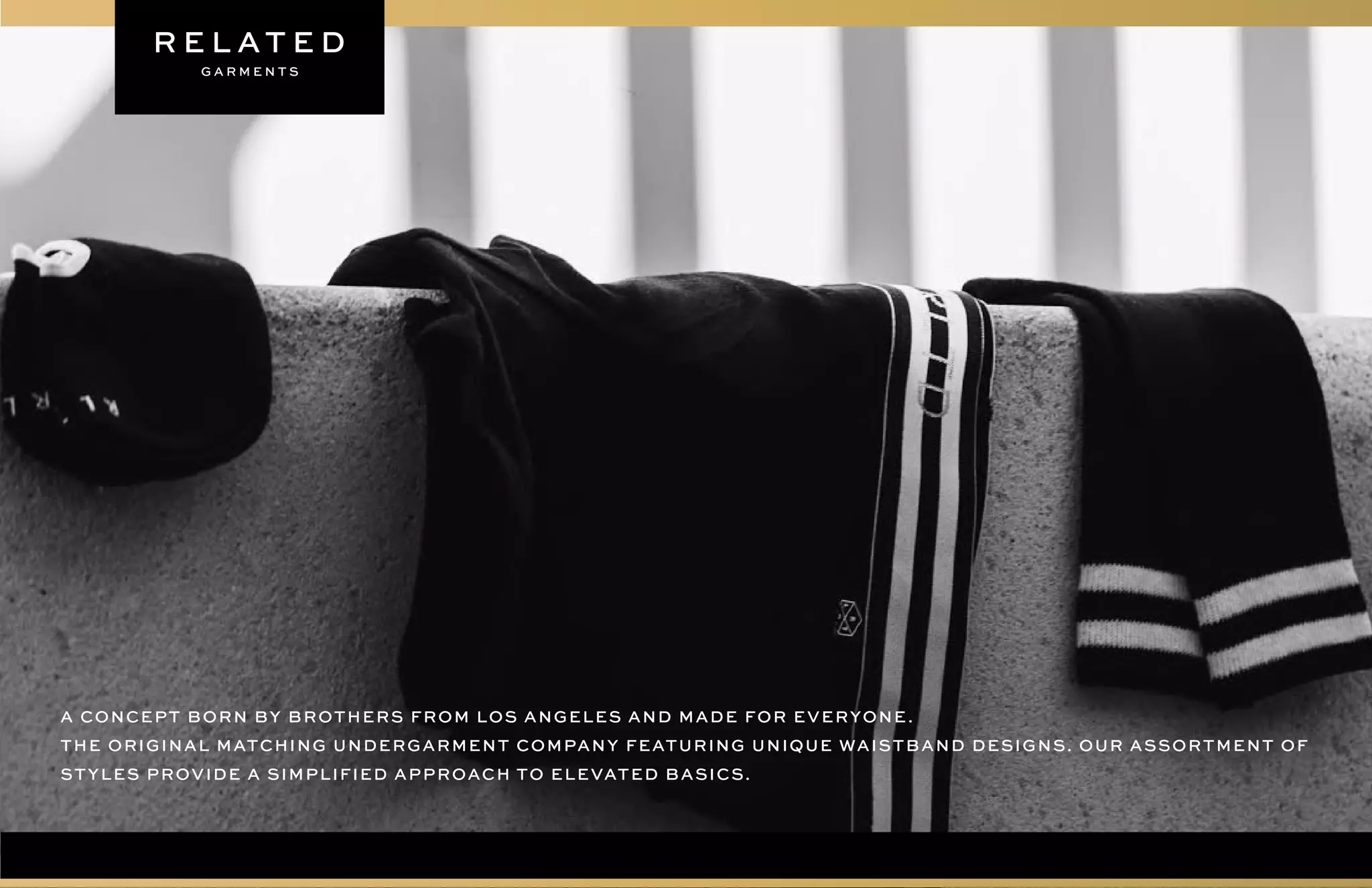
The opening slide establishes the brand identity. It describes Related Garments as a 'concept born by brothers from Los Angeles' and claims the title of the 'original matching undergarment company.' The copy emphasizes 'unique waistband designs' and 'elevated basics.' The imagery is monochromatic and minimalist, signaling a premium market position. This slide serves as a mission statement, focusing on the 'simplified approach' to a category that is often cluttered or utilitarian.
Slide 3: Products + Offerings
This slide categorizes the product line into three distinct pillars. First, the core product range includes underwear, socks, briefs, bralettes, thongs, and panties. Second, it introduces 'Personals,' which allows for personalized and customizable underwear. Third, it highlights 'Membership,' a subscription model for monthly deliveries. Finally, it introduces 'R-Squared,' a functional line designed to eliminate the need to change underwear between work and the gym. This slide demonstrates that the company is thinking about recurring revenue (membership) and technical fabrics (R-Squared) in addition to standard fashion cycles.
Slide 5: Distribution Channels
Slide 5 is perhaps the most strategically significant slide in the deck. It breaks down the business into four quadrants:
Online: Selling direct via their website and through third-party retailers like Amazon, Fancy, and ShopSpring. · Private Label: Manufacturing for high-growth or established brands including Fashion Nova, Rhude, and Chinatown Market. · Hotel: A custom program for in-room sales at luxury chains like Ritz-Carlton, Kimpton, and Morgans Hotel Group. · Wholesale: Nationwide boutique and department store presence, citing Traffic and Rolo.
By listing these partners, the company demonstrates that it is not solely dependent on Facebook or Instagram ad spend for growth, which is a common pitfall for DTC brands.
Slide 7: Celebrity Collaborations
This slide is a pure 'social proof' play. It features headshots of five celebrities: Cedric the Entertainer, George Lopez, Luka Sabbat, Wiz Khalifa, and Bella Thorne. While it does not detail the specific nature of these collaborations (e.g., whether they are equity partners, paid influencers, or design collaborators), the inclusion of these names suggests a high level of cultural relevance and the ability to leverage large social followings for brand awareness.
Slide 9: Industry Success Stories
In the absence of their own growth metrics, Related Garments uses Slide 9 to validate the category. They cite three major competitors: Mack Weldon ($12M raised, 250k customers, double-digit million revenue), MeUndies (3 million pairs shipped, 5 million units projected for 2017), and Stance ($50M raised from Kleiner Perkins, 15 million pairs of socks sold). This slide is intended to prove that 'fancy' basics is a venture-scale category with significant exit potential or at least high-revenue ceilings.
Slide 12: The Team
The 'Key Members' slide focuses on the Appel brothers. Mike Appel (CEO) is credited with 10 years of PR and branding experience, specifically 'aligning brands and celebrities together.' David Appel (Creative Director) is credited with 15 years in clothing production and design. The inclusion of a Chief Operating Officer (Eric Nicolaides) and a Director of Data & Advertisement (Jen Strojin) suggests a balanced team, though the slide lacks specific past company logos or educational backgrounds that are standard in many tech-focused decks.
What Works in This Deck
The multi-channel strategy is the strongest element of the Related Garments pitch. Most apparel startups focus exclusively on DTC, which has become increasingly expensive due to rising customer acquisition costs. By showing established partnerships with the Ritz-Carlton and manufacturing contracts for brands like Fashion Nova, Related Garments demonstrates a diversified revenue base and a 'B2B2C' approach that provides more stability than a pure consumer play.
The use of celebrity names also provides immediate credibility. In the fashion world, the ability to secure a collaboration with someone like Wiz Khalifa or Luka Sabbat is a proxy for brand 'cool' and industry connections, which are often as important as technical specifications in this sector.
What is Missing
The most glaring omission is internal performance data. While the deck does an excellent job of showing who they work with, it does not show how much they are selling. Investors typically look for Month-over-Month (MoM) growth, Gross Margin percentages, and Return on Ad Spend (ROAS). Citing Mack Weldon's success is helpful for market validation, but it does not prove that Related Garments is executing at a similar level.
Furthermore, there is no 'Ask' slide. A pitch deck is a tool to raise capital, yet this version of the deck does not state how much money is being sought, what the valuation is, or what the milestones for the next 18 months look like. Without these details, the deck functions more like a brand lookbook or a partnership proposal than a formal investment vehicle.
Founder Takeaway: The 'Validation by Proxy' Strategy
Founders can learn from how Related Garments uses 'Validation by Proxy.' If your startup is in a crowded space (like apparel), you must prove that the category is worth an investor's time. Related Garments does this by highlighting the massive funding rounds of their competitors. If you don't have a 3-year track record of explosive growth yet, showing that your 'neighbors' in the industry are raising $50M from Kleiner Perkins is a way to keep an investor interested.
However, founders should be careful not to rely solely on this. A deck should eventually transition from 'this is a great market' to 'we are the best team to capture this market because of our specific numbers.' Related Garments succeeds at the former but leaves the latter to be addressed in a follow-up conversation.
Frequently asked questions
- What is the primary value proposition of Related Garments?
- The company focuses on 'elevated basics' with a specific emphasis on matching undergarment sets. According to Slide 1, they aim to provide a 'simplified approach' to basics through unique waistband designs. Their product strategy also includes 'Personals' for customization and 'R-Squared' for functional wear that transitions between work and the gym, as detailed on Slide 3.
- How does the company generate revenue beyond its own website?
- Related Garments utilizes a multi-channel approach. Slide 5 highlights private label manufacturing for brands like Rhude and Dolls Kill, a hotel program for in-room sales at luxury properties like the Ritz-Carlton, and wholesale distribution in boutiques and department stores such as Edition and Golden Nugget. This suggests a diversified revenue stream compared to pure-play DTC brands.
- Who are the key people behind the brand?
- The brand was founded by brothers Mike and David Appel. Mike Appel (CEO) has over 10 years of experience in PR and celebrity branding. David Appel (Creative Director) has over 15 years in the clothing industry, including design roles at Five Four Group and Cohesive & Co. The team also includes directors for operations, marketing, data, and brand (Slide 12).
- What evidence of market fit does the deck provide?
- Rather than showing internal growth charts, the deck provides 'Industry Success Stories' on Slide 9. It cites Mack Weldon's $12 million funding and $10 million+ revenue, MeUndies' 5 million unit sales projection for 2017, and Stance's $50 million raise from Kleiner Perkins. This framing is intended to show the lucrative nature of the 'fancy socks and underwear' market.
- What critical information is missing from this deck?
- The deck is notably missing internal financial data, such as Revenue, Customer Acquisition Cost (CAC), or Lifetime Value (LTV). There is no 'Ask' slide detailing how much capital is being raised or the intended use of funds. Additionally, the deck lacks a formal 'Problem' slide, assuming the investor already understands the need for better basics.