Evy’s Seed deck is a study in restraint, utilizing just 10 slides to secure a $6.4M round. The narrative centers on a massive market inefficiency: 75% of top French e-commerce merchants do not yet offer product protection. By positioning themselves as a modern, API-first broker under ORIAS approval, Evy addresses the technical hurdles (long integration times) and consumer pain points (lack of transparency) that plague legacy insurance providers. While the deck is notably missing a team slide, financial projections, and a specific funding ask, its strength lies in its clear value proposition f…
Key takeaways
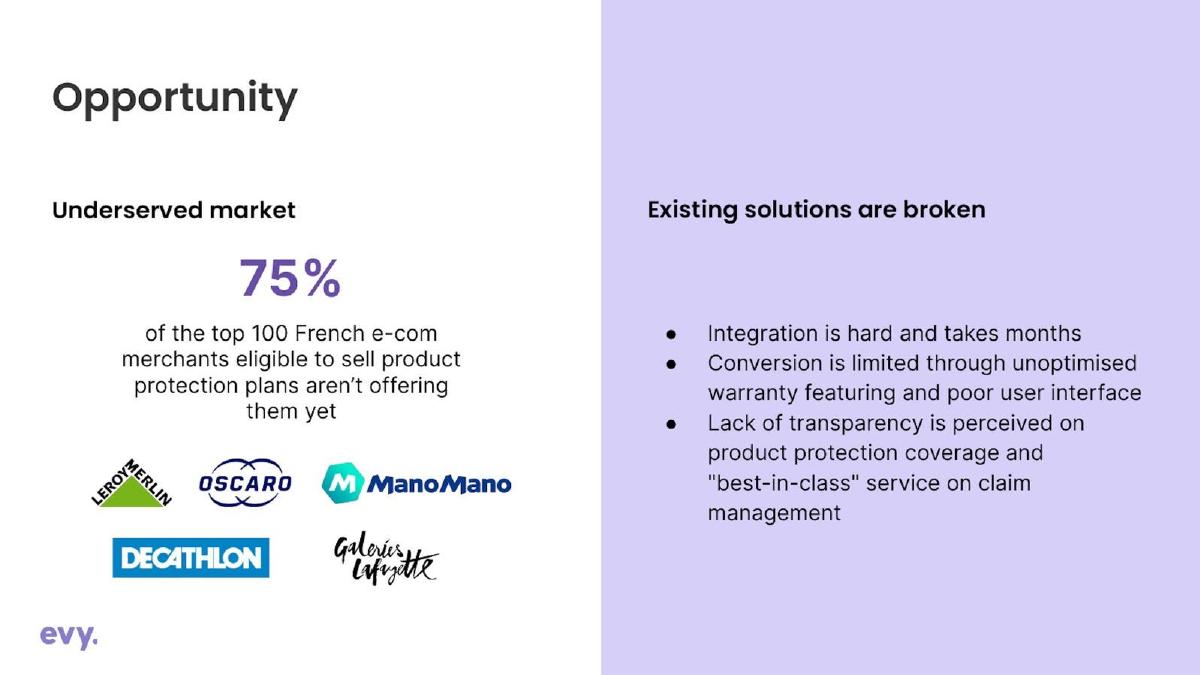
- The deck identifies a specific market gap: 75% of the top 100 French e-commerce merchants eligible for protection plans are not yet offering them (Slide 2).
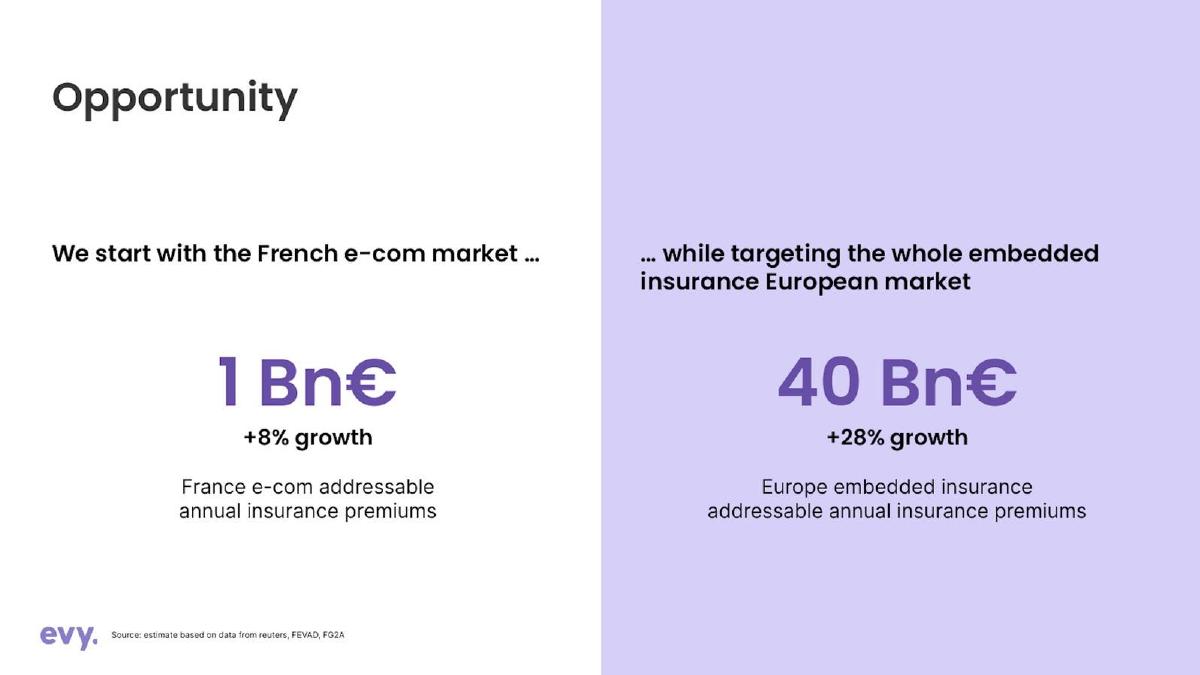
- Evy targets a 1 Bn€ addressable market in France growing at 8%, with a long-term eye on a 40 Bn€ European market growing at 28% (Slide 3).
- The solution addresses three core legacy failures: hard integration, limited conversion, and lack of transparency (Slide 2).
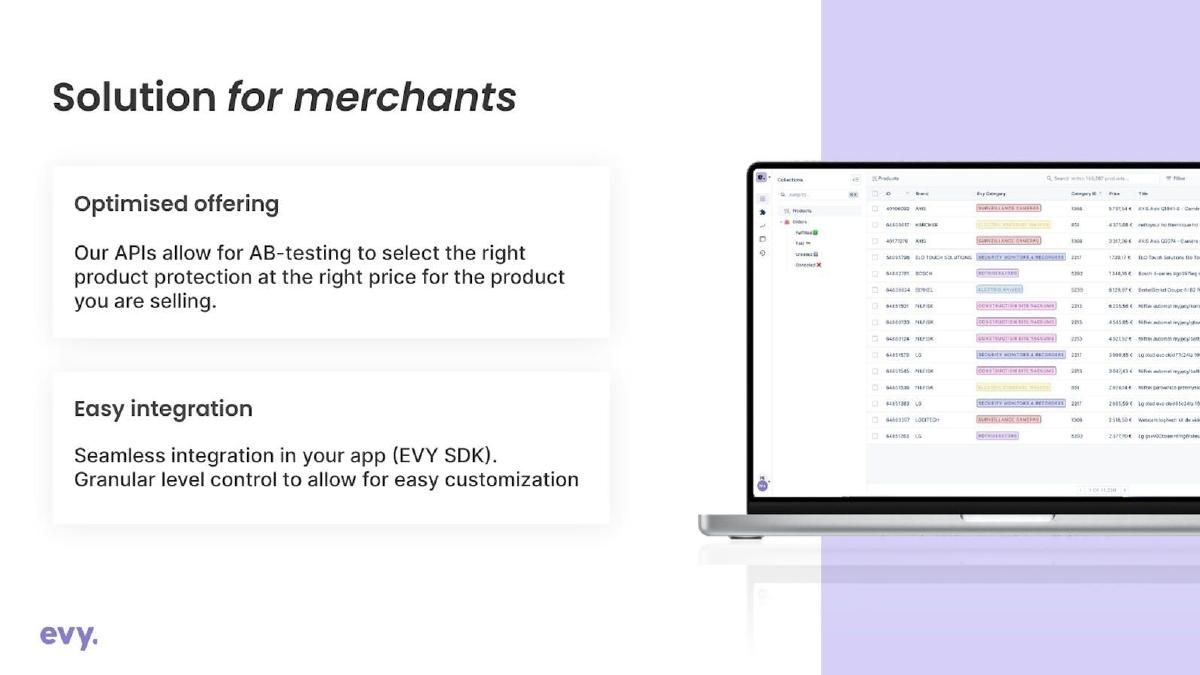
- Technical differentiation is highlighted through an SDK for seamless integration and APIs that allow for A/B testing of protection pricing (Slide 5).
- The company operates as a regulated entity under ORIAS approval, allowing for cross-border operations throughout the EU (Slide 7).
- The product roadmap extends beyond insurance into 'Usage' (maintenance), 'Buyback' (reconditioning), and 'Recycle' (environmental impact) (Slide 8).
- The deck completely omits a team slide, which is highly unusual for a $6.4M Seed round and suggests a separate supplemental document was used.
- There is no mention of current traction, revenue, or specific customer names beyond logos of 'underserved' targets (Slide 2).
The Minimalist Approach to Insurtech Fundraising
Evy’s 10-slide deck for their 2024 Seed round is a masterclass in visual minimalism and narrative clarity. While many fintech decks become bogged down in complex regulatory diagrams and dense spreadsheets, Evy focuses on the core friction points of the merchant experience. As reported by Business Insider, the company raised $6.4M to expand its product protection platform across Europe. The deck succeeds by framing insurance not as a financial product, but as a software integration problem that, once solved, unlocks massive revenue for retailers.
Slide 1 & 10: The Brand Bookends
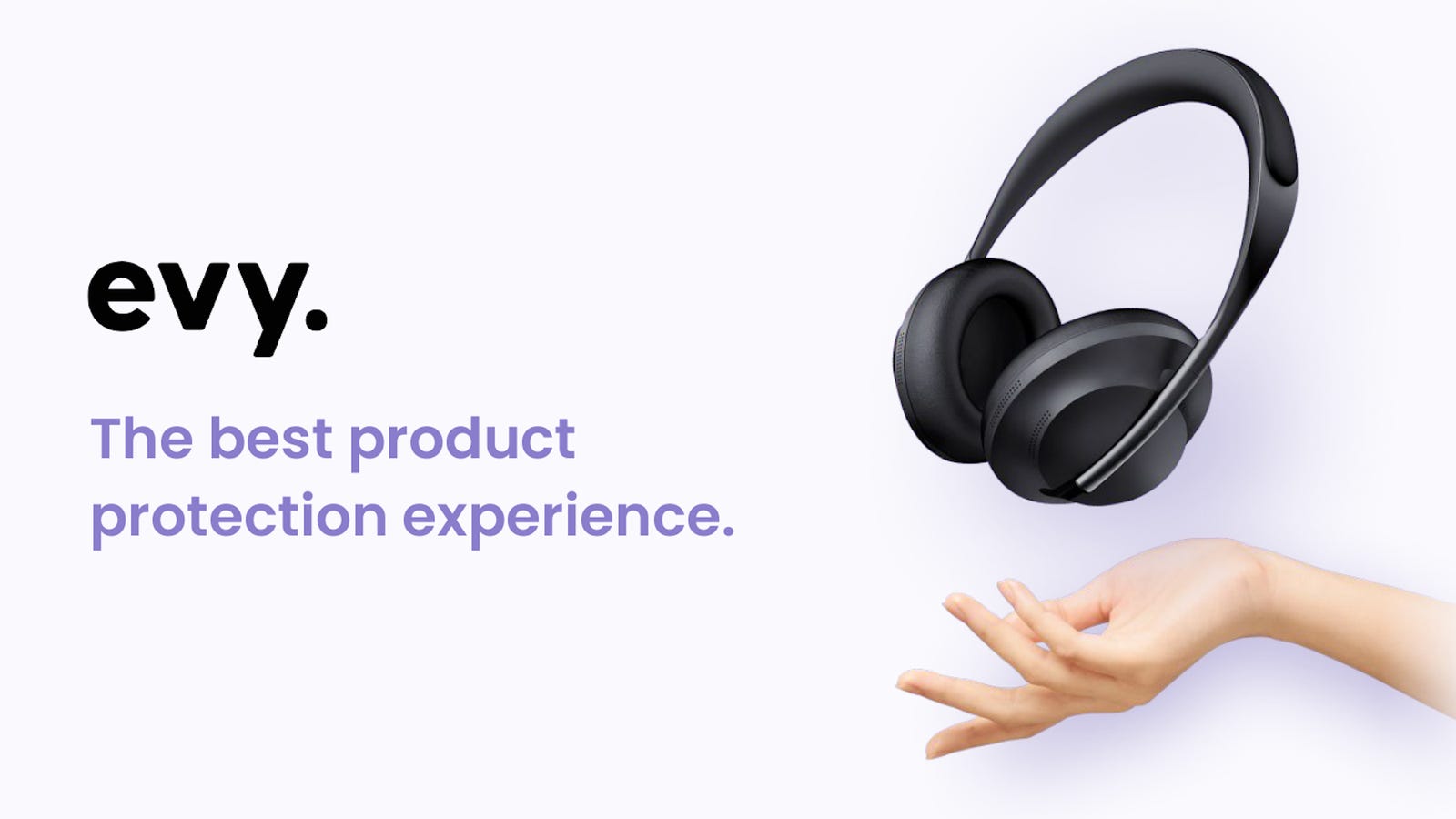
The deck begins and ends with the same visual: a pair of high-end headphones hovering over an open palm. The tagline, "The best product protection experience," is simple and consumer-centric. By using premium consumer electronics in their imagery, they immediately signal the type of high-margin retail categories they are targeting. The repetition of this slide at the end reinforces brand identity, though it misses an opportunity to include contact information or a call to action on the final page.
Slide 2: The Opportunity and the Friction
This is the most important slide in the deck. It identifies a massive gap in the French market: "75% of the top 100 French e-com merchants eligible to sell product protection plans aren’t offering them yet." By listing logos like Decathlon, Leroy Merlin, and Galeries Lafayette, they aren't just showing potential customers; they are highlighting a specific, addressable void in the market. The right side of the slide lists why existing solutions are "broken": integration takes months, conversion is low due to poor UI, and there is a lack of transparency in claims. This sets up the "Why Now" for a modern API-first competitor.
Slide 3: Market Sizing (TAM/SAM)
Evy uses a two-step market expansion narrative. They start with the "France e-com addressable annual insurance premiums" at 1 Bn€ with 8% growth. They then bridge to the "Europe embedded insurance addressable annual insurance premiums" at 40 Bn€ with a much higher 28% growth rate. Citing sources like Reuters and FEVAD adds necessary credibility to these large figures. This slide tells investors that while the entry point is stable, the scale-up opportunity is explosive.
Slide 4: The Core Solution
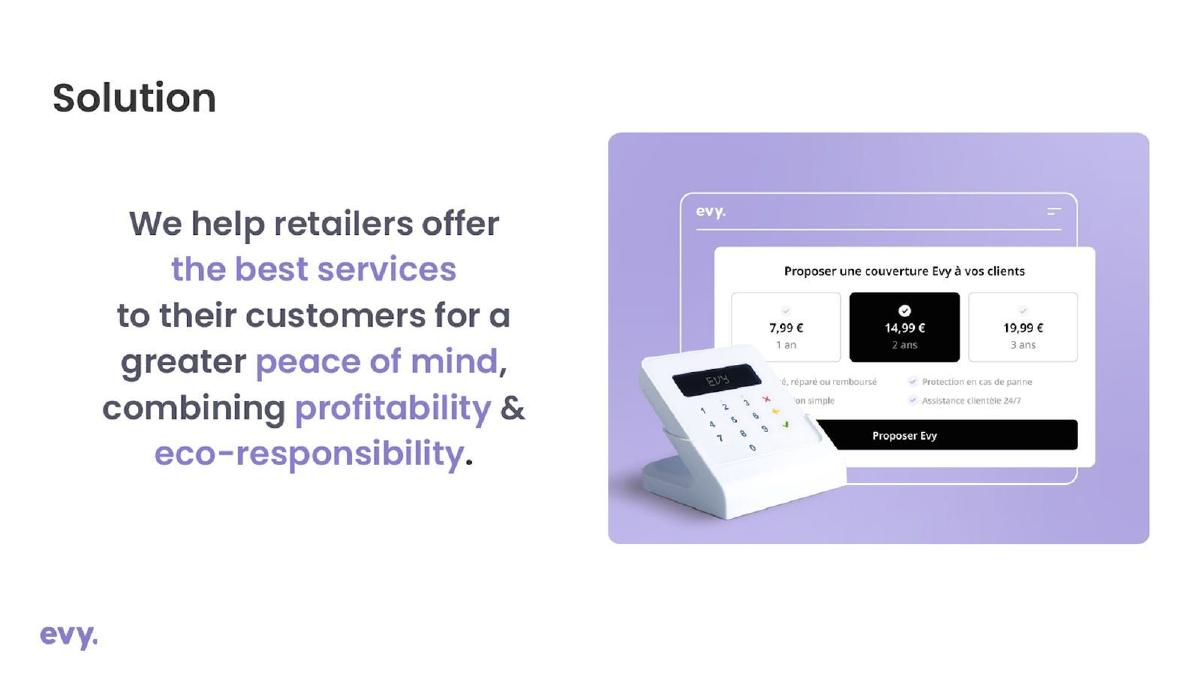
Slide 4 introduces the product interface. The text emphasizes "profitability & eco-responsibility," two themes that recur throughout the deck. The visual shows a clean, three-tiered pricing model (7,99 €, 14,99 €, 19,99 €) integrated into a checkout flow. This makes the abstract concept of "embedded insurance" tangible for the investor.
Slide 5: The Merchant Value Proposition
For the B2B side of the marketplace, Evy highlights "Optimised offering" and "Easy integration." The mention of "APIs allow for AB-testing" is a sophisticated touch; it suggests that Evy isn't just a static insurance broker, but a data-driven partner that helps merchants maximize their attach rates. The visual shows a backend dashboard, proving the product is more than just a concept.
Slide 6: The End Customer Experience
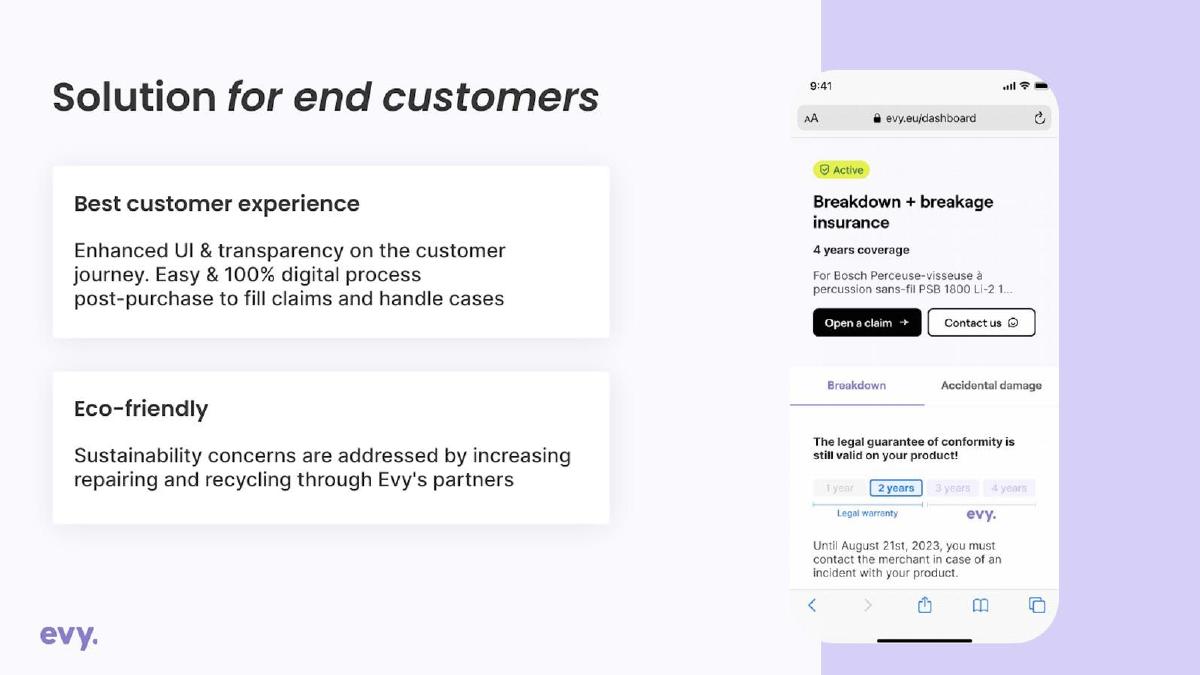
Insurance is notoriously difficult at the claims stage. Evy addresses this by promising a "100% digital process post-purchase to fill claims and handle cases." The mobile mockup shows a clear "Open a claim" button and a timeline that distinguishes between the legal warranty and the Evy protection plan. This transparency is a direct answer to the "broken" legacy solutions mentioned on Slide 2.
Slide 7: Regulatory and Geographic Flexibility
In the world of fintech, regulatory hurdles are the primary barrier to entry. Slide 7 explicitly states that "Evy operates as an insurance broker under ORIAS approval and can operate throughout the EU." This is a crucial de-risking statement. It also outlines their flexibility, offering both "Specific offering" (single product) and "Product family offering" (e.g., all bikes in a household), with both fixed-term and indefinite recurring monthly payments.
Slide 8: The Circular Economy Vision
This slide expands the company's scope beyond simple insurance. Using a kitchen mixer as a focal point, they map out a lifecycle: Product Protection, Usage (maintenance), Buyback (reconditioning), and Recycle. This positions Evy as a "circularity" play, which is a highly attractive narrative for modern VC funds focused on sustainability. It suggests that Evy will own the entire post-purchase relationship with the consumer.
Slide 9: The Long-term Vision
The vision slide is brief: "Become the leading European product protection provider." It reiterates the plan to expand into all insurable categories across both e-commerce and physical retail channels. The use of a purple Maneki-neko (lucky cat) is a stylistic choice that maintains the deck's clean, minimalist aesthetic but offers little new information.
What Evy's Deck is Missing
Despite raising $6.4M, this deck is missing several components that are traditionally considered mandatory for a Seed round:
Team Slide: There is no mention of the founders, their previous exits, or their expertise in insurance or retail. In a regulated industry, the "Why this team?" question is paramount. · Traction and Metrics: The deck does not list current revenue, number of active merchants, or insurance premiums processed to date. It relies entirely on market potential rather than proven performance. · The Ask: There is no slide detailing how much money is being raised or how the funds will be allocated (e.g., 50% engineering, 30% sales). · Competition: The deck mentions that existing solutions are "broken" but does not name or map out the competitive landscape (e.g., Bolttech, Extend, or Mulberry). · Unit Economics: There is no explanation of the take-rate or how the revenue is split between the merchant, the insurer, and Evy.
What Founders Can Learn from Evy
1. Focus on the Friction, Not the Finance: Evy doesn't lead with actuarial tables or risk pools. They lead with the fact that merchants find it "hard" to integrate insurance. By solving a technical pain point, they earn the right to provide the financial product.
2. Use a "Land and Expand" Market Narrative: By starting with the French e-commerce market (1 Bn€) and moving to the European embedded insurance market (40 Bn€), they show a logical, staged growth plan that feels achievable rather than speculative.
3. Visual Consistency: The deck uses a very limited color palette (purple, white, and grey) and high-quality, consistent imagery. This creates a professional, "premium" feel that mirrors the high-end retail brands they want to attract.
4. Regulatory Transparency: If you are in a regulated space, mention your licenses early. Stating their ORIAS approval on Slide 7 immediately removes a major question mark from an investor's mind regarding their ability to scale across the EU.
5. The Power of Minimalism: This deck proves that you don't need 30 slides to raise millions. If your value proposition is clear and the market opportunity is undeniable, brevity can be your greatest ally. However, founders should be prepared to provide the "missing" slides (Team, Traction, Financials) in a secondary data room.
Frequently asked questions
- Why is there no team slide in the Evy deck?
- It is highly probable that the founders presented the team via a separate document or that this version of the deck was intended as a 'teaser' for initial interest. For a $6.4M Seed round, investors would never commit without a deep dive into the founders' backgrounds, especially in a regulated industry like insurance brokerage.
- How does Evy differentiate itself from legacy warranty providers?
- Evy focuses on technical ease and transparency. Slide 2 notes that existing solutions take months to integrate and have poor user interfaces. Evy counters this with an SDK for 'seamless integration' and a 100% digital claims process for the end customer, as shown on Slide 6.
- What is the significance of the ORIAS approval mentioned on Slide 7?
- ORIAS is the French register of insurance intermediaries. Mentioning this approval is a critical trust signal; it confirms that Evy is a regulated broker capable of legally operating across the European Union, which validates their 40 Bn€ TAM claim on Slide 3.
- Is the market data on Slide 3 realistic?
- The deck cites Reuters, FEVAD, and FG2A as sources. By breaking the market into the immediate French opportunity (1 Bn€) and the broader European embedded insurance market (40 Bn€), they provide a credible path from a niche entry point to a massive scale-up opportunity.
- What does 'eco-responsibility' mean in the context of insurance?
- Slide 8 clarifies this by showing a circular economy model. Instead of just paying out claims, Evy aims to manage the product lifecycle through maintenance (Usage), reconditioning (Buyback), and recycling, which appeals to modern ESG-focused investors and consumers.