EV Technology Group (EVT) positions itself as a consolidator of 'sleeping beauty' automotive brands—heritage marques that are currently inactive but retain significant consumer recognition. The August 2022 deck outlines a vertically integrated model combining brand acquisition with manufacturing capabilities through Fablink. Their primary case study is MOKE, which they have transitioned to an electric-only direct-to-consumer (D2C) model. The strategy mimics luxury conglomerates like LVMH, applying the 'house of brands' philosophy to the EV sector. While the deck highlights impressive physical…
Key takeaways
- The company strategy focuses on reviving 'sleeping beauties'—dormant brands that retain heritage and customer loyalty (Slide 7).
- EVT explicitly models its 'house of brands' approach after Bernard Arnault’s strategy with LVMH and Dior (Slide 7).
- MOKE is the flagship brand, leveraging 1960s cultural associations with Brigitte Bardot and James Bond (Slide 31).
- The business model utilizes a direct-to-consumer (D2C) website featuring a vehicle configurator and test ride booking (Slide 19).
- Global expansion for MOKE targets high-lifestyle destinations including Los Angeles, Miami, Arizona, Italy, Greece, and Spain (Slide 43).
- Manufacturing is supported by Fablink, which provides barriers to entry through large-scale assets like an 8-metre tank Electropaint facility (Slide 55).
- Fablink also services external iconic vehicles, including Range Rover, Morgan, and DAF trucks, suggesting a diversified revenue stream (Slide 49).
- The deck is highly visual but omits critical financial metrics, valuation, and the specific 'ask' for the investment round in the reviewed section.
Executive Summary: The LVMH of Electric Vehicles
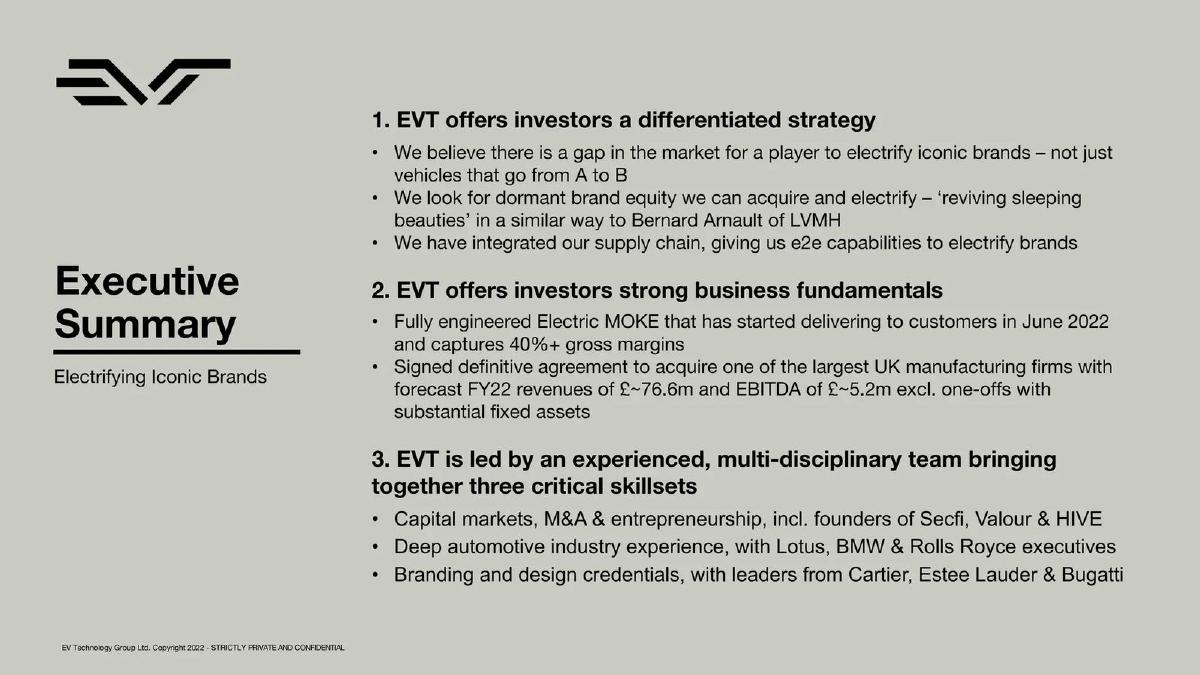
EV Technology Group (EVT) presents a compelling, albeit asset-heavy, vision for the future of specialized electric mobility. Their August 2022 investor deck moves away from the typical 'tech-first' startup narrative, instead leaning heavily into the luxury goods playbook. By positioning themselves as a 'house of brands,' they aim to monetize nostalgia and heritage through modern electrification. The deck focuses heavily on the MOKE brand as a proof of concept, supported by the industrial scale of Fablink. However, the lack of financial transparency in the core slides leaves significant questions about the scalability and margins of reviving niche marques.
Slide 1: Title and Positioning
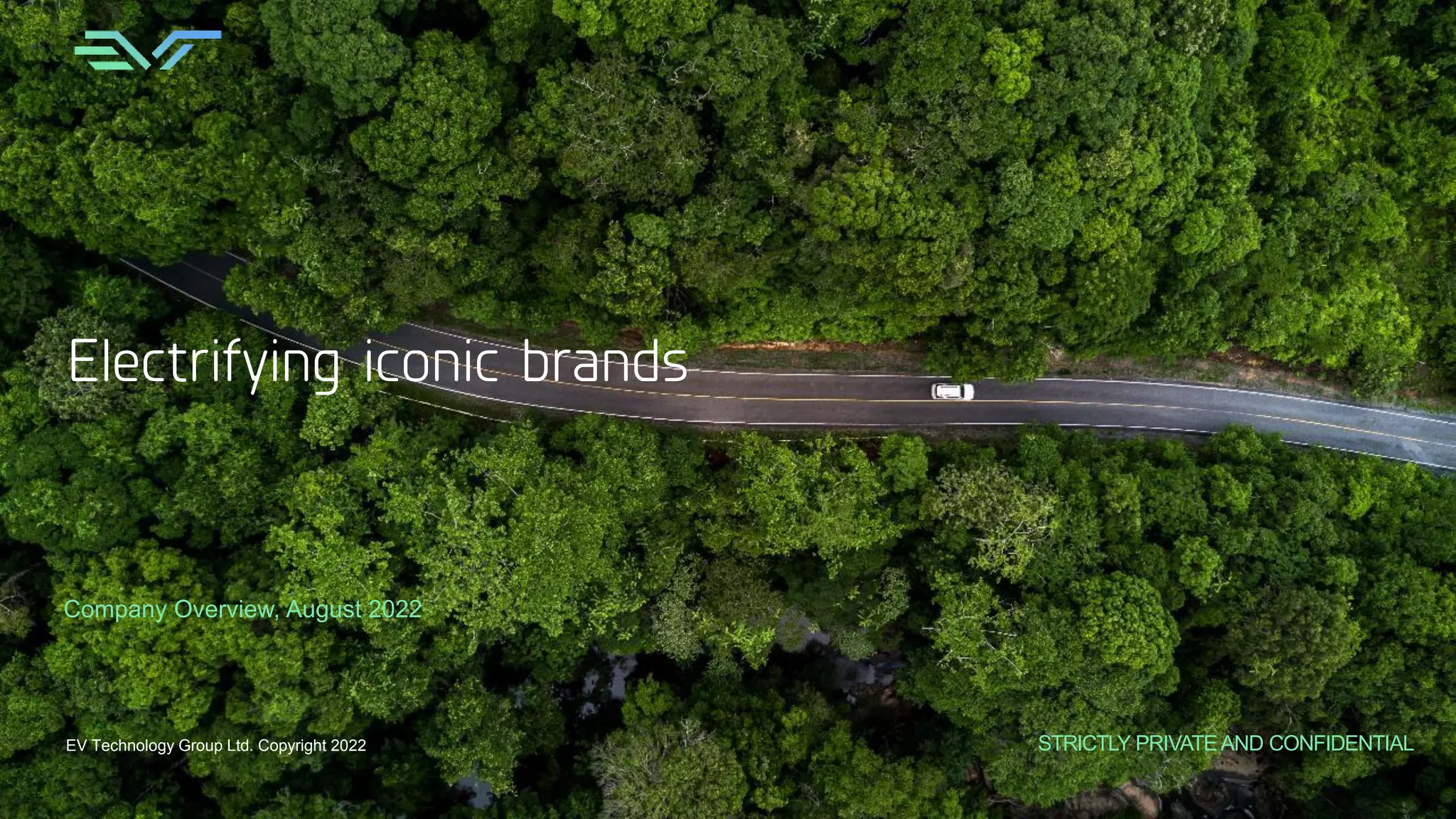
The cover slide sets a lifestyle tone with an aerial shot of a white vehicle on a winding road through dense forest. The tagline, "Electrifying iconic brands," immediately establishes the company's value proposition. It is dated August 2022 and marked as "Strictly Private and Confidential." The branding is clean, using a minimalist EVT logo that suggests a modern, tech-forward identity despite the focus on heritage brands.
Slide 7: The 'Sleeping Beauty' Strategy
This is the most critical conceptual slide in the deck. EVT defines its strategy as reviving "sleeping beauties" —brands that are no longer active but retain "brand equity through heritage." They explicitly draw a parallel to Bernard Arnault of LVMH, citing the revival of Dior. The logic is sound: in a crowded EV market, standing out is expensive. By using brands that people already know and love, EVT claims that "brand heritage, reputation and customer loyalty are hard-won and reward thoughtful reactivations." This slide attempts to de-risk the investment by showing that the 'marketing' work was done decades ago.
Slide 13 & 25: Navigation and Structure
The deck uses standard transition slides to break the presentation into four sections: 1. Vision and Strategy, 2. Business Updates, 3. Team, and 4. Business Lines. Slide 13 highlights "Business Updates," while Slide 25 moves into the "Team" section. These slides indicate a structured, professional approach to the narrative, though the actual content of the team slide was not included in the provided sequence.
Slide 19: The Direct-to-Consumer (D2C) Engine
EVT showcases its digital sales infrastructure through the mokeinternational.com website. The slide emphasizes an "end-to-end MOKE customer experience" that integrates a flagship physical store with a D2C site. Key features listed include a "configurator, delivery, test rides and an interactive, informative part of the customer journey." This reflects a modern automotive sales strategy, similar to Tesla or Rivian, which eliminates the traditional dealership model to preserve margins and control the brand experience.
Slide 31: MOKE – The Flagship Marque
This slide serves as the emotional hook for the MOKE brand. It anchors the brand in the 1960s, citing Brigitte Bardot making it an icon of the French Riviera and its appearance in the James Bond film "Live and Let Die." The imagery—a bright orange MOKE with a surfboard and black-and-white historical photos—reinforces the idea that this is a lifestyle product rather than just a utility vehicle. It justifies the 'sleeping beauty' thesis by showing the depth of cultural penetration the brand already possesses.
Slide 39: Distribution Group
This transition slide introduces the logistical and distribution arm of the company. While the slide itself is just a visual placeholder, it signals that EVT is not just a brand manager but also intends to control the flow of goods to the end market. This is a recurring theme in the deck: vertical integration.
Slide 43: Global Expansion Map
EVT outlines its roadmap for MOKE, targeting "priority destinations" worldwide. The map identifies specific hubs: US West Coast (Los Angeles), US Central (Arizona), US East Coast (Miami), Italy, Greece, and Spain. The selection of these locations is highly strategic; they are all sun-drenched, high-net-worth areas where a leisure vehicle like the MOKE would serve as a status symbol or a rental for luxury tourism.
Slide 49: Industrial Versatility
This slide showcases a collage of vehicles, ranging from luxury cars like the Range Rover and Morgan to heavy machinery like Caterpillar earthmovers and DAF trucks. The caption "Helping to produce some of the world's iconic vehicles" suggests that EVT’s manufacturing arm (Fablink) is a trusted partner for major OEMs. This is a crucial 'credibility' slide, proving that their manufacturing capabilities are not just theoretical but are already utilized by industry leaders.
Slide 55: Manufacturing Moats and Barriers to Entry
The final slide focuses on Fablink’s assets , specifically its Electropaint facility . The deck claims this is the "largest such non-OEM facility in its region" and "one of the largest e-coat facilities in Europe." Technical specs include "8 Metre tanks with a 14 stage process electrophoretic line" and "2 x Powder lines." By highlighting these physical assets, EVT is telling investors that they have a significant "barrier to entry." It is difficult for a new competitor to replicate this level of industrial infrastructure, providing the group with a defensive 'moat.'
What Works in This Deck
Clear Analogy: Comparing the business to LVMH immediately helps investors understand the 'house of brands' model without needing complex explanations. · Strong Visual Identity: The use of high-quality lifestyle photography and historical context for MOKE makes the brand feel premium and desirable. · Vertical Integration: The deck does a good job of showing that the company owns both the 'soft' assets (brands) and the 'hard' assets (manufacturing facilities like Fablink). · Strategic Focus: The expansion map (Slide 43) shows a disciplined approach to growth, focusing on markets where the product-market fit is most obvious.
What Is Missing
Financials and Unit Economics: There is no mention of the MSRP for a MOKE, the cost to manufacture, or the projected revenue. For a public investor deck, this is a glaring omission. · The 'Ask': The slides provided do not state how much capital is being raised or what the valuation of the company is. · Management Team Details: While a 'Team' section is indicated in the table of contents, the specific backgrounds of the leadership were not in the reviewed slides. · Competitive Landscape: The deck assumes a vacuum. It doesn't address other niche EV players or how they will defend against major OEMs eventually entering the 'retro-EV' space.
Founder's Playbook: Lessons to Copy
Leverage Existing Equity: If you are entering a crowded market, look for ways to 'buy' heritage rather than building it. EVT’s 'sleeping beauty' strategy is a masterclass in reducing customer acquisition costs through brand recognition. · Show, Don't Just Tell, Your Moat: Instead of just saying "we have a barrier to entry," EVT showed photos of massive 8-metre chemical tanks. Physical infrastructure is a very persuasive argument for long-term viability. · Use Proven Frameworks: By citing Bernard Arnault, the founders align themselves with one of the most successful business models in history. It gives the venture an air of inevitability. · Targeted Expansion: Don't try to be everywhere. The expansion map shows that EVT knows exactly who their customer is (wealthy people in sunny climates) and where they live.
Frequently asked questions
- What is EV Technology Group's core business model?
- EV Technology Group operates as a 'house of brands' for the electric vehicle market. They identify and acquire 'sleeping beauty' car brands—marques with historical significance but no current market activity. They then re-engineer these vehicles for the electric age and sell them through a direct-to-consumer (D2C) model, supported by their own manufacturing and distribution infrastructure.
- Why does the company focus on heritage brands instead of new ones?
- According to slide 7, building brand heritage, reputation, and loyalty in the motoring world is 'hard-won.' By acquiring existing marques like MOKE, EVT bypasses the massive marketing spend required to establish a new brand from scratch, instead leveraging decades of existing cultural equity and consumer recognition.
- What role does Fablink play in the company's ecosystem?
- Fablink serves as the manufacturing backbone. As shown on slide 55, it possesses significant industrial assets, including one of the largest e-coat (electropaint) facilities in Europe. This provides a 'barrier to entry' for competitors and allows the group to support its own brands while also acting as a tier-one supplier for other major automotive and industrial OEMs.
- How does MOKE fit into the global expansion strategy?
- MOKE is the lead brand for the group's D2C rollout. Slide 43 identifies specific high-value geographic targets for expansion, focusing on coastal and warm-weather regions like the US West Coast (LA), East Coast (Miami), and Mediterranean destinations in Italy, Greece, and Spain, which align with the vehicle's lifestyle branding.
- What financial information is provided in the deck?
- The reviewed slides do not contain specific financial performance data, such as revenue, EBITDA, or unit economics for the MOKE vehicles. While it mentions the 'Distribution Group' and manufacturing assets, it lacks a detailed breakdown of the company's capital structure, current valuation, or the specific terms of the investment round being raised.