The evvnt investment deck from 2016/17 is a study in efficiency and clear value propositions. By focusing on the 'Submit Once' mantra, the company addresses the labor-intensive problem of event promotion across fragmented digital channels. The deck highlights exceptional financial health, including a reported 89% margin on service and a forecast of £1m in revenue for 2016 (Slide 4). With a specific ask of £1m at an £8m pre-money valuation, the founders provide concrete unit economics: a £53 average spend per user against an £18 acquisition cost (Slide 7). While the deck lacks a detailed compe…
Key takeaways
- The company sought £1m ($1.3m) at an £8m ($10.4m) pre-money valuation for its 2016/17 fundraising round (Slide 7).
- evvnt reported a high 89% margin on its service, suggesting a highly automated or low-overhead delivery model (Slide 4).
- Unit economics are clearly defined, with a £53 average spend per user and an £18 customer acquisition cost (Slide 7).
- The platform's core value proposition is 'Submit Once,' allowing organizers to syndicate events to multiple listing sites through one form (Slide 5).
- Revenue growth was stated at 53% quarter-on-quarter, with a forecast of £1m in revenue for the 2016 calendar year (Slide 4).
- The team structure is divided into Management, Tech, and a five-member Board, including a dedicated CEO for the Middle East (Slide 8).
- The funding goal was to triple the user base and expand operations into the USA (Slide 7).
Executive Summary: The Automation of Event Syndication
The evvnt investment deck for the 2016/17 period is a lean, metrics-driven presentation that focuses heavily on the efficiency of its business model. Operating in the 'MarTech' (Marketing Technology) sector, evvnt positions itself as a global leader in helping people promote and find events. The deck is characterized by a bold red-and-white color palette and a recurring 'Submit Once' badge, which serves as the central theme of their product offering.
Slide 1: Title and Funding Ask
The cover slide immediately sets the stage by disclosing the funding requirements. It states a fundraising goal of GBP £1M ($1.3M) for the 2016/17 period. The tagline, "Invest in the future of successful event marketing," is broad, but the inclusion of the specific financial ask on the first slide signals a transparent and direct approach to the investor conversation.
Slide 2: Mission Statement
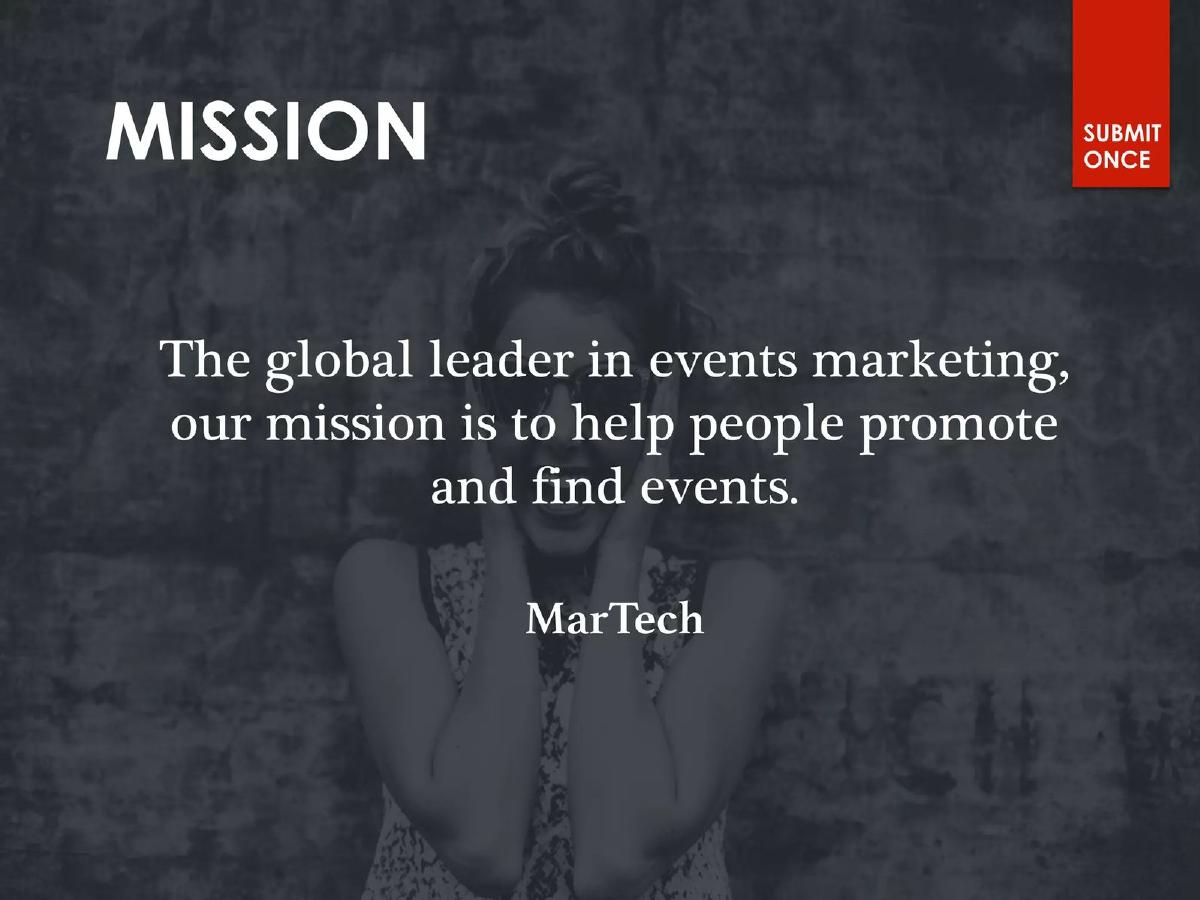
The mission slide is simple: "The global leader in events marketing, our mission is to help people promote and find events." It explicitly categorizes the company as MarTech . While the claim of being a "global leader" is a significant assertion for a company forecasting £1m in revenue, it establishes the scale of their ambition.
Slide 3: The Solution
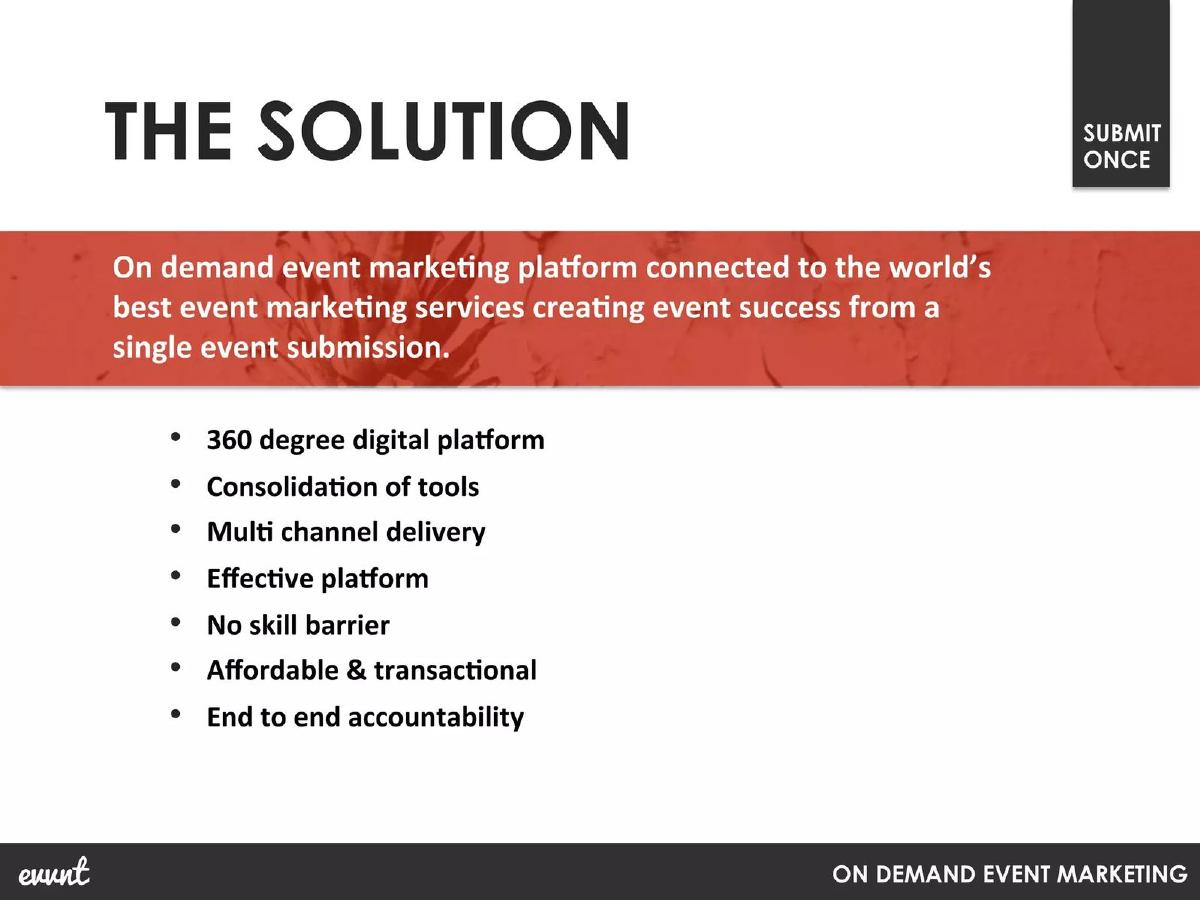
This slide defines the product as an "On demand event marketing platform connected to the world’s best event marketing services." The key features listed include:
360 degree digital platform · Consolidation of tools · Multi channel delivery · No skill barrier · Affordable & transactional · End to end accountability
The emphasis here is on accessibility ("no skill barrier") and the transactional nature of the service, suggesting a self-service model rather than a high-touch agency approach.
Slide 4: Traction and Financial Health
This is arguably the strongest slide in the deck. It provides several critical data points:
Profitability: The company states it is already profitable. · Revenue: £1m ($1.3m) in revenues forecast for 2016. · Staffing: 13 full-time members of staff based in London. · Margins: A very high 89% margin on service . · Growth: 53% revenue growth quarter on quarter.
The slide includes two bar charts. The "User base growth" chart shows a steady climb from near zero in Q2-12 to over 20,000 users by Q3-16. The "Quarterly revenues" chart shows a similar upward trajectory, peaking at approximately £250,000 in Q2-16, though Q3-16 shows a slight dip compared to the previous quarter.
Slide 5: How It Works
This slide breaks down the ecosystem into four sub-brands: evvntly (Marketing), evvnt (Listings), invvite (Ticketing), and discovvr (Discovery). The text explains that a single form allows organizers to publish to "every major relevant listing site with one submission." This clarifies the "Submit Once" branding seen throughout the deck—the core value is the automated syndication of event data across a fragmented web.
Slide 6: Social Proof and Validation
Rather than a standard logo wall, evvnt uses a large-format quote from James Moore, SVP of Global Partnerships at Web.com . He states that "evvnt is well placed to make a major impact" in the local information race. Using a quote from a senior executive at a major web services company provides significant B2B credibility and hints at potential partnership or acquisition channels.
Slide 7: The Ask and Unit Economics
The "What Do We Want?" slide is remarkably specific. It asks for £1m ($1.3m) at an £8m ($10.4m) pre-money valuation . It also provides the unit economics that justify the spend:
Average spend per user: £53 · Customer Acquisition Cost (CAC): £18
The plan for the funds is to "treble our users" and add functionality to increase spend by 25%. They also explicitly mention expansion into the USA and strengthening media partnerships to create a competitive moat.
Slide 8: The Team and Governance
The final slide in this set shows a 15-person organizational structure divided into three tiers:
Management (MGTS): Includes CEO Richard Green, a CFO, Head of Sales, Head of Product, and a specific CEO for the Middle East. · Tech: A CTO, a Technology Lead, and three Senior Developers. · Board: A Chairman (Tim Chambers) and four Non-Executive Directors.
The presence of five board members for a company of this size is unusual and suggests strong external oversight and a network of experienced advisors.
What Works in This Deck
Clarity of Unit Economics: Most decks hide their CAC and LTV (or average spend) in an appendix. evvnt puts them front and center on the 'Ask' slide. Showing a 2.9x return on acquisition cost (£53/£18) makes the request for growth capital very logical.
High Margins: The claim of an 89% margin is a massive hook for investors. It suggests that the "Submit Once" technology is highly scalable and that the cost of fulfilling a customer's order is negligible once the initial integrations are built.
Specific Use of Funds: The deck doesn't just say "hiring and marketing." It says they want to triple the user base and increase spend by 25% through new features. This gives investors a clear benchmark to measure success post-investment.
What Is Omitted
Competitive Landscape: There is no slide comparing evvnt to other event marketing tools or manual processes. While they mention making it "impossible for a competitor to enter," they don't identify who those competitors are.
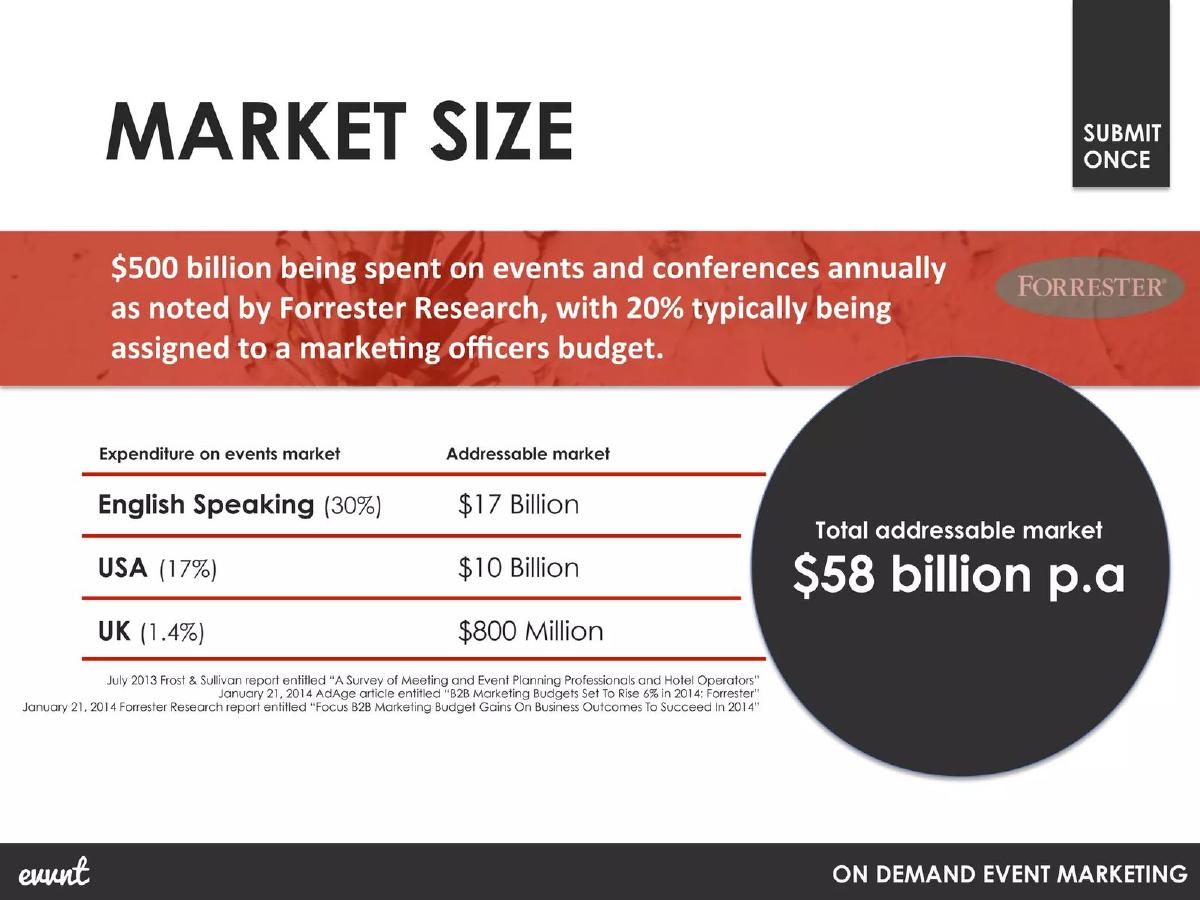
Market Size (TAM): The deck lacks a traditional "Total Addressable Market" slide. While the mission mentions "global," there is no data on how many event organizers exist or the total potential spend in the event marketing category.
Technical Architecture: For a company claiming to automate submissions to "every major relevant listing site," there is no explanation of how they maintain these integrations (APIs vs. scraping vs. manual entry). This is a common point of due diligence for MarTech companies.
Founder's Playbook: What to Copy
The 'One Thing' Branding: The "Submit Once" badge is a masterclass in simplifying a complex product. Founders should find the three-word version of their value proposition and repeat it on every slide.
The Transparent Ask: Including the valuation and the specific unit economics (Slide 7) removes friction. It allows an investor to immediately decide if the deal fits their mandate and if the math makes sense.
Board Representation: Showing a strong board of Non-Executive Directors (Slide 8) can compensate for a young or small management team. It signals to investors that there are "adults in the room" and a broader network supporting the company's growth.
Frequently asked questions
- What is the primary problem evvnt solves?
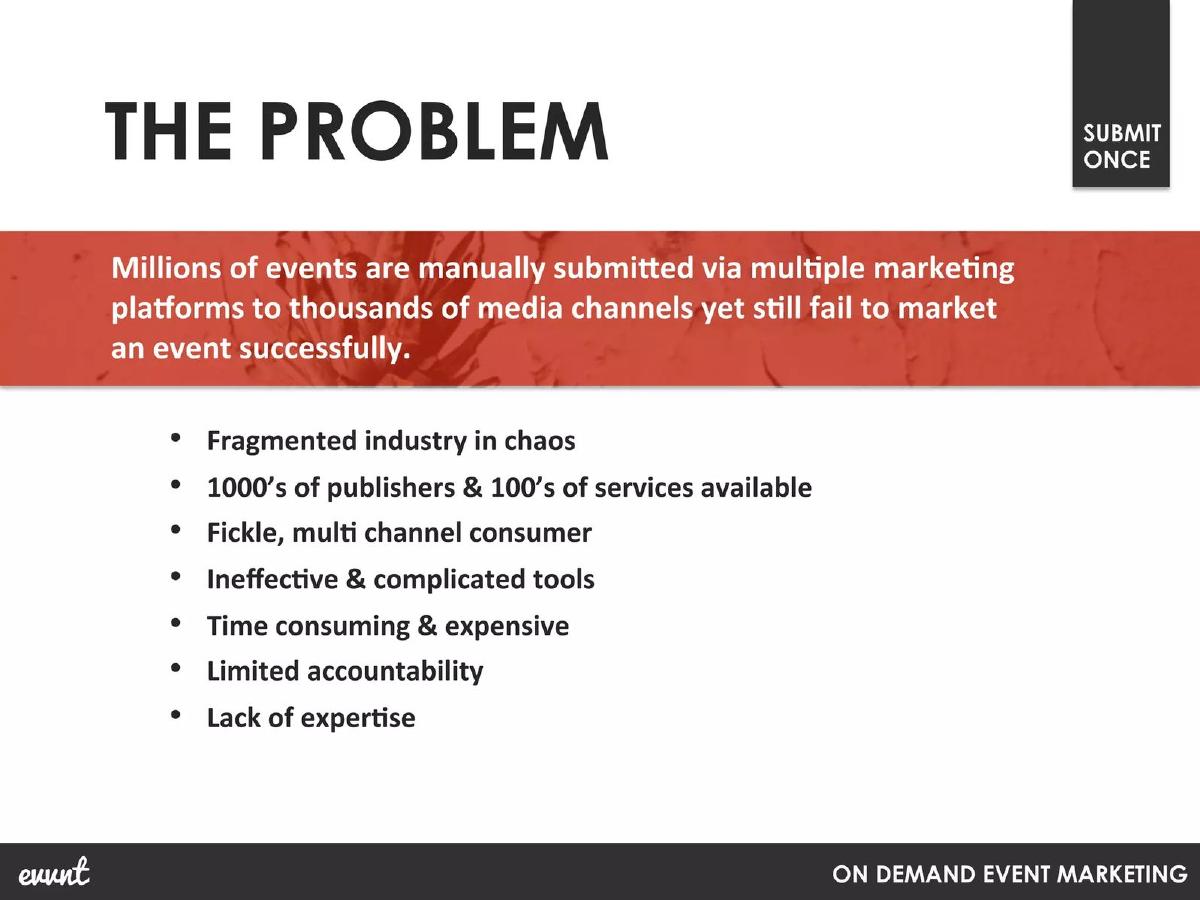
- While a specific 'Problem' slide is not among the provided images, the 'Solution' and 'How it Works' slides (Slides 3 and 5) imply the problem is the fragmentation and time-consuming nature of event marketing. By offering a 'single, intuitive, transactional add-event form,' evvnt eliminates the need for organizers to manually post to dozens of different listing sites, providing a '360 degree digital platform' for multi-channel delivery.
- How does evvnt justify its £8m pre-money valuation?
- The valuation is supported by strong growth metrics and profitability. Slide 4 notes that the company is already profitable, with 53% quarter-on-quarter revenue growth and a forecast of £1m in revenue for 2016. Furthermore, the LTV/CAC ratio is healthy, with users spending nearly 3x their acquisition cost (£53 vs £18) on average, as detailed on Slide 7.
- What are the specific plans for the £1m investment?
- According to Slide 7, the capital is earmarked for three primary objectives: tripling the current user base, adding new platform functionality intended to increase average user spend by 25%, and expanding the business into the United States market to strengthen their competitive moat.
- What is the significance of the 'Submit Once' branding?
- The 'Submit Once' tag appears in the top right corner of almost every slide. This is the company's core brand promise and product hook. It emphasizes the efficiency of their technology, positioning evvnt as a time-saving utility for event organizers who would otherwise have to navigate a complex ecosystem of disparate listing sites.
- Who is behind the company according to the deck?
- The team slide (Slide 8) shows a robust organization led by Founder/CEO Richard Green. The company has a significant technical presence with a CTO, a Technology Lead, and three Senior Developers. Notably, they have a dedicated CEO for the Middle East and a five-person Board of Directors, suggesting a level of corporate governance and international ambition beyond a typical early-stage startup.