Exelarc is a platform targeting the Indian startup market, specifically addressing the high percentage of bootstrapped companies struggling to find funding and talent. The deck outlines a multi-sided marketplace that connects founders with VCs and students seeking experience. While the mission is clear—to help startups 'connect and grow'—the deck relies heavily on high-level concepts rather than specific product mechanics or traction data. The revenue model is ambitious, proposing everything from freemium app features to a 10% success fee on first-round funding. However, the lack of a specifi…
Key takeaways
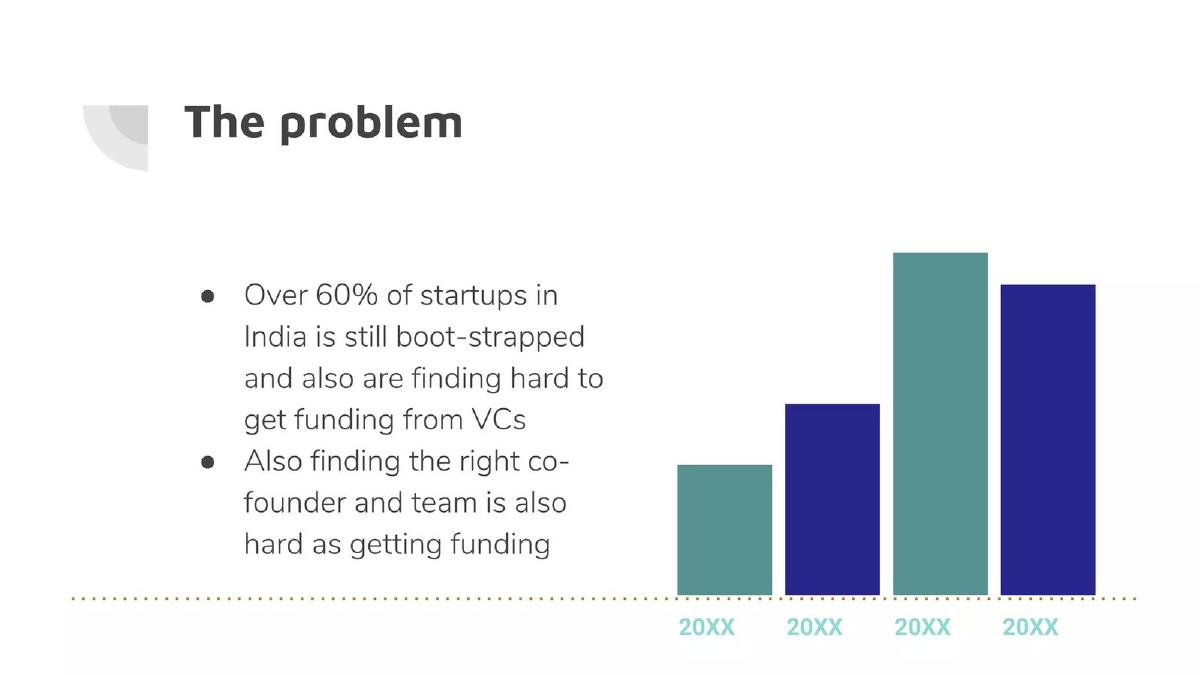
- The company identifies that over 60% of startups in India are bootstrapped and struggle to secure VC funding (Slide 3).
- Exelarc positions itself as a dual-purpose platform for both VC matchmaking and student-startup talent acquisition (Slide 4).
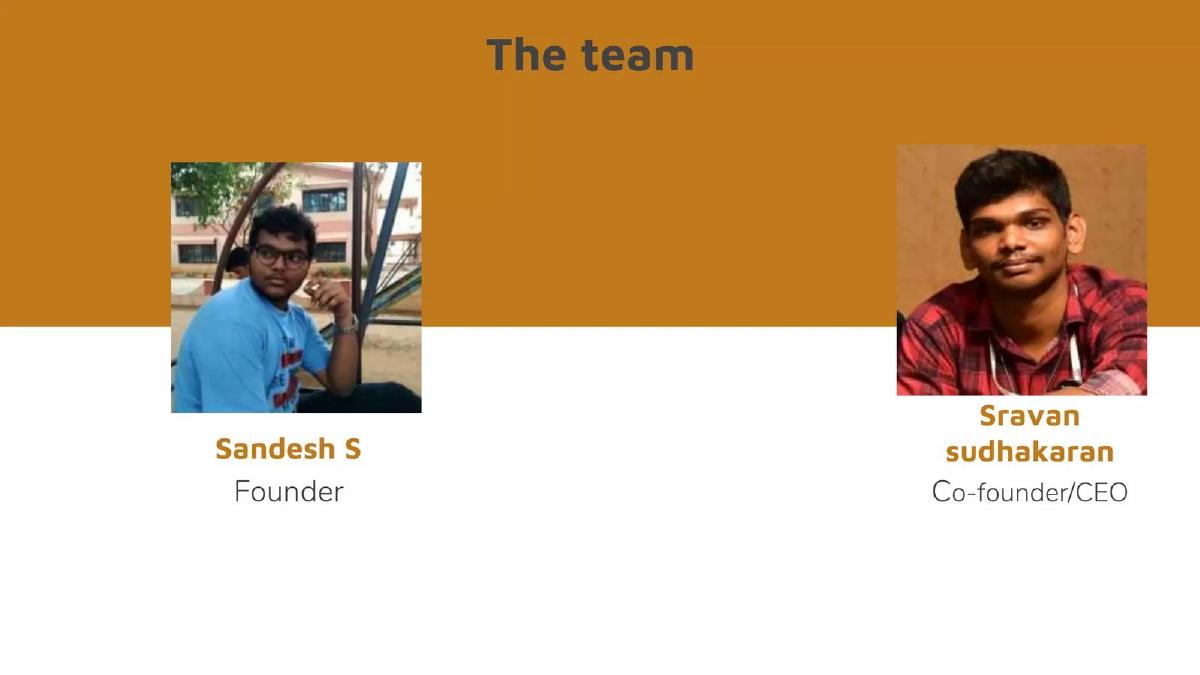
- The founding team consists of Sandesh S and Sravan Sudhakaran, though professional backgrounds are omitted (Slide 5).
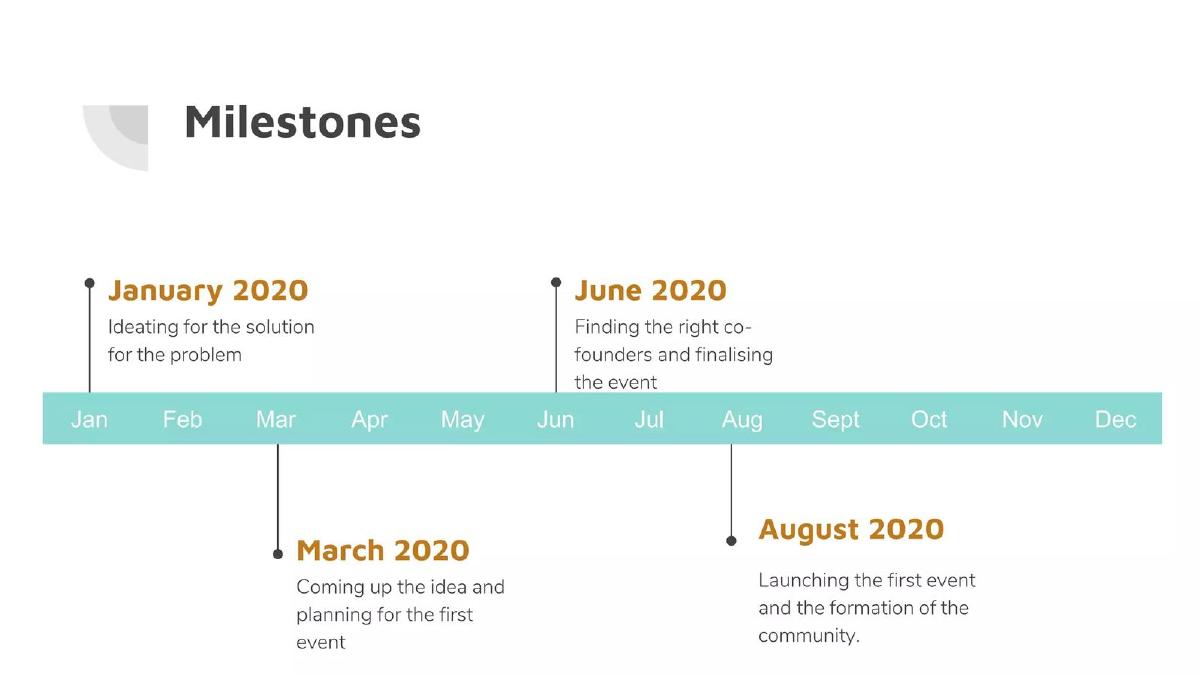
- The company timeline shows a rapid progression from ideation in January 2020 to community formation in August 2020 (Slide 6).
- Revenue streams are highly diversified, including freemium features, event commissions, ad revenue, and a 10% cut of a startup's first funding round (Slide 8).
- Marketing strategy relies on social media, YouTube, and student-focused events (Slide 9).
- AngelList and Glassdoor are identified as primary competitors in the job and networking space (Slide 10).
- The deck concludes without a specific funding request, valuation, or contact information (Slide 12).
Exelarc Pitch Deck Analysis
Exelarc presents a 12-slide deck focused on solving the fragmentation within the Indian startup ecosystem. The deck follows a traditional narrative arc: identifying a local market gap, proposing a platform-based solution, and outlining a path to monetization. However, it remains high-level, focusing more on the 'what' than the 'how' or 'how much.'
Slide 1: Title Slide
The deck opens with a minimalist design featuring the company name, EXELARC , and the tagline Connect and grow . The background uses a teal color palette with abstract data visualization graphics (pie charts and bar graphs), signaling a focus on data or business metrics, though the company itself is a marketplace/community platform.
Slide 2: Mission Statement
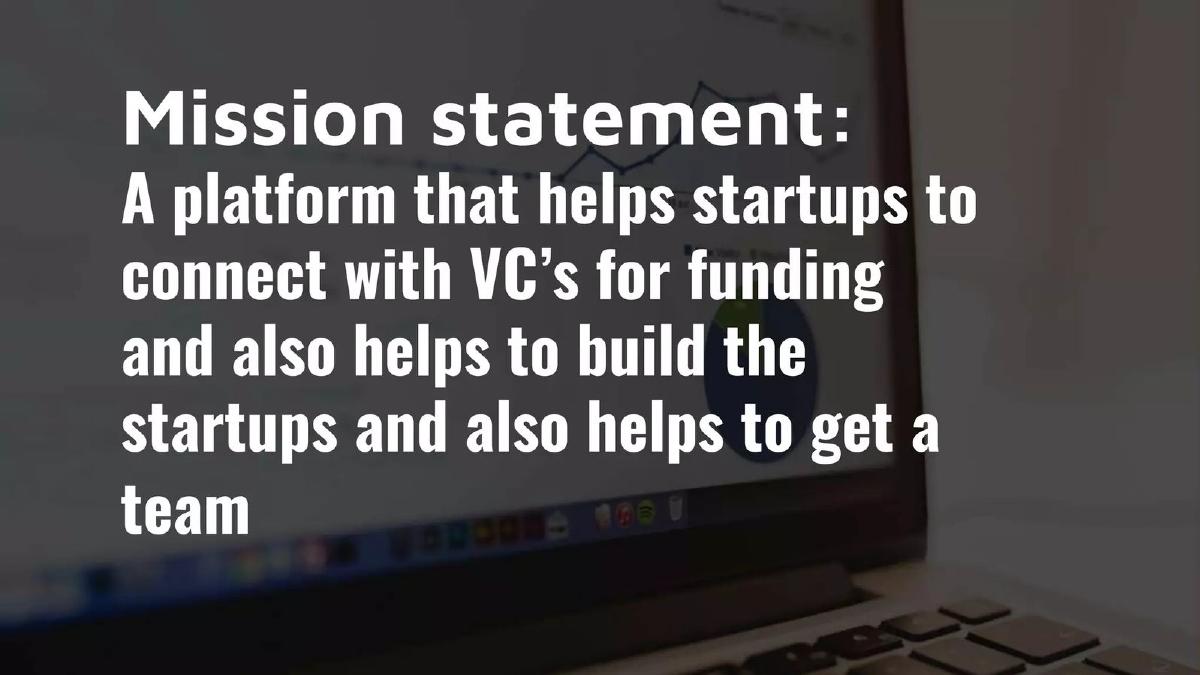
Slide 2 defines the company's purpose: A platform that helps startups to connect with VC's for funding and also helps to build the startups and also helps to get a team . The phrasing is repetitive, but it clearly establishes the three pillars of the business: capital, growth support, and recruitment.
Slide 3: The Problem
The problem slide provides a specific geographic focus. It states that Over 60% of startups in India is still boot-strapped and finding VC funding is difficult. It also notes that finding co-founders and teams is as hard as securing capital. A bar chart is included on the right, but the X-axis labels are generic placeholders (20XX), and the Y-axis lacks a scale, making the chart purely decorative rather than informative.
Slide 4: The Solution
Exelarc proposes a two-sided platform. For startups, it offers a profile [that] helps connect with interested VCs . For students, it offers a way to gain a profile and experience through working with startups . This suggests a marketplace that trades equity or experience for labor, while simultaneously acting as a lead generation tool for investors.
Slide 5: The Team
The team slide introduces Sandesh S (Founder) and Sravan Sudhakaran (Co-founder/CEO) . While the photos are present, the slide is missing critical information that investors look for: past exits, relevant industry experience, or technical expertise. In a crowded marketplace sector, the 'why us' is as important as the 'what,' and this slide fails to answer that.
Slide 6: Milestones
This timeline tracks the company's progress through 2020. It lists January 2020 as the ideation phase, March 2020 for planning the first event, June 2020 for finding co-founders, and August 2020 for launching the first event and community formation. This indicates the deck was likely produced shortly after August 2020, during the earliest stages of the company's life.
Slide 7: How it Works
The process is simplified into three steps: Step 1: Join us on our app using your idea ; Step 2: Use the features in our app and connect with VCs and also find your team if neede[d] ; Step 3: Connect and grow . The slide lacks screenshots or a user interface walkthrough, which would have helped demonstrate the product's maturity.
Slide 8: Revenue Model
This is the most detailed slide in the deck. It lists four revenue streams:
Freemium model in the app (paid vs. free features). · Commission on each registration for startup-related events. · 10% commission on the first funding round secured through the platform. · Ad revenue .
The 10% success fee on funding is a significant figure that would likely face scrutiny from both founders and regulators, as it sits well above typical finder's fees.
Slide 9: Marketing Model
The marketing strategy is standard for a community-led platform: Social media marketing , Youtube marketing , and Connecting through school students and college students events . This aligns with their goal of bringing students onto the platform to work with startups.
Slide 10: Our Competition
Exelarc identifies ANGELLIST and GLASSDOOR as their primary competitors. The slide notes Glassdoor is a competitor specifically in terms of connecting jobs . Acknowledging AngelList is important, as it is the dominant global player in the 'startup-VC-talent' triangle.
Slide 11: How Are We Different
The differentiation points are qualitative: being a more personalised app exclusively for startups and making connecting with VCs more easy . These are subjective claims that would ideally be backed by specific feature comparisons or user testimonials, which are absent here.
Slide 12: Conclusion
The final slide states WE WOULD LOVE TO HEAR FROM YOU . Notably, it lacks a call to action, a specific funding 'ask' (amount or terms), or even a contact email or website URL. This makes the deck feel like a presentation for a competition or a general introduction rather than a formal fundraising document.
What Works
Clear Market Focus: By targeting the Indian startup ecosystem specifically, the founders tap into a massive, growing market with unique local challenges. · Multi-Sided Value: Addressing both the capital gap and the talent gap (via students) creates a potential flywheel effect where more talent attracts more startups, which in turn attracts more VCs. · Revenue Diversity: The deck shows the founders are thinking about multiple ways to monetize, rather than relying solely on a single, unproven stream.
What is Missing
The 'Ask': There is no mention of how much money the company is looking to raise or what those funds would be used for. · Traction Metrics: Even for an early-stage company, investors want to see the number of registered startups, VCs, or students, or the attendance figures from the August 2020 event. · Product Visuals: Without app screenshots or a prototype, the 'How it Works' section remains purely theoretical. · Founder Pedigree: The team slide needs to establish credibility through professional history or academic background. · Unit Economics: While revenue streams are listed, there is no mention of the cost to acquire a user (CAC) or the projected lifetime value (LTV).
What a Founder Should Copy
The Problem Statement: Slide 3 uses a clear statistic (60% bootstrapped) to anchor the problem. Using data to validate the 'pain' is a strong way to start a pitch. · Simple Narrative: The deck is easy to follow. It doesn't get bogged down in technical jargon, making it accessible to a wide range of potential partners or early investors. · Competitor Awareness: Explicitly naming AngelList shows the founders understand the landscape they are entering, even if the differentiation could be stronger.
Frequently asked questions
- What is Exelarc's core value proposition?
- Exelarc aims to be a centralized hub for the Indian startup ecosystem. According to Slide 2 and Slide 4, it provides a platform where startups create profiles to attract VCs and recruit students. The goal is to solve the dual problem of capital scarcity and the difficulty of finding co-founders or early-team members.
- How does Exelarc plan to generate revenue?
- The revenue model on Slide 8 is four-pronged: a freemium app model, commissions on startup event registrations, ad revenue, and a significant 10% commission on the first funding round a startup secures through the platform. This last point is particularly aggressive compared to standard industry success fees.
- Who are the founders of Exelarc?
- Slide 5 identifies Sandesh S as Founder and Sravan Sudhakaran as Co-founder/CEO. The slide includes photos but lacks any information regarding their previous experience, education, or specific roles within the company's technical or business development.
- What stage of development is the company in?
- Based on the Milestones slide (Slide 6), the company was in its infancy during 2020. It moved from ideation in January to 'launching the first event and the formation of the community' in August 2020. The deck appears to be a pre-seed or seed-stage conceptual pitch.
- What are the biggest risks identified in this deck?
- The primary risk is the lack of execution data. There are no metrics on user growth, number of VCs onboarded, or successful matches. Additionally, the 10% funding commission (Slide 8) may be a deterrent for high-quality startups, and the competitive landscape (Slide 10) includes massive, well-entrenched players like AngelList.